Target Superheat Calculator — Fixed Orifice Charging
On this page
Calculate
This selector governs every field, label, result and export on this page, and it takes priority over the site header switch. Switching converts the values you entered rather than reinterpreting them, so 67 F becomes 19.44 C and returns to exactly 67 F when you switch back.
The device decides which charging method applies, and the two families are charged by opposite measurements. A fixed orifice is charged by superheat against a target calculated for the conditions. An expansion valve holds its own superheat and is charged by subcooling, so this calculator returns no target for one at all rather than a target with a warning attached. Look on the indoor coil label or the installation sticker.
Measured in the return air before the coil, in moving air, with a properly wetted and clean wick. This must be a wet bulb temperature and not a relative humidity reading: wet bulb carries the sensible and latent load together, which is the total work the coil is doing. A dry or dirty wick reads 2 to 4 F low, and that error lowers the calculated target.
Measured in the shade, roughly four to six feet from the condenser air intake, so that it represents the air the condenser is actually breathing. A probe left in direct sun reads 5 to 10 F high, which also lowers the calculated target. Do not take this from a weather app: the air at the unit is frequently warmer than the reported ambient, particularly against a wall or on a roof.
Compare a Measurement (Optional)
Total superheat measured at the compressor inlet, at the suction service valve, with the system stabilised. Enter the superheat itself, which is a temperature difference, and not a pressure: turning a suction pressure into a saturation temperature is refrigerant specific and belongs to the Superheat and Subcooling calculator. Leave this blank and the target is still returned; only the comparison is reported as not evaluated.
Used only as a sanity check against the wet bulb, and it appears nowhere in the target formula. A wet bulb cannot exceed the dry bulb of the same air, so if it does the two readings have almost certainly been entered in each other's fields and no target is produced.
Equipment Preconditions (Optional)
A dirty or airflow restricted condenser makes the system behave as though the outdoor temperature were far higher than it is, so floodback that would need a design day can happen at 80 F ambient. This never blocks the target and never suppresses the stabilisation advisory: it qualifies the charge correction only.
The target is compared against total superheat read at the compressor inlet with the system running long enough to settle. Like the condenser check, this is an advisory that qualifies the charge correction and never blocks the target.
Overview
A fixed orifice cannot regulate superheat. A piston, a flowrator, an accurator or a capillary tube is a hole of a fixed size, so the superheat the system produces moves with the indoor load and the outdoor temperature, and the number that is correct today is not the number that was correct last week. That is why charging a piston system starts with calculating what the superheat ought to be under the conditions in front of you.
This calculator does that from two air temperatures: the wet bulb of the air entering the indoor coil and the dry bulb at the condenser. It takes no pressures and no refrigerant, because the target does not depend on either. This page gives the number the system should be showing, not the number it is showing.
The distinction between those two matters more than it sounds. On a hot day with dry indoor air the calculated target drops below the point where the method works, and under those conditions an overcharged system cannot be detected at all. A calculator that hands back a number there is being confident at the moment it has the least right to be, so this one says the test is not valid and tells you how to bring the conditions back into range.
If you need the superheat you actually have, measured from suction pressure and line temperature, that is a different calculation and it lives on the Superheat and Subcooling calculator. Charging a piston system takes both numbers: this page gives the target, that page gives the measurement.
What to Look at First
The test window line, before the number itself. On a hot day with dry indoor air the calculated target falls below the point where the superheat method works at all, and under those conditions an overcharged system cannot be detected. The calculator does not clamp the figure to 5 F and hand it over as a charging target, because that turns an invalid test into a confident wrong answer in the one direction that destroys compressors. If that line says the test is not valid, nothing below it is a charging instruction.
The target, and the conditions it belongs to. A fixed orifice cannot regulate superheat, so the correct superheat moves with the weather. The same correctly charged system reads 28 F in spring and 8 F in a heatwave. Write the target down together with the wet bulb and the outdoor temperature it came from, because a superheat figure in a service record with no conditions beside it cannot be read later.
The absolute superheat line, separately from the comparison. The floodback flag reads the measurement on its own and fires whatever the target is, because a system can sit close to target and still have no margin at all against liquid reaching the compressor. The comparison against target and the absolute reading are two different questions, and they are reported on two different lines for that reason.
The direction of the difference, weighted. A measurement above target means short of charge, which costs capacity and announces itself. A measurement below target means overcharged for these conditions, and that is the direction that sends liquid to the compressor. The two are not symmetrical and the page does not treat them as though they were.
The preconditions, before you touch the gauges. A dirty condenser makes the system behave as though the day were far hotter than it is, and low indoor airflow produces a low superheat reading with nothing wrong with the charge at all. Neither of those blocks the target, and neither of them shows up in the two temperatures you measured.
How to Use This Calculator
Confirm the metering device. This method applies to fixed orifice systems only, meaning a piston, flowrator, accurator or capillary tube. If the system has a thermostatic or electronic expansion valve, the charge is set by subcooling instead and this target does not apply. The device is usually named on the indoor coil label or the installation sticker.
Choose the unit system with the calculator's own selector. Every field, label, result and export follows that selector, and switching it converts the values you already entered rather than reinterpreting them.
Measure the indoor wet bulb in the return air, with a properly wetted wick, in moving air. This is a wet bulb temperature and not a relative humidity reading, because wet bulb carries the sensible and the latent load together, which is the total work the coil is doing.
Measure the outdoor dry bulb in the shade, roughly four to six feet from the condenser air intake. A probe left in the sun reads high, and that error lowers the calculated target.
Confirm the condenser is clean and moving air, and that the system has been running long enough to stabilise. A restricted condenser makes the system behave as though the outdoor temperature were far higher than it is.
Read the target superheat and check the test window. If the target comes out below 5 F the conditions do not support a valid charge check, and the fix is to raise the indoor wet bulb rather than to charge to a low number.
If you already have a measured superheat, enter it and the calculator compares the two and gives the direction of correction. Enter the superheat itself, not the pressure: converting pressure to saturation temperature belongs to the Superheat and Subcooling calculator.
The target is compared against total superheat measured at the compressor inlet, at the suction service valve, with the system stabilised. Superheat read at the evaporator outlet is a lower figure by whatever the suction line picks up on the way, and comparing that against this target reads low.
Inputs & Outputs
Inputs
Outputs
Target Superheat Formula
The target comes from two air temperatures and nothing else. There is no refrigerant in it, because the target is a property of how the system is loaded rather than of what is circulating in it.
INPUTS
- metering_device: fixed orifice, expansion valve, or unknown. Required.
- wb_f: indoor wet bulb at the return. Required.
- db_f: outdoor dry bulb at the condenser. Required.
- measured_sh_f: measured total superheat at the compressor inlet. Optional.
- indoor_db_f: indoor dry bulb, sanity check only. Optional.
- condenser_ok: condenser confirmed clean and moving air. Optional.
- stabilised: system confirmed stabilised. Optional.
OUTPUTS
- target superheat, in F and C
- test window validity, reported above everything else
- the comparison against a measured superheat and the direction of correction
- the floodback flag and the low superheat caution
- the chart envelope check, the measurement conditions and the preconditions
Target Superheat, Imperial
target_F = (3 * wb_F - 80 - db_F) / 2
Three times the indoor wet bulb in F, minus 80, minus the outdoor dry bulb in F, divided by two. This is the formula stated by ACCA for use when the manufacturer charging chart is not to hand.
Target Superheat, Metric
target_C = 1.5 * wb_C - 0.5 * db_C - 40 / 9
The same relationship with the Fahrenheit to Celsius conversion substituted into it, not a separate correlation. The constant is 40 divided by 9, which is 4.4444 and is often printed as 4.444. A wet bulb of 19.44 C with an outdoor 35.00 C returns 7.22 C, which is 13.0 F, matching the Imperial result for 67 F and 95 F exactly.
Charge Comparison
difference = measured_SH - target_SH
A positive difference means the superheat is higher than it should be, which points to being short of charge for these conditions. A negative difference means it is lower than it should be, which is the direction that puts liquid into the compressor.
Valid Test Window
the test is valid only when target_SH is 5 F or above
Below that figure the superheat method cannot detect an overcharge, so the correct action is to raise the indoor wet bulb until the conditions come back into range, not to charge to a clamped number.
Absolute Superheat Flags
floodback risk      when measured_SH <= 5 F
low superheat       when 5 F < measured_SH <= 8 F
caution                and measured_SH < target_SH
The floodback flag reads the measurement on its own, whatever the target is. The caution needs the reading to be below target as well, because at a 67 F wet bulb the target is exactly 8.0 F at 105 F outdoor, so a band on the absolute value alone would condemn a correctly charged system in a heatwave.
Unit Conversion
C = (F - 32) * 5 / 9
delta_C = delta_F / 1.8
A temperature difference in F converts to C by dividing by 1.8, without the 32 degree offset, because a difference has no zero point to shift. A target of 13 F is a target of 7.22 C, not of minus 10.6 C.
Target Superheat vs Actual Superheat
These are two different numbers and charging a fixed orifice system needs both. Confusing them is the most common reason a superheat reading gets misread in the field.
Actual superheat is a measurement. You take the suction pressure at the service valve, convert it to the saturation temperature for the refrigerant in the system using a pressure to temperature chart, and subtract that from the suction line temperature. The refrigerant matters, because the same pressure means a different saturation temperature for R-410A than for R-22, and a zeotropic blend needs the dew point curve rather than a single value. That calculation lives on the Superheat and Subcooling calculator.
Target superheat is a design intent. You take the wet bulb of the air entering the indoor coil and the dry bulb at the condenser, and calculate the superheat a correctly charged system should be producing under those conditions. The refrigerant does not appear anywhere in it, because the target describes how the system is loaded rather than what is circulating inside it. That is this page.
Neither number means anything alone. A measured superheat of 13 F is correct on a 95 F day at a 67 F indoor wet bulb and badly overcharged on a 65 F day at the same wet bulb, where the target is 28 F. A target of 13 F tells you nothing about the system until you measure what it is actually doing.
So the working order is: confirm the metering device is a fixed orifice, calculate the target here for today's conditions, measure the actual superheat at the compressor inlet, and compare. If the measured value is higher than the target the system is short of refrigerant for these conditions. If it is lower, the system is overcharged for these conditions, and that is the direction worth taking seriously, because an undercharge costs capacity while an overcharge sends liquid to the compressor. Within about plus or minus 2 F the two agree within the tolerance of the method.
Fixed Orifice vs TXV Charging
The metering device decides which method you use, and the two methods are not interchangeable. Getting this wrong is not a small inaccuracy, it is charging by the wrong measurement entirely.
A fixed orifice has no moving parts and no feedback. A piston, flowrator, accurator or capillary tube is a calibrated hole, and the refrigerant flow through it depends on the pressure difference across it. That means superheat at the evaporator outlet varies with the charge, the outdoor temperature and the indoor load, which is exactly what makes it a usable charge indicator. Add refrigerant and superheat falls, remove it and superheat rises. So a fixed orifice system is charged by superheat, compared against a target calculated for the conditions.
A thermostatic or electronic expansion valve does have feedback. It senses the superheat leaving the evaporator and modulates its own opening to hold it at a setpoint, usually near 10 F. Because the valve actively defends that number, superheat stops responding to charge across a wide range and stops being a charge indicator at all. A TXV system can be significantly overcharged and still show a normal superheat, because the valve simply closes down to maintain it. Those systems are charged by subcooling on the liquid line instead, commonly 8 to 12 F.
That is why this calculator asks for the metering device before it will produce anything, and why it returns no target at all for an expansion valve rather than a target with a warning attached. If the label on the indoor coil is missing or unreadable, find out before charging rather than guessing, because the two devices are charged by opposite measurements.
The Valid Test Window
The superheat charging method does not work under every condition, and knowing when it stops working is as important as the number itself.
When the indoor air is dry and the outdoor temperature is high, the calculated target falls. At a 62 F indoor wet bulb the target is exactly 5.0 F at 96 F outdoors, 4.5 F at 97 F, and 3.0 F at 100 F. At a 60 F wet bulb and a 100 F day it is exactly zero, and colder or drier still it goes negative.
The California Title 24 charge verification procedure treats a target below 5 F as a condition where the test cannot be performed, and marks those cells in its table with a dash rather than a number. The reason is specific and it is worth understanding rather than memorising. Under those conditions a severely undercharged system will still show over 9 F of superheat and be caught, but an overcharged system cannot be detected by the superheat method at all. The method does not become vaguely less accurate, it goes blind in one direction, and that direction is the one that destroys compressors.
A good deal of published advice handles this by clamping the target to a minimum of 5 F and telling the technician to charge to that. This calculator does not, because charging to a number the method cannot verify is guessing while appearing precise. The published remedy is to change the conditions rather than the number: raise the indoor wet bulb by running the heating or opening windows until the target comes back to 5 F or above, then run the test.
Note also that a positive target is not automatically a usable one. The line sits at 5 F, not at zero, so a calculator that only checks for zero or a negative result will hand back 3.0 F as though it were a charging target.
How to Measure Indoor Wet Bulb and Outdoor Dry Bulb
The whole calculation rests on two temperature readings, and both of the common mistakes push the answer the same way.
The indoor wet bulb is taken in the return air, before the coil, in moving air, with a wick that is properly wetted and clean. It must be a wet bulb temperature and not a relative humidity figure. Wet bulb carries the sensible and latent load together, which is the total work the coil is doing, and that is what governs how much of the evaporator is left over to superheat the vapour. A dry, dirty or partially dried wick reads 2 to 4 F low. Title 24 asks for wet bulb accuracy within plus or minus 2 F with a resolution of 0.2 F, which is not a demanding specification but does rule out guessing.
The outdoor dry bulb is taken in the shade, roughly four to six feet from the condenser air intake, so that it represents the air the condenser is actually breathing. A probe left in direct sunlight reads 5 to 10 F high. Do not take the reading from a weather app either, since the air at the unit is frequently warmer than the reported ambient, particularly against a wall or on a roof.
Now put both errors into the formula. A sunlit probe raises the outdoor figure, which lowers the target. A dry wick lowers the wet bulb, which also lowers the target. They do not cancel, they compound, and they compound in the direction that tells the technician to add refrigerant. A careful looking measurement taken with a sunlit probe and a dry wick can put the target ten degrees below where it belongs.
One more precondition that has nothing to do with the thermometers. Confirm the condenser coil is clean and the fan is moving air before charging. A restricted condenser makes the system behave as though the outdoor temperature were far higher than it is, so the floodback that would need a design day can happen at 80 F ambient, and no amount of care with the readings will show it.
Why Target Superheat Falls on Hotter Days
This is the part that looks backwards until you follow the refrigerant through the coil, and it is worth understanding because a chart or calculator that has it the wrong way round is easy to spot once you know.
Start with the outdoor temperature. A hotter day means the condenser has a harder time rejecting heat, so the condensing pressure rises. The fixed orifice is a hole of a fixed size with that higher pressure behind it, so more refrigerant mass is pushed through it. More liquid entering the evaporator takes longer to boil away, so it travels further along the coil before the last of it turns to vapour. Less of the coil is left downstream of that point to heat the vapour further, so less superheat is added and the reading at the outlet is lower. At a 67 F indoor wet bulb the target runs 28 F at 65 F outdoors, 23 F at 75 F, 18 F at 85 F, 13 F at 95 F and 8 F at 105 F.
Now the indoor wet bulb, which works the other way. A higher wet bulb means warmer, wetter air across the coil and more heat available to boil refrigerant. The liquid finishes boiling earlier in the coil, more of the coil is left to superheat the vapour, and the outlet reading is higher. At a 95 F outdoor temperature, a 63 F wet bulb gives 7 F while a 70 F wet bulb gives 17.5 F.
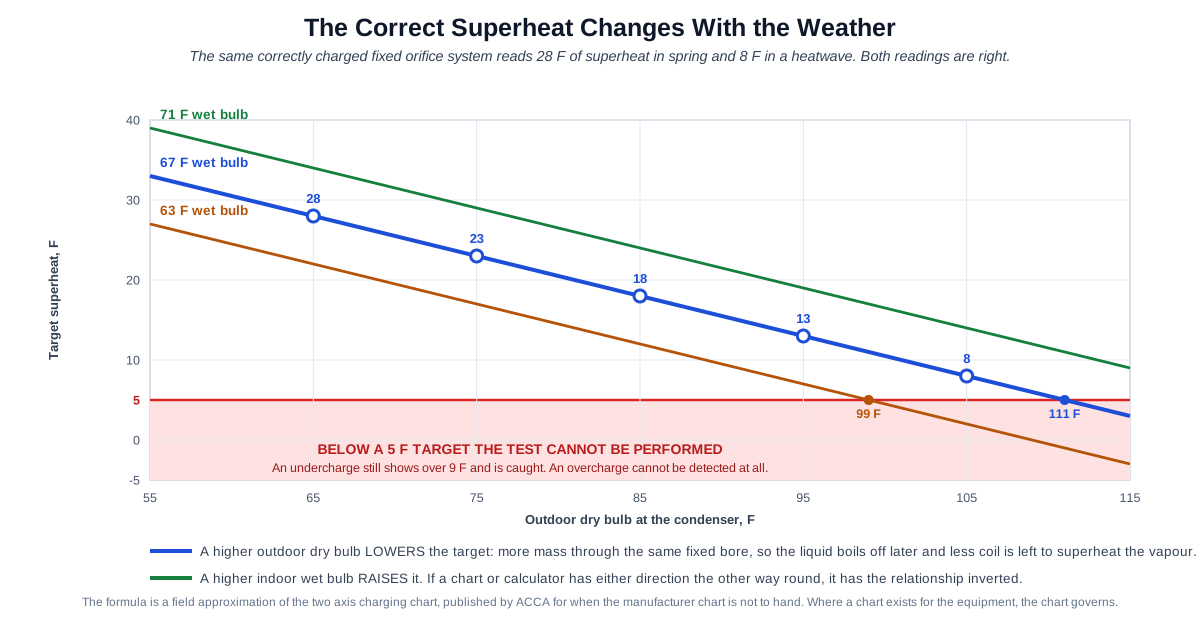
So the two inputs pull in opposite directions, which is why the target needs both and why no single number can stand in for it. It also gives you a quick sanity check on any charging tool: if raising the outdoor temperature raises the target, or raising the indoor wet bulb lowers it, the relationship has been inverted somewhere. At least one published calculator does exactly that.
What Is Target Superheat
Superheat is how much hotter the refrigerant vapour is than the temperature at which it boiled. If refrigerant boils at 40 F in the evaporator and leaves the coil at 52 F, the superheat is 12 F, and that 12 F of margin is the guarantee that no liquid is travelling toward the compressor.
Actual superheat is a measurement. Target superheat is a design intent: the superheat a correctly charged system should be producing under the conditions it is running in at that moment. The two only mean something together, because a superheat reading on its own tells you nothing until you know what it should have been.
For a fixed orifice system the target moves, and it moves a long way, because the orifice has no feedback and cannot adjust. An expansion valve works the other way, sensing the superheat leaving the evaporator and modulating to hold it, which is why those systems are judged by subcooling instead.
Key Facts
- The target superheat formula is three times the indoor wet bulb in F, minus 80, minus the outdoor dry bulb in F, divided by two. ACCA publishes it as the field method for when the manufacturer charging chart is not available.
- The metric form is 1.5 times the wet bulb in C, minus 0.5 times the outdoor dry bulb in C, minus 4.4444, which is the same relationship with the unit conversion substituted rather than a separate correlation.
- The target is refrigerant independent. The actual superheat measurement is not, because a suction pressure has to be converted to a saturation temperature using the chart for the refrigerant in the system.
- A higher indoor wet bulb raises the target. At 95 F outdoor, a 63 F wet bulb gives 7.0 F and a 70 F wet bulb gives 17.5 F.
- A higher outdoor dry bulb lowers the target. At a 67 F wet bulb, a 75 F day gives 23.0 F and a 95 F day gives 13.0 F.
- Below a target of 5 F the charge verification test cannot be performed. Under those conditions a severely undercharged unit will still show over 9 F of superheat and be caught, while an overcharged unit cannot be detected by the superheat method at all.
- The published remedy for that condition is to raise the indoor wet bulb, by running the heating or opening windows, until the conditions return to the valid range.
- Published charging charts cover outdoor dry bulb from 55 F to 115 F, which is 12.8 C to 46.1 C, and indoor wet bulb from 50 F to 76 F, which is 10.0 C to 24.4 C. Residential indoor wet bulb usually falls between 55 F and 72 F.
- Title 24 requires dry bulb and wet bulb measurement accuracy of plus or minus 2 F, with a wet bulb resolution of 0.2 F.
- An outdoor probe left in direct sun reads 5 to 10 F high. A digital psychrometer with a dry wick reads the wet bulb 2 to 4 F low. Both errors lower the calculated target, so both push toward adding refrigerant, and they compound rather than cancel.
- The target is compared against total superheat measured at the compressor inlet, taken at the suction service valve with the system stabilised.
- Fixed orifice metering, meaning a piston, flowrator, accurator or capillary tube, is charged by superheat. A thermostatic or electronic expansion valve holds its own superheat near 10 F and is charged by subcooling, commonly 8 to 12 F.
- The target method carries an accuracy of about plus or minus 2 F. That is the tolerance of the method, not proof that a charge is correct.
- A dirty or airflow restricted condenser makes the system behave as though the outdoor temperature were much higher, so floodback that would need a design day can happen at 80 F ambient, which is 26.7 C.
Applications
- A technician charging a new piston system calculates the target for the conditions on the day, rather than charging to a remembered number, and records both the target and the conditions it was based on.
- A service technician investigating a compressor failure checks what the target would have been at the conditions on the last service visit, and often finds that the system was charged to a summer number in spring.
- A contractor working a maintenance call verifies an existing charge without recovering and weighing the refrigerant, by comparing the measured superheat against the target for the day.
- A technician on a hot dry day discovers that the target has fallen below the valid window, and knows to raise the indoor load rather than to keep adding refrigerant against a number the method cannot support.
- A trainer or an apprentice uses the weather sweep to see why the same correctly charged system reads 28 F of superheat in spring and 8 F in a heatwave, which is the single most useful thing to understand about fixed orifice charging.
- A quality assurance rater running a residential charge verification checks whether the conditions on site support a valid test at all before writing down a result.
Example Calculations
Example 1. A summer service call
Given: indoor wet bulb 63 F, outdoor dry bulb 95 F, fixed orifice metering.
Target superheat is three times 63, which is 189, minus 80, minus 95, giving 14, divided by two, which is 7.0 F. In metric the same case is a 17.22 C wet bulb and a 35.00 C outdoor, returning 3.89 C.
The target is above 5 F, so the conditions support a valid charge check.
Result: a correctly charged system should be showing 7.0 F of superheat at the compressor inlet under these conditions. Measure it and compare.
Example 2. The same system across the seasons
Given: the indoor wet bulb held at 67 F while the outdoor temperature moves.
At 65 F outdoors the target is 28.0 F. At 75 F it is 23.0 F. At 85 F it is 18.0 F. At 95 F it is 13.0 F. At 105 F it is 8.0 F.
Result: the same correctly charged system reads more than three times the superheat on a mild spring day that it reads on a hot afternoon, and every one of those readings is right. Now take the technician who remembers that a piston system runs around 13 F. On a 65 F spring day he adds refrigerant until the gauge shows 13 F, when the correct target was 28 F. Nothing looks wrong that afternoon. In July the head pressure rises, the extra refrigerant is driven into the evaporator, superheat collapses toward zero and liquid reaches the compressor. This is the reason the page will not give a typical value.
Example 3. The test that cannot be run
Given: indoor wet bulb 60 F, outdoor dry bulb 100 F.
Three times 60 is 180, minus 80 is 100, minus 100 is zero, divided by two is 0.0 F.
A common piece of advice is to treat that as a 5 F minimum and charge to it. The regulatory procedure disagrees, and the reason is specific: below a 5 F target a severely undercharged system still shows over 9 F of superheat and is caught, but an overcharged system cannot be detected by the superheat method at all. The method goes blind in the direction that damages compressors.
Result: the test is not valid under these conditions. The remedy is to raise the indoor wet bulb, by running the heating or opening windows, until the target comes back to 5 F or above. Charging to a clamped 5 F would be guessing while appearing precise.
Example 4. The boundary
Given: indoor wet bulb 62 F. At 96 F outdoor the target is exactly 5.0 F, which is valid, since the threshold is at or above 5. At 97 F outdoor the target is 4.5 F, which is not. At 100 F it is 3.0 F, still positive and still outside the valid window.
Result: the line is at 5 F rather than at zero. A positive target is not automatically a usable one, and a calculator that only tests for zero or a negative number will hand back 3.0 F as though it were a charging target.
Example 5. Comparing a measurement
Given: a target of 13.0 F from Example 2, and a measured superheat at the compressor inlet.
At 20 F measured, the difference is plus 7.0 F. Superheat is high, which points to being short of refrigerant for these conditions, a restricted liquid feed, a restricted metering device, an unusually high indoor load, or a measurement problem.
At 6 F measured, the difference is minus 7.0 F. Superheat is low, which points to an overcharge, low indoor airflow or a collapsed indoor load. The reading is also low enough in absolute terms to want a second look before anything else is done.
At 4 F measured, superheat is not just low relative to target, it is close to nothing in absolute terms. That leaves no margin against liquid reaching the compressor, and it is flagged regardless of what the target happens to be.
At 14.5 F measured, the difference is plus 1.5 F, inside the plus or minus 2 F tolerance of the method.
Result: the direction of the difference tells you which way to go, and the absolute value tells you how urgent it is. Those are two separate questions and the low side carries more weight than the high side, because an undercharge wastes capacity while an overcharge destroys compressors.
Example 6. A hot day is not a fault
Given: indoor wet bulb 67 F, outdoor 105 F, so a target of 8.0 F. Measured superheat 8.0 F.
Result: this system is correctly charged, and it is showing single figure superheat because that is what the conditions call for. A low absolute reading is only a problem when it is also below target or close to nothing, and a rule that flagged every reading under 8 F would condemn a properly charged system in a heatwave.
Example 7. The wrong metering device
Given: the same conditions as Example 1, but the system has a thermostatic expansion valve.
Result: no target is produced at all. A TXV modulates to hold its own superheat near 10 F, so superheat stops responding to charge and stops being a charge indicator. The system is charged by subcooling on the liquid line, commonly 8 to 12 F. This is not a warning attached to a number, it is a different method, and returning a target here would invite a technician to charge by a measurement the valve is actively defending.
Example 8. How two small measurement errors become one large one
Given: the true conditions are a 67 F indoor wet bulb and a 95 F outdoor dry bulb, so the true target is 13.0 F. But the outdoor probe was left in the sun and reads 105 F, and the psychrometer wick had dried out so the wet bulb reads 64 F.
Working the formula on the readings actually taken: three times 64 is 192, minus 80 is 112, minus 105 is 7, divided by two is 3.5 F.
Result: two errors that each look small have moved the target 9.5 F downward, and they have done something worse than that. At 3.5 F the result now falls below the 5 F line, so the calculator reports that the test cannot be performed, on a job where the real conditions supported a perfectly valid test. Shade the probe, wet the wick, and the same system returns a usable 13.0 F target. Both errors push the same way, and neither of them announces itself.
Standards & References
- ACCA HVAC Blog, how to determine the target superheat formula without the manufacturer's charging chart The primary source for the formula used on this page. Matt Akins, Manager of HVACR Technical Education at ACCA, states it as three times the indoor wet bulb temperature, minus 80, minus the outdoor ambient temperature, divided by two, and frames it as the field method for when the manufacturer chart is not available. It is published guidance rather than a standard, which is why the manufacturer chart governs wherever one exists.
- California Energy Commission, Title 24 Reference Appendices, RA3.2, Field Verification and Diagnostic Testing of Refrigerant Charge The source of the 5 F validity threshold and of the instrument accuracy requirements. RA3.2 sets the residential charge verification procedure, requires dry bulb and wet bulb accuracy of plus or minus 2 F, and states that where a dash is read from the target superheat table the target is below 5 F and a valid refrigerant charge verification test cannot be performed. It also gives the remedy: run the space heating or open the windows to raise the indoor temperature, or retest when conditions are different.
- Table RA3.2-2, Target Superheat as a function of return air wet bulb and condenser dry bulb The two axis lookup the arithmetic on this page approximates, stated for a condenser dry bulb of 55 F to 89 F. Cells marked with a dash are the conditions where the target falls below 5 F. The reason those cells are blanked rather than filled is the asymmetry this whole page is built around: under those conditions a severely undercharged unit will still show over 9 F of superheat and be caught, while an overcharged unit cannot be detected by the superheat method at all.
- RA3.2.2.6.1, Fixed Metering Device Calculations, Superheat Charging Method The procedure clause itself: actual superheat is calculated as the suction line temperature minus the evaporator saturation temperature, and it is compared against the target read from Table RA3.2-2 for the measured return air wet bulb and condenser air dry bulb. This is the regulatory statement of the same two step method this page and the Superheat and Subcooling calculator split between them.
- Manufacturer charging charts Equipment makers publish their own two axis target superheat charts in installation and service literature for fixed orifice systems, and Carrier family brands share a common chart across Bryant, ICP, Heil, Tempstar and Comfortmaker. Where a chart exists for the equipment in front of you, it governs and the formula on this page is a substitute for its absence. No standards body publishes a target superheat figure for a specific product.
- ACCA technical manuals The current catalogue of ACCA publications. Worth one note on attribution, because it is misreported elsewhere: ACCA Manual T is Air Distribution Basics, a duct and terminal device manual, and it does not cover refrigerant charging or target superheat at all. The formula on this page comes from ACCA's technical education blog, not from Manual T.
Units
Temperatures are entered in Fahrenheit or Celsius. Convert with C equals F minus 32, times five, divided by nine.
Superheat itself is a temperature difference, not a temperature, and differences convert differently: a difference in F becomes a difference in C by dividing by 1.8, with no 32 degree offset, because a difference has no zero point to shift. A target of 13 F is a target of 7.22 C, not of minus 10.6 C. Getting that wrong is one of the easier ways to produce a nonsensical result in metric, so the two conversions never share a code path here.
Useful reference points: the 5 F validity threshold is 2.78 C. A 63 F wet bulb is 17.22 C and a 67 F wet bulb is 19.44 C. A 95 F outdoor day is 35.0 C and a 105 F day is 40.6 C. The published chart envelope of 55 F to 115 F outdoor is 12.8 C to 46.1 C, and 50 F to 76 F indoor wet bulb is 10.0 C to 24.4 C.
The internal unit selector governs the fields, labels, math, on-screen result and any exported result, and it takes priority over any site-wide unit switch. Switching converts the values you entered rather than reinterpreting them, so 67 F becomes 19.44 C and returns to exactly 67 F when switched back.
Limitations
- This calculator applies to fixed orifice metering only: pistons, flowrators, accurators and capillary tubes. A thermostatic or electronic expansion valve holds its own superheat and is charged by subcooling instead, so this target does not apply to those systems and the calculator will not produce one for them.
- The formula is a field approximation of the manufacturer charging chart, published by ACCA for use when that chart is not available. It is not a standard. Where the chart exists for the equipment being charged, the chart governs.
- The calculator returns a target. It does not measure the superheat you have, because that requires suction pressure, a line temperature and a refrigerant specific pressure to temperature conversion, which is a different calculation on a different page.
- A target below 5 F means the conditions do not support a valid charge verification, not that the target is 5 F. The calculator will not clamp the figure and present it as a charging target, because under those conditions an overcharge cannot be detected at all.
- The 5 F threshold comes from the California Title 24 residential charge verification procedure, whose table is stated for a condenser dry bulb of 55 F to 89 F. It is applied here across the full chart envelope as the criterion for a usable target, which is a design choice on this page rather than a claim that the regulation extends that far.
- Outside the published chart envelope, meaning below 55 F or above 115 F outdoor, or below 50 F or above 76 F indoor wet bulb, the formula has no published data behind it. A figure calculated there is an extrapolation rather than a supported charging target, and the calculator withholds the charge action.
- The 5 to 8 F low superheat caution band is a field judgement rather than a published threshold, which is why it is conditioned on the reading being below target as well and is labelled a caution rather than a limit.
- The published envelope of 55 to 115 F outdoor and 50 to 76 F indoor wet bulb comes from the coverage of charging charts in general rather than from a single standard, so treat it as typical coverage rather than a hard boundary of physics.
- The result assumes the condenser is clean and moving air, and that the system has been running long enough to stabilise. A restricted condenser makes the system behave as though the outdoor temperature were far higher, which invalidates the whole exercise regardless of how carefully the temperatures were measured.
- The method carries an accuracy of about plus or minus 2 F, and it depends entirely on the quality of two temperature readings. It cannot detect an airflow problem, a restriction, a failing compressor or a non condensable in the system, and a superheat that will not come to target is frequently a symptom of one of those rather than a charge problem.
Common Mistakes to Avoid
- Charging to a remembered number. There is no single correct superheat for a fixed orifice system. The same correctly charged unit reads 28 F in spring and 8 F in a heatwave, so a number remembered from July is an overcharge in March, and the compressor finds out later.
- Using this target on an expansion valve system. A TXV or EEV holds its own superheat, so superheat stops being a charge indicator and the charge is set by subcooling. This is not a small inaccuracy, it is the wrong method.
- Clamping the target to 5 F when the formula returns zero or less. That converts an invalid test into a confident wrong answer. Under those conditions an undercharge is still visible but an overcharge is invisible, which is precisely the failure worth catching.
- Reading the outdoor temperature in the sun. A probe in direct sunlight reads 5 to 10 F high, which lowers the calculated target and leads to adding refrigerant that is not needed. Read it shaded, four to six feet from the condenser intake.
- Using a dry wick on the wet bulb. A dry or dirty wick reads 2 to 4 F low, which also lowers the target. Together with a sunlit probe the two errors can put the target ten degrees below where it belongs, and they compound rather than cancel.
- Using relative humidity instead of wet bulb. The formula wants a wet bulb temperature, which carries the sensible and latent load together. A humidity reading converted to wet bulb adds its own error to a method that already needs 2 F accuracy.
- Charging before the condenser is checked. A dirty condenser behaves like a much hotter day, so the system can flood back at 80 F ambient. Confirm the coil is clean and the fan is moving air before touching the gauges.
- Comparing against evaporator superheat rather than total superheat. The target is compared against superheat measured at the compressor inlet, at the suction service valve, with the system stabilised.
- Assuming a low reading is always an overcharge. Low indoor airflow and a collapsed indoor load produce the same symptom, and adding or removing refrigerant on that assumption fixes nothing.
- Treating a low absolute superheat as a fault on a hot day. On a 105 F day a target of 8 F is correct, and a system reading 8 F is charged properly. What matters is whether the reading is below target, and whether it is close to nothing.
- Entering a suction pressure where the calculator asks for a measured superheat. This page never takes a pressure. Turning a suction pressure into a saturation temperature is refrigerant specific, and the Superheat and Subcooling calculator does it.
Frequently Asked Questions
What should the superheat be on a fixed orifice system?
What is the target superheat formula?
Why does the target superheat go down when it gets hotter outside?
Can I use this for a TXV system?
What if the calculated target comes out at zero or a negative number?
Do I use wet bulb or relative humidity?
My superheat will not come down to target no matter how much refrigerant I add. What now?
Is 8 F of superheat too low?
Does target superheat depend on the refrigerant?
Where should the actual superheat be measured?
What if the outdoor temperature is below 55 F or above 115 F?
The system has a fixed orifice and I do have the manufacturer chart. Which one wins?
Frequently Used Together
Engineers often use these calculators in combination for complete project workflows:
Related Calculators
Explore similar calculators that might be useful for your project:
Free HVAC Quick Reference. Formulas & Checks.
Airflow, loads, refrigerant & duct checks — one printable page for the job site.
- Key formulas for airflow, load, refrigerant charge & duct sizing
- Quick sanity checks for the most common HVAC design errors
- Printable one-pager for field use and design review
No spam. Unsubscribe any time.
Calculate
This selector governs every field, label, result and export on this page, and it takes priority over the site header switch. Switching converts the values you entered rather than reinterpreting them, so 67 F becomes 19.44 C and returns to exactly 67 F when you switch back.
The device decides which charging method applies, and the two families are charged by opposite measurements. A fixed orifice is charged by superheat against a target calculated for the conditions. An expansion valve holds its own superheat and is charged by subcooling, so this calculator returns no target for one at all rather than a target with a warning attached. Look on the indoor coil label or the installation sticker.
Measured in the return air before the coil, in moving air, with a properly wetted and clean wick. This must be a wet bulb temperature and not a relative humidity reading: wet bulb carries the sensible and latent load together, which is the total work the coil is doing. A dry or dirty wick reads 2 to 4 F low, and that error lowers the calculated target.
Measured in the shade, roughly four to six feet from the condenser air intake, so that it represents the air the condenser is actually breathing. A probe left in direct sun reads 5 to 10 F high, which also lowers the calculated target. Do not take this from a weather app: the air at the unit is frequently warmer than the reported ambient, particularly against a wall or on a roof.
Compare a Measurement (Optional)
Total superheat measured at the compressor inlet, at the suction service valve, with the system stabilised. Enter the superheat itself, which is a temperature difference, and not a pressure: turning a suction pressure into a saturation temperature is refrigerant specific and belongs to the Superheat and Subcooling calculator. Leave this blank and the target is still returned; only the comparison is reported as not evaluated.
Used only as a sanity check against the wet bulb, and it appears nowhere in the target formula. A wet bulb cannot exceed the dry bulb of the same air, so if it does the two readings have almost certainly been entered in each other's fields and no target is produced.
Equipment Preconditions (Optional)
A dirty or airflow restricted condenser makes the system behave as though the outdoor temperature were far higher than it is, so floodback that would need a design day can happen at 80 F ambient. This never blocks the target and never suppresses the stabilisation advisory: it qualifies the charge correction only.
The target is compared against total superheat read at the compressor inlet with the system running long enough to settle. Like the condenser check, this is an advisory that qualifies the charge correction and never blocks the target.