Superheat/Subcooling Calculator
On this page
Calculate
Select Superheat to evaluate evaporator outlet condition, or Subcooling to evaluate condenser liquid-line condition
Saturation temperature from pressure-temperature chart at suction pressure (Superheat) or condensing pressure (Subcooling) — in °F
Actual suction line temperature measured at the service port location — in °F
Overview
The Superheat/Subcooling Calculator evaluates refrigerant circuit condition using two core service metrics: superheat and subcooling. The calculator focuses on refrigerant saturation temperature, measured line temperature, and the relationship between pressure and refrigerant condition. Danfoss training material describes superheat as vapor heated above saturation temperature, and ASHRAE's SuperheatCalc app is specifically built to calculate target superheat plus superheat and subcooling for field service.
This matters because superheat and subcooling are not the same thing and should not be interpreted the same way. Superheat describes how far vapor temperature rises above saturation on the suction side, while subcooling describes how far liquid temperature falls below condensing saturation temperature on the liquid side. Copeland's guidance also shows that correct interpretation depends on where the measurement is taken and, for glide refrigerants, whether dew point or bubble point is being used correctly.
This calculator is a preliminary service evaluation tool. It helps estimate whether a superheat or subcooling reading appears low, normal, high, or very high before final diagnosis. ACCA training emphasizes correct charging using superheat and subcooling methods and comparing readings against manufacturer charging information rather than relying on one number alone.
The interpretation bands used here are illustrative preliminary ranges only — not manufacturer-specific charging targets. Final diagnosis should account for equipment type, refrigerant, operating conditions, measurement location, and verified field measurements before any service action is taken.
How to Use This Calculator
Select the active mode — choose Superheat or Subcooling.
Enter refrigerant saturation temperature — based on pressure-temperature conversion at the relevant service port (°C or °F).
Enter the measured line temperature — suction line temperature for Superheat mode, liquid line temperature for Subcooling mode (°C or °F).
Choose Imperial or Metric units — select the unit system for temperatures.
Click "Calculate" — review calculated superheat or subcooling, status category, and service guidance.
Worked examples for both modes — Superheat and Subcooling — in Imperial and Metric units are shown in the Examples section below.
Inputs & Outputs
Inputs
Outputs
Formula
Superheat Formula
Active when Superheat mode is selected:
Superheat = Measured Suction Line Temperature − Saturation Temperature
| Variable | Meaning | Metric | Imperial |
|---|---|---|---|
| Superheat | Temperature rise of vapor above saturation | °C | °F |
| Measured Suction Line Temperature | Actual suction-line temperature at measurement point | °C | °F |
| Saturation Temperature | Refrigerant saturation temperature at suction pressure | °C | °F |
Subcooling Formula
Active when Subcooling mode is selected:
Subcooling = Saturation Temperature − Measured Liquid Line Temperature
| Variable | Meaning | Metric | Imperial |
|---|---|---|---|
| Subcooling | Temperature drop of liquid below condensing saturation | °C | °F |
| Saturation Temperature | Refrigerant saturation temperature at condensing pressure | °C | °F |
| Measured Liquid Line Temperature | Actual liquid-line temperature at measurement point | °C | °F |
Formula Notes
Both formulas use a fixed temperature-difference method. The saturation temperature must be derived from a pressure-temperature (PT) chart using the measured gauge pressure at the relevant service port.
Danfoss defines superheat as refrigerant vapor heated above saturation temperature. Copeland's service guidance shows measuring subcooling at the condenser outlet or TXV inlet and comparing measured liquid temperature to saturated liquid temperature at that location.
Copeland specifically notes that superheat and subcooling must be measured at the location where the information is needed — which is why sensor placement and stable readings matter.
What Is Superheat and Subcooling
Superheat is the amount by which refrigerant vapor temperature exceeds its saturation temperature at a given pressure. Subcooling is the amount by which liquid refrigerant temperature is below its saturation temperature at a given pressure. These are core refrigeration-service measurements used to understand evaporator outlet condition and condenser liquid-line condition.
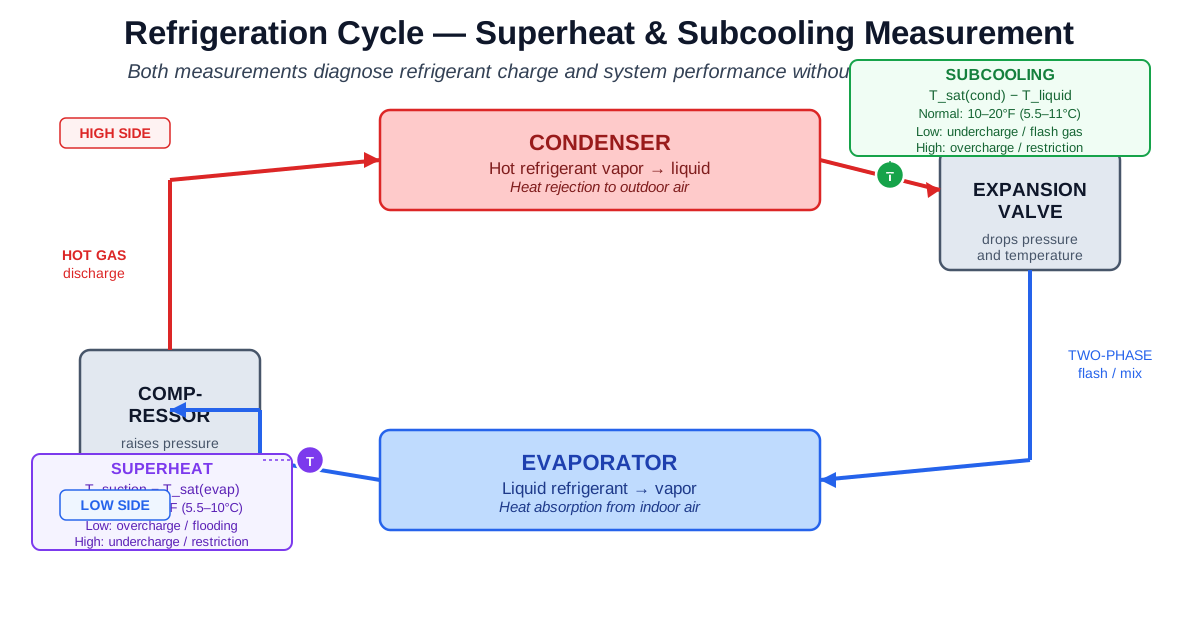
Danfoss defines superheat in exactly this way, and Copeland shows how superheat and subcooling are used in practical service measurements.
In practice, superheat helps evaluate evaporator feeding and vapor condition, while subcooling helps evaluate liquid refrigerant condition leaving the condenser. These readings must be interpreted with stable operating conditions, correct pressure-temperature conversion, and correct line-temperature measurement locations. ACCA training also treats superheat and subcooling as core charging and diagnostic methods.
Interpretation Bands
This calculator uses preliminary interpretation bands for Superheat and Subcooling modes. These are illustrative service evaluation ranges only — not manufacturer charging targets.
Superheat bands:
- LOW (< 5°F / 2.78°C): limited vapor temperature rise, possible overfeeding
- NORMAL (5–20°F / 2.78–11.11°C): typical practical range for many conditions
- HIGH (20–35°F / 11.11–19.44°C): elevated, review airflow and metering
- VERY HIGH (> 35°F / 19.44°C): strongly elevated, verify all readings
Subcooling bands:
- LOW (< 5°F / 2.78°C): limited liquid temperature drop, possible low charge
- NORMAL (5–15°F / 2.78–8.33°C): typical practical range for many conditions
- HIGH (15–25°F / 8.33–13.89°C): elevated, review condenser conditions
- VERY HIGH (> 25°F / 13.89°C): strongly elevated, verify all readings
ACCA training explicitly teaches technicians to use superheat and subcooling methods together with manufacturer charging charts rather than relying on generic bands alone.
Engineering Applications
Superheat and subcooling calculations are used in every refrigerant service scenario. Residential HVAC technicians use superheat to evaluate TXV or fixed orifice performance and subcooling to verify charge condition in the liquid line. Commercial refrigeration technicians apply the same principles to medium and low-temperature systems across different refrigerants.
For blend refrigerants with temperature glide (such as R-410A, R-404A, R-454B), the correct saturation reference point depends on whether dew point or bubble point applies at that location. Copeland specifically highlights glide, dew point, and bubble point behavior for blends, which affects how saturation temperature is selected for superheat and subcooling calculations.
Practical Service Notes
Always derive the saturation temperature from an accurate PT chart matched to the refrigerant type. The suction pressure gauge reading gives the saturation temperature for superheat. The discharge or condensing pressure gauge gives the saturation temperature for subcooling. Using the wrong pressure reference will produce incorrect superheat or subcooling values regardless of probe accuracy.
Allow the system to stabilize before taking readings. Startup conditions, transient loads, and recent thermostat calls can shift superheat and subcooling readings significantly from steady-state values. ACCA training reinforces that readings should be taken under stable operating conditions and compared against manufacturer charging targets — not just preliminary bands.
Key Facts
- Superheat and subcooling are standard refrigeration service metrics used in troubleshooting and charging workflows.
- Superheat is tied to vapor leaving the evaporator above saturation temperature — Danfoss defines it this way in its refrigeration basics guide.
- Subcooling is tied to liquid refrigerant below condensing saturation temperature and is commonly checked during operation.
- Correct interpretation depends on stable operating conditions and correct pressure-temperature conversion, not just one raw reading.
- Manufacturer targets can differ by equipment family, expansion device type, and charging method — ASHRAE SuperheatCalc and ACCA training both reflect that target values are equipment- and procedure-dependent.
- Blend refrigerants with glide require extra care because dew point and bubble point interpretation can affect service readings — Copeland specifically highlights glide, dew point, and bubble point behavior for blends.
Applications
- HVAC service checks and field diagnostics
- Refrigeration troubleshooting and system evaluation
- Evaporator feeding review (superheat mode)
- Condenser liquid-line condition review (subcooling mode)
- Preliminary charging evaluation during commissioning
- Pressure-temperature measurement verification
- Field-service sanity checks before detailed diagnosis
- Training and diagnostic workflow support
Example Calculation
Superheat Example (Imperial)
Inputs:
- Calculation Mode = Superheat
- Refrigerant Saturation Temperature = 40°F (from PT chart at suction pressure)
- Measured Suction Line Temperature = 58°F
Step 1: Apply the superheat formula:
Superheat = Measured Suction Line Temperature − Saturation Temperature
Superheat = 58 − 40 = 18°F
Step 2: Apply interpretation bands (Superheat, Imperial):
- 18°F falls in the NORMAL range (5–20°F)
Result:
- Calculated Superheat = 18.0°F
- Category = NORMAL
This indicates a practical superheat value within a common operating range. Compare with the manufacturer target for the specific equipment.
Subcooling Example (Imperial)
Inputs:
- Calculation Mode = Subcooling
- Refrigerant Saturation Temperature = 110°F (from PT chart at condensing pressure)
- Measured Liquid Line Temperature = 98°F
Step 1: Apply the subcooling formula:
Subcooling = Saturation Temperature − Measured Liquid Line Temperature
Subcooling = 110 − 98 = 12°F
Step 2: Apply interpretation bands (Subcooling, Imperial):
- 12°F falls in the NORMAL range (5–15°F)
Result:
- Calculated Subcooling = 12.0°F
- Category = NORMAL
This indicates a practical subcooling value within a common operating range. Check against equipment-specific targets and stable operating conditions.
Metric Example (Superheat)
Inputs:
- Calculation Mode = Superheat
- Saturation Temperature = 4°C
- Measured Suction Line Temperature = 15°C
Calculation:
Superheat = 15 − 4 = 11°C
Result:
- Calculated Superheat = 11.0°C
- Category = NORMAL (2.78–11.11°C)
Compare against the manufacturer's target for the specific equipment and operating conditions.
Standards & References
- ASHRAE SuperheatCalc — ASHRAE's field calculator for superheat and subcooling service evaluations
- Danfoss — Refrigeration: an introduction to the basics — Danfoss training material defining superheat as vapor heated above saturation temperature
- Copeland — Refrigerant Changeover Guidelines — Copeland guidance on superheat and subcooling measurement in service procedures
- Copeland — Refrigeration Basics: Understanding Refrigerants With Glide — Copeland on dew point, bubble point, and glide refrigerants affecting service readings
- ACCA Technical Training — ACCA guidance on correct charging using superheat and subcooling methods with manufacturer charging charts
Limitations
- This calculator estimates preliminary superheat or subcooling from saturation temperature and measured line temperature only.
- It does not fully model equipment-specific charging targets, refrigerant glide effects, transient startup conditions, or exact metering-device control behavior.
- A superheat or subcooling reading should not be used in isolation — final diagnosis requires refrigerant type, operating conditions, airflow, pressure stability, equipment design, and manufacturer service procedures.
- This calculator does not fully account for refrigerant glide in blended refrigerants — for glide refrigerants, correct dew-point or bubble-point interpretation and manufacturer guidance are especially important.
- These interpretation bands are illustrative preliminary ranges only — they are not manufacturer-specific charging targets. ACCA training and Copeland guidance both reinforce that readings must be interpreted in full system context.
- Correct measurement location is critical — temperature gradients along the line can mislead interpretation if the probe is not placed near the relevant pressure reference point.
Common Mistakes to Avoid
- Measuring temperature at the wrong line location — the probe must be near the relevant pressure reference point.
- Using the wrong saturation temperature from the wrong pressure (suction vs. condensing).
- Failing to stabilize the system before taking readings — transient conditions give misleading results.
- Ignoring airflow across the evaporator or condenser when interpreting results.
- Treating these preliminary interpretation bands as manufacturer charging targets.
- Mixing refrigerant pressure-temperature data incorrectly — especially for blend refrigerants with glide.
- Interpreting one reading without other operating context (ambient conditions, airflow, equipment type).
- Ignoring temperature gradient along the line — temperature changes along the pipe, so probe placement matters.
Frequently Asked Questions
What does this calculator estimate?
What is superheat?
What is subcooling?
Does a normal reading always mean the system is correctly charged?
Why can negative superheat or subcooling occur?
Should I compare the result with manufacturer targets?
Why does probe location matter so much?
Does this calculator diagnose undercharge or overcharge by itself?
Frequently Used Together
Engineers often use these calculators in combination for complete project workflows:
Related Calculators
Explore similar calculators that might be useful for your project:
Free HVAC Quick Reference. Formulas & Checks.
Airflow, loads, refrigerant & duct checks — one printable page for the job site.
- Key formulas for airflow, load, refrigerant charge & duct sizing
- Quick sanity checks for the most common HVAC design errors
- Printable one-pager for field use and design review
No spam. Unsubscribe any time.
Calculate
Select Superheat to evaluate evaporator outlet condition, or Subcooling to evaluate condenser liquid-line condition
Saturation temperature from pressure-temperature chart at suction pressure (Superheat) or condensing pressure (Subcooling) — in °F
Actual suction line temperature measured at the service port location — in °F