Restaurant Cooling Load Calculator
On this page
Calculate
Net floor area of the kitchen zone
Net floor area of the dining zone
Total sensible heat output from all kitchen equipment (ranges, fryers, ovens, griddles, etc.)
Peak number of seated diners in the dining area
Sensible heat gain per person — ASHRAE typical for dining is 75 W/person
Installed lighting power per unit total floor area
Combined wall, roof, window, and solar heat gain per unit total floor area
Total outdoor air volume flow for kitchen exhaust makeup and dining ventilation
Outdoor-to-indoor dry-bulb temperature difference (outdoor minus indoor)
Overview
A Restaurant Cooling Load Calculator estimates the peak cooling demand for a restaurant by summing the five primary heat sources that define food-service HVAC loads: kitchen equipment gain, occupant/dining gain, lighting gain, envelope/solar gain, and ventilation/makeup air sensible load. Restaurants carry fundamentally different load profiles than offices or retail spaces — kitchen equipment and makeup air compensation routinely dominate the total, and dining-area occupancy density is several times higher than typical commercial spaces.
This page uses a fixed additive sensible-load model built from kitchen-driven and dining-driven sensible load inputs, consistent with how recognized HVAC load methods approach food-service facilities. The result is a screening total suitable for early HVAC sizing, equipment selection checks, and zone strategy review before a fuller room-by-room or psychrometric analysis.
How to Use This Calculator
Enter kitchen floor area — in m² or ft².
Enter dining floor area — in m² or ft².
Enter kitchen equipment heat gain — in W or BTU/hr.
Enter occupant count (dining zone).
Select sensible gain per person — choose from 65 W/person — Light dining / café, 75 W/person — Standard seated dining, 85 W/person — Active dining / bar, or 100 W/person — High-activity / buffet.
Select lighting power density — choose from 10 W/m² — Dim / ambient dining, 15 W/m² — Standard restaurant lighting, 20 W/m² — Bright dining / kitchen, or 25 W/m² — High-intensity / display kitchen.
Select envelope / solar load factor — choose from 15 W/m² — Interior / minimal glazing, 30 W/m² — Moderate glazing / shaded, 50 W/m² — Large windows / moderate sun, or 80 W/m² — Extensive glazing / high solar.
Enter makeup air / ventilation airflow — in m³/s or CFM.
Enter ventilation temperature difference — in °C or °F.
Click "Calculate" — get kitchen equipment load, occupant / dining load, lighting load, envelope / solar load, ventilation / makeup air load, total cooling load, and cooling load per area.
Compare the load intensity against the restaurant benchmarks; size kitchen and dining as separate zones and add latent load separately before final selection.
Inputs & Outputs
Inputs
Outputs
Formula
Calculator Formula
This calculator estimates the total sensible cooling load for a restaurant by summing five independent heat-gain components.
Step 1: Kitchen Equipment Load
Q_kitchen = Q_equip
Kitchen equipment is the dominant load source in most full-service restaurants. ASHRAE load methods treat commercial kitchen equipment as a direct internal gain requiring dedicated exhaust and cooling.
- Imperial: Q_kitchen in BTU/hr
- Metric: Q_kitchen in W
Step 2: Occupant Sensible Load
Q_people = N × q_person
Where:
- N = number of dining occupants
- q_person = sensible gain per person (W/person)
Restaurant dining areas have much higher occupancy density than offices. ASHRAE uses 10–15 ft²/person for dining vs 100–150 ft²/person for offices.
Step 3: Lighting Load
Imperial:
Q_lighting = Area_total × LPD × 3.412
Metric:
Q_lighting = Area_total × LPD
Where LPD = lighting power density (W/m²).
Step 4: Envelope / Solar Load
Q_envelope = Area_total × F_env
This page compresses wall, roof, window, and solar effects into one screening factor. Full ASHRAE RTS methods separate these effects in more detail.
Step 5: Ventilation / Makeup Air Sensible Load
Imperial:
Q_vent = 1.08 × CFM × ΔT
Metric:
Q_vent = cp × ρ × q × ΔT
Where:
- cp = 1.005 kJ/kg·K
- ρ = 1.202 kg/m³
- q = airflow (m³/s)
- ΔT = temperature difference (°C)
Makeup air is a critical and often underestimated load in restaurants. Kitchen exhaust hoods require large outdoor air volumes to compensate for extracted air.
Step 6: Total Cooling Load
Q_total = Q_kitchen + Q_people + Q_lighting + Q_envelope + Q_vent
Step 7: Cooling Load per Area
Load Intensity = Q_total / Area_total
- Imperial: BTU/hr·ft²
- Metric: W/m²
Variable Reference
| Variable | Meaning | Units |
|---|---|---|
| kitchenArea | Kitchen floor area | m² / ft² |
| diningArea | Dining floor area | m² / ft² |
| kitchenEquipGain | Kitchen equipment heat gain | W / BTU/hr |
| occupants | Number of dining occupants | — |
| sensibleGainPerPerson | Sensible heat per person | W/person |
| lightingDensity | Lighting power density | W/m² |
| envelopeFactor | Envelope/solar load factor | W/m² |
| makeupAirflow | Makeup air / ventilation airflow | m³/s / CFM |
| ventDeltaT | Ventilation temperature difference | °C / °F |
| Q_total | Total cooling load | W, kW, BTU/hr |
What is Restaurant Cooling Load?
Restaurant cooling load is the peak rate of heat removal required to maintain comfortable indoor conditions in a food-service facility. Unlike offices or retail spaces, restaurants combine two fundamentally different thermal zones: a kitchen zone dominated by high-intensity equipment heat gain and exhaust requirements, and a dining zone dominated by high occupancy density and lighting.
The combined load drives HVAC system selection, zone strategy, makeup air unit sizing, and kitchen exhaust design. Recognized HVAC load methods treat commercial kitchens as a separate load category because their heat gain per square foot far exceeds any other common occupancy type. A restaurant cooling load calculation brings these zone contributions together into one total cooling demand that supports early equipment sizing and system concept decisions.
Why Restaurants Are Different
Restaurant cooling loads per area are typically 3–6× higher than office loads per area. The key differences are:
- Kitchen equipment generates 200–600+ W/m² of heat gain, far exceeding any other occupancy type
- Dining areas have occupancy densities of 10–15 ft²/person, compared to 100–150 ft²/person for offices
- Kitchen exhaust hoods require large makeup air volumes — often 1,000–3,000+ CFM per hood — which adds directly to sensible cooling load
- Makeup air units for restaurants are frequently sized separately from the dining area cooling system
Heat Gain Components
The total cooling load in a restaurant is the sum of five main components:
- Kitchen Equipment Load — direct heat output from ranges, fryers, ovens, griddles, steamers, and other cooking equipment
- Occupant / Dining Load — sensible heat from seated diners at peak occupancy
- Lighting Load — heat output from all lighting fixtures across kitchen and dining zones
- Envelope / Solar Load — heat transfer through walls, roof, and windows plus solar gain
- Ventilation / Makeup Air Load — the energy required to cool outdoor air brought in to replace kitchen exhaust
Practical Tips
- Kitchen equipment dominates — in most full-service restaurants, kitchen equipment accounts for 40–60% of total cooling load
- Don't ignore makeup air — kitchen exhaust hoods extract large air volumes that must be replaced with conditioned outdoor air
- Separate kitchen and dining zones — they require different HVAC systems due to pressure, exhaust, and load differences
- This is sensible-only — latent load from cooking, dishwashing, and high occupancy is significant and should be estimated separately
- Check load intensity — if your result exceeds 400 W/m², verify inputs; if below 80 W/m², check that kitchen equipment is included
Key Facts
- Commercial kitchens generate 200–600+ W/m² of equipment heat gain, far exceeding any other occupancy type.
- Dining areas have occupancy densities of 10–15 ft²/person, compared to 100–150 ft²/person for offices.
- Kitchen exhaust hoods require large makeup air volumes — often 1,000–3,000+ CFM per hood — which adds directly to sensible cooling load.
- Makeup air units for restaurants are frequently sized separately from the dining area cooling system.
- ASHRAE Standard 62.1 defines minimum outdoor air rates for dining and kitchen occupancies.
- Restaurant cooling loads per area are typically 3–6× higher than office loads per area.
- Kitchen and dining zones almost always require separate HVAC systems or zones due to pressure, exhaust, and load differences.
- Latent load from cooking, dishwashing, and high occupancy is significant — this calculator covers sensible load only.
Applications
- Full-service restaurant HVAC system sizing
- Fast-food and quick-service restaurant cooling estimation
- Food court and cafeteria load screening
- Commercial kitchen exhaust and makeup air unit sizing
- Dining area cooling load and zone separation planning
- Tenant fitout HVAC feasibility review
- Ghost kitchen and dark kitchen cooling load estimation
- Bar and brewery HVAC load screening
- Hotel restaurant and banquet facility load review
- Early equipment selection and chiller/RTU sizing
Example Calculation
Imperial Example
Given:
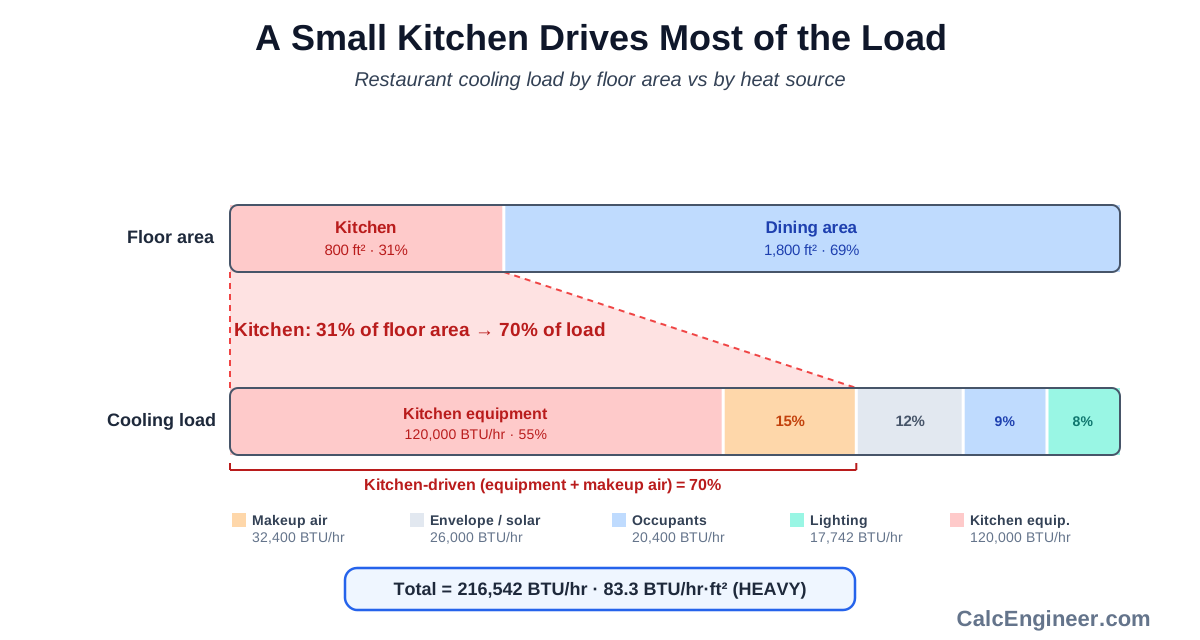
- Kitchen Floor Area = 800 ft²
- Dining Floor Area = 1,800 ft²
- Total Floor Area = 2,600 ft²
- Kitchen Equipment Gain = 120,000 BTU/hr
- Occupants (Dining) = 80
- Sensible Gain per Person = 255 BTU/hr·person
- Lighting Power Density = 2.0 W/ft²
- Envelope/Solar Factor = 10 BTU/hr·ft²
- Makeup Air = 2,000 CFM
- Ventilation ΔT = 15°F
Step 1: Kitchen equipment
Q_kitchen = 120,000 BTU/hr
Step 2: Occupants
Q_people = 80 × 255 = 20,400 BTU/hr
Step 3: Lighting
Q_lighting = 2,600 × 2.0 × 3.412 = 17,742 BTU/hr
Step 4: Envelope/Solar
Q_envelope = 2,600 × 10 = 26,000 BTU/hr
Step 5: Makeup air
Q_vent = 1.08 × 2,000 × 15 = 32,400 BTU/hr
Step 6: Total
Q_total = 120,000 + 20,400 + 17,742 + 26,000 + 32,400 = 216,542 BTU/hr
Step 7: Load per area
216,542 / 2,600 = 83.3 BTU/hr·ft²
Result: HEAVY COOLING LOAD Kitchen equipment is the dominant component at 55% of total load.
Metric Example
Given:
- Kitchen Floor Area = 74 m²
- Dining Floor Area = 167 m²
- Total Floor Area = 241 m²
- Kitchen Equipment Gain = 35,000 W
- Occupants (Dining) = 80
- Sensible Gain per Person = 75 W/person
- Lighting Power Density = 20 W/m²
- Envelope/Solar Factor = 30 W/m²
- Makeup Air = 0.94 m³/s
- Ventilation ΔT = 8°C
Step 1: Kitchen equipment
Q_kitchen = 35,000 W
Step 2: Occupants
Q_people = 80 × 75 = 6,000 W
Step 3: Lighting
Q_lighting = 241 × 20 = 4,820 W
Step 4: Envelope/Solar
Q_envelope = 241 × 30 = 7,230 W
Step 5: Makeup air
Q_vent = 1.005 × 1.202 × 0.94 × 8 × 1000 = 9,087 W ≈ 9,100 W
Step 6: Total
Q_total = 35,000 + 6,000 + 4,820 + 7,230 + 9,100 = 62,150 W = 62.15 kW
Step 7: Load per area
62,150 / 241 = 258 W/m²
Result: HEAVY COOLING LOAD Kitchen equipment accounts for 56% of total load.
Standards & References
- ASHRAE Fundamentals Handbook — Chapter 18: Nonresidential Cooling Load Calculations, including internal gains from people, lighting, and equipment
- ASHRAE Handbook — HVAC Applications — Commercial kitchen ventilation including hood types, exhaust rates, and makeup air strategies
- ASHRAE Standard 62.1 — Ventilation for Acceptable Indoor Air Quality, defining minimum ventilation and outdoor air rates for dining and kitchen occupancies
- International Mechanical Code (IMC) — Kitchen ventilation requirements applicable in many jurisdictions
- Standard sensible-air equation — Q = 1.08 × CFM × ΔT (Imperial) is the recognized HVAC relation for ventilation sensible load
Limitations
- This calculator is a first-pass screening tool, not a final design load engine.
- It does not calculate latent load from cooking, dishwashing, or high occupancy.
- Kitchen-specific hood type effects (Type I vs Type II) are not modeled.
- Exhaust rate by hood size and cooking equipment type is not calculated.
- 100% outdoor air makeup air unit psychrometrics are not included.
- Perimeter vs interior zone timing differences are not addressed.
- Transient thermal mass effects are not modeled.
- Infiltration from kitchen negative pressure is not calculated.
- Walk-in cooler and freezer rejection loads are not included.
- For final design, supplement with a full zone-by-zone analysis, psychrometric review, and kitchen exhaust engineering.
Common Mistakes to Avoid
- Sizing a restaurant HVAC system from a single tons-per-area shortcut without separating kitchen and dining zones. Kitchen zones require dedicated exhaust, negative pressure control, and often 100% outdoor air makeup units.
- Underestimating makeup air load. Kitchen exhaust hoods extract large air volumes that must be replaced with conditioned outdoor air. Ignoring this can result in a severely undersized system and negative pressure problems.
- Forgetting latent load. Restaurant kitchens and high-occupancy dining rooms generate significant moisture from cooking, dishwashing, and people. This calculator is sensible-only and should not substitute for a full sensible-plus-latent analysis in humid climates.
- Applying office-level load intensities to restaurants. Restaurant load per area is typically 3–6× higher than office load per area, so office rules of thumb will produce a severely undersized system.
- Not accounting for kitchen exhaust hood type (Type I vs Type II) and its effect on required makeup air volume.
- Ignoring the timing difference between kitchen and dining peak loads — they do not always coincide.
Frequently Asked Questions
How do you calculate restaurant HVAC load?
How many BTU per square foot does a restaurant need?
Why is kitchen equipment load usually the largest component?
What is makeup air and why does it matter for restaurant cooling?
Should kitchen and dining zones be calculated separately?
Does this calculator include latent load?
What is a typical cooling load per square meter for a restaurant?
Can I use this calculator to size a makeup air unit?
Frequently Used Together
Engineers often use these calculators in combination for complete project workflows:
Related Calculators
Explore similar calculators that might be useful for your project:
Free HVAC Quick Reference. Formulas & Checks.
Airflow, loads, refrigerant & duct checks — one printable page for the job site.
- Key formulas for airflow, load, refrigerant charge & duct sizing
- Quick sanity checks for the most common HVAC design errors
- Printable one-pager for field use and design review
No spam. Unsubscribe any time.
Calculate
Net floor area of the kitchen zone
Net floor area of the dining zone
Total sensible heat output from all kitchen equipment (ranges, fryers, ovens, griddles, etc.)
Peak number of seated diners in the dining area
Sensible heat gain per person — ASHRAE typical for dining is 75 W/person
Installed lighting power per unit total floor area
Combined wall, roof, window, and solar heat gain per unit total floor area
Total outdoor air volume flow for kitchen exhaust makeup and dining ventilation
Outdoor-to-indoor dry-bulb temperature difference (outdoor minus indoor)