Kitchen Hood Exhaust CFM Calculator
On this page
Calculate
Total length of the kitchen exhaust hood (ft)
Number of identical hood segments (default 1)
Overview
A Kitchen Hood Exhaust CFM Calculator estimates the required exhaust airflow for a commercial kitchen hood by applying duty-level exhaust rates to hood dimensions and cooking equipment classification. Kitchen hood exhaust is one of the most code-sensitive HVAC calculations in food service design — minimum exhaust rates are set by NFPA 96 and the International Mechanical Code (IMC) based on hood type, equipment duty level, and hood configuration, and undersizing creates both fire safety and indoor air quality risks.
Commercial kitchen hoods fall into two primary classifications. Type I hoods handle grease-laden vapors from fryers, griddles, ranges, broilers, and woks — they require grease ducts, fire suppression systems, and higher exhaust rates. Type II hoods handle heat and moisture only from ovens, dishwashers, and steamers — no grease duct is required and exhaust rates are lower.
Exhaust airflow is calculated from hood length multiplied by a duty-level exhaust rate expressed in CFM per linear foot (or m³/h per metre). The duty level reflects the heat and grease intensity of the cooking equipment beneath the hood — light, moderate, heavy, or extra heavy — and directly sets the required CFM per foot of hood.
This page uses a fixed hood exhaust model based on hood length and duty-level exhaust rate, producing total required exhaust CFM, exhaust per hood length, and makeup air requirement. The result supports exhaust fan selection, makeup air unit sizing, duct design, and early kitchen ventilation system planning before a full NFPA 96 compliance review.
How to Use This Calculator
Enter hood length — in m or ft.
Select hood type — choose from Type I — Grease-laden vapors, Type II — Heat & moisture only.
Select cooking equipment duty level — choose from Light, Moderate, Heavy, or Extra heavy duty based on cooking equipment intensity.
Enter number of hood segments.
Click "Calculate" — get required exhaust airflow, exhaust rate per hood length, makeup air requirement.
Size the exhaust fan and an equal makeup air unit to this airflow; verify hood type, configuration, and duct/suppression requirements against NFPA 96 and the local code.
Inputs & Outputs
Inputs
Outputs
Formula
Calculator Formula
This page uses one fixed kitchen hood exhaust CFM model.
Step 1: Select duty-level exhaust rate
Exhaust rate R is selected from the duty level:
| Duty Level | Imperial (CFM/ft) | Metric (m³/h·m) |
|---|---|---|
| Light duty (Type II) | 100 | 557 |
| Moderate duty (Type I) | 200 | 1,114 |
| Heavy duty (Type I) | 300 | 1,672 |
| Extra heavy duty (Type I) | 400 | 2,229 |
These rates are consistent with NFPA 96 and IMC exhaust rate frameworks for commercial kitchen hood design.
Step 2: Calculate required exhaust airflow
Q_exhaust = L × R × N
Where:
- Q_exhaust = required exhaust airflow (CFM or m³/h)
- L = hood length (ft or m)
- R = duty-level exhaust rate (CFM/ft or m³/h·m)
- N = number of hood segments
Step 3: Exhaust rate per hood length (confirmation output)
Rate check = Q_exhaust / (L × N)
Should equal the selected duty-level rate R.
Step 4: Makeup air requirement
Q_makeup = Q_exhaust
Makeup air must equal exhaust airflow to maintain kitchen pressure balance. Negative pressure from uncompensated exhaust pulls unconditioned air through every gap in the building envelope and creates door-opening difficulties and draft problems.
Fixed Decision Model
Hood length + hood type + duty level → exhaust rate per foot or metre (from duty level table) → total exhaust CFM or m³/h → makeup air requirement = exhaust airflow.
What is Kitchen Hood Exhaust CFM?
Kitchen hood exhaust CFM is the volume of air per minute that a commercial kitchen exhaust hood must remove from the cooking area to capture heat, grease-laden vapors, smoke, and combustion products before they enter the kitchen space. CFM — cubic feet per minute — is the standard airflow unit used in North American kitchen ventilation design, equivalent to m³/h or L/s in metric systems.
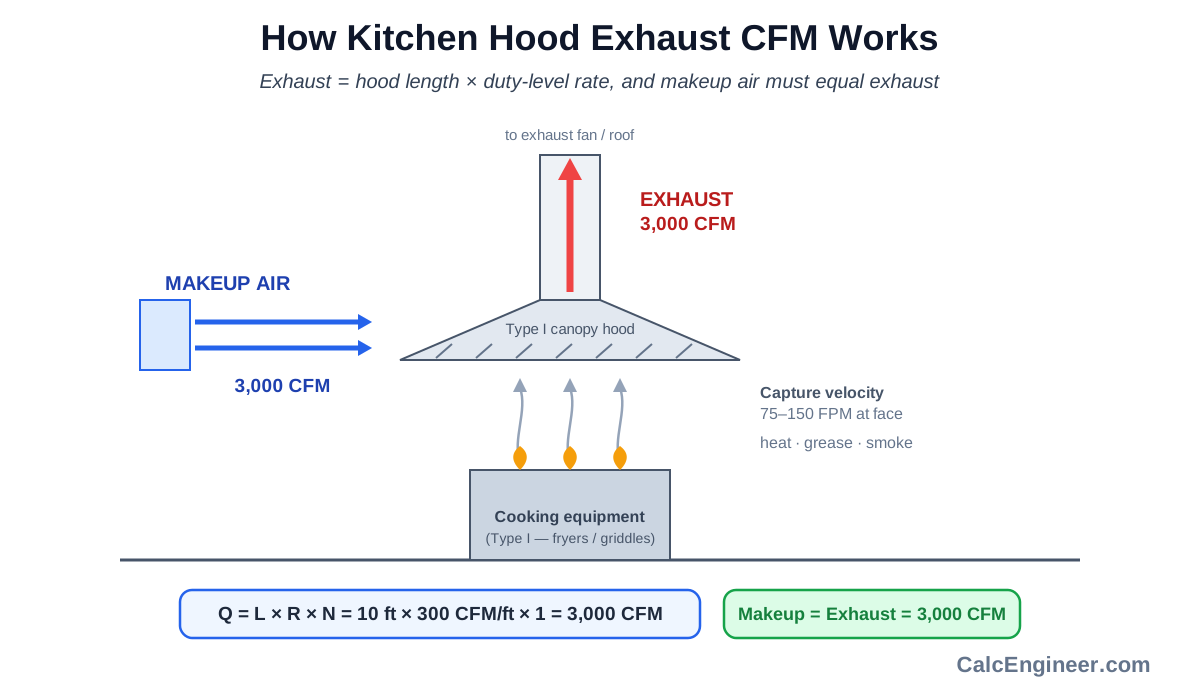
The required exhaust CFM depends on two primary factors: the length of the hood and the cooking equipment duty level beneath it. A longer hood must exhaust more air to maintain adequate capture velocity across its full length. Higher-intensity cooking equipment — charbroilers, wok ranges, and solid-fuel appliances — produces more heat and grease than lighter equipment and requires a higher exhaust rate per linear foot to achieve capture.
Hood classification and makeup air are the two additional design parameters that shape every kitchen exhaust project. Type I and Type II hoods have different exhaust rates, duct requirements, and fire suppression rules. Every CFM exhausted must be matched by equal makeup air supply — both topics are detailed in the sections below.
Hood Type Classifications
Type I Hoods
Type I hoods are required over cooking equipment that produces grease-laden vapors — fryers, griddles, ranges, broilers, woks, and solid-fuel appliances. They require:
- Listed grease duct construction
- Grease filters with proper face velocity
- Listed fire suppression system
- Exhaust rates typically 200–600+ CFM per linear foot
- Exhaust duct velocity maintained at 500–1,500 FPM to prevent grease accumulation
Type II Hoods
Type II hoods serve equipment that produces only heat and moisture with no grease — commercial ovens, dishwashers, steamers, and coffee equipment. They require:
- No grease duct or fire suppression
- Lower exhaust rates (50–150 CFM per linear foot)
- Standard duct construction
Capture Velocity and Hood Performance
Capture velocity is the air velocity at the hood face or at the edge of the cooking equipment that draws cooking effluents into the hood. Typical target capture velocities for commercial kitchen hoods range from 75–150 FPM (0.38–0.76 m/s) at the hood opening face. The duty-level exhaust rates used on this page are designed to achieve adequate capture velocity for each equipment class when the hood is properly sized with correct overhang beyond the cooking equipment.
Makeup Air: The Critical Parallel Requirement
Every volume of air exhausted from a kitchen must be replaced with an equal volume of makeup air to maintain neutral or slightly negative pressure in the kitchen space. If makeup air is insufficient, the kitchen operates at severe negative pressure — exhaust hood capture deteriorates, combustion appliances may back-draft, and staff experience uncomfortable drafts. Makeup air delivery method (short-circuit, transfer, or conditioned supply) affects how much enters through the hood face vs the room, but total makeup airflow must always match total exhaust airflow.
HVAC Unit Conversions
| Unit | Equivalent |
|---|---|
| 1 CFM | 1.699 m³/h |
| 1 CFM | 0.4719 L/s |
| 1 m³/h | 0.5886 CFM |
| 1 FPM | 0.00508 m/s |
| 1 m/s | 196.85 FPM |
Key Facts
- NFPA 96 (Standard for Ventilation Control and Fire Protection of Commercial Cooking Operations) is the primary US code governing Type I kitchen hood exhaust rates and duct requirements.
- IMC (International Mechanical Code) Section 507 sets minimum exhaust rates for commercial kitchen hoods by equipment type and hood configuration.
- Type I hoods require listed grease ducts, grease filters, and a listed fire suppression system — exhaust rates typically range from 200–600+ CFM per linear foot.
- Type II hoods require no grease duct or fire suppression system — exhaust rates typically range from 50–150 CFM per linear foot.
- Makeup air must equal exhaust airflow — typically 80–90% is supplied as transfer or short-circuit air directly into the hood, with the remainder as conditioned room air.
- Demand-controlled kitchen ventilation (DCKV) uses sensors to modulate exhaust and makeup air fan speed based on actual cooking activity, reducing energy consumption by 30–50% compared to constant-volume systems.
- Exhaust duct velocity in Type I systems should be maintained at 500–1,500 FPM (2.5–7.6 m/s) to prevent grease accumulation and reduce fire risk.
- Solid-fuel cooking appliances (wood-fired ovens, charcoal grills) require the highest exhaust rates — often 500+ CFM per linear foot — due to smoke and particulate load.
Applications
- Type I hood exhaust fan sizing for commercial kitchens
- Type II hood exhaust sizing for bakeries and dishwasher areas
- Makeup air unit CFM sizing and selection
- Kitchen exhaust duct sizing and velocity verification
- Restaurant HVAC system design — kitchen zone
- Ghost kitchen and dark kitchen ventilation planning
- Food truck and compact kitchen hood exhaust estimation
- Institutional kitchen hood sizing (schools, hospitals, correctional facilities)
- Demand-controlled kitchen ventilation (DCKV) baseline exhaust rate determination
- NFPA 96 and IMC exhaust rate screening review
Example Calculation
Imperial Example
Given:
- Hood Type = Type I
- Duty Level = Heavy duty (fryers and griddles)
- Hood Length = 10 ft
- Number of Segments = 1
- Exhaust Rate = 300 CFM/ft (heavy duty)
Calculation:
Step 1: Duty level rate
  R = 300 CFM/ft

Step 2: Exhaust airflow
  Q_exhaust = 10 × 300 × 1 = 3,000 CFM

Step 3: Rate check
  3,000 / 10 = 300 CFM/ft ✓

Step 4: Makeup air
  Q_makeup = 3,000 CFM
Result: HIGH EXHAUST REQUIREMENT Hood serves high-intensity cooking equipment. A 3,000 CFM exhaust fan and equal makeup air unit are required. Verify NFPA 96 Type I duct and fire suppression requirements.
Metric Example
Given:
- Hood Type = Type I
- Duty Level = Heavy duty (fryers and griddles)
- Hood Length = 3.05 m
- Number of Segments = 1
- Exhaust Rate = 1,672 m³/h·m (heavy duty)
Calculation:
Step 1: Duty level rate
  R = 1,672 m³/h·m

Step 2: Exhaust airflow
  Q_exhaust = 3.05 × 1,672 × 1 = 5,100 m³/h

Step 3: Rate check
  5,100 / 3.05 = 1,672 m³/h·m ✓

Step 4: Makeup air
  Q_makeup = 5,100 m³/h
Result: HIGH EXHAUST REQUIREMENT Hood serves high-intensity cooking equipment. Exhaust fan and makeup air unit must each handle 5,100 m³/h. Verify applicable kitchen ventilation code for Type I duct and suppression requirements.
Standards & References
- NFPA 96 — Standard for Ventilation Control and Fire Protection of Commercial Cooking Operations — primary US reference for Type I hood exhaust rates, grease duct construction, and fire suppression requirements
- IMC Section 507 — International Mechanical Code — provides minimum exhaust rates for commercial kitchen hoods by equipment type and hood configuration
- ASHRAE Standard 62.1 — Ventilation for Acceptable Indoor Air Quality — covers ventilation requirements for occupied spaces adjacent to kitchen areas
- UL 710 — Standard for Exhaust Hoods for Commercial Cooking Equipment — listing requirements for Type I exhaust hoods
- UL 300 — Standard for Fire Testing of Fire Extinguishing Systems for Protection of Commercial Cooking Equipment — fire suppression system listing
Limitations
- This calculator is a first-pass screening tool, not a full NFPA 96 or IMC code compliance calculation.
- Does not account for hood configuration type (wall-mounted, island, proximity, backshelf, eyebrow) — each has different exhaust rate requirements under NFPA 96 and IMC.
- Does not consider specific equipment BTU/hr input rate and duty classification per NFPA 96 Table 6.1.
- Does not verify hood overhang adequacy and capture velocity at the hood face.
- Does not include duct sizing, static pressure drop, and fan selection calculations.
- Does not account for grease filter face velocity requirements or makeup air delivery method (short-circuit, transfer air, conditioned supply).
- Does not address solid-fuel appliance additional requirements under NFPA 96 Chapter 15 beyond the extra heavy duty rate.
- Does not consider local amendments to NFPA 96 and IMC exhaust rates or climate zone impact on makeup air conditioning load.
- Final design must be verified against the applicable code edition and jurisdiction-specific requirements.
Common Mistakes to Avoid
- Sizing a Type II hood over grease-producing equipment. Type II hoods are only appropriate for heat-and-moisture-producing equipment with no grease — ovens, steamers, and dishwashers. Installing a Type II hood over a fryer, griddle, or range creates a serious fire hazard because Type II systems have no grease duct or fire suppression capability.
- Ignoring makeup air. Every CFM exhausted from a kitchen must be replaced. A kitchen exhausting 3,000 CFM without adequate makeup air supply will operate at severe negative pressure — hood capture suffers, combustion appliances may back-draft, and doors become difficult to open. Makeup air unit sizing is not optional.
- Underestimating duty level. A griddle or flat-top range cooking at high load is heavy duty, not moderate. Solid-fuel appliances — wood-fired pizza ovens, charcoal grills — are extra heavy duty regardless of their BTU rating because smoke and particulate load far exceed gas-fired equipment of equivalent heat output.
- Applying a single duty-level rate to mixed equipment. In kitchens with mixed equipment under one hood — for example, a fryer section and an oven section — a blended or zone-based exhaust rate may be more accurate. Consult the applicable IMC and NFPA 96 tables for combined equipment exhaust requirements.
Frequently Asked Questions
How do you calculate kitchen hood exhaust CFM?
What is the difference between Type I and Type II kitchen hoods?
How many CFM per foot does a commercial kitchen hood need?
Why does makeup air equal exhaust airflow?
What is demand-controlled kitchen ventilation (DCKV)?
What exhaust duct velocity is required for Type I hoods?
Does this calculator apply to solid-fuel cooking equipment?
What is capture velocity and how does it affect exhaust CFM?
Frequently Used Together
Engineers often use these calculators in combination for complete project workflows:
Related Calculators
Explore similar calculators that might be useful for your project:
Free HVAC Quick Reference. Formulas & Checks.
Airflow, loads, refrigerant & duct checks — one printable page for the job site.
- Key formulas for airflow, load, refrigerant charge & duct sizing
- Quick sanity checks for the most common HVAC design errors
- Printable one-pager for field use and design review
No spam. Unsubscribe any time.
Calculate
Total length of the kitchen exhaust hood (ft)
Number of identical hood segments (default 1)