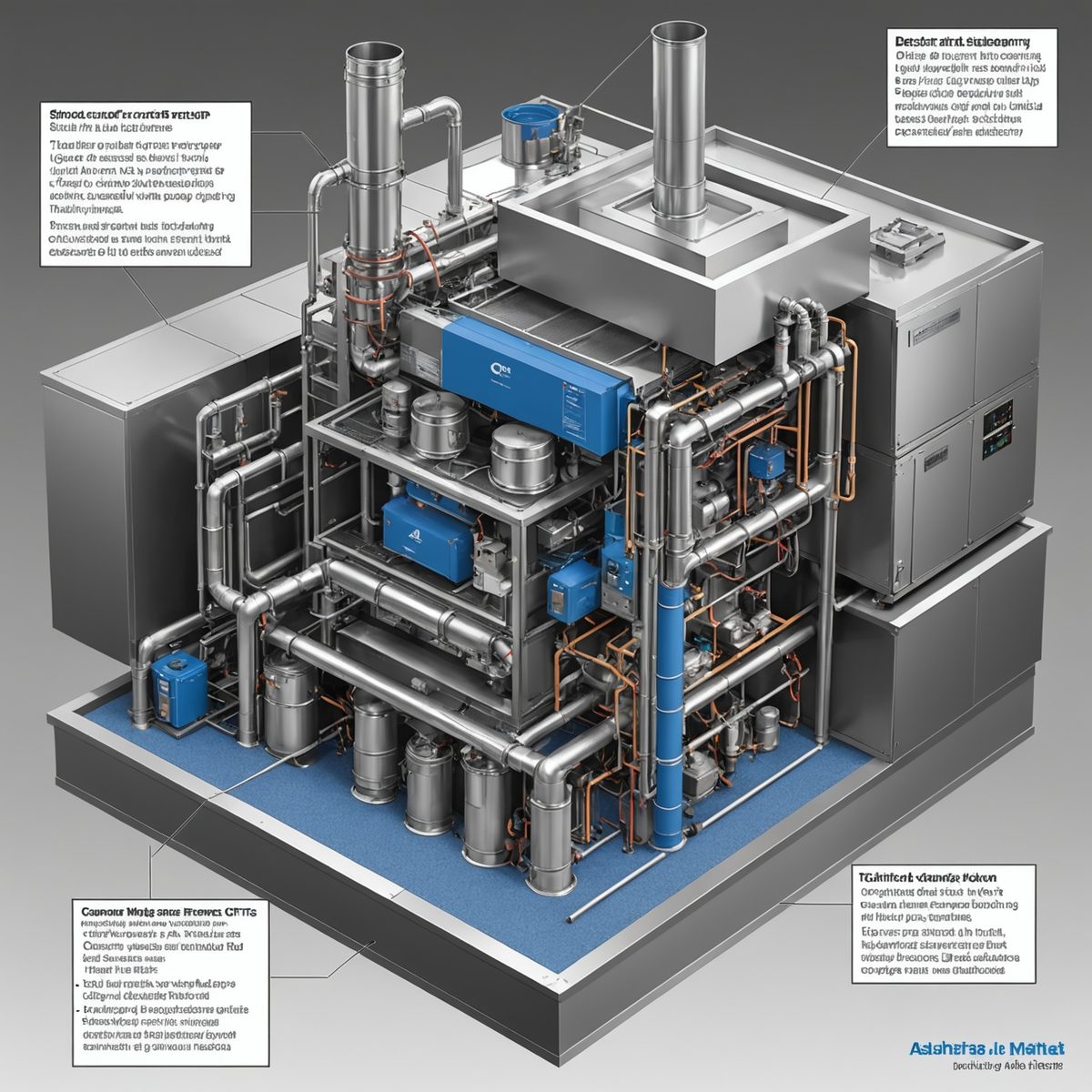
Commercial kitchen makeup air units solve a single physics problem: replacing every cubic foot per minute of exhausted air before kitchen pressure drops below atmospheric. IMC Section 508 and NFPA 96 Section 8 make this mandatory, not optional. Size the unit correctly and the kitchen runs under balanced pressure with grease-hood capture velocity intact, gas appliances firing without combustion back-draft, and kitchen workers receiving conditioned supply air at 65°F (18°C) in winter. Undersize the unit and the kitchen develops negative pressure that breaks the entire ventilation system simultaneously. This article covers the IMC Section 508 makeup air sizing formula, delivery method distribution (short-circuit vs transfer vs conditioned), Climate Zones 2A through 8 conditioning loads, direct-fired versus indirect-fired heater selection per ANSI Z83.4 and ANSI Z83.8, energy recovery mandates per ASHRAE 90.1-2022 Section 6.5.7.2, and the complete Austin Texas restaurant worked example continuing from the Kitchen Hood Exhaust article (3,500 CFM exhaust) and Grease Trap Sizing article (FOG management).
Why Makeup Air Sizing per IMC Section 508 + NFPA 96 Section 8: Pressure Balance, Combustion Safety, and Worker Comfort
Commercial kitchen makeup air systems exist to solve a single fundamental physics problem per IMC Section 508 and NFPA 96 Section 8: every cubic foot per minute of exhausted air must be replaced by an equal volume from outside, or the kitchen develops negative pressure that breaks every system downstream. Hood capture loses effectiveness against the pressure differential, gas appliances back-draft with CO buildup hazard, and worker access through service doors becomes difficult when the kitchen runs at significant negative pressure.
Per ASHRAE 154 Section 4.7 and IMC Section 508.1, the mass balance equation is mandatory:
Q_makeup = Q_exhaust [mass balance]
Failure produces measurable effects: 0.05 inWG (12.4 Pa) negative pressure deteriorates hood capture velocity per ASHRAE 154; 0.20 inWG (49.7 Pa) negative pressure triggers combustion back-drafting per IFGC Section 304.5; 0.50 inWG (124 Pa) negative pressure makes 3-ft service doors difficult to open against suction force.
Makeup air represents the largest single energy consumer in a commercial kitchen, typically 60–75% of HVAC energy budget per ASHRAE 90.1-2022 Section 6.5.7 commentary. Untreated outside air costs nothing to provide (no heating, no cooling, no dehumidification) but produces uncomfortable kitchen worker conditions; fully conditioned outside air costs significantly to maintain. The 80–90% short-circuit / 10–20% conditioned split established in IMC Section 508.2 optimizes between worker comfort and energy cost.
This article is the HVAC supply-air sibling in the commercial kitchen application cluster: the Kitchen Hood Exhaust CFM article sized the 3,500 CFM exhaust airflow for the Austin Texas worked example continuing here; this article sizes the matching 3,500 CFM makeup air system. Together they form the pressure-balanced kitchen ventilation system. The Grease Trap Sizing article handles the FOG that reaches the wastewater system, completing the upstream-downstream commercial kitchen infrastructure cluster.
Calculator Inputs: Exhaust CFM, Delivery Method Split, Climate Zone, Conditioning Type per IMC 508 + ASHRAE 169-2021
The Makeup Air Unit Sizing Calculator workflow proceeds from exhaust airflow to climate-conditioned equipment selection.
Exhaust CFM [CFM or m³/h]: total kitchen exhaust airflow from the preceding Kitchen Hood Exhaust calculator per NFPA 96 Table 6.1 and IMC Table 507.13.1. The output of the Kitchen Hood Exhaust calculator becomes the primary input of this calculator. Typical range: 800 CFM (1,358 m³/h) for a small Type II light-duty hood to 6,000+ CFM (10,194+ m³/h) for a high-volume commercial kitchen.
Delivery Method Split [%]: distribution of makeup air across three delivery paths per IMC Section 508.2. Short-circuit/plenum percentage covers 0–90% (typical 80–90%). Transfer air percentage covers 0–20%. Conditioned room supply covers 10–100% (minimum 10% per IMC Section 508.3). The three percentages must sum to 100%.
Climate Zone per ASHRAE 169-2021, Zones 1–8 with A/B/C moisture suffix: Zone 1A (Hot-Humid) includes Miami and Honolulu with high latent load; Zone 2A (Hot-Humid) includes Houston, Austin, Tampa, and Orlando with moderate-high latent load; Zone 2B (Hot-Dry) includes Phoenix and Tucson with high sensible load; Zone 3A (Mixed-Humid) includes Atlanta, Dallas, and Memphis; Zone 4A (Mixed-Humid) includes Baltimore, Philadelphia, and New York; Zone 5A (Cool-Humid) includes Chicago, Boston, and Detroit with significant heating load; Zones 6A/B (Cold) include Minneapolis, Buffalo, and Denver with heavy heating load; Zones 7 and 8 (Very Cold/Subarctic) include Duluth, Anchorage, and Fairbanks with extreme heating loads.
Design Temperatures per ASHRAE 169-2021: 99% winter design temperature (heating); 1% summer dry bulb (sensible cooling); 1% summer wet bulb (latent cooling).
Conditioning Type: direct-fired gas heater (90%+ efficiency, ANSI Z83.4 listed); indirect-fired gas heater (78–82% efficiency, ANSI Z83.8 listed, heat exchanger separates combustion from makeup air); electric heat (100% conversion efficiency but higher operating cost); steam/hot water coil (if building has central heating system); DX cooling coil (typical 12–15 SEER per AHRI standard); chilled water coil (if building has central chiller plant).
Calculator outputs: required makeup air capacity [CFM or m³/h]; conditioned portion airflow [CFM or m³/h]; heating capacity required [BTU/hr or kW]; cooling capacity required, sensible plus latent [BTU/hr or kW or tons]; annual heating energy consumption [therms or kWh]; annual cooling energy consumption [kWh]; energy recovery applicability flag (≥ 5,000 CFM mandate per ASHRAE 90.1-2022 Section 6.5.7.2).
The calculator does not account for building infiltration and exfiltration through the building envelope, door-opening losses, specific manufacturer model performance curves, altitude correction for high-altitude installations, or local energy code requirements beyond the ASHRAE 90.1 baseline.
Makeup Air Sizing Formula: Q_makeup = Q_exhaust (Imperial or Metric); Conditioned Portion Sizing
Makeup air sizing formula is volumetric mass balance: total makeup volume equals total exhaust volume per IMC Section 508.1 mandatory rule. Conditioning load (heating capacity, cooling capacity) applies to the conditioned portion of makeup air; the short-circuit portion bypasses conditioning entirely.
Mass balance per IMC Section 508.1:
Q_makeup_total = Q_exhaust

where:
  Q_makeup_total = total makeup air requirement [CFM or m³/h]
  Q_exhaust      = total kitchen exhaust airflow [CFM or m³/h]
                   from Kitchen Hood Exhaust calculator
Conditioned portion sizing per IMC Section 508.2:
Q_makeup_conditioned = Q_makeup_total × percentage_conditioned

where:
  Q_makeup_conditioned = airflow to heating/cooling equipment [CFM or m³/h]
  percentage_conditioned = 10% to 100%
                           per IMC Section 508.3 minimum 10%
Heating capacity per ASHRAE Handbook Fundamentals Chapter 18 sensible heat formula:
Q_heating [BTU/hr] = 1.08 × Q_makeup_conditioned [CFM] × ΔT_heating [°F]
Q_heating [kW]     = 0.34 × Q_makeup_conditioned [m³/h] × ΔT_heating [°C]

where:
  1.08 / 0.34 = sensible heat factor (BTU/hr or W per CFM-°F or m³/h-°C)
  ΔT_heating  = T_indoor_target − T_outdoor_winter [°F or °C]
  T_indoor_target  = 65°F (18°C) for kitchen worker comfort
  T_outdoor_winter = 99% winter design temperature per ASHRAE 169-2021
Sensible cooling capacity:
Q_cooling_sensible [BTU/hr] = 1.08 × Q_makeup_conditioned [CFM] × ΔT_cooling [°F]

where:
  ΔT_cooling      = T_outdoor_summer − T_indoor_target [°F]
  T_indoor_target = 78°F (26°C) for kitchen
  T_outdoor_summer = 1% summer dry bulb per ASHRAE 169-2021
Latent cooling capacity per ASHRAE Handbook Fundamentals Chapter 1:
Q_cooling_latent [BTU/hr] = 4.5 × Q_makeup_conditioned [CFM] × Δh

where:
  4.5 = mass flow factor (lb/hr per CFM-h)
  Δh  = enthalpy difference [BTU/lb dry air]
        between outdoor design condition and indoor target
Total cooling capacity:
Q_cooling_total = Q_cooling_sensible + Q_cooling_latent

Tons cooling:
T_cool [tons] = Q_cooling_total / 12,000 BTU/hr per ton
Austin Texas cluster narrative preview (3,500 CFM total makeup air, 85/15 split):
Q_makeup_total        = 3,500 CFM (5,949 m³/h)
Q_makeup_short_circuit = 3,500 × 0.85 = 2,975 CFM (5,057 m³/h)
                        — bypasses conditioning entirely
Q_makeup_conditioned   = 3,500 × 0.15 = 525 CFM (892 m³/h)
                        — heated in winter, cooled in summer
Detailed Climate Zone 2A loads are calculated in the Section 8 worked example.
Delivery Method Distribution: 80-90% Short-Circuit, 0-20% Transfer, 10-20% Conditioned per IMC 508.2
IMC Section 508.2 establishes three delivery methods for makeup air with different energy and comfort tradeoffs. Distribution optimization balances energy cost (favors short-circuit) with worker comfort (favors conditioned supply). Industry standard practice settles at 80–90% short-circuit plus 10–20% conditioned for most installations.
Short-Circuit (Plenum) Makeup Air. 80–90% typical portion.
Untreated outside air introduced directly into the hood plenum via integrated supply diffusers. Bypasses the kitchen space entirely; mixes with captured exhaust in the hood plenum before discharge. Energy cost: minimal (no heating, no cooling, no dehumidification). Worker comfort impact: negligible because the air never contacts the breathing zone. Hood integration: Captiveaire ND-2, Halton KSA, and Greenheck XGI hoods include factory plenum inlets. Limitation per ASHRAE 154 commentary: cannot exceed 90% to prevent positive plenum pressure disrupting capture velocity. Climate impact: works in all climates.
Transfer Air. 0–20% typical portion.
Air drawn from adjacent conditioned spaces (dining room, prep areas, corridors) through transfer grilles or relief openings. Air is already conditioned by the main building HVAC system. Energy cost: zero incremental (the HVAC system already conditions this air for dining and lobby spaces). Worker comfort impact: positive in hot climates, as cool dining-room air migrates to the kitchen. Pressure differential per IMC Section 508: kitchen pressure should remain slightly negative relative to dining (–0.02 to –0.05 inWG) to keep cooking odors out of dining areas. Limitation: requires sufficient adjacent conditioned space; cannot serve an island restaurant kitchen without adjacent spaces. Climate impact: most effective in hot climates where air-conditioned dining is sustained year-round.
Conditioned Room Supply. 10–20% typical portion (minimum 10% per IMC Section 508.3).
Outside air conditioned through a dedicated makeup air unit (heating and cooling) and delivered to the kitchen space through standard ductwork and diffusers. Energy cost: significant (full HVAC load on the conditioned portion). Worker comfort impact: high (delivers comfortable air to the breathing zone). Equipment: direct-fired gas heater, electric heat, hot water coil, or DX cooling/chilled water coil. IMC Section 508.3 mandatory minimum: 10% conditioned for worker comfort. Climate impact: critical in extreme climates (Zones 1A, 7, 8) for outside air conditioning.
Engineering selection guidance per ASHRAE 154 Section 4.7 and IMC Section 508.2 commentary:
| Application | Short-Circuit | Transfer | Conditioned |
|---|---|---|---|
| High-volume kitchen with large dining room | 85% | 0% | 15% (standard) |
| Small restaurant, limited dining | 75% | 0% | 25% (worker comfort priority) |
| Ghost kitchen / dark kitchen | 90–95% | 0% | 5–10% (cost optimization) |
| Open-kitchen design (cooking visible) | 70% | 10–15% | 15–20% (aesthetic + comfort) |
| Hospital / institutional cafeteria | 70% | 10% | 20% (sustained-occupancy comfort) |
| Hot climate (Zone 1A, 2A) | 85% | 5% | 10% (latent load minimization) |
| Cold climate (Zone 5+) | 80% | 5% | 15% (winter heating efficiency) |
Per ASHRAE 90.1-2022 Section 6.5.7: above 5,000 CFM (8,495 m³/h) total exhaust, energy recovery is mandatory regardless of delivery distribution and applies to all conditioned makeup portions.
Climate Zone Conditioning Loads per ASHRAE 169-2021: Heating BTU/hr and Cooling Capacity Calculations
Climate zone determines heating and cooling design loads through ASHRAE 169-2021 design temperature data combined with ASHRAE Handbook Fundamentals Chapter 14 psychrometric methodology. Hot climates require larger cooling capacity; cold climates require larger heating capacity. Climate Zone 2A (Austin) represents a moderate cooling-dominant climate with hot-humid summer and mild winter conditions.
Design temperature data per ASHRAE 169-2021:
| Climate Zone | Representative City | Winter 99% Design [°F/°C] | Summer 1% Dry Bulb [°F/°C] | Summer 1% Wet Bulb [°F/°C] |
|---|---|---|---|---|
| 1A (Hot-Humid) | Miami, FL | 47 / 8 | 91 / 33 | 79 / 26 |
| 2A (Hot-Humid) | Austin, TX | 25 / −4 | 100 / 38 | 76 / 24 |
| 2A (Hot-Humid) | Houston, TX | 31 / −1 | 96 / 36 | 78 / 26 |
| 2B (Hot-Dry) | Phoenix, AZ | 35 / 2 | 110 / 43 | 70 / 21 |
| 3A (Mixed-Humid) | Atlanta, GA | 22 / −6 | 92 / 33 | 75 / 24 |
| 4A (Mixed-Humid) | New York, NY | 14 / −10 | 90 / 32 | 74 / 23 |
| 5A (Cool-Humid) | Chicago, IL | 0 / −18 | 88 / 31 | 75 / 24 |
| 6A (Cold-Humid) | Minneapolis, MN | −11 / −24 | 88 / 31 | 73 / 23 |
| 7 (Very Cold) | Duluth, MN | −16 / −27 | 84 / 29 | 70 / 21 |
Indoor design conditions per ASHRAE Handbook HVAC Applications Chapter 34: kitchen winter target 65°F (18°C) because kitchen workers generate significant metabolic heat; kitchen summer target 78°F (26°C), slightly above general office to offset cooking equipment heat gain.
Heating capacity calculation for 525 CFM conditioned portion (Austin Texas cluster example):
ΔT_heating = T_indoor_target − T_outdoor_winter
           = 65°F − 25°F = 40°F (22°C)

Q_heating = 1.08 × 525 × 40 = 22,680 BTU/hr (6.6 kW)
For full 3,500 CFM at full conditioning (worst case if 100% conditioned):
Q_heating_full = 1.08 × 3,500 × 40 = 151,200 BTU/hr (44.3 kW)
Cooling capacity calculation for Austin Texas (Climate Zone 2A, summer 1% dry bulb 100°F / wet bulb 76°F):
Sensible cooling:
ΔT_cooling = T_outdoor_summer − T_indoor_target
           = 100°F − 78°F = 22°F (12°C)

Q_cooling_sensible = 1.08 × 525 × 22 = 12,474 BTU/hr (3.65 kW)

Latent cooling (Austin humidity):
W_outdoor (Austin summer) ≈ 0.0184 lb water/lb dry air
W_indoor (78°F, 50% RH) ≈ 0.0103 lb water/lb dry air
Δh ≈ 8.7 BTU/lb dry air enthalpy difference

Q_cooling_latent = 4.5 × 525 × 8.7 = 20,554 BTU/hr (6.03 kW)

Total cooling = 12,474 + 20,554 = 33,028 BTU/hr (9.7 kW) = 2.75 tons
Climate zone comparison for the same 525 CFM conditioned portion:
| Climate Zone (Representative) | Heating Q [BTU/hr] | Cooling Q [BTU/hr] | Tons |
|---|---|---|---|
| 1A Miami | 9,072 (2.7 kW) | 23,750 | 2.0 |
| 2A Austin | 22,680 (6.6 kW) | 33,028 | 2.75 |
| 2B Phoenix | 16,200 (4.7 kW) | 31,500 | 2.6 |
| 5A Chicago | 36,855 (10.8 kW) | 22,500 | 1.9 |
| 6A Minneapolis | 43,092 (12.6 kW) | 20,250 | 1.7 |
Hot climates carry moderate-to-large cooling loads with modest heating loads; cold climates carry large heating loads with modest cooling loads. Mixed climates (3A, 4A) carry both, requiring more equipment versatility per ASHRAE Handbook HVAC Systems Chapter 5.
Direct-Fired vs Indirect-Fired Heating per ANSI Z83.4 + ANSI Z83.8: 90% vs 80% Efficiency Comparison
Commercial kitchen makeup air heating uses two primary technology options. Direct-fired gas heaters burn natural gas or propane directly in the outside-air stream; combustion products mix into the supplied air. Indirect-fired heaters separate combustion from supply air through a heat exchanger. Direct-fired offers 90–92% thermal efficiency at lower cost; indirect-fired offers 78–82% efficiency with higher initial cost but separated combustion products.
Direct-Fired Heaters per ANSI Z83.4.
Thermal efficiency: 90–92% (no heat exchanger losses, combustion products warm the air directly). Natural gas or propane fuel. Construction: open-burner system within ductwork; combustion air comes from the makeup air stream. Combustion product limits per ANSI Z83.18: CO ≤ 5 ppm at full firing rate, CO₂ ≤ 0.5%, water vapor approximately 0.1 lb/lb dry air. Common manufacturer models: Modine HD-100, HD-150, HD-250 series; Reznor V-Series; Captiveaire MUA; Hastings Heaters HER series. Capital cost: $5,000–$8,500 for a 3,000–5,000 CFM unit. Limitation per ANSI Z83.18 Section 4: maximum recirculation 20% (most installations use 100% outside air). Building code per IFGC Section 304.5: the kitchen building is required to maintain combustion air ventilation; direct-fired systems generally satisfy this requirement automatically.
Indirect-Fired Heaters per ANSI Z83.8.
Thermal efficiency: 78–82% (heat exchanger losses 18–22%). Natural gas or propane fuel (sometimes oil). Construction: stainless steel or aluminized steel heat exchanger; combustion air separate from supply air; flue vents combustion products outside. No combustion product mixing with supply air provides cleaner air to kitchen workers. Common manufacturer models: Modine PTC Series; Reznor RGE; Greenheck DOAS-Mua; Trane FFRG; Carrier 50TC; Engineered Air HFE. Capital cost: $7,500–$12,000 for a 3,000–5,000 CFM unit (20–30% higher than direct-fired). Required for installations where combustion products in supply air are unacceptable (food processing, restaurants with specific air quality regulations).
Selection comparison:
| Parameter | Direct-Fired Z83.4 | Indirect-Fired Z83.8 |
|---|---|---|
| Efficiency | 90–92% | 78–82% |
| Capital cost (3,500 CFM) | $5,500–$8,500 | $7,500–$11,000 |
| Operating cost (heating) | 100% baseline | +14% vs direct-fired |
| Combustion products in supply | Yes (≤ 5 ppm CO, ≤ 0.5% CO₂) | No (separated by heat exchanger) |
| Service intervals | Annual burner inspection | Annual burner + heat exchanger inspection |
| Lifecycle | 15–20 years | 20–25 years (slower heat exchanger fatigue) |
| Code compliance | ANSI Z83.4 + Z83.18 + IFGC 304 | ANSI Z83.8 + IFGC 304 |
Per ASHRAE Handbook HVAC Applications Chapter 34 selection guidance: direct-fired is preferred for commercial kitchens due to efficiency and cost advantages; indirect-fired is preferred where supply-air quality is critical (institutional facilities, healthcare commercial kitchens, food processing). Most US commercial restaurants use direct-fired makeup air units per industry common practice.
Austin Texas Restaurant Worked Example: 3,500 CFM Makeup Air, 85/15 Split, Climate Zone 2A Conditioning
Continuing the commercial kitchen cluster scenario from the Kitchen Hood Exhaust article (which continued from the Grease Trap article): same Austin Texas restaurant with a 3-compartment sink and 10 ft Type I heavy-duty exhaust hood. This worked example sizes the makeup air unit providing equal 3,500 CFM (5,949 m³/h) replacement supply air per IMC Section 508.1.
Project geometry recap: single-story commercial restaurant, 2,500 sq ft (232 m²) with 1,200 sq ft (111 m²) kitchen; Climate Zone 2A per ASHRAE 169-2021 (Austin, TX); winter 99% design 25°F (−4°C); summer 1% dry bulb 100°F (38°C), wet bulb 76°F (24°C); natural gas service available.
Step 1. Total makeup air requirement per IMC Section 508.1:
Q_makeup_total = Q_exhaust = 3,500 CFM (5,949 m³/h)
Step 2. Delivery method distribution per IMC Section 508.2. High-volume kitchen with moderate dining room: 85% short-circuit plus 15% conditioned is the standard configuration. Climate Zone 2A latent load favors higher short-circuit to minimize latent conditioning cost.
Q_short_circuit = 3,500 × 0.85 = 2,975 CFM (5,057 m³/h)
Q_conditioned   = 3,500 × 0.15 = 525 CFM (892 m³/h)

Verify minimum: 525 CFM = 15% ≥ 10% IMC Section 508.3 minimum. ✓
Step 3. Heating capacity per ASHRAE Handbook Fundamentals Chapter 18:
T_indoor_winter  = 65°F (18°C) kitchen target
T_outdoor_winter = 25°F (−4°C) per ASHRAE 169-2021 Austin
ΔT_heating       = 65 − 25 = 40°F (22°C)

Q_heating = 1.08 × 525 × 40 = 22,680 BTU/hr (6.6 kW)
Step 4. Cooling capacity calculation:
T_indoor_summer  = 78°F (26°C) kitchen target
T_outdoor_summer = 100°F (38°C) Austin 1% design dry bulb
ΔT_cooling       = 100 − 78 = 22°F (12°C)

Sensible cooling:
Q_cooling_sensible = 1.08 × 525 × 22 = 12,474 BTU/hr (3.65 kW)

Latent cooling (Austin humidity):
W_outdoor (100°F, 76°F WB) ≈ 0.0184 lb water/lb dry air
W_indoor (78°F, 50% RH)   ≈ 0.0103 lb water/lb dry air
Δh ≈ 8.7 BTU/lb dry air

Q_cooling_latent = 4.5 × 525 × 8.7 = 20,554 BTU/hr (6.03 kW)

Total cooling:
Q_cooling_total = 12,474 + 20,554 = 33,028 BTU/hr (9.7 kW)
Tons cooling    = 33,028 / 12,000 = 2.75 tons; 3 tons selected
Step 5. Heater technology selection per Section 7 guidance. Commercial restaurant with standard worker comfort requirements: direct-fired preferred for efficiency and cost. Selected: Modine HD-150 (direct-fired natural gas, 150,000 BTU/hr input, 90% efficiency = 135,000 BTU/hr output, ANSI Z83.4 + ANSI Z83.18 listed). Output 135,000 BTU/hr exceeds 22,680 BTU/hr required, providing full-conditioning headroom.
Step 6. Cooling equipment selection. Selected: Greenheck DOAS-Mua dedicated outside air system, 3,500 CFM capacity, integrated 3-ton DX cooling coil with R-410A refrigerant, SEER 14, AHRI certified. Cooling capacity 36,000 BTU/hr ≥ 33,028 BTU/hr required. ✓
Step 7. Energy recovery applicability per ASHRAE 90.1-2022 Section 6.5.7.2. Total exhaust: 3,500 CFM (5,949 m³/h). ASHRAE 90.1-2022 mandate threshold: ≥ 5,000 CFM (8,495 m³/h). At 3,500 CFM, energy recovery is not mandatory. Optional addition: a plate heat exchanger at 50% sensible recovery would reduce heating load 50% and cooling latent load 50%, with incremental capital of $4,500–$6,500 and a 3–5 year payback.
Step 8. Capital cost analysis (2026 commercial pricing):
- Direct-fired heater (Modine HD-150 or Reznor V-150): $7,500–$11,500
- DOAS cooling coil + R-410A package (Greenheck DOAS-Mua or equivalent): $5,500–$8,500
- Gas piping and venting per IFGC Section 304: $1,500–$2,500
- Electrical interlock with kitchen exhaust per NFPA 96 Section 10.5: $800–$1,500
- Installation labor (HVAC contractor, 3–5 days): $4,500–$7,500
- Permit + inspector fee: $300–$600
- Total installed cost: $20,100–$32,100
Step 9. Operating cost analysis (Austin Climate Zone 2A):
- Heating (Austin moderate HDD ~1,500): approximately $127/year (heating is modest in Zone 2A)
- Cooling (Austin CDH ~25,000, sensible + latent + extended summer season): approximately $2,100/year
- Electric fan motor (3 hp × 0.746 kW/hp × 12 hr/day × 365 days × $0.12/kWh): $980/year
- Maintenance per ANSI Z83.4 annual burner inspection plus filter changes: $400/year
- Total operating: $3,607/year
Step 10. Cluster integration with the Kitchen Hood Exhaust article. Hood system $27,400–$41,700 plus makeup air $20,100–$32,100 = $47,500–$73,800 complete pressure-balanced commercial kitchen HVAC infrastructure. Cross-link to the Kitchen Hood Exhaust article for the 3,500 CFM exhaust side; cross-link to the Grease Trap Sizing article for FOG-laden wastewater management from the same cooking equipment.
Selected configuration: 3,500 CFM (5,949 m³/h) makeup air unit, 85/15 short-circuit/conditioned split, Modine HD-150 direct-fired gas heater (ANSI Z83.4 + ANSI Z83.18) for winter heating, Greenheck DOAS-Mua 3-ton DX cooling for summer dehumidification and sensible cooling, NFPA 96 Section 10.5 exhaust interlock controls.
Energy Recovery per ASHRAE 90.1 Section 6.5.7.2: 50% Sensible Recovery Above 5,000 CFM
ASHRAE 90.1-2022 Section 6.5.7.2 mandates air-to-air energy recovery for commercial kitchen makeup air systems serving ≥ 5,000 CFM (8,495 m³/h) exhaust airflow. Recovery transfers thermal energy from exhaust air (already conditioned by the makeup air system and warmed by cooking) to incoming outside air, reducing total HVAC energy consumption 30–50%.
Energy recovery technologies per ASHRAE Handbook HVAC Systems and Equipment Chapter 28:
Enthalpy (Total) Wheel. Captures both sensible heat and latent (moisture) energy. Typical effectiveness: 70–80% sensible, 60–75% latent. Construction: rotating desiccant-coated wheel between supply and exhaust ducts. Limitation: cross-contamination risk between exhaust grease aerosols and supply air makes enthalpy wheels less common in commercial kitchen applications. Cost: $8,000–$15,000 for a 5,000 CFM application.
Plate Heat Exchanger. Sensible-only heat transfer (no moisture). Typical effectiveness: 50–65% sensible. Construction: stationary aluminum or stainless steel plate stack separating exhaust and supply. Zero cross-contamination makes this suitable for grease-laden commercial kitchen exhaust. Cost: $4,500–$10,000 for a 5,000 CFM application.
Heat Pipe / Phase-Change. Sensible-only heat transfer. Typical effectiveness: 45–60% sensible. Construction: refrigerant-filled tubes between exhaust and supply streams. Simple, no moving parts, suitable for grease conditions with pre-cleaning. Cost: $3,500–$8,000 for a 5,000 CFM application.
Run-Around Glycol Loop. Two heat exchanger coils connected by a glycol-water loop. Typical effectiveness: 45–60% sensible. Fully separated streams can interconnect remote exhaust and makeup air units. Cost: $7,500–$12,000 for a 5,000 CFM application including pump.
Energy savings example (3,500 CFM Austin Texas, 50% effective plate heat exchanger):
Without recovery:
Annual heating + cooling: ~$2,200 + $2,100 = $4,300/year

With 50% sensible recovery:
Heating savings: 50% × $2,200 = $1,100/year
Cooling savings: 50% × $2,100 × 0.7 (sensible portion) = $735/year
Total savings: $1,835/year

Recovery capital: $5,500–$10,000
Simple payback: 3.0–5.5 years
ASHRAE 90.1-2022 Section 6.5.7.2 enforcement: ≥ 5,000 CFM is mandatory. For the Austin Texas worked example (3,500 CFM): not mandatory but economically attractive with a 3–5 year payback. IECC 2021 Commercial C404 and C405 in some jurisdictions extend the mandate to 4,000+ CFM thresholds; verify with the AHJ per local adoption.
Direct-Fired Heater Combustion Air per ANSI Z83.18: CO ≤ 5 ppm and CO2 ≤ 0.5% Limits
Direct-fired gas heaters introduce combustion products (CO, CO₂, water vapor, NOₓ) directly into the supply air stream. ANSI Z83.18 (Recirculating Direct Gas-Fired Industrial Air Heaters) establishes performance and emission limits ensuring supply air remains within OSHA exposure standards.
ANSI Z83.18 and ANSI Z83.4 combustion product limits: CO (Carbon Monoxide) ≤ 5 ppm at full firing rate per ANSI Z83.18 Section 4.4; CO₂ (Carbon Dioxide) ≤ 5,000 ppm (0.5%) at full firing rate per ANSI Z83.18; NO₂ (Nitrogen Dioxide) ≤ 0.5 ppm per OSHA 29 CFR 1910.1000; water vapor approximately 0.1 lb water/lb dry air added to supply air at full firing rate.
Per IFGC Section 304 and OSHA 29 CFR 1910.1000: the OSHA 8-hour TWA exposure limit is 50 ppm CO; ASHRAE 62.1 IAQ guidance sets 9 ppm CO maximum; direct-fired heaters at ≤ 5 ppm at full firing rate provide a 10× safety margin against the OSHA TWA limit. Continuous monitoring via CO sensors is required by local code amendments in many jurisdictions.
Combustion air requirements per IFGC Section 304: 1 CFM combustion air per 2,500 BTU/hr input rating is typical. For the Modine HD-150 (150,000 BTU/hr): approximately 60 CFM combustion air required. Direct-fired systems integrate combustion air handling automatically through the makeup air stream, generally satisfying IFGC Section 304.5 combustion air ventilation requirements.
ANSI Z83.18 testing methodology: a combustion analyzer measures CO and CO₂ emissions at the burner exit; performance is verified at minimum, mid, and maximum firing rates; annual recalibration per manufacturer recommendations ensures continued compliance.
The ≤ 5 ppm CO limit is engineered into the burner design via excess-air ratio (typically 30–50% above stoichiometric) and cannot be exceeded without burner malfunction. Annual ANSI Z83.18 compliance verification is recommended per manufacturer service intervals.
Manufacturer Survey: Modine HD, Reznor V-Series, Greenheck DOAS-Mua, Engineered Air
Commercial kitchen makeup air market includes 8–10 major US manufacturers offering direct-fired, indirect-fired, and DOAS (Dedicated Outside Air System) products in the 500–15,000 CFM range. Selection considers heating technology (direct-fired vs indirect-fired vs heat pump), conditioning integration (heating only vs heating + cooling), and DOAS sophistication.
Survey of major commercial kitchen makeup air manufacturers (per 2026 distributor pricing and product specifications):
| Manufacturer | Product Series | Heating Type | Cooling Option | Capacity Range (CFM / m³/h) | Capital Cost Range |
|---|---|---|---|---|---|
| Modine | HD Series | Direct-fired Z83.4 + Z83.18 | DX add-on | 800–15,000 / 1,358–25,479 | $5,000–$18,000 |
| Modine | PTC Series | Indirect-fired Z83.8 | DX integrated | 1,500–10,000 / 2,548–16,987 | $8,000–$20,000 |
| Reznor | V-Series | Direct-fired Z83.4 | None (heater only) | 1,000–12,000 / 1,699–20,381 | $4,500–$15,500 |
| Reznor | RGE Series | Indirect-fired Z83.8 | DX option | 2,000–12,000 / 3,397–20,381 | $7,500–$18,000 |
| Greenheck | DOAS-Mua | Direct or indirect | Integrated DX or CW | 500–8,000 / 849–13,590 | $8,500–$22,000 |
| Greenheck | MSX | Hot water or steam coil | CW coil integrated | 800–20,000 / 1,358–33,975 | $10,000–$28,000 |
| Captiveaire | DemandFlow Plus MUA | Direct-fired | DX integrated | 1,000–10,000 / 1,699–16,987 | $7,500–$18,500 |
| Hastings Heaters | HER Series | Direct-fired Z83.18 | None | 1,500–12,000 / 2,548–20,381 | $5,500–$14,500 |
| Engineered Air | HFE / HVU | Direct or indirect | DX integrated | 2,000–15,000 / 3,397–25,479 | $9,000–$22,000 |
| Cambridge | MagnaPure | Direct-fired premium | DX integrated, ERV optional | 1,500–10,000 / 2,548–16,987 | $12,000–$28,000 |
Selection considerations per ASHRAE Handbook HVAC Applications Chapter 34:
(1) Heating fuel availability. Natural gas is preferred where available (90%+ direct-fired efficiency); propane backup for rural locations; electric resistance heat for full-electric facilities at premium operating cost.
(2) Cooling integration. Direct-fired heater plus separate DX cooling coil produces lower initial capital; integrated DOAS unit carries higher capital but simpler installation and a single-manufacturer warranty.
(3) Capacity sizing. Typical practice: select a unit at ≥ 110% of required capacity for design margin and reduced cycling frequency.
(4) Service network. Modine, Reznor, and Captiveaire offer broad US service coverage. Greenheck DOAS-Mua specializes in integrated systems. Specialty manufacturers such as Engineered Air and Cambridge offer custom configurations.
Per ASHRAE 154 and manufacturer warranties: select from current AHRI-certified rating lists and ANSI Z83.4 (direct-fired) or ANSI Z83.8 (indirect-fired) listed equipment.
Application Boundaries: 100% Outside Air DOAS, Tempering Only, Cold-Climate Glycol Coils, Solid-Fuel Kitchens
Calculator applicable scope: standard commercial kitchen makeup air systems per IMC Section 508 and ASHRAE 90.1; makeup airflow 500–15,000 CFM (849–25,479 m³/h) typical commercial range; Climate Zones 1–6 (most US installations); sea level to moderate altitude; direct-fired or indirect-fired gas heating plus DX or CW cooling.
Applications requiring extended methodology:
100% Outside Air DOAS. All makeup air is conditioned (not just the 10–20% portion). Common in hospitals, food processing, pharmaceutical kitchens, and institutional environments. Significantly higher energy cost (3–7× the standard split). Heat recovery is economically necessary at 50%+ effectiveness. ASHRAE 62.1 IAQ priority overrides energy economics in these applications. Use the full conditioning calculation for the entire makeup air volume.
Tempering Only (Cold-Climate Heating Only). Direct-fired gas heating but no cooling capability. Common in cold climates (Zones 6+, 7, 8) where summer cooling load is minimal. Simpler installation and lower capital cost. Below-design summer kitchen temperature is accepted as a worker condition tradeoff.
Cold-Climate Glycol Coils. Glycol-water mixture replaces straight water in the hydronic heating coil to prevent freezing at outdoor air temperatures below 0°F (−18°C). 30% propylene glycol is typical for Zones 6–7. 50% propylene glycol is used for Zone 8 and extreme arctic conditions. Heat transfer effectiveness reduces approximately 10–15% versus water-only.
Solid-Fuel Kitchen Coordination per NFPA 96 Chapter 15. Solid-fuel exhaust (wood, charcoal, pellet) typically discharges at higher temperatures than gas equipment. Makeup air units must accommodate cooler average mixed-air temperatures. May require larger heating capacity for the same indoor target temperature. Cross-reference to the Kitchen Hood Exhaust article for the solid-fuel application boundary.
Ghost Kitchens and Dark Kitchens. Compact installations with high exhaust density per square foot. 90–95% short-circuit plus 5–10% conditioned is acceptable due to minimal worker presence. DCKV integration per DOE Building Technologies Office DCKV studies provides valuable demand-controlled operation due to variable cooking activity.
Open-Kitchen Restaurants. Kitchen visible to dining area with aesthetic priority. 70–80% short-circuit plus 20–30% conditioned for better visual comfort. May require ceiling-mounted diffusers versus hood-integrated plenum makeup. Coordination with dining room HVAC pressure balance is critical.
High-Altitude Installations (> 3,000 ft / 914 m). Reduced air density requires CFM correction for equivalent mass flow capture. Per ASHRAE Handbook Fundamentals Chapter 1: density correction applies to sensible heat factors and fan performance per ANSI/AMCA 210. Cross-reference to the Kitchen Hood Exhaust article for altitude correction methodology.
Per IMC Section 508.1 mandatory: Q_makeup = Q_exhaust mass balance applies to all configurations regardless of delivery method distribution. Climate, altitude, and application type modify conditioning portion sizing but not the total volume requirement.
Makeup Air Unit Sizing Calculator
Commercial kitchen makeup air unit sizing per IMC Section 508, ASHRAE 90.1, and ASHRAE 169-2021. Calculates total makeup CFM (m³/h) to match exhaust airflow, heating and cooling capacity for the conditioned portion based on climate zone design temperatures (winter 99% and summer 1%), and energy recovery applicability per ASHRAE 90.1-2022 Section 6.5.7.2 ≥ 5,000 CFM mandate. Supports direct-fired ANSI Z83.4 + Z83.18, indirect-fired ANSI Z83.8, electric heating, and DX cooling configurations.
Try the Makeup Air Unit Sizing Calculator
Use our free online calculator to perform this calculation instantly.
Open Makeup Air Unit Sizing CalculatorFAQ
How do I size makeup air for a commercial kitchen?
Per IMC Section 508.1, NFPA 96 Section 8, and ASHRAE 154 Section 4.7: total makeup air CFM must equal total exhaust air CFM (Q_makeup = Q_exhaust mass balance is mandatory). After establishing volume, distribute via three delivery methods per IMC Section 508.2: 80–90% short-circuit (plenum makeup directly to hood) plus 0–20% transfer air (from adjacent conditioned spaces) plus 10–20% conditioned room supply. Conditioned portion requires heating capacity per ASHRAE Handbook Fundamentals Chapter 18: Q_heating = 1.08 × CFM × ΔT_heating. For the Austin Texas Climate Zone 2A worked example: 3,500 CFM total, 525 CFM conditioned (15%), heating 22,680 BTU/hr (6.6 kW), cooling 33,028 BTU/hr (9.7 kW), approximately 3 tons.
What's the difference between direct-fired and indirect-fired makeup air heaters?
Per ANSI Z83.4 (Direct-Fired), ANSI Z83.8 (Indirect-Fired), and ANSI Z83.18 (Recirculating Direct): direct-fired heaters burn gas directly in the supply air stream, achieving 90–92% thermal efficiency; combustion products (CO ≤ 5 ppm and CO₂ ≤ 0.5% per ANSI Z83.18) mix into the supplied air but remain well below OSHA 29 CFR 1910.1000 8-hour TWA exposure limits. Indirect-fired heaters separate combustion via a heat exchanger, achieving 78–82% efficiency; combustion products vent outside with no mixing into supply air. Direct-fired is preferred for commercial restaurants (lower capital, higher efficiency); indirect-fired is preferred for institutional kitchens, food processing, or sensitive applications. Capital cost for a 3,500 CFM unit: direct-fired $5,500–$8,500 versus indirect-fired $7,500–$11,500.
What percentage of makeup air should be conditioned?
Per IMC Section 508.3 and ASHRAE 154 Section 4.7: minimum 10% conditioned, typical 15–25% conditioned. The 10% minimum ensures worker comfort at minimum HVAC investment. The remaining 80–90% is delivered as short-circuit plenum makeup (unconditioned outside air directly into the hood plenum, bypassing the kitchen space). For the Austin Climate Zone 2A worked example: 85% short-circuit (2,975 CFM / 5,057 m³/h) plus 15% conditioned (525 CFM / 892 m³/h) is the standard commercial restaurant configuration. Cold climates (Zone 5+) may require a higher conditioned percentage (20–25%) for worker comfort through harsh winters; hot climates (Zone 1A, 2A) typically use 10–15% conditioned to minimize the latent dehumidification load.
When is energy recovery mandatory for makeup air systems?
Per ASHRAE 90.1-2022 Section 6.5.7.2: mandatory for commercial kitchen makeup air systems serving ≥ 5,000 CFM (8,495 m³/h) exhaust airflow. Recovery transfers heat from exhaust to incoming outside air through an air-to-air heat exchanger (plate, heat pipe, run-around glycol loop, or enthalpy wheel), typically achieving 50% sensible recovery. Below the 5,000 CFM threshold, energy recovery is encouraged but not mandatory. IECC 2021 commercial energy code may extend the mandate to lower CFM thresholds in specific jurisdictions; verify with the AHJ. Capital cost ranges $4,500–$15,000 incremental depending on technology, with simple payback typically 3–7 years from heating and cooling energy savings.
How does climate zone affect makeup air sizing?
Per ASHRAE 169-2021 design temperature data and ASHRAE Handbook Fundamentals Chapter 18: climate zone determines heating and cooling design loads. Hot climates (Zone 1A Miami, 2A Austin, 2B Phoenix) require larger cooling capacity (33,000+ BTU/hr on 525 CFM conditioned for humid-hot climates) with modest heating. Cold climates (Zone 5A Chicago, 6A Minneapolis, 7 Duluth) require large heating capacity (37,000–43,000 BTU/hr on 525 CFM at extreme winter ΔT) with modest cooling. Mixed climates (Zone 3A Atlanta, 4A New York) carry both. Annual energy consumption varies dramatically: Austin Zone 2A approximately $3,600/year (cooling-dominant); Minneapolis Zone 6A approximately $5,500/year (heating-dominant).
Does negative kitchen pressure really matter that much?
Per IMC Section 508.1, NFPA 96 Section 8, and IFGC Section 304.5: yes, severely. Insufficient makeup air produces measurable kitchen pressure drop. At 0.05 inWG (12.4 Pa) negative pressure, hood capture velocity deteriorates per ASHRAE 154 (smoke escapes to dining). At 0.20 inWG (49.7 Pa) negative pressure, combustion back-drafting is triggered per IFGC Section 304.5 (dangerous CO buildup from gas appliances). At 0.50 inWG (124 Pa) negative pressure, 3-ft service doors become difficult to open against suction force (a worker safety hazard during emergencies). Per ASHRAE 154 Section 4.7: total makeup CFM must equal exhaust CFM. Field deficiency commonly results from disabled makeup air units (operators turn them off for perceived energy savings), which creates serious safety hazards and code violations per NFPA 96 commentary.
Related Calculators
Kitchen hood exhaust airflow sizing per NFPA 96 Table 6.1 and IMC Section 507, the upstream exhaust pair to this makeup air article in the commercial kitchen application set: Kitchen Hood Exhaust article | Kitchen Hood Exhaust CFM Calculator.
Grease trap sizing for commercial kitchen wastewater FOG management per PDI G101 / ASME A112.14.3, the Plumbing-side complement in this kitchen building application set: Grease Trap Sizing article | Grease Trap Sizing Calculator.
Grease duct sizing per NFPA 96 Chapter 7 for exhaust ductwork sizing: Grease Duct article | Grease Duct Sizing Calculator.
Commercial kitchen energy recovery sizing per ASHRAE 90.1 Section 6.5.7.2 for HRV/ERV applications above the 5,000 CFM threshold: Commercial Kitchen Energy Recovery Calculator.
Restaurant load calculation per Manual N and ASHRAE 90.1 for broader kitchen and dining HVAC integration: Restaurant Load Calculation Calculator.
General CFM and ventilation rate calculators applicable to non-kitchen commercial spaces: CFM Calculator | Ventilation Rate Calculator.
Fan power and duct velocity calculators for exhaust fan and duct system design: Fan Power Calculator | Duct Velocity Calculator | Static Pressure Calculator.