Return Air Ratio Calculator
On this page
Calculate
Total volume airflow rate of supply air from the AHU
Volume of recirculated return air entering the mixing box
Overview
A Return Air Ratio Calculator determines the proportion of total supply airflow that is recirculated return air versus fresh outdoor air in an air-handling unit mixing box. Return air ratio is a fundamental HVAC system parameter that directly controls the balance between energy efficiency and indoor air quality — a higher return air ratio recirculates more conditioned indoor air, reducing the conditioning energy required for outdoor air tempering, while a lower return air ratio introduces more fresh outdoor air, improving ventilation and diluting indoor contaminants.
Return air ratio and outdoor air fraction are complementary values that always sum to 100%. Every AHU mixing box blends these two airstreams — return air from the conditioned space and outdoor air from outside — into the total supply airflow that passes through the cooling or heating coil. The ratio between them is set by damper position and is governed by minimum outdoor air requirements from ASHRAE Standard 62.1, energy code requirements from ASHRAE Standard 90.1, and application-specific codes such as ASHRAE Standard 170 for healthcare facilities.
This page uses a fixed return air ratio model that calculates recirculation percentage, outdoor air fraction, and airflow volumes from entered supply, return, and outdoor air quantities. The result supports AHU mixing box sizing, damper selection, outdoor air verification against ASHRAE 62.1 minimums, and energy recovery feasibility assessment.
How to Use This Calculator
Select input method — choose from Enter Return Air Volume, Enter Outdoor Air Volume, Enter Outdoor Air Percentage.
Enter total supply airflow — in m³/h or CFM.
Enter return air volume — in m³/h or CFM.
Enter outdoor air volume — in m³/h or CFM.
Enter outdoor air percentage — in %.
Click "Calculate" — get return air ratio, outdoor air fraction, return air volume.
Verify the absolute outdoor air volume against ASHRAE 62.1 minimums for the occupancy; if outdoor air fraction exceeds ~60%, evaluate energy recovery.
Inputs & Outputs
Inputs
Outputs
Formula
Calculator Formula
Step 1: Return air volume (if outdoor air is entered)
Q_return = Q_supply − Q_outdoor
Step 2: Outdoor air volume (if return air is entered)
Q_outdoor = Q_supply − Q_return
Step 3: Return air ratio
RA_ratio = (Q_return / Q_supply) × 100
Step 4: Outdoor air fraction
OA_fraction = (Q_outdoor / Q_supply) × 100
Step 5: Verification
RA_ratio + OA_fraction = 100%
Q_return + Q_outdoor = Q_supply
Variable Reference
| Variable | Meaning | Units |
|---|---|---|
| Q_supply | Total supply airflow | CFM / m³/h |
| Q_return | Return air volume | CFM / m³/h |
| Q_outdoor | Outdoor air volume | CFM / m³/h |
| RA_ratio | Return air ratio | % |
| OA_fraction | Outdoor air fraction | % |
What is Return Air Ratio
Return air ratio is the percentage of an air-handling unit's total supply airflow that comes from recirculated return air rather than fresh outdoor air. It is the fundamental parameter that describes how an AHU mixing box blends the two available airstreams — return air drawn from the conditioned space through ceiling grilles and return ducts, and outdoor air drawn through the building's fresh air intake — into the mixed airstream that passes through the filter, cooling coil, heating coil, and fan before being supplied back to the space.
Return air ratio and outdoor air fraction are always complementary — they sum to 100%. A system with an 80% return air ratio has a 20% outdoor air fraction, meaning one-fifth of the supply air is fresh outdoor air and four-fifths is recirculated indoor air. This ratio has direct implications for both energy consumption and indoor air quality.
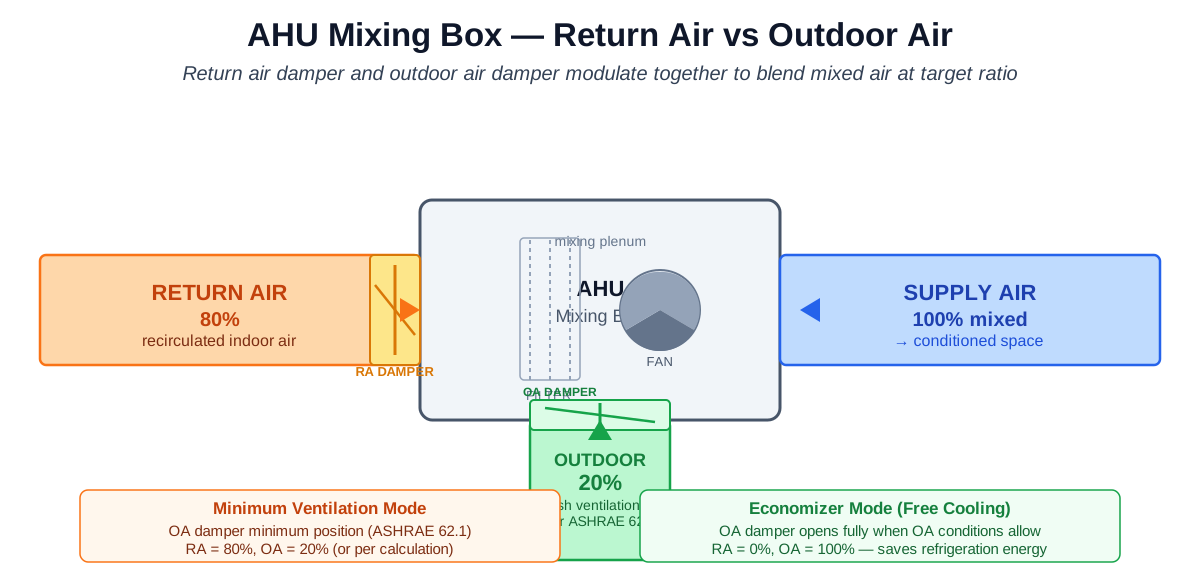
Higher return air ratios reduce conditioning energy because recirculated indoor air is already close to the desired supply temperature. Lower return air ratios improve ventilation effectiveness and dilute indoor contaminants but increase the energy required to condition incoming outdoor air.
Return air ratio is controlled by mixing box dampers — the outdoor air damper and return air damper — which are modulated by the AHU control system. In economizer mode, the outdoor air fraction increases to use free cooling when outdoor conditions are favorable. At minimum ventilation, the outdoor air damper holds the minimum position required by ASHRAE 62.1 for the occupancy type.
Energy and IAQ Implications
The balance between return air ratio and outdoor air fraction represents a trade-off in HVAC design:
- Higher return air ratio = lower conditioning energy but higher recirculation of indoor contaminants
- Lower return air ratio = better indoor air quality but higher conditioning energy for outdoor air tempering
ASHRAE Standard 62.1 sets minimum outdoor air requirements by occupancy type — results below the applicable minimum outdoor air fraction should be flagged. ASHRAE Standard 170 sets minimum outdoor air for healthcare occupancies — often 100% OA for certain spaces. Energy codes (ASHRAE 90.1) may require energy recovery on systems with high outdoor air fractions.
Practical Return Air Ratio Context by Space Type
| Space Type | Typical Return Air Ratio | Notes |
|---|---|---|
| Offices and retail | 75–90% return air | Standard commercial HVAC range |
| Hospitals (general) | 0–20% return air | 80–100% OA depending on room type |
| Kitchens | 0% return air | 100% OA required |
| Cleanrooms | 80–95% recirculation | Intensive filtration and conditioning |
| Laboratories | 0% return air | 100% OA often required |
HVAC Unit Conversions
| Unit | Equivalent |
|---|---|
| 1 CFM | 1.699 m³/h |
| 1 m³/h | 0.5886 CFM |
| 1 L/s | 2.119 CFM |
| 1 CFM | 0.4719 L/s |
Practical Tips
When estimating return air ratio, always verify the absolute outdoor air volume against ASHRAE 62.1 minimum rates for the specific occupancy type, population density, and floor area. A 20% outdoor air fraction may be adequate for a lightly occupied office but completely insufficient for a densely occupied conference room.
If outdoor air fraction exceeds 60%, evaluate energy recovery — the payback period for ERV/HRV equipment shortens significantly at higher outdoor air fractions. If return air ratio equals 0% (100% outdoor air), size the makeup air unit for the full outdoor air conditioning load.
Important: This calculator provides a screening estimate of return air ratio. Final ventilation design should always be verified using ASHRAE 62.1 calculations for the specific occupancy type and density, and confirmed through commissioning and TAB procedures.
Key Facts
- ASHRAE Standard 62.1 sets minimum outdoor air requirements for commercial occupancies — typically 5–10 CFM per person plus 0.06–0.12 CFM per square foot of floor area for offices.
- A typical commercial office AHU operates at 75–90% return air (10–25% outdoor air) at minimum ventilation position.
- Kitchens, laboratories, and healthcare isolation rooms often require 100% outdoor air — zero return air recirculation.
- ASHRAE Standard 170 sets minimum outdoor air for healthcare facilities — operating rooms typically require 100% outdoor air.
- ASHRAE Standard 90.1 and many energy codes require energy recovery on systems with outdoor air fractions above 70% above defined airflow thresholds.
- In economizer mode, outdoor air fraction can reach 100% when outdoor conditions are suitable for free cooling.
- Demand-controlled ventilation (DCV) modulates outdoor air fraction based on CO₂ sensors, increasing outdoor air when occupancy is high and reducing it when spaces are empty.
- Cleanrooms recirculate 80–95% of supply air but filter and condition it intensively — recirculation in cleanrooms is not the same as return air ratio in standard HVAC.
Applications
- AHU mixing box damper sizing and selection
- Outdoor air fraction verification against ASHRAE 62.1
- Economizer control strategy and damper range design
- Energy recovery feasibility assessment
- Demand-controlled ventilation (DCV) baseline OA calculation
- Healthcare facility ventilation compliance review
- Laboratory exhaust and makeup air balance verification
- Cleanroom recirculation system design
- Indoor air quality investigation and audit
- Commissioning and TAB (testing, adjusting, balancing) verification
Example Calculation
Imperial Example
Given:
- Total Supply Airflow = 8,000 CFM
- Return Air Volume = 6,400 CFM
- Outdoor Air Volume = derived
Step 1: Outdoor air volume
Q_outdoor = 8,000 − 6,400 = 1,600 CFM
Step 2: Return air ratio
RA_ratio = (6,400 / 8,000) × 100 = 80.0%
Step 3: Outdoor air fraction
OA_fraction = (1,600 / 8,000) × 100 = 20.0%
Step 4: Verification
6,400 + 1,600 = 8,000 ✓
Result: TYPICAL RETURN AIR RATIO 80% return air / 20% outdoor air is within the standard commercial HVAC range. Verify that 1,600 CFM outdoor air meets ASHRAE 62.1 minimum ventilation requirements for the occupancy type and floor area served.
Metric Example
Given:
- Total Supply Airflow = 13,600 m³/h
- Outdoor Air Fraction = 15% (entered directly)
Step 1: Outdoor air volume
Q_outdoor = 13,600 × 0.15 = 2,040 m³/h
Step 2: Return air volume
Q_return = 13,600 − 2,040 = 11,560 m³/h
Step 3: Return air ratio
RA_ratio = (11,560 / 13,600) × 100 = 85.0%
Step 4: Outdoor air fraction
OA_fraction = 15.0%
Step 5: Verification
11,560 + 2,040 = 13,600 ✓
Result: HIGH RETURN AIR RATIO 85% return air / 15% outdoor air is at the upper end of the typical commercial range. Verify that 2,040 m³/h outdoor air satisfies ASHRAE 62.1 minimum ventilation rates for the occupancy type, density, and floor area.
Standards & References
- ANSI/ASHRAE Standard 62.1 — Ventilation for Acceptable Indoor Air Quality
- ASHRAE Standard 90.1 — Energy Standard for Buildings — economizer and energy recovery requirements
- ASHRAE Standard 170 — Ventilation of Health Care Facilities — minimum outdoor air and recirculation requirements
- ASHRAE Fundamentals Handbook Chapter 1 — Air density and psychrometric properties for related airflow calculations
Limitations
- This calculator is a first-pass screening tool, not a full ventilation compliance analysis.
- It does not calculate ASHRAE 62.1 minimum outdoor air volume for specific occupancy types and densities — it only calculates the ratio from entered airflow values.
- Mixed air temperature from return and outdoor air blending is not calculated.
- Economizer control sequences and high-limit shutoff conditions are not modeled.
- Demand-controlled ventilation (DCV) CO₂ setpoint and reset are not included.
- Energy recovery unit sizing or effectiveness is not calculated.
- Duct leakage effects on actual outdoor air delivery are not accounted for.
- Multiple zone outdoor air correction (Ventilation Efficiency Procedure per ASHRAE 62.1) is not included.
Common Mistakes to Avoid
- Assuming that any return air ratio within a typical range automatically satisfies ASHRAE 62.1. The standard sets minimum outdoor air as an absolute volume — CFM per person plus CFM per square foot — not as a percentage of supply air.
- Applying standard commercial return air ratios to spaces that require 100% outdoor air by code. Kitchens, laboratories, healthcare isolation rooms, and procedure rooms often require zero return air recirculation regardless of energy cost.
- Confusing return air ratio with supply air efficiency. A high return air ratio means the system is recirculating conditioned air efficiently, but it says nothing about whether the supply air is being delivered effectively to the occupied zone.
- Forgetting that return air ratio changes continuously in systems with economizer control. The ratio calculated on this page reflects a single operating point — typically the minimum ventilation position. During economizer operation, outdoor air fraction may increase to 100%.
Frequently Asked Questions
How do you calculate return air ratio?
What is a typical return air ratio for a commercial building?
What is the difference between return air ratio and outdoor air fraction?
What does ASHRAE 62.1 say about outdoor air fraction?
When is 100% outdoor air required?
How does economizer mode affect return air ratio?
Why does high outdoor air fraction require energy recovery?
What is demand-controlled ventilation and how does it affect return air ratio?
Frequently Used Together
Engineers often use these calculators in combination for complete project workflows:
Related Calculators
Explore similar calculators that might be useful for your project:
Free HVAC Quick Reference. Formulas & Checks.
Airflow, loads, refrigerant & duct checks — one printable page for the job site.
- Key formulas for airflow, load, refrigerant charge & duct sizing
- Quick sanity checks for the most common HVAC design errors
- Printable one-pager for field use and design review
No spam. Unsubscribe any time.
Calculate
Total volume airflow rate of supply air from the AHU
Volume of recirculated return air entering the mixing box