Indoor Air Quality CO2 Calculator
On this page
Calculate
Total number of people in the space
Metabolic activity level of occupants — determines CO2 generation rate
Total room volume — multiply floor area by ceiling height
Fresh outdoor air component only — not total supply including return air
Outdoor ambient CO2 concentration — default 420 ppm as of 2024–2026
Desired maximum indoor CO2 — 1,100 ppm is the common ASHRAE proxy guideline threshold
Overview
An Indoor Air Quality CO2 Calculator estimates the steady-state carbon dioxide concentration a space will reach when occupants have been present long enough for CO2 generation and ventilation dilution to reach equilibrium. This steady-state mass balance model is the standard engineering approach for evaluating whether a ventilation system can maintain acceptable indoor air quality for a given occupancy scenario and activity level.
Indoor CO2 concentration is the most widely used practical indicator of ventilation adequacy in occupied buildings. When people breathe, they exhale carbon dioxide at a rate determined by their metabolic activity. In an enclosed space with insufficient outdoor air supply, CO2 accumulates — and its steady-state concentration directly reflects how well the ventilation system is diluting occupant-generated contaminants with fresh outdoor air.
CO2 is not a direct measure of all IAQ parameters. Volatile organic compounds, particulates, humidity, and biological contaminants each require separate evaluation. However, because CO2 correlates with the occupant-generated pollutant load that ventilation is designed to dilute, it serves as a practical, measurable proxy for overall ventilation performance. A space with CO2 well above 1,000 ppm is almost certainly under-ventilated for its occupancy; a space near outdoor levels is almost certainly well-ventilated.
This page implements the full steady-state mass balance equation across four activity levels — sedentary, light, moderate, and heavy — and covers both Imperial and Metric unit systems. It outputs steady-state CO2 in ppm, the required ventilation rate to meet a user-defined CO2 target, outdoor air per person, air changes per hour, and a clear IAQ status classification from Excellent to Unacceptable.
How to Use This Calculator
Enter number of occupants (n) — in persons.
Select activity level — select the metabolic activity level (Sedentary, Light, Moderate, or Heavy).
Enter room volume (vr) — in m³ or ft³.
Enter outdoor airflow supplied (q) — in L/s or CFM.
Enter outdoor co2 baseline (co2_out) — in ppm.
Enter target indoor co2 (co2_target) — in ppm.
Click "Calculate" — get steady-state co2 concentration (co2_ss), co2 above outdoor baseline (δco2), required ventilation rate (q_required).
Compare steady-state CO2 against your target (≤1,100 ppm typical, ≤800 ppm high-performance); enter outdoor air only and match activity level to actual use.
Inputs & Outputs
Inputs
Outputs
Formula
Calculator Formula
This page uses the steady-state mass balance CO2 model.
CO2 generation rate (G) by activity level:
| Activity Level | Imperial (CFM/person) | Metric (L/s per person) |
|---|---|---|
| Sedentary (office, classroom) | 0.0052 | 0.00245 |
| Light (retail, light assembly) | 0.0069 | 0.00326 |
| Moderate (gymnasium, exercise) | 0.0138 | 0.00652 |
| Heavy (sports, vigorous exercise) | 0.0208 | 0.00982 |
Step 1 — Steady-state CO2 concentration
Imperial:
CO2_ss = CO2_out + (N × G × 1,000,000) / Q
Metric:
G_mh = G × 3.6    (convert L/s to m³/h)
Q_mh = Q × 3.6    (convert L/s to m³/h)
CO2_ss = CO2_out + (N × G_mh × 1,000,000) / Q_mh
Note: The 10⁶ factor converts the volumetric ratio of CO2 generation to outdoor airflow into parts per million.
Step 2 — CO2 above outdoor baseline
ΔCO2 = CO2_ss − CO2_out
Step 3 — Required ventilation to meet target CO2
Imperial:
Q_required = (N × G × 1,000,000) / (CO2_target − CO2_out)
Units: CFM
Metric:
Q_required_mh = (N × G_mh × 1,000,000) / (CO2_target − CO2_out)
Q_required = Q_required_mh / 3.6
Units: L/s
Step 4 — Outdoor air per person
OA_person = Q / N
Imperial: cfm/person | Metric: L/s per person
Step 5 — Air changes per hour
Imperial:
ACH = (Q × 60) / Vr
Where: Q in CFM, Vr in ft³
Metric:
ACH = (Q × 3.6) / Vr
Where: Q in L/s, Vr in m³
Step 6 — Ventilation adequacy
Adequacy (%) = (Q / Q_required) × 100
Variable Reference
| Variable | Meaning | Units |
|---|---|---|
| N | Number of occupants | persons |
| G | CO2 generation rate per person | CFM/person or L/s per person |
| Q | Outdoor airflow supplied | CFM or L/s |
| Vr | Room volume | ft³ or m³ |
| CO2_out | Outdoor CO2 baseline | ppm |
| CO2_target | Target indoor CO2 | ppm |
| CO2_ss | Steady-state CO2 concentration | ppm |
| ΔCO2 | CO2 above outdoor baseline | ppm |
| Q_required | Required ventilation rate | CFM or L/s |
| ACH | Air changes per hour | h⁻¹ |
What is Indoor Air Quality CO2 Concentration
Indoor air quality CO2 concentration is the steady-state level of carbon dioxide that accumulates in an occupied space when occupant generation and ventilation dilution reach equilibrium. CO2 is exhaled by occupants at a rate proportional to their metabolic activity — sedentary office workers generate approximately 0.0052 CFM (0.00245 L/s) of CO2 per person, while people engaged in vigorous exercise generate four times that amount.
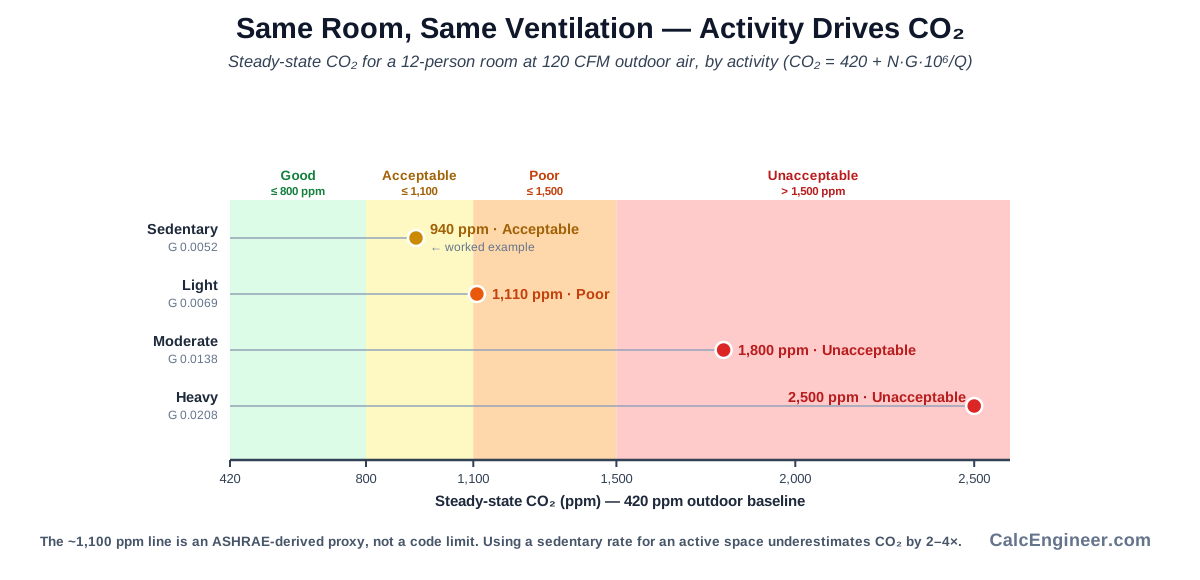
In a well-ventilated space, outdoor air continuously dilutes this CO2 to near-outdoor levels. In an under-ventilated space, CO2 accumulates toward a steady-state concentration determined by the balance between generation and dilution.
The steady-state mass balance model — also called the well-mixed room model in engineering literature — is the mathematical framework that predicts this equilibrium concentration. It assumes a perfectly mixed room, constant occupancy, and steady outdoor airflow — conditions that approximate real-world operation in most mechanically ventilated commercial buildings.
CO2 monitoring has gained significantly increased attention since 2020, when public health guidance for airborne pathogen control converged on ventilation rate as a primary mitigation measure. CO2 sensors are now widely deployed in schools, offices, and public buildings as a real-time indicator of whether ventilation is keeping pace with occupancy.
Engineering Applications
The steady-state CO2 model is the standard tool for ventilation adequacy assessment across commercial, educational, and institutional buildings. Mechanical engineers use it for design verification — confirming that the outdoor air delivery meets IAQ requirements for the intended occupancy and activity level. Facilities managers use it for operational audits — comparing measured or estimated outdoor airflow against the rate needed to maintain acceptable CO2 levels.
CO2 sensor threshold calibration is a direct application: the model calculates what CO2 concentration corresponds to a given ventilation rate, allowing building automation systems to set alarm thresholds that trigger increased outdoor airflow before occupant comfort is compromised.
Demand-controlled ventilation (DCV) system design relies on this model to establish baseline outdoor airflow rates and CO2 setpoints. When CO2 is below the target, outdoor airflow can be reduced to save conditioning energy. When CO2 approaches the target, outdoor airflow increases to maintain acceptable IAQ.
Recommended Ranges
CO2 Context by Space Type at ASHRAE 62.1 Minimum Ventilation Rates
| Space Type | Typical CO2 Range (ppm) |
|---|---|
| Private office, 1–2 occupants | 600–750 |
| Open office, moderate density | 750–950 |
| Classroom, 30 students | 900–1,100 |
| Conference room, 10–15 persons | 1,000–1,400 |
| Gymnasium, light activity | 600–1,200 |
| Retail, variable occupancy | 600–900 |
Conference rooms are the highest-risk space type for CO2 accumulation due to high density relative to volume and intermittent occupancy.
HVAC Unit Conversions
| Unit | Equivalent |
|---|---|
| 1 CFM | 0.4719 L/s |
| 1 L/s | 2.119 CFM |
| 1 ft³ | 0.02832 m³ |
| 1 m³ | 35.315 ft³ |
| ppm | Dimensionless — identical in both unit systems |
Practical Tips
Always enter outdoor airflow only — not total supply airflow. The most common error is entering total supply air volume (which includes recirculated return air) instead of the outdoor air component alone. This produces a false-compliant result that dramatically underestimates actual CO2 concentration.
Match activity level to the actual use of the space — not the architectural classification. A gymnasium used for exercise classes requires the moderate or heavy activity G value, not the sedentary value.
Use 420 ppm as the outdoor CO2 baseline for current conditions (2024–2026). The historical 400 ppm value increasingly underestimates indoor CO2.
This is a steady-state model — it represents equilibrium CO2 after the space has been occupied long enough for concentration to stabilize (typically 1–3 hours depending on room volume and airflow). Transient CO2 during the first hour of occupancy may differ from the steady-state prediction.
CO2 is an indicator of ventilation adequacy, not a direct measure of all IAQ parameters. VOCs, particulates, humidity, and other pollutants require separate evaluation.
Key Facts
- The ASHRAE 62.1 ventilation rates for typical sedentary occupancy correspond to a steady-state CO2 of approximately 1,000–1,100 ppm at a 420 ppm outdoor baseline. This is the origin of the widely cited 1,000 ppm guideline — it is a proxy derived from ventilation rate calculations, not a code limit set by ASHRAE.
- ASHRAE Standard 62.1 does NOT set a CO2 concentration limit. It sets outdoor airflow rates. CO2 is a useful proxy, but ventilation compliance is determined by airflow measurement, not CO2 alone.
- NIOSH sets an occupational CO2 REL of 5,000 ppm as an 8-hour TWA and 30,000 ppm STEL. These are occupational safety thresholds — not IAQ comfort limits. Discomfort and reduced cognitive performance occur at far lower concentrations.
- Research published in Environmental Health Perspectives (Allen et al., 2016) found measurable reductions in cognitive test scores at 1,000 ppm compared to 550 ppm, with further reductions at 2,500 ppm.
- Outdoor CO2 has risen from the historical 400 ppm baseline to approximately 420–425 ppm as of 2024–2026 and continues to increase.
- Conference rooms are the highest-risk space type for CO2 accumulation — high occupant density relative to volume, combined with intermittent occupancy that delays system response, routinely produces CO2 above 1,500 ppm when fully occupied.
- Activity level has a factor-of-4 impact on CO2 generation rate. Using a sedentary G value for a gymnasium or fitness class will underestimate CO2 generation by 2–4 times.
- Demand-controlled ventilation (DCV) uses CO2 sensors to modulate outdoor airflow in real time. ASHRAE 62.1 permits DCV for most occupancy types; ASHRAE 90.1 requires it in certain climate zones and occupancy categories.
Applications
- Mechanical engineer design verification of outdoor air adequacy.
- Conference room ventilation sizing and CO2 threshold assessment.
- Classroom and school IAQ screening and HVAC upgrade planning.
- Facilities management audit of delivered outdoor air vs design intent.
- CO2 sensor alert threshold calibration for building automation systems.
- Demand-controlled ventilation (DCV) baseline sizing and target setting.
- Post-pandemic school and office ventilation improvement programs.
- IAQ consultant gap analysis and corrective action recommendation.
- Portable air cleaner supplemental ventilation equivalence estimation.
- Public health official screening of building ventilation adequacy.
Example Calculation
Imperial Example
Given:
- Occupants = 12 (conference room)
- Activity Level = Sedentary
- Room Volume = 3,600 ft³ (30 × 20 × 6 ft)
- Outdoor Airflow = 120 CFM
- Outdoor CO2 = 420 ppm
- Target CO2 = 1,100 ppm
- G (sedentary) = 0.0052 CFM/person
Step 1 — Steady-state CO2:
CO2_ss = 420 + (12 × 0.0052 × 1,000,000) / 120
       = 420 + 62,400 / 120
       = 420 + 520
       = 940 ppm
Step 2 — ΔCO2:
ΔCO2 = 940 − 420 = 520 ppm above outdoor
Step 3 — Required ventilation:
Q_required = (12 × 0.0052 × 1,000,000) / (1,100 − 420)
           = 62,400 / 680
           = 91.8 CFM
Step 4 — Per-person rate:
120 / 12 = 10.0 cfm/person
Step 5 — ACH:
ACH = (120 × 60) / 3,600 = 2.00 ACH
Step 6 — Adequacy:
(120 / 91.8) × 100 = 130.7%
Result: ACCEPTABLE IAQ — CO2 at 940 ppm. System meets the 1,100 ppm target with 30.7% margin above required ventilation rate.
Metric Example
Given:
- Occupants = 12
- Activity Level = Sedentary
- Room Volume = 100 m³
- Outdoor Airflow = 56 L/s
- Outdoor CO2 = 420 ppm
- Target CO2 = 1,100 ppm
- G (sedentary) = 0.00245 L/s per person
Step 1 — Convert to m³/h:
G_mh = 0.00245 × 3.6 = 0.00882 m³/h per person
Q_mh = 56 × 3.6 = 201.6 m³/h
Step 2 — Steady-state CO2:
CO2_ss = 420 + (12 × 0.00882 × 1,000,000) / 201.6
       = 420 + 105,840 / 201.6
       = 420 + 525
       = 945 ppm
Step 3 — ΔCO2:
ΔCO2 = 945 − 420 = 525 ppm above outdoor
Step 4 — Required ventilation:
Q_required_mh = (12 × 0.00882 × 1,000,000) / (1,100 − 420)
              = 105,840 / 680
              = 155.6 m³/h
Q_required = 155.6 / 3.6 = 43.2 L/s
Step 5 — Per-person rate:
56 / 12 = 4.7 L/s per person
Step 6 — ACH:
ACH = (56 × 3.6) / 100 = 201.6 / 100 = 2.02 ACH
Step 7 — Adequacy:
(56 / 43.2) × 100 = 129.6%
Result: ACCEPTABLE IAQ — CO2 at 945 ppm. Ventilation 29.6% above minimum required to meet 1,100 ppm target.
Standards & References
- ANSI/ASHRAE Standard 62.1-2022 — Ventilation and Acceptable Indoor Air Quality in Buildings. Sets minimum outdoor airflow rates by occupancy type. Does not set a CO2 concentration limit — the 1,000–1,100 ppm proxy is derived from its ventilation rates for typical sedentary occupancy at a 420 ppm outdoor baseline.
- ASHRAE Standard 90.1-2022 — Energy Standard for Sites and Buildings. Requires demand-controlled ventilation in certain occupancy types and climate zones, using CO2 sensing as the standard control input.
- NIOSH REL for CO2 — 5,000 ppm TWA and 30,000 ppm STEL. Occupational safety thresholds only — not IAQ comfort limits.
- Allen et al. (2016), Environmental Health Perspectives — Documents measurable cognitive performance reduction at 1,000 ppm vs 550 ppm CO2.
- CDC Ventilation Guidance (2021) — References CO2 monitoring as a practical ventilation proxy for airborne pathogen mitigation.
- EPA Indoor Air Quality Tools for Schools — References CO2 monitoring as part of a practical IAQ management program for K-12 facilities.
Limitations
- This calculator uses the steady-state well-mixed room model. It predicts the equilibrium CO2 concentration reached after sufficient time — typically 1–3 hours depending on room volume and airflow. It does not model the transient CO2 rise from the moment occupants enter an unoccupied space.
- The well-mixed room assumption treats CO2 as uniformly distributed throughout the volume. In real spaces, CO2 concentration varies with supply diffuser placement, return location, and air movement patterns.
- CO2 generation rates are metabolic averages by activity level. Individual variation is significant — age, body mass, and fitness level all affect CO2 output.
- The calculator does not account for multi-zone systems where outdoor air is distributed unequally across rooms.
- CO2 indicates ventilation adequacy for occupant-generated pollutants only. It does not indicate the presence or concentration of VOCs, formaldehyde, particulate matter, radon, mold, or other IAQ concerns.
- In leaky buildings, uncontrolled air infiltration may supplement mechanical outdoor air delivery. This calculator assumes all outdoor air enters through the mechanical system.
Common Mistakes to Avoid
- Entering total supply airflow instead of outdoor airflow. The steady-state CO2 equation uses outdoor airflow only — the fresh air component. Entering total supply air including recirculated return air dramatically underestimates CO2 concentration and produces a false-compliant result.
- Using the wrong activity level. A sedentary G value applied to a gymnasium or fitness class underestimates CO2 generation by a factor of 2–4, making IAQ appear far better than actual conditions.
- Using 400 ppm as the outdoor CO2 baseline. Outdoor CO2 has risen to approximately 420–425 ppm as of 2024–2026. Using 400 ppm underestimates indoor CO2 by 20–25 ppm.
- Treating steady-state results as peak CO2 during occupancy transients. If a room starts unoccupied and fills with people, CO2 will rise toward the steady-state value over time — not immediately.
- Treating the 1,000–1,100 ppm threshold as a code requirement. ASHRAE 62.1 does not set a CO2 limit. The 1,000–1,100 ppm figure is a proxy derived from ventilation rate calculations — useful for design guidance but not a regulatory pass/fail criterion.
Frequently Asked Questions
What CO2 level is acceptable indoors?
Does ASHRAE 62.1 set a CO2 concentration limit?
Why does my conference room show poor IAQ even with adequate overall ventilation?
What is the difference between steady-state CO2 and peak CO2?
How does activity level affect CO2 concentration?
Can I use CO2 readings from a sensor instead of calculating?
What is demand-controlled ventilation and when is it required?
Is this calculator valid for residential buildings?
Frequently Used Together
Engineers often use these calculators in combination for complete project workflows:
Related Calculators
Explore similar calculators that might be useful for your project:
Free HVAC Quick Reference. Formulas & Checks.
Airflow, loads, refrigerant & duct checks — one printable page for the job site.
- Key formulas for airflow, load, refrigerant charge & duct sizing
- Quick sanity checks for the most common HVAC design errors
- Printable one-pager for field use and design review
No spam. Unsubscribe any time.
Calculate
Total number of people in the space
Metabolic activity level of occupants — determines CO2 generation rate
Total room volume — multiply floor area by ceiling height
Fresh outdoor air component only — not total supply including return air
Outdoor ambient CO2 concentration — default 420 ppm as of 2024–2026
Desired maximum indoor CO2 — 1,100 ppm is the common ASHRAE proxy guideline threshold