School Classroom Ventilation Calculator
On this page
Calculate
Total people in the room including students and teacher
Net classroom floor area
Room ceiling height — defaults to 9 ft (2.74 m) if left blank
Outdoor air volume delivered to this room — not total supply including return air
Zone air distribution effectiveness per ASHRAE 62.1 Table 6-2
Overview
Classroom ventilation is one of the most consequential HVAC design decisions in any school building. Inadequate outdoor air supply directly impairs student concentration, increases absenteeism from airborne illness, and places the facility out of compliance with ASHRAE Standard 62.1 — the ventilation code referenced by most building codes across the United States and internationally.
The ASHRAE 62.1 Ventilation Rate Procedure calculates the minimum required outdoor airflow for a breathing zone using two components: a people-dependent rate and an area-dependent rate. For classrooms, both components are significant — the high occupant density of a typical classroom drives a large people component, while the room area adds a baseline that accounts for building material off-gassing and general dilution needs independent of occupancy.
This calculator implements the full ASHRAE 62.1 breathing zone calculation, applies zone air distribution effectiveness (Ez) to derive the actual required supply outdoor airflow, and compares it against the airflow you provide to assess ventilation adequacy. Results are expressed as a percentage of the ASHRAE 62.1 minimum, per-person ventilation rate, and air changes per hour — three metrics that engineers, facilities managers, and school administrators each rely on in practice.
Post-pandemic awareness has elevated classroom ventilation to a public health priority beyond code compliance. CDC and ASHRAE Epidemic Task Force guidance recommends 4–6 equivalent ACH for schools. This calculator surfaces ACH alongside compliance status so designers can evaluate both the regulatory floor and the higher performance targets now expected in modern school construction.
How to Use This Calculator
Enter number of occupants (pz) — in persons.
Enter floor area (az) — in m² or ft².
Enter ceiling height — in m or ft.
Enter supplied outdoor airflow — in L/s or CFM.
Select air distribution effectiveness (ez) — choose from 1.0 — Ceiling supply, ceiling/high-sidewall return, 0.8 — Ceiling supply, floor return, 1.0 — Floor supply, floor return.
Click "Calculate" — get Vbz, Voz, ventilation adequacy (%), per-person rate, and ACH.
Use Voz as the outdoor-air design quantity; enter outdoor air only (not total supply), include the teacher in the count, and target 4–6 ACH per CDC/ASHRAE guidance.
Inputs & Outputs
Inputs
Outputs
Formula
Calculator Formula
Step 1 — Breathing zone outdoor airflow
Vbz = (Rp × Pz) + (Ra × Az)
Imperial values:
- Rp = 10 cfm/person
- Ra = 0.12 cfm/ft²
Metric values:
- Rp = 5 L/s per person
- Ra = 0.6 L/s per m²
Step 2 — Zone outdoor airflow after distribution effectiveness
Voz = Vbz / Ez
- Ez = 1.0 for ceiling supply, ceiling or high-sidewall return (most classrooms)
- Ez = 0.8 for ceiling supply, floor return in heating mode
- Ez = 1.0 for floor supply, floor return
Step 3 — Air changes per hour
Imperial:
ACH = (Supplied Airflow CFM × 60) / (Az ft² × Ceiling Height ft)
Metric:
ACH = Supplied Airflow m³/h / (Az m² × Ceiling Height m)
Step 4 — Ventilation adequacy
Adequacy (%) = (Supplied Outdoor Airflow / Voz) × 100
Step 5 — Per-person ventilation rate
Imperial:
Rate = Supplied Outdoor Airflow CFM / Pz
Metric:
Rate = Supplied Outdoor Airflow L/s / Pz
Variable Reference
| Variable | Meaning | Units |
|---|---|---|
| Rp | People outdoor air rate | cfm/person or L/s per person |
| Ra | Area outdoor air rate | cfm/ft² or L/s per m² |
| Pz | Number of occupants | persons |
| Az | Room floor area | ft² or m² |
| Ez | Zone air distribution effectiveness | dimensionless |
| Vbz | Breathing zone outdoor airflow | CFM or L/s |
| Voz | Zone outdoor airflow required | CFM or L/s |
| ACH | Air changes per hour | h⁻¹ |
What is School Classroom Ventilation
School classroom ventilation refers to the controlled introduction of outdoor air into an occupied classroom to dilute CO₂, bioeffluents, volatile organic compounds (VOCs), and airborne pathogens generated by occupants and building materials. Unlike residential spaces, classrooms present a demanding ventilation challenge: a high density of occupants — typically 25–35 students plus a teacher in 600–1,000 ft² — in a space occupied for six or more continuous hours per day.
Mechanical ventilation for classrooms is governed by ASHRAE Standard 62.1, which mandates a minimum outdoor airflow based on both the number of people and the floor area of the breathing zone. The people-dependent component accounts for metabolic CO₂ and bioeffluent generation; the area-dependent component accounts for pollutants emitted by building materials, flooring, and furnishings regardless of how many people are present.
Proper classroom ventilation has measurable effects on educational outcomes. Studies cited in ASHRAE literature and the EPA's Indoor Air Quality Tools for Schools program link higher ventilation rates to improved student test scores, reduced illness-related absences, and lower teacher sick days. Ventilation in classrooms is therefore not merely a code compliance exercise — it is a direct investment in learning outcomes and occupant health.
Recommended Ranges
By Occupancy Scenario (Imperial)
| Scenario | Occupants | Area | Vbz |
|---|---|---|---|
| Typical classroom | 31 (30+1) | 900 ft² | 418 CFM |
| Small classroom | 21 (20+1) | 650 ft² | 288 CFM |
| Large classroom | 36 (35+1) | 1,100 ft² | 492 CFM |
ACH Context for Schools
| Target | ACH Range |
|---|---|
| ASHRAE 62.1 compliance | 3–5 ACH |
| CDC / post-pandemic | ≥ 4–6 ACH |
| High-performance design | 6–10 ACH |
Per-Person Benchmark
ASHRAE 62.1 minimum ≈ 10 cfm/person (5 L/s per person) for the people component only. Total rate including area component typically 13–15 cfm/person for standard classroom density.
HVAC Unit Conversions
| Unit | Equivalent |
|---|---|
| 1 CFM | 0.4719 L/s |
| 1 L/s | 2.119 CFM |
| 1 ft² | 0.0929 m² |
| 1 ft | 0.3048 m |
| 1 L/s | 3.6 m³/h |
Practical Tips
Always enter outdoor airflow only — not total supply airflow. The most common error in classroom ventilation assessment is entering the total supply air volume (which includes recirculated return air) instead of the outdoor air component alone. This produces a false-compliant result.
Include the teacher in the occupant count. ASHRAE 62.1 requires all people in the breathing zone. A classroom of 30 students has 31 occupants.
If ACH is below 4, consider supplemental HEPA filtration. CDC and ASHRAE Epidemic Task Force guidance recommends 4–6 equivalent ACH for schools. Portable HEPA units can supplement mechanical ventilation to achieve higher equivalent ACH without increasing outdoor air volume.
Verify Ez matches the actual diffuser and return configuration. Most classrooms use ceiling supply with ceiling return (Ez = 1.0), but perimeter systems with floor returns in heating mode require Ez = 0.8, increasing the required outdoor air by 25%.
Key Facts
- ASHRAE 62.1 sets the minimum outdoor air rate for classrooms at 10 cfm/person (5 L/s per person) for the people component, plus 0.12 cfm/ft² (0.6 L/s per m²) for the area component.
- A typical classroom of 30 students plus one teacher in 900 ft² requires approximately 418 CFM (197 L/s) of outdoor airflow under ASHRAE 62.1 — roughly 13.5 cfm/person when the area component is included.
- ASHRAE 62.1 compliance alone typically yields 3–5 ACH in a standard classroom. CDC and ASHRAE Epidemic Task Force guidance recommends targeting 4–6 equivalent ACH for improved pathogen dilution.
- Zone air distribution effectiveness (Ez) reduces the credit given to supplied outdoor air if the distribution system is not optimal. A ceiling supply with floor return in heating mode carries Ez = 0.8, meaning the system must supply 25% more outdoor air than Vbz.
- Demand-controlled ventilation (DCV) is permitted by ASHRAE 62.1 and ASHRAE 90.1 for classrooms where occupancy varies — it reduces outdoor air during unoccupied or partially occupied periods, cutting conditioning energy while maintaining code compliance.
- Energy recovery ventilation (ERV or HRV) is required by ASHRAE 90.1 in many climate zones when outdoor air fraction exceeds certain thresholds, and is strongly recommended for classrooms with enhanced ventilation targets.
Applications
- New construction mechanical design to verify that the HVAC system delivers sufficient outdoor airflow to all classrooms before the building permit is submitted.
- Existing building assessments where facilities managers need to determine whether current air handling unit settings meet ASHRAE 62.1 for actual occupancy counts.
- School district sustainability and operations teams benchmarking ventilation quality across multiple buildings and prioritizing capital improvement spending.
- Mechanical engineers using Voz as the outdoor air design quantity for AHU sizing, damper selection, and duct design.
- Commissioning agents and building envelope consultants comparing measured outdoor airflow rates from balancing reports against the code-required Voz.
Example Calculation
Imperial Example
Given:
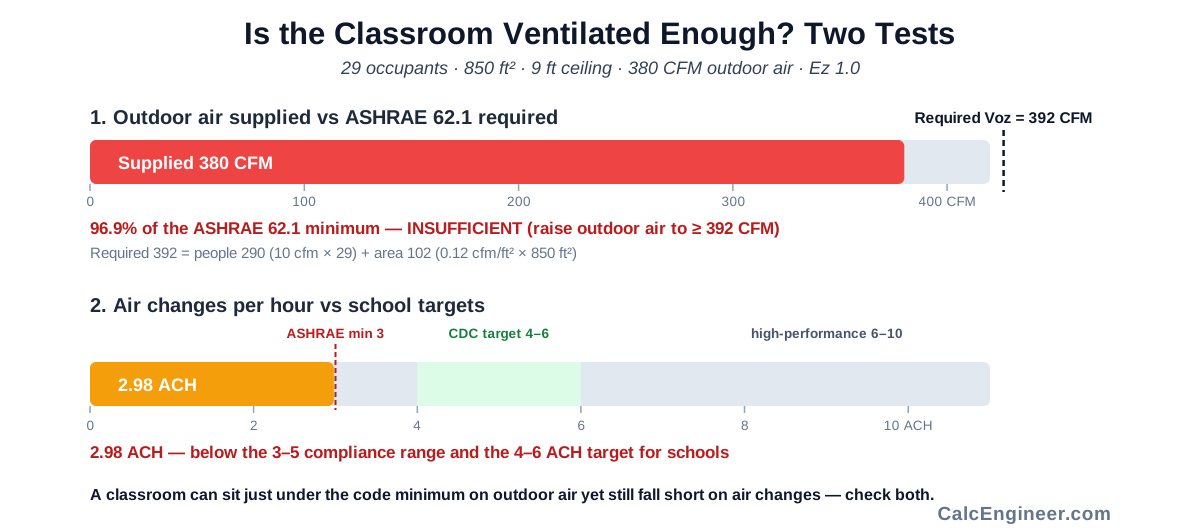
- Classroom: 28 students + 1 teacher = 29 occupants
- Floor area: 850 ft²
- Ceiling height: 9 ft
- Supplied outdoor airflow: 380 CFM
- Ez: 1.0 (ceiling supply, ceiling return)
Step 1 — Vbz:
Vbz = (10 × 29) + (0.12 × 850)
Vbz = 290 + 102 = 392 CFM
Step 2 — Voz:
Voz = 392 / 1.0 = 392 CFM
Step 3 — ACH:
Room volume = 850 × 9 = 7,650 ft³
ACH = (380 × 60) / 7,650 = 22,800 / 7,650 = 2.98 ACH
Step 4 — Adequacy:
Adequacy = (380 / 392) × 100 = 96.9%
Step 5 — Per-person rate:
380 / 29 = 13.1 cfm/person
Result: INSUFFICIENT VENTILATION — supplied airflow is 3.1% below ASHRAE 62.1 minimum. Increase outdoor air intake to at least 392 CFM.
Metric Example
Given:
- Classroom: 28 students + 1 teacher = 29 occupants
- Floor area: 79 m²
- Ceiling height: 2.74 m
- Supplied outdoor airflow: 185 L/s
- Ez: 1.0
Step 1 — Vbz:
Vbz = (5 × 29) + (0.6 × 79)
Vbz = 145 + 47.4 = 192.4 L/s
Step 2 — Voz:
Voz = 192.4 / 1.0 = 192.4 L/s
Step 3 — ACH:
Room volume = 79 × 2.74 = 216.5 m³
Supplied airflow in m³/h = 185 × 3.6 = 666 m³/h
ACH = 666 / 216.5 = 3.08 ACH
Step 4 — Adequacy:
Adequacy = (185 / 192.4) × 100 = 96.2%
Step 5 — Per-person rate:
185 / 29 = 6.4 L/s per person
Result: INSUFFICIENT VENTILATION — 3.8% below ASHRAE 62.1 minimum. Increase outdoor airflow to at least 192.4 L/s.
Standards & References
- ASHRAE Standard 62.1-2022 — Ventilation and Acceptable Indoor Air Quality (Table 6-1 Educational Facilities). Primary reference for Vbz and Voz calculations; Rp and Ra values for classrooms are in Table 6-1.
- ASHRAE Standard 90.1-2022 — Energy Standard for Sites and Buildings Except Low-Rise Residential Buildings. Sets requirements for energy recovery ventilation when outdoor air fractions exceed defined thresholds.
- ASHRAE Epidemic Task Force — Building Readiness guidance documents (2020–2022). Recommends 4–6 equivalent ACH for schools as a practical target for improved pathogen dilution.
- EPA Tools for Schools — Indoor Air Quality guidance for K-12 facilities, published by the US Environmental Protection Agency.
- CDC Ventilation in Buildings guidance (2021) — Recommends increasing total airflow and outdoor air fraction in schools as a respiratory illness mitigation measure.
- ASHRAE Handbook — HVAC Applications — Chapter on Educational Facilities. Provides design guidance, typical airflow ranges, and system selection criteria for school HVAC.
Limitations
- This calculator implements the ASHRAE 62.1 Ventilation Rate Procedure only. The ASHRAE 62.1 IAQ Procedure — an alternative compliance path based on contaminant concentration modeling — is not included.
- Ez values cover the most common school configurations. Unusual supply/return geometries, displacement ventilation systems, or underfloor air distribution require Ez values from ASHRAE 62.1 Table 6-2 that may differ from the defaults offered.
- The calculator does not account for system-level ventilation efficiency (Ev) used in multi-zone recirculating systems under the ASHRAE 62.1 multiple-zone calculation procedure.
- Natural ventilation and mixed-mode ventilation systems are outside the scope of this calculator. ASHRAE 62.1 Chapter 6 provides a natural ventilation compliance path that relies on operable window area and wind-driven pressure differentials.
- The calculator assumes a single, uniform occupant density across the room. Spaces with significant occupancy variation may require DCV analysis or a time-averaged occupancy approach outside the scope of this tool.
Common Mistakes to Avoid
- Using student count only without including the teacher. ASHRAE 62.1 requires total occupants in the breathing zone. A classroom of 30 students has 31 occupants when the teacher is present.
- Entering total supply airflow instead of outdoor air supply. Vbz is a requirement for outdoor air only — not total supply including recirculated return air. Entering total supply airflow will produce a false-compliant result that severely overestimates actual outdoor air delivery.
- Ignoring Ez when the system has floor return or sill-level return in heating mode. Defaulting to Ez = 1.0 in these configurations understates the required supply outdoor airflow by 25%, producing a Voz that is too low to achieve code-compliant breathing zone conditions.
- Using nominal room dimensions rather than measured net floor area. Columns, storage alcoves, and teacher's desk areas reduce net floor area and therefore reduce the area component of Vbz — but the occupant count remains the same.
- Confusing Vbz with Voz. Vbz is the breathing zone requirement before Ez correction. Voz is what the system must actually supply. In most ceiling-supply classrooms Ez = 1.0 and they are equal, but this is not always the case.
- Applying this calculator to a multi-zone AHU without performing the system-level multiple-zone calculation. Each zone Voz is correct for its room, but the AHU outdoor air damper must be sized using the ASHRAE 62.1 Ev procedure.
Frequently Asked Questions
What outdoor air rate does ASHRAE 62.1 require for classrooms?
What is the difference between Vbz and Voz?
How many air changes per hour should a classroom have?
Can a classroom use natural ventilation instead of mechanical ventilation?
What is demand-controlled ventilation and does it apply to classrooms?
Why does Ez matter and what value should I use for a typical classroom?
What if my classroom ventilation result shows INSUFFICIENT — what should I do?
Is this calculator valid outside the United States?
Frequently Used Together
Engineers often use these calculators in combination for complete project workflows:
Related Calculators
Explore similar calculators that might be useful for your project:
Free HVAC Quick Reference. Formulas & Checks.
Airflow, loads, refrigerant & duct checks — one printable page for the job site.
- Key formulas for airflow, load, refrigerant charge & duct sizing
- Quick sanity checks for the most common HVAC design errors
- Printable one-pager for field use and design review
No spam. Unsubscribe any time.
Calculate
Total people in the room including students and teacher
Net classroom floor area
Room ceiling height — defaults to 9 ft (2.74 m) if left blank
Outdoor air volume delivered to this room — not total supply including return air
Zone air distribution effectiveness per ASHRAE 62.1 Table 6-2