Wine Cellar Cooling Load Calculator
On this page
Calculate
Interior length of the wine cellar
Interior width of the wine cellar
Interior ceiling height of the wine cellar
Target storage temperature inside the wine cellar
Design temperature of surrounding spaces or outdoor ambient
Overall heat transfer coefficient of the insulated enclosure (all surfaces averaged)
Infiltration rate from door openings and air leakage
Total installed lighting wattage inside the cellar
Sensible heat from occupants (approx. 70–90 W per person for sedentary activity)
Heat from small equipment or accessories inside the cellar
Overview
The Wine Cellar Cooling Load Calculator estimates the cooling capacity required to maintain stable wine storage conditions inside a cellar or wine room. Instead of using a vague sizing guess, this calculator uses a fixed HVAC load model based on transmission heat gain through the enclosure, air infiltration, and internal sensible heat gains.
Wine cellars should not be treated like standard comfort-cooled rooms. A cellar must maintain relatively stable storage temperature while limiting temperature swings, infiltration, and unnecessary internal heat gain. In practice, load often rises quickly when the cellar is surrounded by warm spaces, includes glass, has weak insulation, or experiences frequent door opening. ASHRAE Fundamentals provides the underlying framework for enclosure heat transfer, infiltration, and cooling-load calculation, while refrigeration references are the right context for specialty low-temperature conditioned spaces.
This calculator is a preliminary sensible cooling load tool. It is designed to help users estimate cooling requirement before final equipment selection, not to replace manufacturer performance verification or a full refrigeration design review.
How to Use This Calculator
Enter the wine cellar dimensions — length, width, and height in ft or m.
Enter the target indoor cellar temperature — in °F or °C.
Enter the design ambient or adjacent-space temperature — in °F or °C.
Enter the U-value — overall heat transfer coefficient of the enclosure in BTU/h·ft²·°F or W/m²·K.
Enter air changes per hour (ACH) — infiltration rate from door openings and leakage.
Enter internal gains — lighting, people, and equipment loads in W.
Select Imperial or Metric units using the toggle at the top.
Click Calculate and review the total cooling load in W, BTU/hr, kW, and tons.
For best results, use realistic peak design conditions — not average daily conditions.
Inputs & Outputs
Inputs
Outputs
Formula
Fixed Component-Sum Wine Cellar Cooling Load Model
This calculator uses one exact path:
Transmission + Infiltration + Internal Gains → Total Cooling Load
Step 1 — Room Geometry
Volume = Length × Width × Height
Wall Area = 2 × (Length + Width) × Height
Ceiling Area = Length × Width
Floor Area = Length × Width
Envelope Area = Wall Area + Ceiling Area + Floor Area
Step 2 — Transmission Heat Gain
Q_trans = U × A × ΔT
| Variable | Meaning | Metric | Imperial |
|---|---|---|---|
| Q_trans | Transmission load | W | BTU/hr |
| U | U-value | W/m²·K | BTU/h·ft²·°F |
| A | Envelope area | m² | ft² |
| ΔT | Ambient − Cellar temperature | K | °F |
Step 3 — Infiltration Heat Gain
Metric:
Airflow (m³/s) = ACH × Volume / 3600
Q_inf = 1200 × Airflow × ΔT
Imperial equivalent:
CFM = ACH × Volume / 60
Q_inf = 1.08 × CFM × ΔT
The constant 1200 W/(m³/s·K) is the volumetric sensible heat capacity of air (ρ × cp ≈ 1.2 kg/m³ × 1005 J/kg·K = 1,206 J/m³·K, rounded to 1,200 for screening use). The imperial constant 1.08 BTU/(hr·CFM·°F) corresponds to approximately 1,207 W/(m³/s·K) in SI units, so the two calculation constants differ by about 0.6%.
Step 4 — Internal Sensible Gains
Q_internal = Q_lighting + Q_people + Q_equipment
Step 5 — Total Cooling Load
Total Cooling Load = Q_trans + Q_inf + Q_internal
Total Cooling Load (kW) = Total / 1000
Total Cooling Load (tons) = Total / 3516
| Unit Conversion | Value |
|---|---|
| 1 ton of cooling | 12,000 BTU/hr = 3,516 W |
| 1 kW | 3,412 BTU/hr |
| 1 W | 3.412 BTU/hr |
What is Wine Cellar Cooling Load
Wine cellar cooling load is the amount of heat that must be removed from a wine cellar to maintain stable storage conditions. In practical HVAC terms, that load comes from three main sources: heat transfer through the enclosure, warm air entering through leakage or door openings, and internal sensible gains from lights, people, and equipment.
This is fundamentally different from standard room cooling because wine storage spaces are designed around a colder target temperature and tighter stability requirements than ordinary comfort spaces. Refrigeration-oriented design context is therefore more relevant than generic residential AC sizing, and equipment should be selected with both sensible capacity and installation conditions in mind.
Load Components
- Transmission Load — heat conducted through walls, ceiling, and floor driven by the temperature difference between the cellar and surrounding spaces
- Infiltration Load — sensible heat carried in by outside air entering through door openings, gaps, and leakage
- Internal Gains — heat from lighting, occupants, and small equipment operating inside the cellar
Why Accurate Load Estimation Matters
An undersized system cannot maintain stable cellar temperature during peak heat-gain conditions, which risks long-term storage quality. An oversized system may short-cycle and fail to provide adequate humidity control. Proper sizing starts with a realistic load estimate based on the actual enclosure, ambient conditions, and operating assumptions.
Practical Tips
Always use peak design ambient temperature, not daily averages. In basements or interior rooms, the adjacent-space temperature is often the dominant factor rather than outdoor conditions. Account for all surfaces including ceiling, floor, and door, and estimate the U-value for the actual insulation assembly.
For glass doors or glass walls, the U-value is significantly higher than for an insulated opaque assembly. A single glass door in a small cellar can represent a large fraction of the total transmission load.
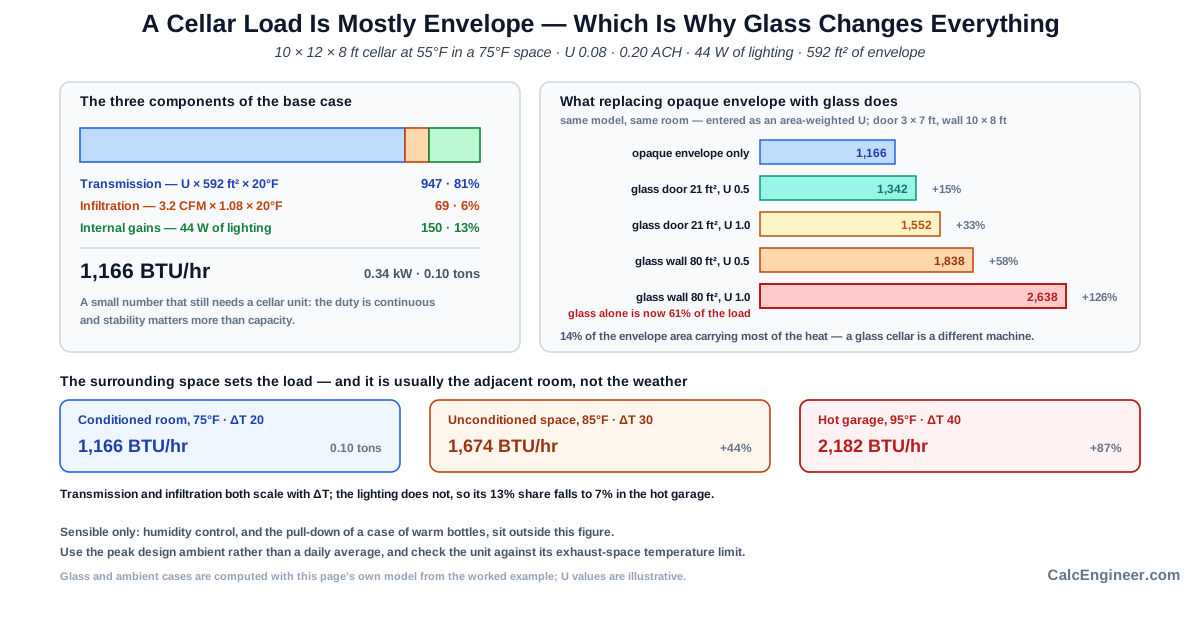
If the cellar uses LED lighting on a timer, the lighting load may be modest; if halogen or incandescent fixtures are used, lighting load should be calculated carefully.
This calculator is a preliminary sensible load tool. Final equipment selection must account for humidity control requirements, exhaust-space temperature limits, manufacturer capacity derating, and installation conditions.
Key Facts
- Wine cellar load is strongly affected by insulation quality, glass area, adjacent-space temperature, and air leakage.
- Transmission and infiltration can dominate the result in a small cellar.
- A typical residential wine cellar target temperature is around 55°F (13°C), requiring continuous cooling in most climates.
- A specialized cellar cooling unit should be checked against its actual operating envelope, not just nominal capacity.
Applications
- Residential wine cellar sizing
- Wine room retrofit planning
- Glass wine wall / display cooling review
- Basement wine cellar design
- Enclosure upgrade evaluation
- Preliminary refrigeration equipment selection
- Adjacent-space heat-gain assessment
- Early-stage HVAC / refrigeration feasibility review
Example Calculation
Imperial Example
Given:
- Length = 10 ft, Width = 12 ft, Height = 8 ft
- Cellar Temperature = 55°F
- Ambient Temperature = 75°F
- U-value = 0.08 BTU/h·ft²·°F
- ACH = 0.20
- Lighting Load = 44 W (150 BTU/hr)
Step 1: Geometry
Volume = 10 × 12 × 8 = 960 ft³
Envelope Area = 2×(10+12)×8 + 2×(10×12) = 352 + 240 = 592 ft²
ΔT = 75 − 55 = 20°F
Step 2: Transmission Load
Q_trans = 0.08 × 592 × 20 = 947 BTU/hr
Step 3: Infiltration Load
CFM = 0.20 × 960 / 60 = 3.2 CFM
Q_inf = 1.08 × 3.2 × 20 = 69 BTU/hr
Step 4: Internal Gains
Q_internal = 150 BTU/hr
Step 5: Total
Total = 947 + 69 + 150 = 1,166 BTU/hr
Tons = 1,166 / 12,000 = 0.10 tons
Metric Example
Given:
- Length = 3.05 m, Width = 3.66 m, Height = 2.44 m
- Cellar Temperature = 13°C
- Ambient Temperature = 24°C
- U-value = 0.45 W/m²·K
- ACH = 0.20
- Lighting Load = 44 W
Step 1: Geometry
Volume = 3.05 × 3.66 × 2.44 = 27.2 m³
Envelope Area = 2×(3.05+3.66)×2.44 + 2×(3.05×3.66) = 32.7 + 22.3 = 55.0 m²
ΔT = 24 − 13 = 11 K
Step 2: Transmission Load
Q_trans = 0.45 × 55.0 × 11 = 272 W
Step 3: Infiltration Load
Airflow = 0.20 × 27.2 / 3600 = 0.00151 m³/s
Q_inf = 1200 × 0.00151 × 11 = 20 W
Step 4: Internal Gains
Q_internal = 44 W
Step 5: Total
Total = 272 + 20 + 44 = 336 W = 0.34 kW
Tons = 336 / 3,516 = 0.10 tons
Standards & References
- ASHRAE Handbook — Fundamentals — core reference for heat transfer, infiltration, psychrometrics, and cooling/heating load calculation methods
- ASHRAE Handbook — Refrigeration — relevant reference for specialty conditioned spaces and non-comfort cooling applications
- ASHRAE Load Calculation Applications Manual — support reference for practical load-calculation methodology
- Manufacturer wine-cellar design guidance — practical reference for cellar temperature targets, humidity expectations, enclosure requirements, and installation constraints
Limitations
- This calculator estimates sensible cooling load only — latent moisture load and active humidity-control performance are not modeled.
- It does not model bottle pull-down load from newly added warm inventory.
- It does not account for compressor cycling behavior or manufacturer capacity derating.
- It does not model solar gain through complex glazing geometry unless the effect is captured in the U-value.
- It does not calculate transient load spikes from repeated door openings over time.
- Final equipment selection must be verified against manufacturer performance data and installation requirements, especially where the exhaust space is warm or humidity control is critical.
Common Mistakes to Avoid
- Using average ambient temperature instead of peak design ambient.
- Ignoring adjacent warm rooms or exhaust conditions.
- Underestimating heat gain through glass, doors, and leakage.
- Treating a wine cellar like a normal comfort-cooled room.
- Assuming that a standard residential AC unit will work in a wine cellar without modifications.
- Forgetting lighting or occupancy gains.
- Mixing U-values from different unit systems.
- Assuming low load means any unit will work.
- Ignoring manufacturer installation limits for exhaust-space temperature.
Frequently Asked Questions
What does this calculator estimate?
Why is a wine cellar different from a normal air-conditioned room?
What temperature is typically used for wine cellar storage?
Does this calculator include humidity control?
Why does glass increase the load so much?
Can I use tons instead of BTU/hr or kW?
What happens if the calculated result is zero or negative?
Frequently Used Together
Engineers often use these calculators in combination for complete project workflows:
Related Calculators
Explore similar calculators that might be useful for your project:
Free HVAC Quick Reference. Formulas & Checks.
Airflow, loads, refrigerant & duct checks — one printable page for the job site.
- Key formulas for airflow, load, refrigerant charge & duct sizing
- Quick sanity checks for the most common HVAC design errors
- Printable one-pager for field use and design review
No spam. Unsubscribe any time.
Calculate
Interior length of the wine cellar
Interior width of the wine cellar
Interior ceiling height of the wine cellar
Target storage temperature inside the wine cellar
Design temperature of surrounding spaces or outdoor ambient
Overall heat transfer coefficient of the insulated enclosure (all surfaces averaged)
Infiltration rate from door openings and air leakage
Total installed lighting wattage inside the cellar
Sensible heat from occupants (approx. 70–90 W per person for sedentary activity)
Heat from small equipment or accessories inside the cellar