A Correct Answer to Half the Question
The calculation on the page is an ordinary cooling load carried out properly. Heat arrives through the enclosure, it arrives with the air that leaks in, and it arrives from the lights and whatever else is running inside. The page adds those three terms, reports the total in watts, kilowatts, British thermal units per hour and tons of refrigeration, and states without hedging that what it returns is a sensible load.
A wine store has two conditions to hold, and only one of them is a temperature. The calculation addresses that one. The other is a humidity, and the page is explicit that it does not address it at all. In most applications a note of that kind marks a detail deferred to a later stage of design. Here it marks a second requirement that constrains how the first one may be met.
The awkwardness is in the equipment rather than in the arithmetic. Removing sensible heat with a cooling coil removes moisture at the same time, because the surface of the coil sits below the dew point of the air passing over it and water condenses out. In a comfort application that is useful, and a good part of the reason the coil is there. In a wine store it is the opposite of what is wanted, because the enclosure needs its humidity held up rather than pulled down. The two requirements therefore pull against each other through the same piece of equipment, and the one the calculation covers is the one that does the damage to the one it does not.
What follows works through what the sensible result means once the second requirement is admitted. It puts a number on the water that ordinary equipment would remove at the calculated load, sets that number against the water the cellar air is actually holding, shows why purpose-built cellar units are specified differently, and works out what the thermal mass of a loaded store does to the whole problem. The calculation itself is sound inside its stated scope. The scope is where the interest lies.
Calculator Inputs: An Enclosure and Three Gains
The field list is short, and its shape says what kind of model is behind it.
Room Length, Width, Height        ft or m
Indoor Cellar Temperature         °F or °C
Ambient / Adjacent Temperature    °F or °C
Wall / Ceiling / Floor U-Value    BTU/(h·ft²·°F) or W/(m²·K)
Air Changes per Hour              ACH
Lighting Load                     W
People Load                       W
Equipment Load                    W
Those go into four relations:
Envelope Area = 2 × (L + W) × H + 2 × L × W
Q_trans = U × A × ΔT
Q_inf   = 1.08 × CFM × ΔT      [Imperial]
Q_inf   = 1200 × airflow × ΔT  [Metric]
Total   = Q_trans + Q_inf + Q_internal
Three features of the field list are worth noting before any numbers go into it. The three internal gains are entered in watts in both unit systems, while every other quantity switches with the system, so an imperial user who reads a lighting figure in British thermal units per hour somewhere else has to convert it before it goes in. The U-value is a single figure applied to the whole enclosure, floor and ceiling included. And there is no separate field for glazed area, which means any glass has to be carried inside that averaged U-value rather than beside it.
What comes out is the transmission, infiltration and internal terms with their total, the total repeated in watts, kilowatts, British thermal units per hour and tons of refrigeration. The four figures are one result in four units.
The absences are more interesting than the fields. There is no humidity on either side of the enclosure, which is what a latent term would be built from. There is no mass of stored wine, which is what sets the thermal inertia of the room. There is nothing for a delivery of warm bottles. And there is nothing describing the space the equipment rejects its heat into, which is a constraint on the equipment rather than on the room. Each of those is worked out below from quantities the page does not ask for.
Stability Rather Than Level
The number the thermostat holds matters less than how much that number moves, which reverses the usual priority of a cooling design.
Wine expands and contracts as its temperature changes, and so does the small volume of air trapped in the neck of the bottle above it. The cork sits between the two and works as a piston, and a stopper cycled often enough can lose its seal. What the store is protecting itself against is the repetition rather than the displacement of any single cycle. A drift of several kelvins across a season is carried far more easily than the same swing inside a day.
That has a direct consequence for selection. Equipment whose capacity substantially exceeds the load runs in short bursts with noticeable temperature swings between them, and the margin that would be routine in a comfort application works against the requirement here. Oversizing does not simply waste capacity in a wine store, it degrades the thing being bought.
Practised storage temperatures fall roughly between 10 and 15 °C (50 and 59 °F), and the value chosen inside that range follows from what the store is for, since wine held for decades and wine held for a season are not the same problem. Sources and practitioners do not agree on a single figure, and the disagreement matters less than it looks, because the permissible rate of change and the size of the swing carry more weight than the setpoint itself.
The calculation gives a load at steady state and says nothing about behaviour during cycling. The thermal mass covered further down smooths those swings considerably, and that is one of the few features of this problem working in the designer's favour.
The difference from a food store is worth stating. A cold room tolerates excursions inside its operating band, because the product responds to the mean temperature it sees. Here the part that responds is the closure, and what it responds to is the cycles.
Per ASHRAE Handbook, Refrigeration, on specialty conditioned storage and published wine storage practice: the stability of the stored temperature is weighted more heavily than its absolute value, which pushes equipment selection in the opposite direction from comfort cooling.
Humidity Is Bounded on Both Sides
The humidity requirement has a floor and a ceiling, and the two come from different failure modes.
The floor comes from the cork. Dry air draws moisture out of it, the cork loses its resilience, and a closure that has hardened no longer seals against the neck. That opens a path for air into the bottle, which is the outcome the whole store exists to prevent.
The ceiling comes from everything around the wine. Excess humidity damages labels, and it encourages mould on corks, cases and racking. Neither failure touches the wine directly, and both are expensive.
Relative humidity ranges taken for storage run roughly from 50 to 70 percent, with practice varying inside that band. Both edges come from the failure modes above rather than from any property of the wine itself, which is why the band is quoted rather than a value.
The two-sided shape of the requirement is what makes it hard to meet. This is not a matter of adding moisture, nor of removing it, but of holding a quantity inside a band while the equipment that controls temperature pushes it steadily toward one edge. The section below puts a number on how hard it pushes.
Moisture arrives in a cellar from three directions. It comes in with infiltrating air, it comes out of the building fabric, which matters in an underground room in contact with soil, and it moves between the air and the timber and the bottles themselves as conditions change. A cellar is not a sealed system with respect to water, which is the only reason a store behind ordinary equipment does not dry out completely.
The calculation contains none of this, and could not. A latent term needs the moisture content of the air on both sides of the enclosure and a rate of moisture exchange with the fabric, and neither is among the fields. The page declares the result sensible-only and lists latent load among the things it does not model.
Per ASHRAE Handbook, Fundamentals, on moisture in buildings and published wine storage practice: the humidity requirement is bounded below by cork desiccation and above by mould and label damage, so the quantity has to be held within a band rather than driven in one direction.
Ordinary Equipment Removes Too Much Water
Matching a piece of ordinary cooling equipment to the calculated sensible load also fixes how much water it will remove, and for a small cellar that amount is large against what the room holds.
The fixing factor is the sensible heat ratio:
SHR = Q_sensible / Q_total

SHR   sensible heat ratio, dimensionless
      about 0.70 to 0.80 for comfort equipment at ordinary conditions,
      0.90 and above for equipment designed for a dry-coil duty
Q_sensible   the part of the capacity that lowers air temperature, W or BTU/hr
Q_total      the whole capacity of the machine at those conditions, W or BTU/hr
The ratio is a characteristic of the machine at stated operating conditions rather than a constant, and it moves with entering air condition, airflow and evaporator temperature. Taking 0.75 for a comfort machine is an assumption made to get a number, not a rating read off a plate.
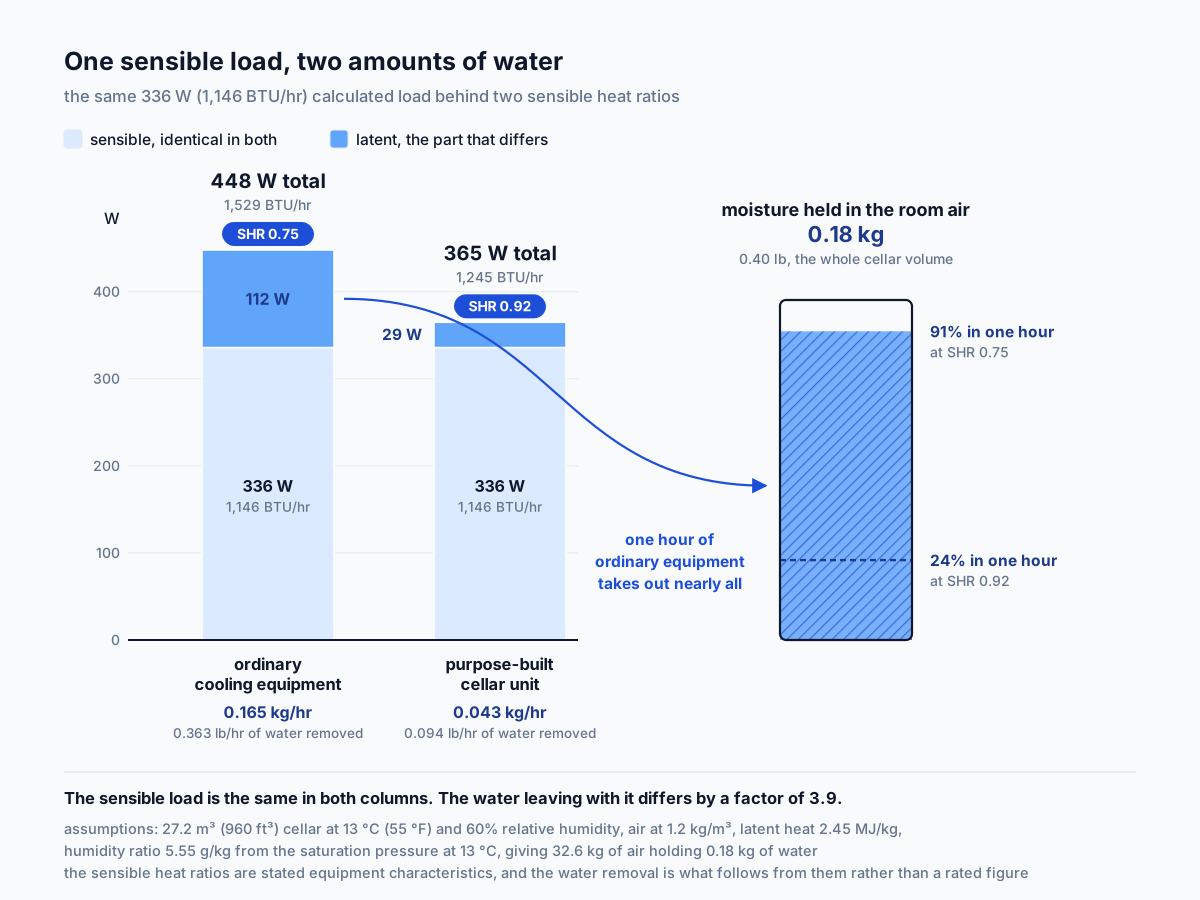
Apply it to the calculated load. At a sensible load of 336 W (1,146 BTU/hr) and a sensible heat ratio of 0.75:
Total capacity = 336 / 0.75 = 448 W (1,529 BTU/hr)
Latent part    = 448 − 336  = 112 W (382 BTU/hr)
Turning the latent watts into water needs a latent heat of vaporisation, and 2,450 kJ/kg (1,053 BTU/lb) is a reasonable value at storage conditions, though the property varies with temperature and is an assumption here in the same way the ratio is:
112 / 2,450,000 = 4.57 × 10⁻⁵ kg/s = 0.165 kg/hr (0.36 lb/hr)
Now the quantity that gives the figure its meaning. The cellar in the page example is 27.2 m³ (960 ft³), which at an air density of 1.2 kg/m³ is 32.6 kg (72 lb) of air. At 13 °C (55 °F) and 60 percent relative humidity the humidity ratio of that air is about 5.55 g/kg (38.9 grains per pound), so the room air is holding:
32.6 × 0.00555 = 0.18 kg (0.40 lb) of water
Equipment matched strictly to the sensible load can therefore remove about ninety percent of the water in the room air in a single hour of running. That does not mean the humidity collapses to nothing, because moisture keeps arriving with infiltration and out of the fabric. It means the humidity that eventually settles will sit well below the band the store needs, unless something is putting water back.
What makes the mismatch structural rather than incidental is the size of the room. The moisture a cellar holds scales with its volume, while the capacity of the equipment is set by the load, and the load of a small well-insulated box is dominated by its surface area and its temperature difference. Halving the volume does not halve the load. The smaller the cellar, the sharper the mismatch becomes.
Per ASHRAE Handbook, HVAC Systems and Equipment, on sensible heat ratio and psychrometric practice: equipment selected to match a sensible load also removes latent heat in proportion to its sensible heat ratio, and for a small conditioned volume the resulting rate of water removal is large relative to the moisture the air holds.
Why Cellar Units Run Warmer Coils
The way purpose-built cellar equipment avoids over-drying is a design decision about the temperature of the evaporator rather than anything done by the controls.
Moisture condenses on the evaporator surface when that surface is below the dew point of the air passing over it, and the amount that condenses grows with the difference between the two. Lower the coil and more water comes off it. That is the whole mechanism, and it is why a machine optimised for capacity per unit of heat exchanger tends to be a good dehumidifier whether or not anyone wanted one.
A cellar unit works with a higher evaporator temperature, closer to the temperature of the room air. The air-side temperature difference is small, condensation falls away, and the sensible heat ratio moves toward unity. Values above 0.90 are typical of the class, and the same arithmetic as before follows from one:
Total capacity = 336 / 0.92 = 365 W (1,245 BTU/hr)
Latent part    = 365 − 336  = 29 W (99 BTU/hr)
Water removed  = 29 / 2,450,000 = 0.043 kg/hr (0.094 lb/hr)
Against 0.165 kg/hr (0.36 lb/hr) from the machine at 0.75, that is smaller by a factor of nearly four, for exactly the same duty on the temperature side.
The warm coil is paid for twice. Less capacity comes out of a given heat exchanger area, so the unit is physically larger for the same refrigeration effect. And the small air-side temperature difference has to be made up with airflow, so the fan moves more air through the store, which has consequences of its own for a room where air movement across labels is unwelcome.
Two other measures appear alongside the warm coil. Some units carry integral humidification to put back what the coil still takes out. Others use control strategies that favour more frequent, shallower compressor runs over long ones, which keeps the coil from settling at its coldest condition.
The consequence for anyone using the calculated figure is a matter of which capacity to compare it against. The result is a sensible load, and it belongs beside the sensible capacity of the unit at the actual operating conditions, not beside a nominal total capacity from a catalogue.
Per manufacturer design guidance for wine cellar cooling units and ASHRAE Handbook, HVAC Systems and Equipment: a higher evaporator temperature reduces condensation and raises the sensible heat ratio, which is the principal means by which cellar equipment avoids removing more moisture than the store can afford.
Thermal Mass Works in Your Favour
A loaded cellar carries a great deal of heat capacity, and unlike most cooling problems that mass is an asset rather than an obstacle.
The capacity comes almost entirely from the contents:
C = m_wine × c_wine + m_glass × c_glass + racking and fabric

c_wine    close to water, about 4,000 J/(kg·K) (0.96 BTU/(lb·°F))
c_glass   about 840 J/(kg·K) (0.20 BTU/(lb·°F))
Take a store of 750 bottles, each holding 0.75 kg (1.65 lb) of wine in about 0.5 kg (1.10 lb) of glass. Both the bottle count and the glass weight are assumptions here, chosen to be representative rather than measured:
Wine:  562.5 kg (1,240 lb) × 4,000 = 2.25 MJ/K
Glass: 375 kg (827 lb)     × 840   = 0.32 MJ/K
Total: about 2.57 MJ/K (1,350 BTU/°F)
Against that, the rate at which the room loses ground is the same total transmittance the load calculation is built from:
Envelope:     U × A = 0.45 × 55.07 = 24.8 W/K (47.0 BTU/(h·°F))
Infiltration: 1200 × 0.00151 = 1.8 W/K (3.4 BTU/(h·°F))
Total:        26.6 W/K (50.4 BTU/(h·°F))
Those two numbers give a first-order time constant:
τ = C / UA_total = 2,570,000 / 26.6 = 96,600 s = 26.8 hours
If the cooling stops, the store approaches ambient along an exponential with that time constant. Starting at 13 °C (55 °F) with 24 °C (75 °F) outside the enclosure:
After  6 hours: 15.2 °C (59.4 °F)
After 12 hours: 17.0 °C (62.6 °F)
After 24 hours: 19.5 °C (67.1 °F)
A failed compressor or a power cut of several hours therefore does not take the store outside anything acceptable, which is a different position from most conditioned spaces of this size. The same cellar standing empty would warm through that range in a small fraction of the time, because the heat capacity of the air and the fabric is nowhere near that of the wine.
The reverse side of the same property is that everything is slow. The store takes a long time to reach condition after commissioning, and a long time to recover after a delivery — the subject of the next section.
Per thermal properties of aqueous solutions and glass and standard first-order response: the heat capacity of a loaded cellar gives a time constant measured in tens of hours, so short interruptions of cooling produce small excursions in stored temperature.
Loading Warm Bottles Is a Separate Event
Bringing new stock into the cellar adds a quantity of heat that has nothing to do with the steady load, and the mass that protects the store is the same mass that slows its removal.
The size of the event is a finite energy rather than a rate:
E = m × c × ΔT

Delivery of 100 bottles at 20 °C (68 °F) into a store at 13 °C (55 °F), ΔT = 7 K (12.6 °F)

Wine:  75 kg (165 lb) × 4,000 × 7 = 2.10 MJ
Glass: 50 kg (110 lb) × 840   × 7 = 0.29 MJ
Total: about 2.39 MJ (2,270 BTU)
How long that takes to remove depends on what capacity is spare. The steady load is already using part of the machine, and only the excess is available for the delivery:
Unit capacity 500 W (1,706 BTU/hr), steady load 336 W (1,146 BTU/hr)
Excess: 164 W (560 BTU/hr)
Time:   2,390,000 / 164 = 14,600 s = 4.1 hours
While that excess is going into the delivery, the room temperature rises, and the rest of the store experiences exactly the sort of excursion the whole design is trying to avoid. How large the excursion is depends on the ratio between the mass arriving and the mass already there, so the same delivery into a full cellar is a smaller event than into a half-empty one.
Three responses are usual in practice. Deliveries are broken into batches rather than loaded whole. Stock is pre-cooled elsewhere before it enters the store. Or the unit is chosen with enough excess capacity to bring a delivery down in an acceptable time.
The third of those runs straight into the conflict from earlier. Excess capacity is what a pull-down needs and what steady operation does not want, because it is the same margin that produces short cycling and the temperature swings the closures object to. The resolution is either capacity modulation, so that the machine can be large for a delivery and small the rest of the time, or an accepted pull-down of many hours.
The page states that bottle pull-down load from newly added warm inventory is not modelled, which is why it appears here as a separate calculation rather than as another term in the total.
Per ASHRAE Handbook, Refrigeration, on pull-down load in conditioned storage: introducing warm product adds a finite quantity of heat whose removal time follows from the capacity available above the steady load, and the same thermal mass that stabilises the store extends that time.
Glass Dominates a Small Cellar
A glazed door or wall transfers heat several times faster than the insulated assembly around it, and in a small enclosure that one element can outweigh everything else.
The orders of magnitude are far apart:
Insulated cellar envelope    about 0.45 W/(m²·K)  (0.08 BTU/(h·ft²·°F)) in this case
Single glazing               about 5.7 W/(m²·K)   (1.00 BTU/(h·ft²·°F))
Double glazing               about 2.8 W/(m²·K)   (0.49 BTU/(h·ft²·°F))
Coated and gas-filled units  lower again
Those glazing figures are published reference values for whole assemblies and vary with frame, spacer, coating and fill, so a real product needs its own number.
Take a door of 1.6 m² (17.2 ft²) in the enclosure of the page example, where the temperature difference is 11 K (20 °F):
As insulated wall:  1.6 × 0.45 × 11 = 7.9 W (27 BTU/hr)
As double glazing:  1.6 × 2.80 × 11 = 49.3 W (168 BTU/hr)
As single glazing:  1.6 × 5.70 × 11 = 100.3 W (342 BTU/hr)
Against the 272 W (928 BTU/hr) transmission term of that example, replacing a piece of wall that size with double glazing adds 41 W (140 BTU/hr), which is 15 percent, and with single glazing adds 92 W (314 BTU/hr), which is 34 percent — from one door.
An entire glazed wall is a different scale of change. The 3.05 × 2.44 m (10 × 8 ft) end wall of the same room is 7.44 m² (80.1 ft²):
As insulated wall: 7.44 × 0.45 × 11 = 36.8 W (126 BTU/hr)
As double glazing: 7.44 × 2.80 × 11 = 229.2 W (782 BTU/hr)
Increase:                             192 W (655 BTU/hr)
Transmission goes from 272 to 464 W (928 to 1,583 BTU/hr), and the total load from 336 to 528 W (1,146 to 1,802 BTU/hr), a factor of 1.6 on the whole calculation from one surface.
Because the model takes one U-value for the whole enclosure, glazing has to be weighted into it by area rather than left out of it:
U_avg = (U_opaque × A_opaque + U_glazed × A_glazed) / A_total
Entering the U-value of the insulated construction for an enclosure that contains glass understates transmission by an amount comparable to the transmission itself, which is the largest single error available in this calculation.
Per published glazing thermal transmittance values and ASHRAE Handbook, Fundamentals: glazed assemblies transfer heat at several times the rate of insulated opaque construction, so a glass door or wall has to be weighted into the averaged U-value rather than omitted from it.
One U-Value, Several Different Neighbours
The model applies one temperature difference to the whole enclosure, and the surfaces of a cellar rarely all face the same thing.
A cellar floor usually sits on soil or over a basement slab. A cellar ceiling may face a heated room above, an unconditioned roof space, or outside air. Walls can do any of those, and a room in the corner of a basement commonly does three of them at once. The single ambient temperature in the field list has to stand for all of them.
Ground is the surface that departs furthest. Soil in contact with a floor slab is considerably cooler than summer outdoor air and warmer than winter outdoor air, and it moves slowly enough that it can be treated as a separate boundary condition rather than as part of the swing.
Put a number on it in the same room. The floor is 3.05 × 3.66 m, which is 11.16 m² (120 ft²), and taking soil at 15 °C (59 °F) against a stored 13 °C (55 °F) gives a temperature difference of 2 K (3.6 °F) rather than the 11 K (20 °F) the model applies:
As modelled:  11.16 × 0.45 × 11 = 55 W (188 BTU/hr)
On soil:      11.16 × 0.45 × 2  = 10 W (34 BTU/hr)
Difference:   45 W (154 BTU/hr), 17 percent of transmission
The total falls from 336 to 291 W (1,146 to 993 BTU/hr) on that correction alone.
Two ways of handling it are available. Calculate each surface against its own boundary condition and add the results, which is transparent and does not fit the field list. Or weight both the U-value and the temperature difference into a single equivalent pair, which fits the field list and hides what has been assumed.
The simple form is deliberate. The page presents the model as a preliminary estimate and tells the user to account for all surfaces and to establish a U-value for the actual construction. It also notes that for a below-grade cellar the neighbouring rooms rather than the outdoor air are usually what governs, which is the same point arriving from the other direction.
Per ASHRAE Handbook, Fundamentals, on heat transfer through building assemblies: applying a single temperature difference to surfaces facing different conditions overstates or understates the transmission term depending on which surfaces dominate the area.
Where the Heat Goes After It Leaves
The heat taken out of the cellar has to be rejected somewhere, and where that somewhere is decides whether the equipment can take it out at all.
What arrives at the condenser is more than the cooling load. The machine also has to reject the work its compressor puts in:
Cooling load 336 W (1,146 BTU/hr), coefficient of performance about 2.5
Compressor input: 336 / 2.5 = 134 W (457 BTU/hr)
Rejected at the condenser: 336 + 134 = 470 W (1,604 BTU/hr)
That heat goes into an adjacent room if the unit is a through-wall type, or outdoors if the condenser has been split out and remoted. The two arrangements are not interchangeable, and the choice is usually made on cost and on where there is a wall to use.
Rejecting into a small enclosed space starts a chain. The room warms, condensing temperature rises with it, capacity falls and power draw increases, so the machine both needs to run longer and is less able to. Manufacturers state a maximum temperature for the space receiving the rejected heat, and exceeding it puts the unit outside its operating envelope regardless of how the load calculation came out.
There is a second path back into the calculation. A neighbouring room warmed by rejected heat raises the temperature difference across the cellar enclosure, which increases the transmission term the calculation started from. The smaller that room, the more pronounced the loop.
The consequence is that the calculated figure is a load on the cellar side only. Checking the conditions on the rejection side is a separate exercise, and it constrains equipment selection more often than the load does.
Per manufacturer installation requirements for wine cellar cooling units: the heat rejected includes the compressor input in addition to the cooling load, and the temperature of the space receiving it is a stated limit on the operating envelope.
Worked Example: 1,166 BTU per Hour Across Three Terms
The imperial case on the page, worked through with what each step is doing.
Room                  10 × 12 × 8 ft (3.05 × 3.66 × 2.44 m)
Storage temperature   55 °F (13 °C)
Adjacent space        75 °F (24 °C)
U-value               0.08 BTU/(h·ft²·°F) (0.45 W/(m²·K))
Air changes per hour  0.20
Lighting              44 W (150 BTU/hr)
The lighting entry is worth pausing on, because the field takes watts in both unit systems. The 44 W is what goes into the box, and the 150 BTU/hr beside it is the same quantity in the units the imperial result will be reported in.
Step 1, the geometry:
Volume:        10 × 12 × 8 = 960 ft³ (27.2 m³)
Wall area:     2 × (10 + 12) × 8 = 352 ft²
Floor+ceiling: 2 × 120 = 240 ft²
Envelope:      592 ft² (55.0 m²)
ΔT:            75 − 55 = 20 °F (11.1 K)
Step 2, transmission:
0.08 × 592 × 20 = 947 BTU/hr (278 W)
Step 3, infiltration. The air change rate becomes a volume flow, and the 1.08 constant carries the density and specific heat of air together:
Airflow: 0.20 × 960 / 60 = 3.2 CFM (1.51 L/s)
1.08 × 3.2 × 20 = 69 BTU/hr (20 W)
Step 4, internal gains, which here is the lighting alone:
150 BTU/hr (44 W)
Step 5, the total:
947 + 69 + 150 = 1,166 BTU/hr (342 W, 0.34 kW)
Tons: 1,166 / 12,000 = 0.10
Step 6, where it comes from:
Transmission    81.2 percent
Internal gains  12.9 percent
Infiltration     5.9 percent
Transmission dominating by that margin is characteristic of a small room with a low air change rate, and it says where attention belongs. An error of ten percent in the U-value moves the answer more than doubling the lighting.
Step 7, what the figure is. It is a sensible load. Equipment matched to it at a sensible heat ratio of 0.75 would have a total capacity near 448 W (1,529 BTU/hr) and would remove about 0.165 kg (0.36 lb) of water an hour. A cellar unit at 0.92 would remove about 0.043 kg (0.094 lb) an hour for the same duty.
Step 8, what glazing would do to it. Replacing 1.6 m² (17.2 ft²) of that envelope with a double-glazed door at 2.8 W/(m²·K) adds about 41 W (140 BTU/hr), or 15 percent of transmission. Single glazing over the same area adds about 92 W (314 BTU/hr).
Step 9, what the floor boundary would do to it. A slab on soil at 15 °C (59 °F) rather than the assumed 24 °C (75 °F) reduces transmission by about 45 W (154 BTU/hr), or 17 percent. The two corrections act in opposite directions and there is no reason for them to cancel.
Step 10, what to do with the result. Compare it with the sensible capacity of the unit at the actual conditions rather than with a nominal total. Check the conditions in whatever space receives the rejected heat. And treat the humidity requirement as a separate question with its own answer.
Metric Example and What a Glass Wall Costs
The metric case is the same room in the other unit system.
Room                3.05 × 3.66 × 2.44 m
Storage 13 °C, adjacent space 24 °C
U-value 0.45 W/(m²·K), 0.20 air changes per hour, lighting 44 W

Volume 27.2 m³, envelope 55.0 m², ΔT 11 K
Transmission:  0.45 × 55.0 × 11 = 272 W (928 BTU/hr)
Infiltration:  1200 × 0.00151 × 11 = 20 W (68 BTU/hr)
Internal:      44 W (150 BTU/hr)
Total:         272 + 20 + 44 = 336 W (0.34 kW, 1,146 BTU/hr, 0.10 tons)
The two cases do not land on exactly the same number. The imperial total of 1,166 BTU/hr is 342 W against the metric 336 W, a difference of 1.6 percent. That comes from rounding the inputs rather than from the model: 0.45 W/(m²·K) is a rounded conversion of 0.08 BTU/(h·ft²·°F), whose exact value is 0.454, and 11 K is a rounded 11.11. The same relations are being evaluated in both.
Now put the glazed wall of the earlier section into this case. The 3.05 × 2.44 m end wall is 7.44 m² (80.1 ft²), and double glazing at 2.8 W/(m²·K) replaces insulated construction at 0.45:
Was:  7.44 × 0.45 × 11 = 36.8 W (126 BTU/hr)
Now:  7.44 × 2.80 × 11 = 229.2 W (782 BTU/hr)

Transmission: 272 → 464 W (928 → 1,583 BTU/hr)
Total load:   336 → 528 W (1,146 → 1,802 BTU/hr)
The equipment grows with it, and so does everything the equipment does. At a sensible heat ratio of 0.75 the machine for the glazed room has a total capacity of 704 W (2,402 BTU/hr) with 176 W (601 BTU/hr) latent, and removes about 0.26 kg (0.57 lb) of water an hour against 0.165 kg (0.36 lb) before. The humidity problem grows in step with the load, which is a second reason to be careful with glass in a store of this size.
The averaged U-value the field list wants can be checked against the surface-by-surface figures. With 47.63 m² (512.7 ft²) of opaque envelope left:
U_avg = (47.63 × 0.45 + 7.44 × 2.80) / 55.07 = 0.767 W/(m²·K) (0.135 BTU/(h·ft²·°F))
Check: 0.767 × 55.07 × 11 = 464 W (1,583 BTU/hr)
Per ASHRAE Handbook, Fundamentals: an averaged U-value weighted by area reproduces the transmission term of a separate surface-by-surface calculation, provided every surface faces the same temperature difference.
Application Boundaries: Latent, Transient, Equipment
The model covers a steady-state sensible load through the enclosure, with infiltration and internal gains. Everything below sits outside it and has to be picked up separately.
Latent load. Not in the calculation, and the humidity requirement it belongs to constrains how the sensible load may be removed. Sizing an air-side system needs both halves.
Equipment dehumidification. Set by the sensible heat ratio of whatever is selected, at 0.165 kg/hr (0.36 lb/hr) for a comfort machine at this load against 0.043 kg/hr (0.094 lb/hr) for a cellar unit, and capable of exceeding what the store can afford.
Pull-down after a delivery. A finite 2.39 MJ (2,270 BTU) for a hundred bottles entering 7 K (12.6 °F) warm, taking about 4.1 hours on 164 W (560 BTU/hr) of spare capacity.
Thermal response. A time constant near 26.8 hours for a loaded store, which governs behaviour after a failure and after a delivery and appears nowhere in a steady-state result.
Equipment cycling. The swing in stored temperature while the machine cycles is outside the calculation and matters more to the closures than the mean value does.
Differing boundary conditions. One temperature difference is applied to every surface, and the floor correction alone was worth 45 W (154 BTU/hr) in the example above.
Glazing. Has to be weighted into the averaged U-value by area, since a single glazed wall took the same room from 336 to 528 W (1,146 to 1,802 BTU/hr).
Heat rejection conditions. About 470 W (1,604 BTU/hr) arrives at the condenser for a 336 W (1,146 BTU/hr) load, and the temperature limit of the space receiving it is a constraint on selection that the load does not express.
Equipment matching. The result is a sensible load and belongs beside a sensible capacity at the actual conditions, not beside a nominal total.
Per the calculator's stated scope and ASHRAE Handbook, Refrigeration: a steady-state sensible load from the enclosure, infiltration and internal gains is the scope of this model, while latent load, equipment dehumidification, pull-down, thermal response, cycling and heat rejection conditions each require separate treatment.
Wine Cellar Cooling Load Calculator
Wine cellar cooling load by component sum: it takes the room geometry, an averaged enclosure U-value, an air change rate and the internal gains, and returns the transmission, infiltration and internal terms with their total. The result is a sensible load, and the page is explicit that humidity is outside it. That omission matters more here than in most applications, since equipment removing sensible heat also removes moisture the store needs to keep. A preliminary sizing estimate, not an equipment selection.
Open Wine Cellar Cooling Load CalculatorStandards and References
- ASHRAE Handbook, Fundamentals (American Society of Heating, Refrigerating and Air-Conditioning Engineers, current edition). Heat transfer through building assemblies, infiltration, the properties of moist air and the psychrometric relations behind the humidity ratio used above.
- ASHRAE Handbook, Refrigeration (American Society of Heating, Refrigerating and Air-Conditioning Engineers, current edition). Specialty conditioned storage, product pull-down load, and the storage conditions appropriate to different stored goods.
- ASHRAE Handbook, HVAC Systems and Equipment (American Society of Heating, Refrigerating and Air-Conditioning Engineers, current edition). Refrigeration equipment characteristics, including sensible heat ratio and its dependence on evaporator temperature and entering air condition.
- ASHRAE Load Calculation Applications Manual (American Society of Heating, Refrigerating and Air-Conditioning Engineers, current edition). Load calculation method and its application, including the treatment of surfaces facing different boundary conditions.
- Manufacturer data for wine cellar cooling units (current published editions). Sensible and total capacity at stated conditions, sensible heat ratio, maximum temperature of the space receiving rejected heat, and installation requirements.
- Published glazing thermal transmittance values (current editions of glazing and fenestration reference data). Whole-assembly U-values for single glazing, insulating units and coated or gas-filled constructions.
- Thermophysical property data for aqueous solutions and glass (current editions of the standard property references). Specific heat capacities used in estimating the heat capacity of a loaded store and the energy in a warm delivery.
- Published wine storage practice (current editions of the wine storage and cellar design literature). Temperature and relative humidity ranges taken for storage, the effect of fluctuation on closures, and the reasons the humidity band is bounded at both ends.
- CIBSE Guide A, Environmental Design (Chartered Institution of Building Services Engineers, current edition). Thermal properties of construction, ground-contact heat loss and infiltration rates, as an alternative source for the transmission and infiltration terms.
FAQ
Does this calculation cover humidity?
Per the calculator's stated scope: no, it returns a sensible load only. That matters more in a wine store than in most applications, because equipment removing sensible heat also condenses moisture out of the air, and the store needs its humidity held up rather than pulled down. The page lists latent moisture load and active humidity control among the things it does not model.
How much water would ordinary equipment remove?
Per psychrometric practice: at a sensible load of 336 W (1,146 BTU/hr) and a sensible heat ratio of 0.75, total capacity is about 448 W (1,529 BTU/hr) of which 112 W (382 BTU/hr) is latent, removing roughly 0.165 kg (0.36 lb) of water per hour. A 27.2 m³ (960 ft³) cellar at 13 °C (55 °F) and 60 percent relative humidity holds about 0.18 kg (0.40 lb) of water in its air, so an hour of running is most of what the room has.
Why are cellar units different from ordinary cooling equipment?
Per manufacturer design guidance: they run a higher evaporator temperature, which reduces condensation on the coil and raises the sensible heat ratio towards unity. At a ratio of 0.92 the same 336 W (1,146 BTU/hr) sensible load removes about 0.043 kg (0.094 lb) of water per hour, roughly a quarter of the ordinary case, at the cost of a physically larger unit and more airflow through the store.
How long can the cellar go without cooling?
Per the thermal capacity of the stored wine: longer than most conditioned spaces. A cellar holding around 750 bottles has a heat capacity near 2.57 MJ/K (1,350 BTU/°F) against a total transmittance of about 26.6 W/K (50.4 BTU/(h·°F)), giving a time constant of roughly 27 hours, so a six hour interruption raises the store by about two kelvins from 13 to 15.2 °C (55 to 59.4 °F).
Does loading new bottles matter?
Per ASHRAE Handbook, Refrigeration, on pull-down load: yes, and the page notes it is not modelled. One hundred bottles entering at 20 °C (68 °F) into a 13 °C (55 °F) cellar carry about 2.39 MJ (2,270 BTU), which takes some four hours to remove on 164 W (560 BTU/hr) of capacity available above the steady load.
Why does a glass door change the answer so much?
Per published glazing transmittance values: because glazed assemblies transfer heat at several times the rate of insulated construction. A 1.6 m² (17.2 ft²) double-glazed door adds around 41 W (140 BTU/hr) to a 272 W (928 BTU/hr) transmission term, and single glazing of the same area adds about 92 W (314 BTU/hr). Since there is no separate glazing field, that has to be weighted into the averaged U-value.
Can I select equipment directly from this figure?
Per the calculator's stated scope: not by itself. The figure is a sensible load and should be compared with the sensible capacity of the equipment at the actual conditions rather than with a nominal total. The temperature of the space receiving the rejected heat, about 470 W (1,604 BTU/hr) for this load, is a separate constraint stated by the manufacturer.
Related Calculators
- Refrigeration Load Calculator: the full load of a storage room, including the product and infiltration terms a cellar calculation leaves out, and the closest thing to a complete treatment of the same room.
- Psychrometric Calculator: the state of moist air, which is where the humidity ratio and the dew point come from, and the dew point is what decides how much water leaves on the coil.
- Air Changes Per Hour Calculator: the air change rate behind the infiltration term, which carries moisture into the store as well as heat.
- Cooling Load Calculator: the load of an ordinary room, where the dehumidification that comes with cooling is wanted rather than resisted.
- HVAC Heat Load Calculator: envelope heat gains in the general case, useful for checking the transmission term against a surface-by-surface calculation.
- AC Tonnage Calculator: conversion of a load into refrigeration capacity, the same 12,000 BTU/hr per ton the page applies to the total.
- CFM Calculator: the airflow needed to carry a load at a given temperature difference, which is the quantity a warm coil forces upward.
- Dehumidifier Sizing for Pools: the inverse problem, where removing water is the object of the exercise rather than a side effect of holding a temperature.