Thermal Comfort PMV/PPD Calculator
On this page
Calculate
Indoor dry-bulb air temperature in °F
Area-weighted average temperature of surrounding surfaces in °F
Indoor relative humidity percentage (0–100%)
Local air velocity near the occupant in fpm
Total clothing thermal resistance in clo (e.g. 0.5 = light summer clothing, 1.0 = typical office winter)
Occupant activity level in met (e.g. 1.0 = seated, 1.2 = standing, 2.0 = light walking)
Overview
The Thermal Comfort PMV/PPD Calculator evaluates indoor comfort using the Predicted Mean Vote (PMV) and Predicted Percentage Dissatisfied (PPD) framework. This is the standard analytical model used to assess thermal sensation and expected dissatisfaction in moderate indoor environments. ISO 7730 specifies a method to evaluate general thermal comfort and the degree of dissatisfaction using PMV and PPD, and ASHRAE Standard 55 defines acceptable thermal environmental conditions for a substantial majority of occupants.
This matters because comfort is not determined by air temperature alone. Thermal sensation depends on air temperature, mean radiant temperature, humidity, air speed, clothing insulation, and metabolic rate. ASHRAE’s Standard 55 explicitly lists those six environmental and personal factors within scope.
This calculator is a preliminary comfort evaluation tool. It helps estimate whether the modeled condition is likely cold, cool, acceptable, warm, or hot before deeper review of local discomfort, air distribution, and real occupancy behavior. ISO 7730 also covers local discomfort criteria in addition to PMV/PPD.
How to Use This Calculator
Enter air temperature – the dry-bulb temperature of the indoor air (°C or °F).
Enter mean radiant temperature – the area-weighted average temperature of surrounding surfaces (°C or °F).
Enter relative humidity – the indoor relative humidity (%).
Enter air speed – the local air velocity near the occupant (m/s or fpm).
Enter clothing insulation – the total clothing assembly thermal resistance (clo).
Enter metabolic rate – the activity level of the occupant (met).
Choose Imperial or Metric – select the unit system for temperature and air speed.
Click “Calculate” – review PMV, PPD, and comfort category.
Typical neutral conditions: air temperature 24°C, mean radiant temperature 24°C, relative humidity 50%, air speed 0.10 m/s, clothing 0.5 clo, metabolic rate 1.1 met.
Inputs & Outputs
Inputs
Outputs
Formula
PMV/PPD Model (ISO 7730 / Fanger)
The PMV is calculated using the Fanger thermal comfort equation:
PMV = (0.303 × e^⁻⁰·⁰³⁶ᴹ + 0.028) × L
Where L is the thermal load:
L = (M − W)
    − 3.05 × 10⁻³ × [5733 − 6.99 × (M − W) − pa]
    − 0.42 × [(M − W) − 58.15]
    − 1.7 × 10⁻⁵ × M × (5867 − pa)
    − 0.0014 × M × (34 − ta)
    − 3.96 × 10⁻⁸ × fcl × [(tcl + 273)⁴ − (tr + 273)⁴]
    − fcl × hc × (tcl − ta)
Clothing Surface Temperature (tcl) — Iterative
tcl = 35.7 − 0.028 × (M − W)
      − Rcl × {3.96 × 10⁻⁸ × fcl × [(tcl + 273)⁴ − (tr + 273)⁴]
              + fcl × hc × (tcl − ta)}
PPD Equation
PPD = 100 − 95 × exp(−0.03353 × PMV⁴ − 0.2179 × PMV²)
Comfort Band Thresholds (ISO 7730 / ASHRAE 55)
| Category | PMV Range |
|---|---|
| COLD | PMV < −1.5 |
| COOL | −1.5 ≤ PMV < −0.5 |
| ACCEPTABLE | −0.5 ≤ PMV ≤ +0.5 |
| WARM | +0.5 < PMV ≤ +1.5 |
| HOT | PMV > +1.5 |
ASHRAE Standard 55 uses −0.5 to +0.5 as the PMV acceptability zone for a substantial majority of occupants.
Variables
| Variable | Meaning | Units |
|---|---|---|
| M | Metabolic rate | W/m² (= met × 58.15) |
| W | External mechanical work | W/m² (= 0 for normal activities) |
| ta | Air temperature | °C |
| tr | Mean radiant temperature | °C |
| pa | Water vapor partial pressure | Pa |
| fcl | Clothing surface area factor | — |
| Rcl | Clothing thermal resistance | m²·K/W (= 0.155 × clo) |
| tcl | Clothing surface temperature | °C (iterative) |
| hc | Convective heat transfer coefficient | W/m²·K |
| PMV | Predicted Mean Vote | — |
| PPD | Predicted Percentage Dissatisfied | % |
Unit Handling
| Mode | Air Temperature | Mean Radiant Temp | Air Speed |
|---|---|---|---|
| Metric | °C | °C | m/s |
| Imperial | °F → converted to °C internally | °F → converted to °C internally | fpm → converted to m/s internally |
PMV and PPD are dimensionless and identical in both unit modes.
What is Thermal Comfort PMV/PPD
PMV/PPD is a model used to estimate how a large group of occupants is likely to feel in a thermal environment. PMV predicts the average thermal sensation vote, while PPD estimates the percentage of occupants likely to be dissatisfied. ISO 7730 specifies this analytical method for moderate thermal environments, and ASHRAE Standard 55 uses a PMV-based method as one pathway for evaluating thermal comfort.
This is different from simply asking whether a room is “too hot” or “too cold.” Comfort depends on the balance between heat produced by the body and heat exchanged with the environment. Clothing, activity, air speed, humidity, air temperature, and radiant conditions all affect the result.
How PMV Works
The PMV equation integrates heat exchange from radiation, convection, evaporation, and respiration into a single thermal sensation index. What makes the model computationally iterative is the clothing surface temperature (tcl): it appears in both the radiative and convective heat exchange terms and must be solved by fixed-point iteration until convergence.
Once PMV is known, PPD follows directly from a nonlinear exponential function. The minimum PPD value under this model is approximately 5% at PMV = 0, which reflects the model’s assumption that some occupants are always dissatisfied even under neutral conditions.
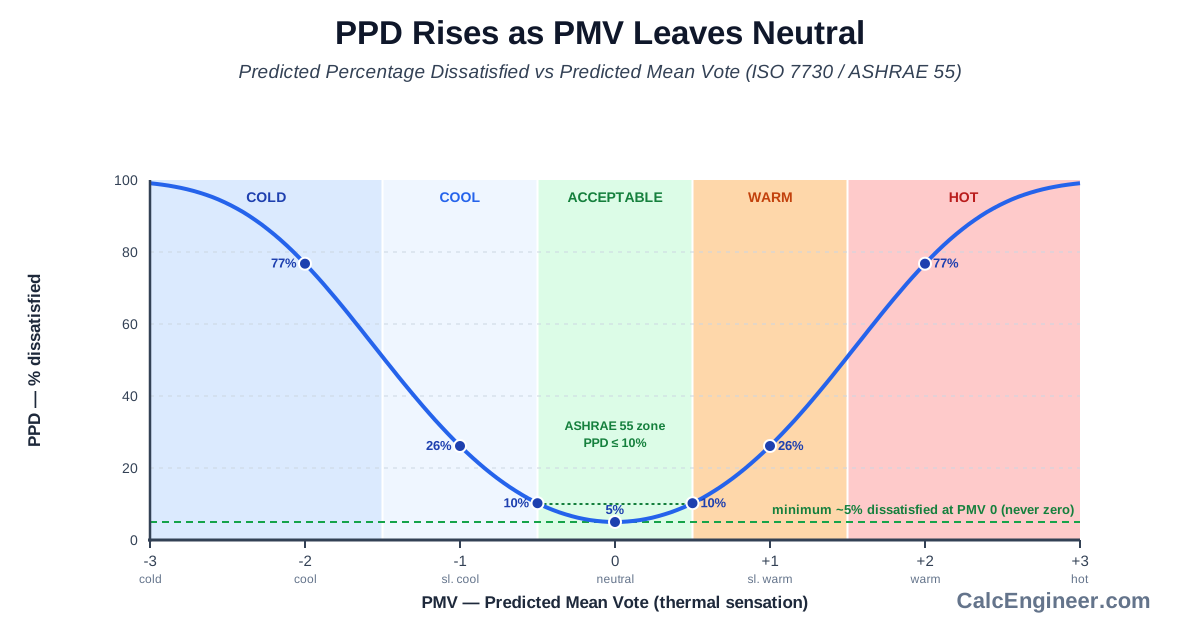
This model is a population-based estimator, not an individual preference predictor. It estimates the likely average response of a large occupant group. Local discomfort — from draft, radiant asymmetry, floor temperature, or vertical stratification — requires separate evaluation under ISO 7730 and ASHRAE Standard 55.
Key Facts
- PMV predicts the average thermal sensation of a large group of occupants, not an individual’s response.
- Even at PMV = 0, the PPD model predicts approximately 5% dissatisfied — perfect universal satisfaction is not achievable.
- ASHRAE Standard 55 uses −0.5 to +0.5 PMV as the acceptability zone for a substantial majority of occupants.
- ISO 7730 also includes local discomfort criteria (draft, radiant asymmetry, floor temperature, stratification) beyond PMV/PPD.
- Air speed has a large effect in warm conditions and is explicitly addressed in ASHRAE 55’s elevated-air-speed provisions.
- Clothing and activity assumptions are among the largest sources of uncertainty in PMV calculations.
Applications
- Office and classroom thermal comfort evaluation.
- HVAC setpoint assessment and design-stage comfort screening.
- Radiant and air-movement balance checks.
- Preliminary standard-oriented comfort review before detailed assessment.
- PMV/PPD comparison across design options.
- Occupant comfort troubleshooting in existing buildings.
Example Calculation
Metric Example — Slightly Cool but Acceptable
Given:
- Air Temperature = 24°C
- Mean Radiant Temperature = 24°C
- Relative Humidity = 50%
- Air Speed = 0.10 m/s
- Clothing = 0.5 clo
- Metabolic Rate = 1.1 met
Result:
PMV ≈ −0.46
PPD ≈ 9%
Category: ACCEPTABLE
Interpretation: PMV = −0.46 falls within the −0.5 to +0.5 acceptability band, so the condition is ACCEPTABLE — but it sits near the COOL edge of the band rather than at thermal neutrality, and about 9% of occupants are predicted dissatisfied. Light clothing (0.5 clo) at 24°C tends slightly cool.
Metric Example — Slightly Warm
Given:
- Air Temperature = 27°C
- Mean Radiant Temperature = 28°C
- Relative Humidity = 60%
- Air Speed = 0.05 m/s
- Clothing = 0.5 clo
- Metabolic Rate = 1.2 met
Result:
PMV ≈ +0.97
PPD ≈ 25%
Category: WARM
Interpretation: PMV = +0.97 falls in the WARM band. This indicates a warm condition with elevated dissatisfaction — about 25% of occupants predicted dissatisfied — likely unless temperature, air movement, clothing, or internal-load assumptions are adjusted.
Standards & References
- ISO 7730:2025 — Ergonomics of the thermal environment — Analytical determination and interpretation of thermal comfort using calculation of the PMV and PPD indices
- ASHRAE Standard 55-2023 — Thermal Environmental Conditions for Human Occupancy
- ASHRAE Read-Only Standards — Free read-only access to ASHRAE standards including Standard 55
- CBE Thermal Comfort Tools — Center for the Built Environment online comfort tools
Limitations
- This calculator is a preliminary whole-body comfort estimator only.
- It does not model local discomfort: draft, radiant asymmetry, floor temperature, vertical stratification, or transient conditions.
- It does not account for individual preference differences, personal adaptation, or behavioral adjustment.
- PMV/PPD is a population-based model — it does not predict individual occupant responses.
- ISO 7730 explicitly includes local discomfort criteria in addition to PMV/PPD.
- ASHRAE Standard 55 also distinguishes whole-body comfort from local discomfort and elevated-air-speed effects.
Common Mistakes to Avoid
- Treating air temperature as the only comfort variable and ignoring mean radiant temperature.
- Entering unrealistic clothing insulation values (e.g. 0 clo or 3+ clo for typical office occupants).
- Entering unrealistic metabolic rate values (e.g. 0 met).
- Ignoring air speed effects, especially in warmer conditions.
- Assuming PMV near zero guarantees universal occupant satisfaction.
- Ignoring local discomfort factors such as draft or radiant asymmetry.
- Treating PMV/PPD output as a full substitute for field comfort evaluation.
- Using outdoor air temperature instead of indoor air temperature.
Frequently Asked Questions
What does this calculator estimate?
What does PMV mean?
What does PPD mean?
Is PMV between -0.5 and +0.5 usually considered acceptable?
Why can PPD still be nonzero when PMV is near zero?
Does this calculator include local discomfort?
Can elevated air speed improve comfort?
Does this calculator prove compliance with a comfort standard?
Related Calculators
Explore similar calculators that might be useful for your project:
Free HVAC Quick Reference. Formulas & Checks.
Airflow, loads, refrigerant & duct checks — one printable page for the job site.
- Key formulas for airflow, load, refrigerant charge & duct sizing
- Quick sanity checks for the most common HVAC design errors
- Printable one-pager for field use and design review
No spam. Unsubscribe any time.
Calculate
Indoor dry-bulb air temperature in °F
Area-weighted average temperature of surrounding surfaces in °F
Indoor relative humidity percentage (0–100%)
Local air velocity near the occupant in fpm
Total clothing thermal resistance in clo (e.g. 0.5 = light summer clothing, 1.0 = typical office winter)
Occupant activity level in met (e.g. 1.0 = seated, 1.2 = standing, 2.0 = light walking)