Subway Platform Heat Load Calculator
On this page
Calculate
Enter a positive value to subtract from total load. Leave blank or enter 0 if no offset applies.
Overview
The Subway Platform Heat Load Calculator estimates the cooling load on a subway or metro platform using a fixed total-load approach. It is intended for transit environments where platform conditions are influenced by passenger density, train movement, tunnel air, lighting, equipment, and ventilation interaction rather than ordinary office-style HVAC assumptions.
This matters because a subway platform is not a typical commercial room. Heat gain can be driven by passenger surges, train braking and train presence, tunnel air transfer, lighting, equipment, and the effectiveness of platform ventilation or cooling strategy.
This calculator is a preliminary sizing tool. It helps estimate whether the modeled platform load appears low, moderate, high, or very high before detailed system design, airflow simulation, or station-environment analysis.
How to Use This Calculator
Enter Passenger Heat Gain — estimated heat load from platform occupants (kW or BTU/h).
Enter Train-Related Heat Gain — modeled train braking and train-presence heat effect (kW or BTU/h).
Enter Lighting + Equipment Load — internal electrical gains on the platform (kW or BTU/h).
Enter Ventilation / Cooling Offset — optional; enter a positive value to subtract from total load (kW or BTU/h). Leave blank if no offset applies.
Choose Metric or Imperial units.
Click "Calculate" — review total platform heat load, equivalent cooling in tons (Imperial), and the result category.
All inputs are empty by default. Enter 0 for any heat-gain component that does not apply to your platform model. The ventilation offset is optional — leave blank if the model does not include a ventilation relief term.
Inputs & Outputs
Inputs
Outputs
Formula
Core Formula
Total Platform Heat Load = Passenger Load + Train Load + Lighting/Equipment Load − Ventilation Offset
This calculator uses a fixed summed platform heat-load model. Each heat-gain component is entered separately and summed to produce the total platform load.
Imperial Unit Conversion
Equivalent Cooling (tons) = Total Heat Load (BTU/h) ÷ 12,000
Shown only in Imperial mode.
Variable Reference
| Variable | Meaning | Units |
|---|---|---|
| Passenger Load | Heat gain from platform occupants | kW / BTU/h |
| Train Load | Train braking and train-presence heat effect | kW / BTU/h |
| Lighting + Equipment Load | Internal electrical gains on the platform | kW / BTU/h |
| Ventilation Offset | Heat removal or relief term (optional, subtracted) | kW / BTU/h |
| Total Platform Heat Load | Sum of all included gains minus offset | kW / BTU/h |
| Equivalent Cooling | Imperial tons of refrigeration | tons |
Unit Conversions
| Conversion | Factor |
|---|---|
| 1 kW | 3,412.14 BTU/h |
| 1 refrigeration ton | 12,000 BTU/h |
| 1 refrigeration ton | 3.517 kW |
What is Subway Platform Heat Load
Subway platform heat load is the total cooling demand created by the heat sources affecting a platform environment under a stated operating condition. In practice, that can include passengers, trains, braking-related heat effects, tunnel air transfer, lighting, equipment, and the way ventilation interacts with the station.
This is different from a standard office or retail cooling-load problem. A platform is coupled to train operation and tunnel conditions, and loads can change substantially with train frequency, occupancy surges, and the degree of enclosure or ventilation control.
Main Heat Sources on a Subway Platform
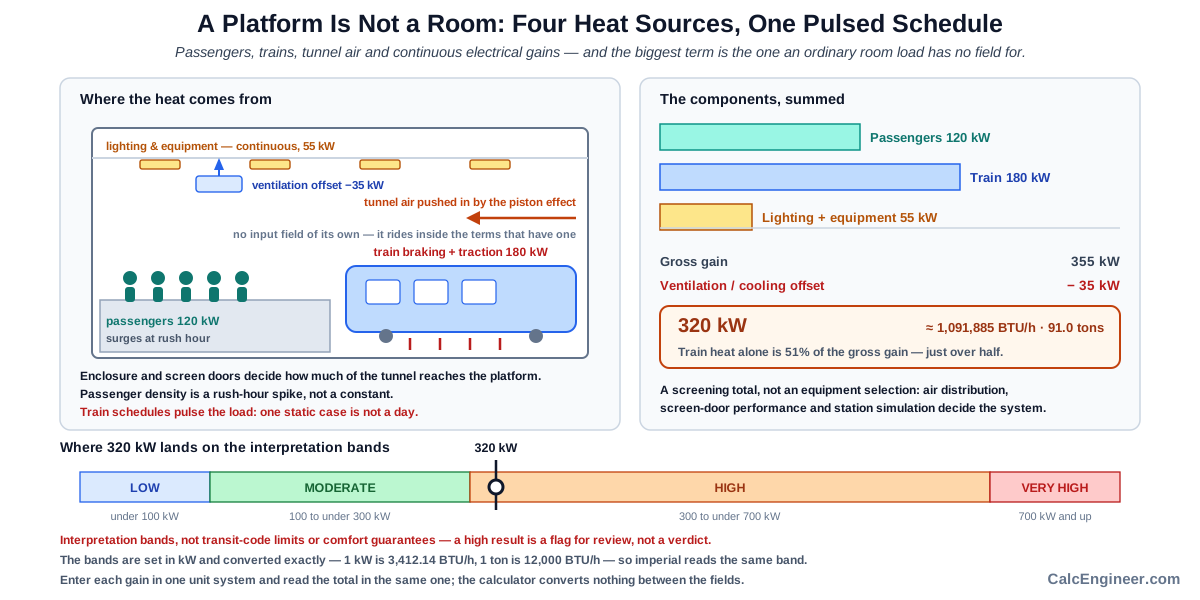
- Passenger occupancy — each person generates sensible and latent heat; the load scales directly with platform density and dwell time
- Train-related heat — heat from braking resistance, traction equipment, and train-induced air movement through the tunnel
- Lighting and equipment — platform lighting, signage, communications equipment, and other continuously operating electrical loads
- Tunnel air infiltration — unconditioned tunnel air entering the platform zone, particularly where platform screen doors are absent or leaky
- Ventilation interaction — the degree to which ventilation or mechanical cooling offsets the above gains
Why Subway Platform Load Is Different from Standard HVAC
Ordinary commercial HVAC models assume a relatively stable, well-bounded space with predictable occupancy and no large moving heat sources. A subway platform violates nearly all of those assumptions. Train schedules drive pulsed load events. Passenger density can spike dramatically at rush hour or during service disruptions. Tunnel air carries heat from the broader underground network. Even platform geometry — open, semi-enclosed, or fully enclosed with screen doors — changes the thermal behavior fundamentally.
This means subway platform HVAC design must account for operational variability, tunnel interaction, and the specific characteristics of the station environment in a way that simple room load calculations cannot.
Interpretation Thresholds
These thresholds are preliminary interpretation bands. They are not transit-code limits, comfort guarantees, or universal subway-platform criteria.
The bands are defined in kilowatts, and the kilowatt cut is what decides the category. The BTU/h and ton columns are the same three cuts converted exactly at 1 kW = 3,412.14 BTU/h and 1 refrigeration ton = 12,000 BTU/h — they are not rounded independently, so one platform cannot fall in different categories in the two unit systems.
| Category | kW | BTU/h | tons |
|---|---|---|---|
| LOW | < 100 | < 341,214 | < 28.43 |
| MODERATE | 100 to < 300 | 341,214 to < 1,023,642 | 28.43 to < 85.30 |
| HIGH | 300 to < 700 | 1,023,642 to < 2,388,498 | 85.30 to < 199.04 |
| VERY HIGH | ≥ 700 | ≥ 2,388,498 | ≥ 199.04 |
The ranges are continuous, not whole-number: 299.5 kW is MODERATE, 300.0 kW is HIGH, and there is no value between the two bands that belongs to neither.
Engineering Applications
This calculator can be used for preliminary subway platform cooling-load review, station HVAC concept design, platform ventilation and cooling screening, train-influence load checks, passenger-surge load checks, platform environmental planning, comparative option studies, and quick sanity checks before detailed simulation.
It is not a substitute for dynamic station environmental simulation, CFD airflow modeling, or full station HVAC system design. Those tools are needed when final equipment sizing, compliance verification, or detailed performance analysis is required.
Key Facts
- Train braking and train presence can be major environmental heat sources in underground metro systems.
- Passenger density during surge periods can substantially increase platform heat load.
- Tunnel air transfer can change platform heat conditions depending on station enclosure and ventilation design.
- Platform screen doors affect the exchange between platform and tunnel environments.
- Lighting and equipment loads in underground stations are often significant due to continuous operation.
Applications
- Preliminary subway platform cooling-load review.
- Station HVAC concept design.
- Platform ventilation and cooling screening.
- Train-influence load checks.
- Passenger-surge load checks.
- Platform environmental planning.
- Comparative option studies.
- Quick sanity checks before detailed simulation.
Example Calculation
Metric Example
Inputs:
- Passenger Load = 120 kW
- Train Load = 180 kW
- Lighting + Equipment = 55 kW
- Ventilation Offset = 35 kW
Calculation:
Total Heat Load = 120 + 180 + 55 − 35
Total Heat Load = 320 kW
Result:
Subway Platform Heat Load = 320 kW
Category = HIGH
This indicates substantial platform cooling demand and should trigger review of passenger loading, train influence, tunnel-air effects, and ventilation strategy.
Imperial Example
The same platform, with each component entered in BTU/h. The component values are the metric example converted at 1 kW = 3,412.14 BTU/h and rounded, so the total is written with ≈ rather than =.
Inputs:
- Passenger Load = 409,500 BTU/h
- Train Load = 614,200 BTU/h
- Lighting + Equipment = 187,700 BTU/h
- Ventilation Offset = 119,400 BTU/h
Calculation:
Total Heat Load = 409,500 + 614,200 + 187,700 − 119,400
Total Heat Load ≈ 1,092,000 BTU/h

Equivalent Cooling = 1,092,000 ÷ 12,000 = 91.0 tons
Result:
Subway Platform Heat Load ≈ 1,092,000 BTU/h
Equivalent Cooling = 91.0 tons
Category = HIGH
Both examples describe one platform: 320 kW is 1,091,885 BTU/h without the intermediate rounding. The interpretation bands are set in kilowatts and converted exactly, so the same platform cannot read one category in Metric and another in Imperial.
Standards & References
- Subway Environmental Design Handbook, Volume I — Principles and Applications, Second Edition The profile reference for environmental control in underground rapid transit. Volume I follows the engineering sequence from design criteria through load analysis to system concept and equipment selection, covering temperature, humidity, air quality and rapid pressure change. Published 1976 by the U.S. Department of Transportation, Urban Mass Transportation Administration.
- ASHRAE — Sustainable Design in Metro Stations (conference paper, 2018) A conference paper rather than an ASHRAE standard, presented at the 3rd International Conference on Efficient Building Design: Materials and HVAC Equipment Technologies. It sets out HVAC design concepts for metro stations, including platform screen doors isolating the platform from the tunnel and the effect of that isolation on system energy use.
- TRB — Test Simulations of a Single-Track Subway Environment Neil Meltzer, Transportation Research Record 785. Test runs of the Subway Environment Simulation program over a single-track, two-stop route, varying schedule, alignment, distributed heat sources, blockage ratio, vent shafts and fans — the dynamic analysis that a single static total like the one on this page only stands in for.
- NFPA 130 — Standard for Fixed Guideway Transit and Passenger Rail Systems The profile code for fixed guideway transit, covering stations, trainways and emergency ventilation. It is a life-safety document: it is not the source of the LOW / MODERATE / HIGH / VERY HIGH bands used here, and no result on this page is an NFPA 130 compliance check.
Limitations
- This calculator provides a simplified preliminary estimate only.
- It does not fully model: dynamic train movement through time, detailed tunnel airflow simulation, full passenger-flow transients, radiative exchange, moisture or latent load, platform screen door performance, emergency smoke-control cases, or full CFD air-distribution behavior.
- It does not explicitly account for thermal bridges or infiltration through station entrances, exits, vestibules, or connecting spaces.
- Final platform HVAC design should also consider train operation, tunnel interaction, occupancy variability, ventilation effectiveness, and station geometry.
- Detailed system design for underground transit spaces typically requires broader analysis than a single static cooling-load result.
Common Mistakes to Avoid
- Treating a subway platform like an ordinary commercial room.
- Ignoring train-related heat effects.
- Ignoring tunnel-air influence or infiltration.
- Underestimating passenger surge conditions.
- Mixing units between kW, BTU/h, and tons.
- Treating illustrative interpretation bands like design standards.
- Using one static case as if it represents all operating periods.
Frequently Asked Questions
What does this calculator estimate?
Is this the same as a normal room cooling-load calculation?
Why does train influence matter so much?
Does a high result always mean the design is poor?
Why can tunnel air matter on a platform?
Does this calculator prove passenger comfort?
What if the result is extremely high?
Can I size final equipment directly from this result?
Frequently Used Together
Engineers often use these calculators in combination for complete project workflows:
Related Calculators
Explore similar calculators that might be useful for your project:
Free HVAC Quick Reference. Formulas & Checks.
Airflow, loads, refrigerant & duct checks — one printable page for the job site.
- Key formulas for airflow, load, refrigerant charge & duct sizing
- Quick sanity checks for the most common HVAC design errors
- Printable one-pager for field use and design review
No spam. Unsubscribe any time.
Calculate
Enter a positive value to subtract from total load. Leave blank or enter 0 if no offset applies.