Ship Engine Room Ventilation Calculator
On this page
Calculate
Total installed diesel engine power in horsepower — converted to kW at 0.745699872 before the calculation runs
Used to determine the ISO 8861 default combustion-air requirement when manufacturer data is not available.
Percentage of engine power released as heat into the engine room. Use manufacturer data where available.
Temperature increase allowed inside the engine room. The ISO 8861 design basis limit is 22.5°F — a larger value is flagged in the results.
Overview
The Ship Engine Room Ventilation Calculator estimates the airflow a marine machinery space needs so the installed diesel engines can draw combustion air and the space can carry away the heat they release. Enter engine power, engine type, the radiated heat loss factor and the allowable temperature rise, and the calculator returns the required airflow together with every intermediate quantity it used to get there.
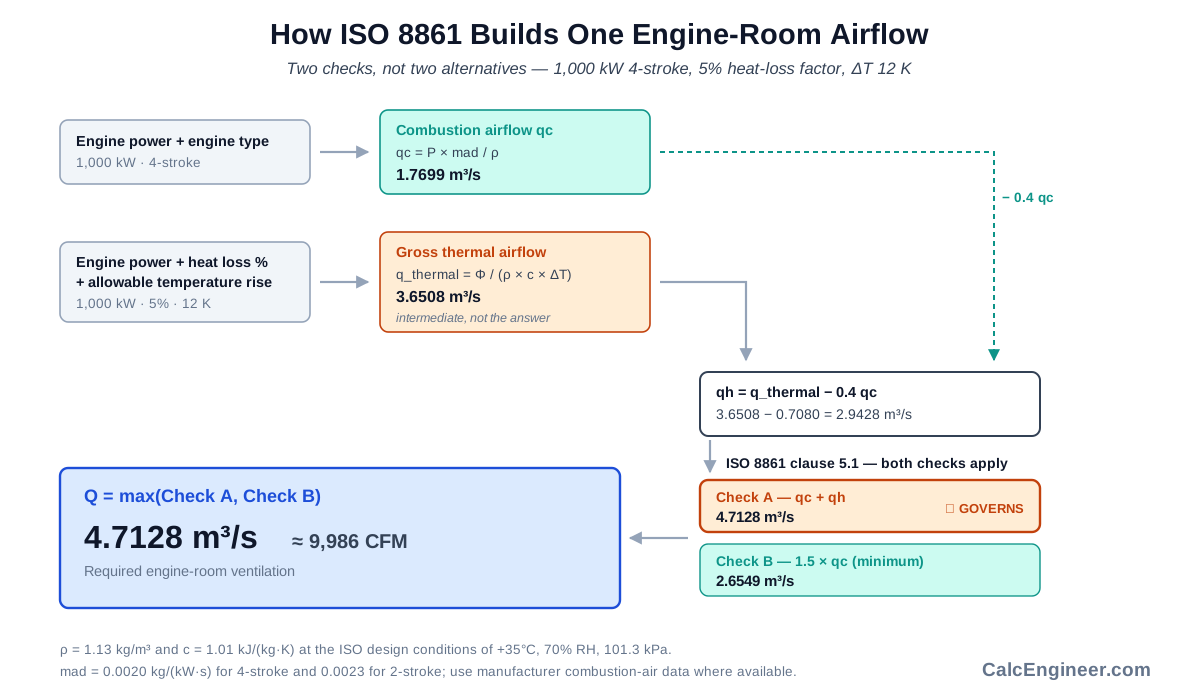
The calculation follows the total-airflow rule of ISO 8861:1998. The standard does not treat combustion air and heat removal as rival demands to choose between. It builds one airflow out of both — the combustion air quantity qc plus the heat-evacuation quantity qh — and then applies a separate mandatory minimum of 1.5 qc. The required airflow is the larger of those two checks, so a machinery space with almost no heat load still receives combustion air plus fifty percent.
The heat-evacuation quantity is not the same thing as the gross airflow needed to carry the heat away. Combustion air already passes through the space and takes part of the heat with it, so ISO 8861 deducts 0.4 qc from the gross thermal airflow. This calculator reports the gross figure and the ISO component as separate lines, so the deduction is visible rather than buried inside a single number.
The whole calculation runs in SI — kilowatts, kilograms, kelvin and cubic metres per second — with Imperial inputs converted in and the answer converted out at 2118.880003 CFM per m³/s. Switching the unit toggle therefore changes only the presentation. Treat the result as a preliminary airflow basis: final fan selection still needs static pressure, louver and duct losses, redundancy, and vessel-specific class approval.
How to Use This Calculator
Select Imperial or Metric units using the toggle at the top of the page.
Enter the installed engine power — kW for Metric, HP for Imperial. Imperial power is converted to kilowatts before anything is calculated.
Choose the engine type. 4-stroke and 2-stroke diesels have different ISO 8861 combustion-air guidance values, 0.0020 and 0.0023 kg/(kW·s).
Enter the radiated heat loss factor as a percentage of engine power released into the engine room as heat. Use engine-maker data whenever you have it.
Enter the allowable engine room temperature rise — °C in Metric, °F in Imperial. The ISO 8861 design basis is 12.5 K, which is 22.5°F.
Click Calculate to run the calculation.
Compare the two ISO checks. Check A is qc + qh, Check B is the 1.5 qc minimum, and the required ventilation is whichever is larger. Use it as a preliminary basis for marine fan sizing.
This is an ISO 8861-based preliminary calculation covering one diesel-engine group. Final fan selection should account for actual static pressure, intake and exhaust louver losses, duct routing, redundancy requirements, and class-rule compliance.
Inputs & Outputs
Inputs
Outputs
Formula
Calculator Formula
ISO 8861:1998 total-airflow model
ISO 8861 does not pick between combustion air and heat removal. Clause 5.1 builds one airflow from both and then applies a separate mandatory floor, and the required airflow is the larger of the two checks:
Q = max(qc + qh, 1.5 × qc)
The whole calculation runs in SI. Imperial power is converted to kilowatts and an Imperial temperature rise to kelvin before anything is computed, and the airflow is converted to CFM only for display, so the unit toggle changes the presentation and never the result.
Step 1 — Combustion Airflow
qc = P × mad / ρ
| Variable | Meaning | Units |
|---|---|---|
| qc | Combustion airflow | m³/s |
| P | Engine power | kW |
| mad | Combustion air requirement | kg/(kW·s) |
| ρ | Air density at ISO design conditions | kg/m³ |
Step 2 — Engine Heat Emission
Φ = P × HL / 100
| Variable | Meaning | Units |
|---|---|---|
| Φ | Heat emitted into the engine room | kW |
| P | Engine power | kW |
| HL | Radiated heat loss factor | % |
Step 3 — Gross Thermal Airflow
q_thermal = Φ / (ρ × c × ΔT)
| Variable | Meaning | Units |
|---|---|---|
| q_thermal | Gross heat-removal airflow | m³/s |
| Φ | Heat emitted into the engine room | kW |
| c | Specific heat capacity of air | kJ/(kg·K) |
| ΔT | Allowable temperature rise | K |
This is an intermediate quantity, not the ISO heat-evacuation term. It is the airflow that would be needed if nothing else removed heat from the space.
Step 4 — ISO Heat-Evacuation Component
qh = max(0, q_thermal − 0.4 × qc)
The combustion air already passes through the machinery space on its way to the engines, so it removes part of the heat before it reaches the extraction fans. ISO 8861 clause 5.3 credits that by deducting 0.4 of the diesel-engine combustion airflow. The full clause also deducts 0.4 of the generator-set combustion air and adds boiler combustion air; with one engine group and no generators or boilers those terms are zero.
The clamp at zero exists only so the result panel never prints a negative airflow. It cannot change the answer: whenever the raw value falls below zero the heat load is tiny, and Check B governs by a wide margin.
Step 5 — ISO Total-Airflow Checks
Q1 = qc + qh
Q2 = 1.5 × qc
Step 6 — Required Ventilation
Q = max(Q1, Q2)
Constants
| Constant | Value | Basis |
|---|---|---|
| ρ | 1.13 kg/m³ | ISO 8861 design conditions: +35°C, 70% RH, 101.3 kPa |
| c | 1.01 kJ/(kg·K) | Specific heat capacity of air |
| mad | 0.0020 kg/(kW·s) | Guidance value for 4-stroke diesel engines |
| mad | 0.0023 kg/(kW·s) | Guidance value for 2-stroke diesel engines |
ISO 8861 recommends using manufacturer data where available; the standard guidance values are used when specific combustion-air data are unavailable.
Unit Conversion
| From | To | Factor |
|---|---|---|
| HP | kW | 0.745699872 |
| ΔT °F | ΔT K | 5 / 9 |
| m³/s | CFM | 2118.880003 |
Calculator Variables
| Variable | Meaning | Units |
|---|---|---|
| enginePower | Total installed diesel engine power | kW (Metric) / HP (Imperial) |
| engineType | 4-stroke or 2-stroke, selects mad | kg/(kW·s) |
| heatLoss | Radiated heat loss factor | % |
| tempRise | Allowable temperature rise | °C (Metric) / °F (Imperial) |
| combustionAirflow | Combustion airflow qc | m³/s / CFM |
| grossHeatRemovalAirflow | Gross thermal airflow q_thermal | m³/s / CFM |
| heatEvacuationComponent | ISO heat-evacuation component qh | m³/s / CFM |
| isoCheckA | qc + qh | m³/s / CFM |
| isoCheckB | 1.5 × qc | m³/s / CFM |
| requiredVentilation | Required engine room ventilation | m³/s / CFM |
What is Ship Engine Room Ventilation?
Ship engine room ventilation is the process of supplying and removing air from a marine machinery space so engines and auxiliary equipment can operate under acceptable thermal and air supply conditions. It serves two functions at once: it feeds combustion air to the engines, and it carries away the heat rejected by machinery, exhaust surfaces and auxiliary equipment.
ISO 8861:1998 combines those two functions into a single airflow rather than choosing between them. The combustion air quantity qc follows from engine power and the air requirement per kilowatt-second. The heat-evacuation quantity qh follows from the heat released into the space, less 0.4 qc, because the combustion air already removes part of that heat as it passes through. Their sum is the first check. The standard then imposes a second, independent check of 1.5 qc, and the required airflow is whichever check is larger.
The allowable temperature rise is the sensitivity that matters most. A tighter limit raises the gross thermal airflow in direct proportion, and with it the heat-evacuation component. Once the heat load falls far enough that qh drops below 0.5 qc, the 1.5 qc check takes over and the required airflow stops responding to temperature at all. ISO 8861 sets its design basis at +35°C ambient with a maximum engine-room rise of 12.5 K.
Engineering Applications
This calculator is used for marine engine room preliminary ventilation sizing, propulsion machinery space airflow checks, generator room ventilation estimates, and early-stage fan selection. It is also useful for comparing ventilation demand across different engine power ratings, engine types, heat rejection scenarios, and temperature-rise assumptions during concept-stage vessel design.
Key Facts
- ISO 8861:1998 sets the total engine room airflow as the larger of two checks: qc + qh, and a minimum of 1.5 × qc.
- The 1.5 × qc minimum means ventilation never falls below combustion air plus fifty percent, however small the heat load is.
- The heat-evacuation term qh deducts 0.4 × qc, because combustion air already carries part of the machinery heat out of the space.
- ISO 8861 design conditions are +35°C, 70% relative humidity and 101.3 kPa, which give an air density of 1.13 kg/m³.
- The ISO 8861 design basis limits engine room temperature rise to 12.5 K.
- Default combustion-air requirements differ by engine type: 0.0020 kg/(kW·s) for 4-stroke and 0.0023 kg/(kW·s) for 2-stroke diesel engines.
- A tighter allowable temperature rise raises the gross thermal airflow in direct proportion, and with it the heat-evacuation component.
Applications
- Marine engine room preliminary ventilation sizing.
- Propulsion machinery space ventilation checks.
- Generator room ventilation estimates.
- Early-stage fan airflow selection.
- Marine HVAC and machinery-space concept design.
- Comparing ventilation demand across different engine sizes and temperature-rise assumptions.
Example Calculation
Worked Example
Inputs:
- Engine power = 1000 kW
- Engine type = 4-stroke diesel
- Heat loss factor = 5%
- Allowable temperature rise = 12°C
Constants:
- mad = 0.0020 kg/(kW·s)
- ρ = 1.13 kg/m³
- c = 1.01 kJ/(kg·K)
Step 1 — Combustion airflow:
qc = 1000 × 0.0020 / 1.13
qc = 1.7699 m³/s
Step 2 — Engine heat emission:
Φ = 1000 × 5 / 100
Φ = 50 kW
Step 3 — Gross thermal airflow:
q_thermal = 50 / (1.13 × 1.01 × 12)
q_thermal = 3.6508 m³/s
Step 4 — ISO heat-evacuation component:
qh = 3.6508 − 0.4 × 1.7699
qh = 2.9428 m³/s
Step 5 — ISO total-airflow checks:
Q1 = 1.7699 + 2.9428 = 4.7128 m³/s
Q2 = 1.5 × 1.7699    = 2.6549 m³/s
Step 6 — Required ventilation:
Q = max(4.7128, 2.6549)
Q = 4.7128 m³/s
Check A governs here: the heat released into the space is large enough that qc + qh clears the 1.5 qc minimum comfortably. This is the calculated minimum engine-room ventilation airflow for the stated inputs and assumptions.
The Same Case in Imperial
This is not a second calculation. It is the same physical case restated, so the answer has to match after rounding.
Inputs:
- Engine power = 1341.02 HP (1000 kW)
- Engine type = 4-stroke diesel
- Heat loss factor = 5%
- Allowable temperature rise = 21.6°F (12 K)
Conversion in:
P = 1341.02 × 0.745699872 = 1000 kW
ΔT = 21.6 × 5 / 9 = 12 K
Conversion out:
Q = 4.7128 m³/s × 2118.880003
Q ≈ 9,986 CFM
Step 6 — Required ventilation:
Q ≈ 9,986 CFM
This is the calculated minimum engine-room ventilation airflow for the stated inputs and assumptions.
Standards & References
- ISO 8861:1998 — Shipbuilding — Engine-room ventilation in diesel-engined ships — Design requirements and basis of calculations The governing standard for this calculator. Clause 4 fixes the design conditions at +35°C, 70% RH and 101.3 kPa with a maximum engine-room temperature rise of 12.5 K. Clause 5.1 sets the total airflow as the larger of qc + qh and 1.5 qc. Clauses 5.2.2 and 5.2.3 give the combustion-air equation and the guidance values of 0.0020 and 0.0023 kg/(kW·s). Clause 5.3 gives the heat-evacuation equation with its 0.4 deduction, and clause 6.1 derives engine heat emission from engine power and a heat-loss percentage.
- ISO 8861:1998 preview extract The publicly available preview of the standard, used to verify the equations, the 0.4 deduction factor and the density and specific-heat constants written into this page.
- Engine-maker project guides and heat-balance data Manufacturer combustion-air and heat-rejection figures for the specific engine model. ISO 8861 gives its guidance values for use when this data is not available, so manufacturer data takes priority over both defaults in this calculator.
- Vessel-specific class rules and statutory requirements Classification-society rules and flag-state requirements govern the final engine-room ventilation design, including fan redundancy, closing appliances and fire-safety arrangements that no airflow calculation covers.
Limitations
- This is a simplified preliminary calculator based on the ISO 8861 design equations within the scope of the four inputs above — not a full ISO 8861 compliance calculation.
- It models one diesel-engine group rather than a complete multi-equipment machinery-space model.
- Separate diesel generator, boiler, electrical, tank, exhaust-pipe and other heat loads are not individually modeled. The full ISO 8861 heat-evacuation equation carries terms for all of them.
- Manufacturer combustion-air and heat-rejection data should be used where available; the 0.0020 and 0.0023 kg/(kW·s) values are the standard's fallback guidance figures.
- It does not calculate duct pressure loss, louver loss, weather intake loss, or fan static pressure.
- It does not model local hot spots, poor airflow distribution, or compartment circulation inefficiencies.
- The result is a sizing airflow only and should not be treated as a full fan selection output.
- Final design must comply with vessel-specific class and statutory requirements.
Common Mistakes to Avoid
- Treating gross heat-removal airflow as an alternative to combustion airflow and simply taking max(qc, q_thermal). ISO 8861 adds them, after deducting 0.4 qc from the thermal side.
- Skipping the 1.5 × qc minimum. Even a machinery space with a very small heat load cannot be ventilated below combustion airflow plus fifty percent.
- Using the gross thermal airflow as qh. The 0.4 qc deduction is part of the ISO equation, not an optional refinement.
- Using a temperature rise greater than the 12.5 K ISO 8861 design basis while still calling the result ISO-consistent.
- Mixing independent Imperial and Metric constants instead of converting one SI calculation. A calculator whose answer changes with the unit toggle has two physical models, not one.
- Using generic combustion-air factors when manufacturer data are available.
- Applying the 4-stroke guidance value to a 2-stroke engine, which understates combustion air by about 15%.
- Confusing allowable temperature rise with the outdoor ambient temperature.
- Treating this as a complete class-compliance calculation instead of a preliminary sizing tool.
Frequently Asked Questions
What does this calculator measure?
How does ISO 8861 determine total engine-room airflow?
Why is the heat-evacuation component smaller than the gross heat-removal airflow?
What happens when the heat load is very small?
Why does lower allowable temperature rise increase airflow?
Can I enter a temperature rise above 12.5 K?
Does this result include static pressure or fan brake power?
Do I need special corrosion-resistant fans for marine engine rooms?
Frequently Used Together
Engineers often use these calculators in combination for complete project workflows:
Related Calculators
Explore similar calculators that might be useful for your project:
Free HVAC Quick Reference. Formulas & Checks.
Airflow, loads, refrigerant & duct checks — one printable page for the job site.
- Key formulas for airflow, load, refrigerant charge & duct sizing
- Quick sanity checks for the most common HVAC design errors
- Printable one-pager for field use and design review
No spam. Unsubscribe any time.
Calculate
Total installed diesel engine power in horsepower — converted to kW at 0.745699872 before the calculation runs
Used to determine the ISO 8861 default combustion-air requirement when manufacturer data is not available.
Percentage of engine power released as heat into the engine room. Use manufacturer data where available.
Temperature increase allowed inside the engine room. The ISO 8861 design basis limit is 22.5°F — a larger value is flagged in the results.