Paint Booth Ventilation Calculator | CFM & m³/h
On this page
Calculate
Booth opening width in ft
Booth opening height in ft
Target booth face velocity in fpm
Overview
The Paint Booth Ventilation Calculator estimates the airflow required to exhaust a spray booth based on booth opening area, target face velocity, and booth type. The result is the required ventilation rate in CFM for Imperial inputs and m³/h for Metric inputs. The model applies a face-velocity approach referenced in NFPA 33 and OSHA 29 CFR 1910.94 for preliminary spray booth airflow screening.
The calculation is driven by four inputs: booth opening width, booth opening height, target face velocity, and booth type factor. Booth opening area scales the base airflow requirement directly. Face velocity sets the strength of airflow across the opening. The booth type factor applies a fixed screening adjustment for Open Face, Crossdraft, Downdraft, and Side Draft configurations, reflecting that some booth layouts require a modestly stronger airflow allowance to maintain effective overspray capture and directional airflow.
This is a preliminary engineering screening tool, not a code-compliance or hazardous-classification calculator. Final paint booth ventilation must be checked against NFPA 33, OSHA 29 CFR 1910.94, the International Mechanical Code, and any project-specific process or safety requirements. The calculator does not address filter pressure drop, solvent concentration, explosion risk, or booth manufacturer specifications.
Use this calculator to estimate whether a proposed booth configuration produces a low, normal, high, or very high ventilation demand before committing to fan selection. It supports initial exhaust fan capacity screening, makeup-air balance review, comparison of face velocity assumptions, and early identification of whether a design looks too aggressive or too conservative before moving to detailed system design.
How to Use This Calculator
Select Imperial or Metric units.
Enter the booth opening width — ft in Imperial, m in Metric.
Enter the booth opening height — ft in Imperial, m in Metric.
Enter the target face velocity — fpm in Imperial, m/s in Metric.
Select the booth type — Open Face, Crossdraft, Downdraft, or Side Draft.
Click Calculate and use the resulting airflow as a preliminary basis for exhaust fan sizing, makeup-air review, booth face-velocity verification, and filter loading and airflow distribution review.
All numeric input fields are empty by default. Enter values for all fields before calculating. The booth type is pre-selected to Open Face.
Inputs & Outputs
Inputs
Outputs
Formula
Imperial Formula
CFM_required = Width × Height × FaceVelocity × F_booth
Metric Formula
Q_required = Width × Height × FaceVelocity × 3600 × F_booth
Booth Type Factor
| Booth Type | F_booth |
|---|---|
| Open Face | 1.00 |
| Crossdraft | 1.00 |
| Downdraft | 1.15 |
| Side Draft | 1.10 |
Step-by-Step — Imperial
Step 1: Booth Opening Area
Area = Width × Height
Where:
- Area = booth opening area, ft²
- Width = booth opening width, ft
- Height = booth opening height, ft
Step 2: Booth Type Factor — select from the table above.
Step 3: Required Ventilation Rate
CFM_required = Width × Height × FaceVelocity × F_booth
Where:
- Width = booth opening width, ft
- Height = booth opening height, ft
- FaceVelocity = target face velocity, fpm
- F_booth = booth type factor (dimensionless)
- CFM_required = required ventilation rate, CFM
Step-by-Step — Metric
Step 1: Booth Opening Area
Area = Width × Height
Where:
- Area = booth opening area, m²
- Width = booth opening width, m
- Height = booth opening height, m
Step 2: Booth Type Factor — same table as Imperial.
Step 3: Required Ventilation Rate
Q_required = Width × Height × FaceVelocity × 3600 × F_booth
Where:
- Width = booth opening width, m
- Height = booth opening height, m
- FaceVelocity = target face velocity, m/s
- 3600 converts m³/s to m³/h
- F_booth = booth type factor (dimensionless)
- Q_required = required ventilation rate, m³/h
Variable Reference
| Variable | Meaning | Units |
|---|---|---|
| Width | Booth opening width | ft / m |
| Height | Booth opening height | ft / m |
| Area | Booth opening area | ft² / m² |
| FaceVelocity | Target face velocity | fpm / m/s |
| F_booth | Booth type factor | dimensionless |
| CFM_required / Q_required | Required ventilation rate (output) | CFM / m³/h |
Formula Meaning
Required ventilation increases when booth opening area is larger, target face velocity is higher, or the booth type factor is higher. That is the basis of the result classification. A LOW result means a relatively modest booth airflow requirement. A NORMAL result means a practical paint booth ventilation range. A HIGH or VERY HIGH result means a stronger airflow demand and should trigger review of fan sizing, makeup air, filter loading, and airflow uniformity.
Decision Bands — Imperial (CFM)
| Category | Range |
|---|---|
| LOW | < 5,000 CFM |
| NORMAL | 5,000 – 14,999 CFM |
| HIGH | 15,000 – 29,999 CFM |
| VERY HIGH | ≥ 30,000 CFM |
Decision Bands — Metric (m³/h)
| Category | Range |
|---|---|
| LOW | < 8,495 m³/h |
| NORMAL | 8,495 – 25,484 m³/h |
| HIGH | 25,485 – 50,969 m³/h |
| VERY HIGH | ≥ 50,970 m³/h |
What is Paint Booth Ventilation
Paint booth ventilation is the controlled movement of air through a spray booth to capture overspray, remove contaminants from the work zone, maintain directional airflow through the booth, and support finish quality and a cleaner working environment.
In practical design, booth ventilation depends mainly on booth opening size, target face velocity, booth configuration, exhaust and makeup-air balance, filter loading, and airflow uniformity across the booth face. Unlike general building ventilation driven by occupant density or comfort targets, paint booth ventilation is primarily a source-capture and overspray-removal problem.
The controlling design driver is face velocity across the booth opening — the airflow per unit area needed to move overspray and contaminants away from the spray zone. Required exhaust airflow scales directly with booth opening area and face velocity target.
Engineering Applications
This calculator is useful for paint booth airflow screening, spray booth exhaust sizing, comparing different face velocity assumptions, makeup-air planning, preliminary filter-loading and airflow distribution review, and checking whether a booth airflow requirement looks low, normal, high, or very high before committing to fan selection.
Key Facts About Paint Booth Ventilation
Paint booth airflow demand increases with booth opening area and with target face velocity. Doubling the face velocity target doubles the required ventilation rate for the same booth. Booth configuration modifies the basic area × velocity calculation through the booth type factor, with downdraft and side-draft configurations carrying modest additional allowances over open-face and crossdraft layouts.
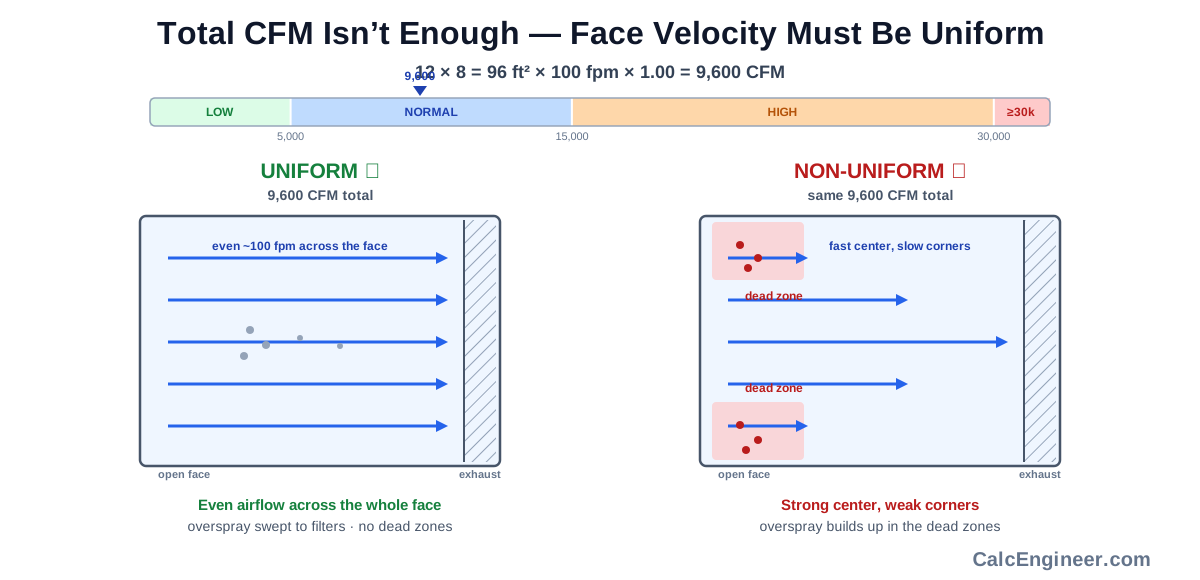
Airflow uniformity across the booth face matters at least as much as total exhaust volume. A booth with the correct total CFM but poor air distribution can still have dead zones that allow overspray to accumulate near the work surface. Makeup air delivery path and inlet configuration also affect whether supply air reaches the booth face uniformly.
Filter loading as filters collect overspray increases system resistance over time, which can reduce delivered airflow below the design value if fans are not adequately sized for the dirty-filter condition.
Practical Tips
When using this calculator, always verify that the face velocity target is realistic for the intended spray process. Very low face velocities may be insufficient for aggressive spray processes or solvent-heavy coatings. Very high face velocities may create turbulence that disrupts the spray pattern or increases overspray losses.
The booth type factor is a fixed screening allowance and should not be treated as a precise engineering multiplier. For final booth design, coordinate with booth manufacturer specifications, applicable code requirements, and project-specific process and safety review.
Important: This calculator provides a simplified booth airflow screening result for preliminary ventilation review. Final paint booth ventilation design should account for actual spray process, coating type, booth geometry, filter loading, makeup-air delivery, fan selection, and applicable code requirements including NFPA 33 and OSHA 29 CFR 1910.94.
Key Facts
- Paint booth airflow demand increases directly with booth opening area.
- Higher target face velocity increases required exhaust airflow proportionally.
- Booth configuration affects effective airflow demand through the booth type factor.
- Airflow uniformity matters, not just total CFM or m³/h.
- Makeup air must be coordinated with exhaust airflow to maintain booth pressure balance.
- This calculator estimates ventilation rate only and does not prove code compliance or hazardous classification.
Applications
- Paint booth airflow screening.
- Spray booth exhaust sizing.
- Comparing different booth face velocity assumptions.
- Makeup-air planning and balance review.
- Preliminary filter-loading and airflow distribution review.
- Checking whether a booth airflow requirement looks low, normal, high, or very high.
Example Calculation
Imperial Example
Given:
- Booth opening width = 12 ft
- Booth opening height = 8 ft
- Target face velocity = 100 fpm
- Booth type = Crossdraft
Step 1: Booth opening area
Area = 12 × 8 = 96 ft²
Step 2: Booth type factor For Crossdraft: F_booth = 1.00
Step 3: Required ventilation
CFM_required = 12 × 8 × 100 × 1.00 = 9,600 CFM
Result: 9,600 CFM → NORMAL — This falls in the NORMAL range and indicates a practical paint booth ventilation requirement.
Metric Example
Given:
- Booth opening width = 4.0 m
- Booth opening height = 2.5 m
- Target face velocity = 0.5 m/s
- Booth type = Downdraft
Step 1: Booth opening area
Area = 4.0 × 2.5 = 10.0 m²
Step 2: Booth type factor For Downdraft: F_booth = 1.15
Step 3: Required ventilation
Q_required = 4.0 × 2.5 × 0.5 × 3600 × 1.15 = 20,700 m³/h
Result: 20,700 m³/h → NORMAL — This falls in the NORMAL range and indicates a moderate but meaningful booth airflow requirement.
Standards & References
- NFPA 33 — Standard for Spray Application Using Flammable or Combustible Materials — covers ventilation requirements for spray finishing operations including paint booths, exhaust systems, and makeup air.
- OSHA 29 CFR 1910.94 — Ventilation (Spray Finishing Operations) — federal occupational health regulation for spray booth ventilation, face velocity minimums, and exhaust requirements.
- ANSI/AIHA Z9.2 — Fundamentals Governing the Design and Operation of Local Exhaust Ventilation Systems — principles for local exhaust design applicable to spray booth capture velocity and exhaust airflow.
- ACGIH Industrial Ventilation: A Manual of Recommended Practice — widely used reference for industrial exhaust ventilation design including spray finishing and coating operations.
- IMC (International Mechanical Code) — Spray Finishing Operations — building code requirements for spray booth ventilation, exhaust, and makeup air.
Limitations
- This is a preliminary paint booth ventilation calculator, not a full code-compliance or process-hazard design tool.
- It uses a fixed calculator-specific airflow model and does not calculate: solvent concentration, LEL or explosion risk, fire-code compliance, hazardous area classification, filter pressure drop, duct pressure loss, static pressure, fan brake horsepower, temperature control, or final permit acceptance.
- It does not account for filter resistance, increasing pressure drop as filters load, or the resulting impact on fan selection and real delivered airflow.
- It does not replace booth manufacturer data, detailed exhaust design, or project-specific safety review.
- Actual booth airflow requirements can vary with spray process, coating type, overspray characteristics, booth geometry, operator position, and filter condition.
Common Mistakes to Avoid
- Assuming booth size alone determines airflow.
- Ignoring the effect of target face velocity on total airflow demand.
- Forgetting to coordinate makeup air with exhaust airflow.
- Ignoring filter loading and airflow non-uniformity.
- Treating this as a fire-code or hazardous-classification calculator.
- Using an unrealistically low face velocity target.
- Ignoring booth configuration differences when selecting booth type factor.
- Assuming total airflow alone guarantees good overspray capture.
Frequently Asked Questions
What does this calculator estimate?
Why does booth opening area matter?
Why does target face velocity matter?
Why does booth type matter?
What is a typical face velocity for a paint booth?
What does a VERY HIGH result mean?
Does this calculator account for filter loading?
Does this calculator replace code review?
Frequently Used Together
Engineers often use these calculators in combination for complete project workflows:
Related Calculators
Explore similar calculators that might be useful for your project:
Free HVAC Quick Reference. Formulas & Checks.
Airflow, loads, refrigerant & duct checks — one printable page for the job site.
- Key formulas for airflow, load, refrigerant charge & duct sizing
- Quick sanity checks for the most common HVAC design errors
- Printable one-pager for field use and design review
No spam. Unsubscribe any time.
Calculate
Booth opening width in ft
Booth opening height in ft
Target booth face velocity in fpm