NEC Service Entrance Size Calculator
On this page
Calculate
Scope is single-family and individual units. Commercial occupancies are out of scope.
Both runs both methods and uses the lower demand — industry practice for qualifying dwellings.
Residential standard is 120/240V single-phase. Three-phase used in some 208Y/120V building configurations.
Habitable area only — exclude garages, open porches, unfinished spaces per NEC 220.12. Drives 3 VA/ft² general lighting load.
Auto-size finds the smallest NEC 240.6(A) standard rating meeting calculated demand. Manual evaluates a specific rating.
Electric range or oven nameplate kW rating. NEC Table 220.55 demand factor applied. Enter 0 if none.
Electric dryer nameplate VA. NEC 220.54 applies 5000 VA minimum. Enter 0 if none or gas.
Nameplate VA or watts. Counted at 100% demand. Enter 0 if gas, tankless gas, or none.
Compressor nameplate VA or watts. NEC 220.60 non-coincident: larger of heating vs cooling is used. Enter 0 if no cooling.
Heat pump compressor nameplate VA. NEC 220.60 non-coincident load applies. Enter 0 if no electric heating.
Supplemental heat, EV charger, fixed appliances, motor, other loads, continuous load, future reserve. Open to add.
Overview
This calculator sizes a residential electrical service per NEC Article 220 — the calculation an electrician or plan reviewer runs before pulling a permit for a new dwelling, a panel upgrade, an EV charger, or an all-electric conversion. It implements both recognized approaches: the Standard Method of Article 220 Part III with its category-by-category demand factors, and the Optional Method of 220.82 with the aggregate 100%/40% factor, and can run them side by side and take the lower result, which is common industry practice for qualifying dwellings.
Enter the habitable square footage and the electric loads actually present — range, dryer, water heater, HVAC with or without supplemental heat, EV charging, fixed appliances — and the calculator returns the calculated demand in VA and amperes, utilization of the selected service, and the smallest standard rating from NEC 240.6(A) that carries the load. The result distinguishes code adequacy from practical headroom: a service above 80% utilization is flagged AT-LIMIT as a planning signal, not a code violation.
How to Use the NEC Service Entrance Size Calculator
Select dwelling type — single-family or individual unit in multi-family.
Select calculation method — Standard, Optional, or Both (compare). Selecting Both runs the comparison and uses the lower value per industry practice.
Select system voltage — 120/240V single-phase 3-wire (most common residential) or appropriate alternative.
Enter dwelling square footage — habitable area only. Exclude garages, open porches, and unfinished spaces per NEC 220.12.
Set service rating mode — Auto-Size (recommended for new calculations) or Manual (to evaluate a specific service rating).
If Manual mode: select service rating from 100, 125, 150, 200, 400, or 600 A.
Enter load inputs: range kW (if electric), dryer VA (if electric), water heater VA (if electric), HVAC cooling and heating VA, supplemental heat strip VA.
Set the supplemental heat interlock flag if a heat pump with supplemental heat is present — this affects demand by 10–20%.
Enter fixed appliances (dishwasher, disposal, microwave, blower, etc.) — the 75% demand factor per NEC 220.53 applies automatically when 4 or more are entered.
Enter EV charger VA and outlets count — NEC 220.57 demand factors apply automatically for 2 or more outlets.
Enter largest motor VA if significant — set the 'already counted' flag to prevent double-counting the nameplate.
Click Calculate. Review the status badge, demand breakdown, and top contributors to understand what drives the service size.
All load inputs are optional except square footage. Enter only the electric loads present in the dwelling — leave gas appliance fields blank. The calculator uses NEC 2023 Article 220. Verify the code edition adopted by the AHJ.
Inputs & Outputs
Inputs
Outputs
Formula
NEC Service Entrance Sizing Formulas
Standard Method (NEC 220 Part III)
Step 1 — General Lighting & Small Appliance Load (NEC 220.12, 220.52):
GL_total = (sq_ft × 3) + (small_appliance_circuits × 1500) + (laundry_circuit ? 1500 : 0)
Step 2 — General Lighting Demand (NEC Table 220.42 — dwelling):
GL_demand = MIN(GL_total, 3000) × 1.00
          + MAX(0, MIN(GL_total − 3000, 117000)) × 0.35
          + MAX(0, GL_total − 120000) × 0.25
Step 3 — Cooking Equipment Demand (NEC Table 220.55):
Range_demand = 8 kW for single range ≤ 12 kW
             = 8 kW + 5% × (kW − 12) × 1000 for 12 kW < range ≤ 27 kW
Step 4 — Dryer Demand (NEC 220.54):
Dryer_demand = MAX(dryer_nameplate_va, 5000) [if dryer present]
Step 5 — HVAC Non-Coincident (NEC 220.60):
HVAC_demand = MAX(hvac_heating_va + supplemental_heat_va, hvac_cooling_va)
Step 6 — Fixed Appliances (NEC 220.53):
Fixed_demand = fixed_total × 0.75   [when 4 or more fixed appliances]
            = fixed_total × 1.00   [when fewer than 4]
Step 7 — Largest Motor (NEC 220.50 / 430.24):
LM_addition = largest_motor_va × 0.25  [when already counted elsewhere]
            = largest_motor_va × 1.25  [when NOT already counted]
Step 8 — EV Charger (NEC 625.42 / 220.57):
EV_demand = ev_charger_va × 1.00            [for 1 outlet]
          = ev_charger_va × 0.60            [for 2 outlets]
          = ev_charger_va × factor          [for 3+ outlets per 220.57]
Step 9 — Continuous Load Adder (NEC 215.3 / 230.42):
Cont_addition = continuous_load_va × 0.25 [25% adder on already-counted portion]
Step 10 — Total Standard Method Demand:
Demand_VA = GL_demand + Range_demand + Dryer_demand + HVAC_demand
          + Fixed_demand + WH_demand + LM_addition + EV_demand
          + Other_demand + Cont_addition
Optional Method (NEC 220.82)
Step 1 — General Loads (full nameplate, no category demand factors):
General_loads = (sq_ft × 3) + small_appliances + laundry
              + range_full_nameplate + dryer_nameplate + water_heater
              + fixed_appliances_total + EV_demand_after_220.57
Step 2 — General Demand (NEC 220.82(B)):
General_demand = MIN(General_loads, 10000) × 1.00
              + MAX(0, General_loads − 10000) × 0.40
Step 3 — HVAC per NEC 220.82(C):
Case A (A/C only):            HVAC_demand = cooling × 1.00
Case B (heat pump only):      HVAC_demand = MAX(cooling, heating) × 1.00
Case C (heat pump + supp, not interlocked):  HVAC_heat = heating + supp × 0.65
Case C (heat pump + supp, interlocked):      HVAC_heat = MAX(heating, supp)
                                             HVAC_demand = MAX(cooling, HVAC_heat)
Step 4 — Total Optional Method Demand:
Demand_VA_optional = General_demand + HVAC_demand + LM_addition_optional
Demand Current Conversion
Single-phase: I_demand = Demand_VA / V_LL
Three-phase:  I_demand = Demand_VA / (V_LL × √3)
Service Utilization
utilization = (I_demand / service_rating_amps) × 100
Auto-Size Logic
recommended_rating = smallest in [100, 125, 150, 200, 400, 600]
                     where rating ≥ I_demand AND rating ≥ 100  (NEC 230.79(C) minimum)
Standard Method versus Optional Method
The choice between Standard Method (NEC 220 Part III) and Optional Method (NEC 220.82) has significant practical consequences for service sizing. For typical modern single-family dwellings with electric range, dryer, water heater, and HVAC, Optional Method per 220.82 produces 10–25% lower calculated demand than Standard Method per 220 Part III. The reason is the aggregate demand factor: Optional Method sums all general loads and applies 100% to the first 10 kVA and 40% to the remainder, whereas Standard Method applies category-specific factors that are individually less aggressive than the aggregate 40% on the bulk.
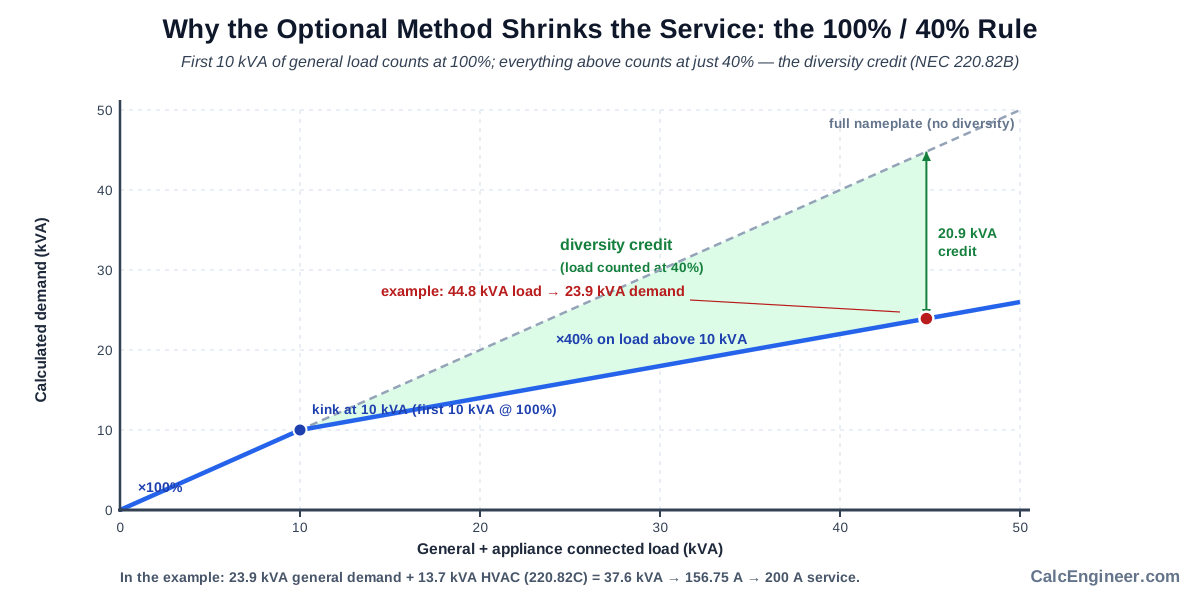
For a 2,500 sq ft all-electric dwelling with range 12 kW, dryer 5500 VA, water heater 4500 VA, AC 6000 VA, EV charger 9600 VA, and typical fixed appliances, Standard Method might calculate 180 A demand while Optional Method calculates 130 A demand — a 38% difference that can mean the difference between a 200 A service and a 150 A service.
Both methods are valid per NEC. Industry practice for qualifying dwellings is to calculate both ways and use whichever produces the lower demand, provided eligibility for Optional Method. The Optional Method eligibility depends on dwelling type only — not on the selected service rating size.
Connected Load vs Calculated Demand
Connected Load is the sum of all nameplate ratings of every load on the service — what the building would draw if every device operated at maximum simultaneously. Calculated Demand is what remains after applying NEC Article 220 demand factors that recognize realistic diversity. The two are not interchangeable.
For a typical 2,000 sq ft single-family dwelling with electric range, dryer, water heater, and HVAC, Connected Load might be 65–75 kVA while Calculated Demand might be 25–30 kVA — a 60% reduction. The reduction reflects that the range, dryer, water heater, and HVAC equipment do not all operate at full nameplate simultaneously in normal residential use.
NEC 230.79 sizes the service to Calculated Demand, not Connected Load. Sizing to Connected Load would require 300+ A residential services routinely, which is impractical and not what the code intends. The most common error in service sizing is mistaking Connected Load for Calculated Demand.
100 A vs 200 A Service — When Do You Need an Upgrade?
The 100 A versus 200 A question dominates residential service sizing. NEC 230.79(C) sets 100 A as the minimum for one-family dwellings. A typical 100 A service comfortably serves a small dwelling (1,200–1,500 sq ft) with a mix of gas appliances and electric AC up to about 3 tons. Calculated demand under Optional Method typically lands at 60–85 A for this profile.
The same 100 A service is frequently inadequate for modern all-electric dwellings. Adding any one of the following commonly pushes the service to UNDERSIZED: Level 2 EV charger at 32–48 A continuous, heat pump conversion replacing gas furnace with supplemental heat strip, electric range conversion from gas (8 kW demand per Table 220.55), or heat pump water heater (4.5 kW at 100%). A 200 A service comfortably handles modern all-electric dwellings up to 3,500–4,500 sq ft with EV charging, heat pump heating, and electric range, dryer, water heater.
Heat Pump and Supplemental Heat Service Calculation
Heat pumps with electric supplemental heat strips are increasingly common in modern residential construction and retrofits, and their service load calculation per NEC 220.82(C) has nuances that most simplified calculators miss. The key distinction is whether the heat pump compressor and the supplemental heat strip are interlocked (cannot run simultaneously) or not (can run simultaneously during defrost cycles, setback recovery, or extreme cold).
NEC 220.82(C)(3) provides two different demand calculations. When interlocked: HVAC_heat_demand = MAX(compressor, supplemental). When NOT interlocked (typical residential): HVAC_heat_demand = compressor × 100% + supplemental × 65%. For a 3-ton heat pump with 7.2 kW compressor and 10 kW supplemental heat strip, the difference is 3,700 VA (roughly 15 A on a 240V service) — which can shift the recommended service rating from 150 A to 200 A.
The default assumption in this calculator is NOT interlocked, reflecting typical residential operation where the supplemental heat strip can engage during defrost cycles and morning setback recovery while the compressor is running.
Key Facts
- Optional Method per NEC 220.82 typically yields 10–25% lower calculated demand than Standard Method for qualifying dwellings due to the aggregate 40% demand factor on loads above 10 kVA.
- NEC 230.79(C) sets 100 A as the minimum service disconnecting means rating for one-family dwellings. Many local jurisdictions require 200 A minimum for new residential construction.
- Standard residential service ratings per NEC 240.6(A): 100, 125, 150, 200, 400, 600 A. Note: 320 A is NOT a NEC 240.6(A) standard rating — it is market shorthand for 320 A continuous-rated meter sockets serving 400 A class services.
- The 80% utilization threshold for AT-LIMIT is industry guidance recommending 25% spare capacity for modern residential load growth (EV, heat pump, all-electric conversion) — NOT a strict NEC code requirement.
- NEC 310.12 dwelling rule allows service entrance conductors to be sized at 83% of the service rating for single-family or individual dwelling unit services 100 A to 400 A. This rule affects conductor sizing only, not the service rating itself.
- For three-phase services, the demand current formula includes √3 once: I = VA / (V_LL × √3). Single-phase formula: I = VA / V_LL. Double √3 is a common calculation error.
- The heat pump supplemental heat interlock setting (220.82(C)(3)) can change calculated demand by 10–20%. Default assumption is NOT interlocked — simultaneous operation possible during defrost cycles.
- NEC 220.57 (NEC 2023+) introduces demand factors for 2 or more EV charging outlets — typically 60% for 2 outlets, reducing calculated EV demand below full nameplate.
- Connected Load (sum of nameplates) is typically 30–60% higher than Calculated Demand (after Article 220 factors). Service rating is sized to Calculated Demand per NEC 230.79.
- Adding a single Level 2 EV charger (40 A / 9.6 kW) to a typical existing 100 A dwelling commonly increases calculated demand by 16–30 A, frequently pushing the service from ADEQUATE to UNDERSIZED.
Applications
- New residential construction — sizing the service for new single-family or multi-family individual unit with electric loads.
- Service upgrade evaluation — determining if an existing 100 A or 150 A service is adequate after adding an EV charger, heat pump, or all-electric appliance package.
- All-electric conversion — sizing service for a dwelling converting from gas appliances to electric range, electric dryer, heat pump water heater, heat pump heating, and EV charging.
- Method comparison documentation — comparing Standard Method vs Optional Method for AHJ permit submittal, especially when the lower demand allows a smaller standard service rating.
- EV charger addition evaluation — quantifying how much a Level 2 EV charger adds to calculated demand and whether the existing service can accommodate it.
- Heat pump retrofit — calculating the service impact of a heat pump conversion with supplemental electric heat strip, with proper NEC 220.82(C)(3) interlock treatment.
Example Calculation
Example — Modern All-Electric Dwelling, 2,200 sq ft, Optional Method
Inputs: single-family dwelling, Optional Method, 120/240V single-phase (V_LL = 240), 2200 sq ft, 2 small appliance circuits, laundry present, range 12 kW, dryer 5500 VA, water heater 4500 VA, AC compressor 7200 VA, supplemental heat strip 10000 VA (NOT interlocked), EV charger 9600 VA × 1 outlet, fixed appliances: dishwasher 1200 VA + disposal 900 VA, manual mode, 100 A service selected.
Step 1 — General Loads (220.82(B)):
General_loads = (2200 × 3) + (2 × 1500) + 1500 + 12000 + 5500 + 4500 + 9600 + (1200 + 900)
             = 6600 + 3000 + 1500 + 12000 + 5500 + 4500 + 9600 + 2100 = 44,800 VA
Step 2 — General Demand (220.82(B) factor):
General_demand = 10000 × 1.00 + (44800 − 10000) × 0.40 = 10000 + 13920 = 23,920 VA
Step 3 — HVAC (220.82(C)(3), NOT interlocked):
HVAC_heat_demand = (7200 × 1.00) + (10000 × 0.65) = 7200 + 6500 = 13,700 VA
HVAC_demand = MAX(7200 cooling, 13700 heat) = 13,700 VA
Step 4 — Total Demand:
Demand_VA = 23920 + 13700 = 37,620 VA
I_demand = 37620 / 240 = 156.75 A
Step 5 — Status at 100 A service:
156.75 A > 100 A → UNDERSIZED
Deficit: 156.75 − 100 = 56.75 A
Step 6 — Recommended rating:
125 A: 156.75 > 125 → fails
150 A: 156.75 > 150 → fails
200 A: 156.75 ≤ 200 → fits. Utilization 156.75/200 = 78.4% → ADEQUATE.
Recommended: 200 A
Result: UNDERSIZED at 100 A. Recommended: 200 A service (78.4% utilization). EV charger (25.5% of demand) and HVAC/supplemental heat (36.4% of demand) are the top contributors.
Standards & References
- NFPA 70 (NEC) Article 220: Branch-Circuit, Feeder, and Service Load Calculations. Free read-only access via NFPA.
- NEC 220.12: Lighting Load for Specified Occupancies (3 VA/sq ft for dwellings).
- NEC Table 220.42: General Lighting Demand Factors for Dwelling Units (35% factor on loads 3001–120,000 VA).
- NEC 220.52: Small-Appliance and Laundry Load (1500 VA each circuit).
- NEC 220.53: Fixed Appliances — 75% demand factor when 4 or more on same feeder/service.
- NEC 220.54: Electric Clothes Dryers — 5000 VA minimum demand.
- NEC Table 220.55: Cooking Equipment Demand Factors for household ranges.
- NEC 220.60: Noncoincident Loads — larger of heating or cooling load taken.
- NEC 220.50 / 430.24: Motor load — largest motor receives 25% adder on top of nameplate.
- NEC 220.82: Optional Method for Dwelling Units.
- NEC 220.82(C): Heating and Air-Conditioning Load (with heat pump interlock provisions).
- NEC 220.57: Electric Vehicle Charging Demand Factors (NEC 2023+).
- NEC 215.3 / 230.42: Continuous loads require 125% sizing — 25% adder applied by calculator.
- NEC 230.79(C): 100 A minimum service disconnecting means rating for one-family dwellings.
- NEC 240.6(A): Standard Ampere Ratings. Residential subset: 100, 125, 150, 200, 400, 600 A.
- NEC 310.12: Single-Phase Dwelling Services — 83% rule for service entrance conductor sizing.
- NEC 230.40: Service Conductors — multiple service drop/lateral provisions for service split.
- OSHA 1910.305: Wiring methods, components, and equipment for general use. Free federal regulation.
- Mike Holt Electrical NEC Training: Industry reference for NEC service entrance calculations.
Units
This calculator uses United States customary units throughout. Service ratings are in amperes (A), load values in volt-amperes (VA), range ratings in kilowatts (kW), and dwelling area in square feet (ft²). The sq ft input follows NEC 220.12 which is calibrated to imperial units. Approximate metric: 1 ft² ≈ 0.0929 m².
Limitations
- Calculator implements NEC 2023 (NFPA 70-2023) Article 220 for residential dwelling occupancies only. Verify the code edition adopted by the authority having jurisdiction.
- Scope is single-family dwellings and individual dwelling units within multi-family buildings. Commercial occupancies, specialized occupancies, and multi-family building entire-service calculations (NEC 220.84) are out of scope.
- Standard residential ratings array: [100, 125, 150, 200, 400, 600] per NEC 240.6(A). 320 A is excluded as not a NEC 240.6(A) standard rating.
- 600 A is the upper bound — above 600 A, INFEASIBLE is returned with direction-of-travel alternatives requiring engineering review.
- Optional Method (NEC 220.82) eligibility checked by dwelling type only. The NEC 230.79(C) 100 A minimum is enforced as a separate downstream constraint on the recommended rating.
- Heat pump treatment per NEC 220.82(C)(3) is controlled by the Supplemental Heat Interlock selector. Default is NOT interlocked (simultaneous operation possible).
- NEC 220.57 EV demand factors apply only when the Number of EV Outlets is 2 or more (NEC 2023+). Earlier NEC editions may require 100% per outlet.
- Fixed appliances entered as individual VA values; up to 4 separate entries supported. The range, dryer, HVAC, and water heater are entered separately and are NOT counted in the fixed appliance list.
- Calculator does not perform service entrance conductor sizing per NEC 310.12 (use Wire Size Calculator), grounding electrode conductor sizing, SCCR verification, voltage drop, or conduit fill.
- AT-LIMIT 80% utilization threshold is industry practice for residential headroom, NOT a strict NEC requirement.
Common Mistakes to Avoid
- Mistaking Connected Load for Calculated Demand. Connected Load (sum of nameplates) is 30–60% higher than Calculated Demand. Service rating is sized to Calculated Demand per NEC 230.79.
- Including garage, open porch, or unfinished space square footage. NEC 220.12 dwelling general lighting applies only to habitable area. A 400 sq ft garage adds ~1,200 VA to GL before demand factors.
- Tying Optional Method eligibility to the selected service rating. NEC 220.82 is eligible based on dwelling type only — not on the chosen service rating.
- Skipping the supplemental heat interlock distinction. NEC 220.82(C)(3) requires different treatment based on whether the heat pump compressor and supplemental heat strip can operate simultaneously.
- Counting the largest motor twice. NEC 220.50 / 430.24 add 25% to the largest motor. The nameplate itself is typically already in fixed appliances or HVAC. Set the 'already counted' flag correctly.
- Treating continuous load as a new load. Continuous load VA is the portion of already-counted load requiring the 125% multiplier — enter only the already-counted continuous portion, not a new separate load.
- Using 320 A as a NEC 240.6(A) standard rating. NEC 240.6(A) does not list 320 A. Use 400 A in the calculator and configure 320 A meter equipment separately.
- Applying double √3 in three-phase formula. The correct formula is I = VA / (V_LL × √3) — √3 appears once only.
- Confusing AT-LIMIT with a code violation. AT-LIMIT (utilization 80–100%) is fully code-compliant per NEC 230.79. The 80% threshold is industry practice for headroom, not a strict code requirement.
Frequently Asked Questions
Is 100 A service enough for a modern house?
Do I need 200 A service for an EV charger?
What is the difference between Standard Method and Optional Method?
How does the heat pump supplemental heat strip affect the calculation?
What does AT-LIMIT mean — is my service inadequate?
Why isn't 320 A a standard service rating in this calculator?
What does NEC 310.12 do for residential service entrance conductors?
How does garage square footage affect the service size calculation?
Frequently Used Together
Engineers often use these calculators in combination for complete project workflows:
Related Calculators
Explore similar calculators that might be useful for your project:
Electrical Quick Reference — Keep It Open During Design
8 NEC formulas for voltage drop, ampacity, motor current, and CT burden. One sheet, every project.
- Voltage drop by NEC method — single-phase and 3-phase
- Ampacity with temperature & grouping derating (NEC 310.15)
- %VD limits by circuit type: branch, feeder, sensitive loads
No spam. Unsubscribe any time.
Calculate
Scope is single-family and individual units. Commercial occupancies are out of scope.
Both runs both methods and uses the lower demand — industry practice for qualifying dwellings.
Residential standard is 120/240V single-phase. Three-phase used in some 208Y/120V building configurations.
Habitable area only — exclude garages, open porches, unfinished spaces per NEC 220.12. Drives 3 VA/ft² general lighting load.
Auto-size finds the smallest NEC 240.6(A) standard rating meeting calculated demand. Manual evaluates a specific rating.
Electric range or oven nameplate kW rating. NEC Table 220.55 demand factor applied. Enter 0 if none.
Electric dryer nameplate VA. NEC 220.54 applies 5000 VA minimum. Enter 0 if none or gas.
Nameplate VA or watts. Counted at 100% demand. Enter 0 if gas, tankless gas, or none.
Compressor nameplate VA or watts. NEC 220.60 non-coincident: larger of heating vs cooling is used. Enter 0 if no cooling.
Heat pump compressor nameplate VA. NEC 220.60 non-coincident load applies. Enter 0 if no electric heating.
Supplemental heat, EV charger, fixed appliances, motor, other loads, continuous load, future reserve. Open to add.