Conduit Fill Calculator (NEC)
On this page
Calculate
EMT caps at 4 in trade size. RMC, IMC, PVC, RTRC reach 6 in.
Auto-size finds the smallest trade size that complies with NEC fill limits. Track B (sizing efficiency) is only shown for manual selections.
Set if this raceway connects enclosures (panels, boxes) with ≤ 24 in (600 mm) of raceway length. The 60% rule overrides count-based rules.
Standard lookup reads area from NEC Table 5 (or 5A / Table 8). Custom area (Note 5) uses a manufacturer-supplied actual cross-section for MC, AC, NM-B, and other cables not in Table 5.
Material affects ampacity tables and termination requirements (NEC 110.14(C)) but does not affect fill calculation.
How to Use the Conduit Fill Calculator
Select the conduit type: EMT, IMC, RMC, PVC schedule 40, PVC schedule 80, ENT, FMC, LFMC, LFNC-A, LFNC-B, HDPE, or RTRC.
Select a specific trade size from 1/2 in (metric 16) through 6 in (metric 155), or choose Auto-size to let the calculator find the smallest compliant size.
Set the nipple flag if the raceway length between enclosures is 24 in (600 mm) or less. The 60% fill rule will apply.
Add conductor entries. For Standard lookup: select insulation type (THHN, THWN-2, XHHW-2, RHW-2, etc.), wire size (AWG or kcmil), and quantity. For Custom area: enter a label, the actual cross-sectional area from the manufacturer datasheet, and quantity.
Optional flags per entry: compact stranding (Table 5A, available for #1 AWG and larger), bare conductor (Table 8), current-carrying flag (for ampacity adjustment context).
Click Calculate. The calculator reports fill ratio, fill utilization, compliance status badge, and a recommended trade size when applicable.
The EGC (equipment grounding conductor) must be added manually as a conductor entry — the calculator does not auto-size it. EGC sizing requires NEC Table 250.122 based on overcurrent protection rating.
Inputs & Outputs
Inputs
Outputs
Formula
NEC Conduit Fill Formulas (Chapter 9)
Total Conductor Area:
A_wires_total = Σ (A_wire_i × n_i)
Where A_wire_i is the cross-sectional area of conductor i from:
- NEC Table 5 — standard insulated concentric stranded (THHN, THWN-2, XHHW-2, RHW-2, etc.)
- NEC Table 5A — compact stranded (#1 AWG and larger only)
- NEC Table 8 — bare conductors
- Custom area (Note 5) — multi-conductor cables not in Table 5 (MC, AC, NM-B, optical fiber, control)
And n_i is the quantity of conductor i.
Conduit Internal Area:
A_conduit = NEC Table 4 lookup [conduit_type][trade_size]
NEC Maximum Fill Percentage (Table 1):
| Configuration | Max Fill |
|---|---|
| 1 conductor | 53% |
| 2 conductors | 31% |
| 3 or more conductors | 40% |
| Nipple ≤ 24 in, any count | 60% (Note 4) |
The fill rule depends only on total conductor count and nipple flag — not on trade size or conductor type.
Maximum Allowed Fill Area:
A_max_fill = A_conduit × (fill_percent_max / 100)
Fill Ratio (% of conduit area):
fill_ratio = (A_wires_total / A_conduit) × 100
Fill Utilization (% of NEC allowed fill):
fill_utilization = (A_wires_total / A_max_fill) × 100
Spare Capacity Area (COMPLIANT / AT-LIMIT):
A_spare = A_max_fill − A_wires_total
Fill Deficit Area (OVER-FILL / INFEASIBLE):
A_deficit = A_wires_total − A_max_fill
Track A — Fill Compliance (priority order, mutually exclusive):
| Priority | Class | Condition |
|---|---|---|
| 1 | INFEASIBLE | A_wires_total > A_max_fill at largest trade size of selected type |
| 2 | OVER-FILL | A_wires_total > A_max_fill at selected trade size |
| 3 | AT-LIMIT | A_wires_total ≤ A_max_fill AND fill_utilization > 95% |
| 4 | COMPLIANT | A_wires_total ≤ A_max_fill AND fill_utilization ≤ 95% |
Track B — Sizing Efficiency (manual trade size, COMPLIANT or AT-LIMIT only):
| Class | Condition |
|---|---|
| OPTIMAL | Selected size is smallest size of conduit type where A_wires_total ≤ A_max_fill |
| OVERSIZED | A smaller trade size of same conduit type also satisfies the fill inequality |
What Is Conduit Fill?
Conduit fill is the ratio of total conductor cross-sectional area to the internal cross-sectional area of the raceway, expressed as a percentage. NEC Chapter 9 Table 1 caps this ratio for two reasons. First, conductors must be pull-able through the conduit without insulation damage from sidewall pressure, friction, or jamming. Second, a conduit cross-section packed to capacity restricts air circulation around individual conductors, raising operating temperature and accelerating insulation aging. Fill limits encode both constraints.
The fill limit varies by conductor count because pull mechanics depend on bundle geometry. A single conductor in a conduit can be pushed against one wall and slide freely; the practical limit is set by jamming risk for compressed bundles and lands at 53%. Two conductors arrange in a more rigid geometry where one can pin the other against the conduit wall; the limit drops to 31%. Three or more conductors can adjust their packing freely as they pull, restoring some efficiency, and the limit returns to 40%. Nipples ≤ 24 in are exempt because the pull distance is too short for accumulated friction to matter; 60% applies.
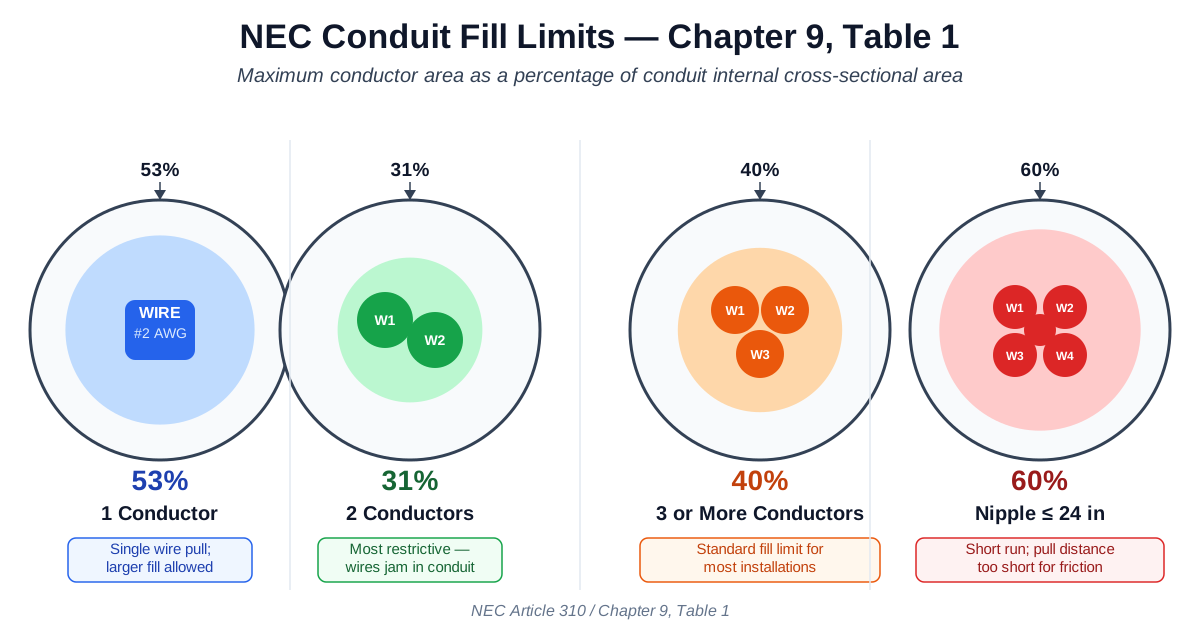
NEC fill limits are not safety margins. A conduit at 39% fill complies; one at 41% violates the code. The 1% gap is a code-compliance line, not an engineering risk threshold. Practical pulling difficulty rises continuously above roughly 35% fill regardless of where the code limit sits.
Two-Track Architecture: Compliance Then Efficiency
This calculator separates two distinct engineering questions. Track A asks whether the conductor bundle complies with NEC Chapter 9 Table 1 fill limits at the selected trade size — a legally enforceable check. Track B asks whether the selected trade size is cost-optimal, or whether a smaller size in the same conduit type would also comply — a cost-optimization check.
Track A always runs first and takes priority. INFEASIBLE means the bundle cannot fit in any trade size of the selected conduit type — not that the installation is impossible in any raceway. OVER-FILL means the NEC limit is exceeded at the selected trade size, requiring upsize or redesign. AT-LIMIT means the bundle complies but fill utilization exceeds 95% of the allowed maximum, leaving little spare capacity. COMPLIANT means the bundle fits within the NEC limit with adequate margin for practical installation.
Track B runs only when Track A returns COMPLIANT or AT-LIMIT for a manual trade size selection. OPTIMAL means no smaller trade size of the selected conduit type would accommodate the bundle — the selection is cost-efficient. OVERSIZED means a smaller trade size also complies — the current selection adds unnecessary material cost and conduit weight.
Conduit Fill Percentage by Conductor Count
NEC Chapter 9 Table 1 sets four fill limits based on conductor count and nipple status. The rule depends only on total conductor count — the sum of all conductors in the raceway — and the nipple flag. Conductor size, conductor type, and conduit trade size do not affect which percentage applies.
One conductor: 53%. Two conductors: 31%. Three or more conductors: 40%. Nipples ≤ 24 in between enclosures: 60% regardless of count. The 60% nipple rule overrides the count-based rule when the nipple flag is set. If a raceway qualifies as a nipple, 60% applies whether it carries one conductor or thirty.
Total conductor count for fill rule selection includes all conductors in the raceway — phase conductors, neutral, equipment grounding conductor (EGC), isolated grounding conductors, and signaling conductors. This differs from the current-carrying conductor count used for ampacity adjustment per NEC 310.15(C)(1), which excludes EGC and neutrals carrying only unbalanced current. Conduit fill and ampacity adjustment are independent calculations.
Conduit Type Selection and Trade Size Limits
NEC Table 4 lists internal cross-sectional areas for each conduit type and trade size. Internal area differs by type because conduit wall thickness varies. At 1 in trade size, EMT internal area is 0.864 in² (557 mm²), RMC is 0.836 in² (539 mm²), and PVC schedule 80 is 0.770 in² (497 mm²). The differences accumulate for larger bundles.
Trade size limits also vary by type. EMT and ENT are available from 1/2 in through 4 in. RMC, IMC, PVC schedule 40, PVC schedule 80, HDPE, and RTRC are available from 1/2 in through 6 in. When a bundle is INFEASIBLE in EMT at 4 in maximum, switching to RMC at 6 in may resolve the problem — INFEASIBLE is always scoped to the selected conduit type, not to all raceway solutions.
PVC schedule 40 and schedule 80 use the same trade size designations but have different wall thicknesses. Schedule 80 has a thicker wall and a smaller internal area at the same trade size. Schedule 80 is required where the conduit is exposed to physical damage. Using schedule 40 dimensions for a schedule 80 installation will overestimate the available fill area and may cause a code violation.
Key Facts
- INFEASIBLE is scoped to the selected conduit type, not all raceway solutions. A bundle that fails in EMT may still fit in RMC, IMC, or PVC, where larger trade sizes (up to 6 in) are available.
- Two-track architecture: code compliance (Track A) checked first, sizing efficiency (Track B) on COMPLIANT or AT-LIMIT manual selections.
- NEC Chapter 9 Table 1 caps fill at 53% / 31% / 40% / 60% by conductor count and nipple status.
- Fill rule depends only on total conductor count and nipple flag, not on trade size. The same percent applies across all trade sizes within one calculation.
- Conductor area looked up from NEC Table 5 (concentric stranded), Table 5A (compact stranded #1 AWG and larger), or Table 8 (bare). Multi-conductor cables not in Table 5 use actual area per Note 5.
- Conduit internal area looked up from NEC Table 4 by type and trade size. Internal area differs by conduit type — at 1 in, EMT is 0.864 in², RMC is 0.836 in², PVC schedule 80 is 0.770 in².
- Fill ratio (% of conduit area) and fill utilization (% of allowed fill) are different measures. A 26% fill ratio in a nipple is 43% utilization (against 60%), while the same 26% in a standard run is 65% utilization (against 40%).
- The calculator does not auto-add the equipment grounding conductor (EGC). EGC must be entered as a conductor entry; sizing requires NEC Table 250.122.
- Total conductor count drives the fill rule. Current-carrying conductor count (excluding EGC and unbalanced-only neutrals) drives ampacity adjustment per NEC 310.15(C)(1) — a separate calculation outside conduit fill.
Applications
- Sizing branch circuits, feeders, and service conductors in EMT, RMC, IMC, PVC, ENT, FMC, LFMC, LFNC, HDPE, RTRC for residential, commercial, and industrial installations.
- Validating designer-specified trade sizes against NEC Chapter 9 fill rules before construction.
- Documenting fill margin for inspection or as-built records, with both Imperial (in²) and Metric (mm²) values.
- Determining whether an additional circuit can be pulled through an existing conduit without exceeding NEC limits.
- Validating field changes — adding conductors, swapping insulation type, switching gauge — before the work starts.
- Checking re-pull feasibility after equipment replacement (panel upgrade, motor swap, control system retrofit).
- Comparing conduit type alternatives when one type proves infeasible. Typical workflow: EMT fails at 4 in maximum, switch to RMC or PVC for 5 or 6 in trade sizes.
- Checking nipple connections between disconnects, sub-panels, and pull boxes where the 60% rule applies.
Example Calculation
Example Calculations
Example 1 — AT-LIMIT / OPTIMAL Standard Feeder
Inputs: 6× #3 AWG THHN copper conductors in 1-1/4 in EMT (manual), not a nipple.
Step 1 — Conductor area (NEC Table 5, THHN #3): A_wire = 0.0973 in² (62.8 mm²) per conductor. A_wires_total = 6 × 0.0973 = 0.5838 in² (376.6 mm²).
Step 2 — Conduit area (NEC Table 4, EMT 1-1/4 in): A_conduit = 1.496 in² (965 mm²).
Step 3 — Fill rule: 6 conductors, not a nipple → 40% per Chapter 9 Table 1.
Step 4 — Maximum allowed fill: A_max_fill = 1.496 × 0.40 = 0.5984 in² (386 mm²).
Step 5 — Fill measures:
- Fill ratio = 0.5838 / 1.496 = 39.0% of conduit area
- Fill utilization = 0.5838 / 0.5984 = 97.6% of NEC allowed fill
- Spare capacity = 0.5984 − 0.5838 = 0.0146 in² (9.4 mm²)
Result: Track A = AT-LIMIT (utilization 97.6% > 95%). Track B: next smaller is 1 in EMT (max fill = 0.864 × 0.40 = 0.346 in²); 0.5838 > 0.346 → fails. 1-1/4 in is the smallest compliant EMT size → OPTIMAL. Badge: AT-LIMIT / OPTIMAL.
Example 2 — Custom Area per Note 5 (MC Cable)
Inputs: 4× 4-conductor 12 AWG MC cable (OD = 0.55 in each), in 2 in EMT, manual, not a nipple.
Step 1 — Custom area: π × (0.55/2)² = 0.2376 in² (153.3 mm²) per cable. A_wires_total = 4 × 0.2376 = 0.9504 in² (613 mm²). Enter as Custom area (Note 5).
Step 2 — Conduit area (EMT 2 in): A_conduit = 3.356 in² (2165 mm²).
Step 3 — Fill rule: 4 entries, not a nipple → 40%. A_max_fill = 3.356 × 0.40 = 1.3424 in².
Result: Fill ratio = 28.3%, fill utilization = 70.8%, spare = 0.3920 in² (253 mm²). Track A = COMPLIANT. Track B: next smaller (1-1/2 in EMT, max fill = 2.036 × 0.40 = 0.814 in²); 0.9504 > 0.814 → fails → OPTIMAL. Badge: COMPLIANT / OPTIMAL.
Example 3 — Nipple vs. Standard Run (Same Bundle)
Inputs (both): 6× #12 AWG THHN copper in 1/2 in EMT (manual). A_wires_total = 6 × 0.0133 = 0.0798 in² (51.5 mm²). A_conduit = 0.304 in² (196 mm²).
Without nipple: 40% rule → A_max_fill = 0.1216 in² → fill ratio = 26.2% → fill utilization = 65.6% → COMPLIANT / OPTIMAL.
With nipple (≤ 24 in): 60% rule → A_max_fill = 0.1824 in² → fill ratio = 26.2% (unchanged — geometric ratio) → fill utilization = 43.8% → COMPLIANT / OPTIMAL.
Fill ratio is unchanged because it is a geometric ratio. Fill utilization changes because the applicable code limit changes. The nipple version has 66.2 mm² spare vs. 27.0 mm² — substantially more headroom for a short raceway.
Standards & References
- NFPA 70 (NEC) Chapter 9, Table 1 — Percent of Cross Section of Conduit and Tubing for Conductors. Defines fill limits 53% / 31% / 40% / 60% by conductor count and nipple status.
- NFPA 70 (NEC) Chapter 9, Table 4 — Dimensions and Percent Area of Conduit and Tubing. Internal cross-sectional areas for all conduit types and trade sizes.
- NFPA 70 (NEC) Chapter 9, Table 5 — Dimensions of Insulated Conductors and Fixture Wires. Cross-sectional areas by Type and Size for concentric stranded conductors.
- NFPA 70 (NEC) Chapter 9, Table 5A — Compact Copper and Aluminum Building Wire Nominal Dimensions and Areas. Reduced dimensions for compact-stranded conductors #1 AWG and larger.
- NFPA 70 (NEC) Chapter 9, Table 8 — Conductor Properties. Bare conductor dimensions.
- NEC 310.15(C)(1) — Adjustment Factors for More Than 3 Current-Carrying Conductors. Ampacity reduction from 80% (4–6 conductors) to 35% (41+). Separate from fill calculation.
- NEC 250.122 — Size of Equipment Grounding Conductors. EGC sizing by overcurrent protection rating.
- OSHA 1910.305 — Wiring methods, components, and equipment for general use. Adopts NEC installation rules as federal regulation.
- NFPA 70 (NEC) Articles 358, 342, 344, 352, 362, 348, 350, 356, 353, 355 — Conduit type articles defining permitted uses, support, bending, and installation for EMT, IMC, RMC, PVC, ENT, FMC, LFMC, LFNC, HDPE, RTRC.
Units
- in² — cross-sectional areas (conductor areas and conduit areas from NEC Chapter 9 Tables 4, 5, 5A, 8)
- mm² — metric equivalents for all cross-sectional areas (1 in² = 645.16 mm²)
- % — fill ratio (conductor area as % of conduit area) and fill utilization (conductor area as % of NEC allowed fill)
- AWG — American Wire Gauge for conductor sizes 18 AWG through 4/0 AWG (smaller number = larger conductor)
- kcmil — thousands of circular mils for conductor sizes 250 kcmil and larger
- Trade sizes — nominal designations (1/2 in, 3/4 in, 1 in, ... 6 in) paired with NEC metric designators (16, 21, 27, ... 155); metric designators are NEC labels, not actual metric diameters
Limitations
- Calculator implements NEC 2023 (NFPA 70-2023) Chapter 9 Tables. Earlier code editions (2017, 2020) have nearly identical fill rules and dimensions for major conductor types, but minor table differences are possible.
- The calculator does not perform ampacity adjustment per 310.15(C)(1), EGC sizing per 250.122, voltage drop, ambient temperature derating per 310.15(B), bending radius validation, pull tension, sidewall pressure, or jam-ratio calculations.
- Multi-conductor cables (MC, AC, NM-B, SE/USE, optical fiber, control cable) are not in Table 5. Use the Custom area (Note 5) entry type with actual cross-sectional area from the manufacturer datasheet.
- Compact stranding lookup (Table 5A) is available for #1 AWG and larger only. Selecting compact for unsupported sizes produces a validation error.
- Mixed conductor materials (Cu and Al) compute correctly for fill, but ampacity tables and termination requirements differ between materials and must be checked separately.
- Cable tray fill (NEC Article 392) and busway design (Article 368) use different rules from conduit fill and are out of scope.
- Underground conduit applications must verify mechanical protection per Article 300 and burial-depth rules per the conduit type's article separately.
- INFEASIBLE is scoped to the selected conduit type only — another conduit type may accommodate the bundle.
- Parallel-runs estimates for INFEASIBLE bundles are rough area-screening only — full parallel design requires equal conductor distribution, separate EGC per run, and phase grouping per NEC 300.20.
Common Mistakes to Avoid
- Forgetting to include the equipment grounding conductor in the conductor list. The EGC counts toward total conductor count for fill rule selection and contributes to total conductor area. Calculator does not auto-add it.
- Counting current-carrying conductors instead of total conductors when selecting the fill rule. The fill rule uses total count (phase + neutral + EGC + isolated grounding + signaling). The 4-or-more current-carrying threshold is for ampacity adjustment per 310.15(C)(1), a different calculation.
- Estimating capacity from trade size visually instead of looking up actual Table 4 internal area. Trade size labels are nominal — internal area depends on conduit type. At 1 in trade size, EMT has 0.864 in², RMC has 0.836 in², PVC schedule 40 has 0.832 in², PVC schedule 80 has 0.770 in².
- Setting the nipple flag for raceways longer than 24 in. Note 4 to Table 1 specifies 24 in (600 mm) maximum between enclosures. A 30 in raceway is not a nipple — standard fill rules apply.
- Confusing fill ratio with fill utilization. Fill ratio is conductor area as a percent of conduit area. Fill utilization is conductor area as a percent of allowed fill. A 26% fill ratio in a nipple corresponds to 43% utilization; the same 26% in a standard run corresponds to 65% utilization.
- Skipping compact stranding for large conductors. Compact stranded copper and aluminum #1 AWG and larger have ~5–10% smaller cross-sectional area than concentric stranded. Switching to compact (Table 5A) sometimes resolves OVER-FILL without upsizing the conduit.
- Using Schedule 40 PVC dimensions for a Schedule 80 installation. Schedule 80 has a thicker wall and a smaller internal area than Schedule 40 at the same trade size.
- Treating an OVER-FILL result as a soft warning. NEC fill limits are mandatory. An over-filled conduit fails inspection and cannot be installed as designed.
- Specifying a single conduit when the bundle is INFEASIBLE for the conduit type. EMT caps at 4 in trade size; RMC, IMC, PVC, and RTRC reach 6 in. Switching type often resolves INFEASIBLE without resorting to parallel runs.
- Applying different fill rules for recommended-size vs. input scenario. The recommended trade size always uses the same fill_percent_max (same nipple flag, same conductor count rule) as the user's input scenario.
Frequently Asked Questions
What conduit fill percentage does the NEC allow?
How do I know if I should use the 40% rule or the 60% nipple rule?
Why is my conduit OVER-FILL even though the trade size looks generous?
Does the equipment grounding conductor count in conduit fill?
How do I enter MC cable, NM-B, or other multi-conductor cables?
What is the difference between conduit fill and ampacity adjustment?
Why doesn't auto-size always pick the smallest physical size?
Frequently Used Together
Engineers often use these calculators in combination for complete project workflows:
Related Calculators
Explore similar calculators that might be useful for your project:
Electrical Quick Reference — Keep It Open During Design
8 NEC formulas for voltage drop, ampacity, motor current, and CT burden. One sheet, every project.
- Voltage drop by NEC method — single-phase and 3-phase
- Ampacity with temperature & grouping derating (NEC 310.15)
- %VD limits by circuit type: branch, feeder, sensitive loads
No spam. Unsubscribe any time.
Calculate
EMT caps at 4 in trade size. RMC, IMC, PVC, RTRC reach 6 in.
Auto-size finds the smallest trade size that complies with NEC fill limits. Track B (sizing efficiency) is only shown for manual selections.
Set if this raceway connects enclosures (panels, boxes) with ≤ 24 in (600 mm) of raceway length. The 60% rule overrides count-based rules.
Standard lookup reads area from NEC Table 5 (or 5A / Table 8). Custom area (Note 5) uses a manufacturer-supplied actual cross-section for MC, AC, NM-B, and other cables not in Table 5.
Material affects ampacity tables and termination requirements (NEC 110.14(C)) but does not affect fill calculation.