Wire Size / Ampacity Calculator (NEC)
On this page
Calculate
NEC Table 310.16 lists Copper and Aluminum separately. Aluminum starts at #12 AWG.
Select a specific AWG/kcmil size for manual analysis, or Auto-size to find the smallest compliant size.
Load operating ≥ 3 hours at maximum current. NEC 210.20 applies a 125% multiplier.
Load operating < 3 hours. No 125% multiplier applies.
Conductor insulation column used for base ampacity lookup. 75°C (THWN/RHW) is default for most commercial installations.
Per NEC 110.14(C), final ampacity is capped at the terminal temperature column regardless of insulation rating. Verify actual equipment listing/marking. 90°C is uncommon — verify equipment marking.
Installation ambient temperature in °C. Default 30°C is the Table 310.16 base condition. Correction applies per Table 310.15(B)(1).
Count of current-carrying conductors sharing this raceway. EGC and unbalanced-only neutrals are not counted. Default 3 — no adjustment applies.
NEC 310.15(B)(2): raceway in direct sunlight on a rooftop adds +18°C to ambient before correction lookup. Verify installation height for exact adder.
If > 100 ft, a voltage drop advisory fires. This calculator does not compute voltage drop — verify separately per NEC 210.19.
NEC 310.10(G): each parallel conductor must be #1/0 AWG or larger, equal length, same insulation, common terminations. Calculator analyzes one conductor of the parallel set.
Required when parallel set is enabled. Minimum 2. Each conductor carries total required ampacity divided by this count.
When provided, triggers explicit NEC 240.4(D) small conductor rule check for #10 AWG and smaller.
How to Use the Wire Size / Ampacity Calculator
Select Conductor Material: Copper or Aluminum. Aluminum starts at #12 AWG per NEC Table 310.16 and has lower ampacity per AWG than Copper.
Select Wire Size or Auto-size. Auto-size finds the smallest compliant conductor. Manual size evaluates the specific AWG/kcmil and adds Track B sizing efficiency analysis.
Enter load values. Continuous load (operating ≥ 3 hours) and non-continuous load are entered separately — the 125% multiplier on continuous load is applied automatically per NEC 210.20.
Select Insulation Temperature Rating: 60°C (TW), 75°C (THWN, RHW — default), or 90°C (THHN, THWN-2, XHHW-2). This determines the base ampacity column from Table 310.16.
Select Termination Temperature Rating per NEC 110.14(C). 75°C is default for most commercial equipment. Final ampacity cannot exceed the terminal temperature column from Table 310.16.
Enter Ambient Temperature in °C. Leave blank or enter 30 for the Table 310.16 base condition. Enter actual installation ambient for derating.
Enter Current-Carrying Conductor Count. EGC and unbalanced-only neutrals are excluded from this count. Default 3 applies no bundling adjustment.
Optionally enter rooftop flag, run length, parallel set configuration, and intended OCPD. Each unlocks additional soft checks and advisory notes.
Click Calculate. Results show the full 4-step derating chain, sizing classification badge, and recommended wire size when applicable.
This calculator implements NEC Table 310.16 (raceway, cable, or earth installation, ≤3 current-carrying conductors, 30°C ambient base). Free-air installations per Table 310.17, motor branch circuit sizing per NEC 430.22, and service load calculations per NEC Article 220 are out of scope.
Inputs & Outputs
Inputs
Outputs
Formula
NEC Wire Ampacity Formulas (Article 310)
Required Ampacity (NEC 210.20 / 215.3):
I_required = (1.25 × I_continuous) + I_non_continuous
The 125% multiplier on continuous load is mandatory per NEC 210.20. Comparing raw load amperes to conductor ampacity without this factor is a code violation.
Base Ampacity:
I_base = NEC Table 310.16 [size][material][insulation temperature column]
4-Step Derating Chain:
| Step | Formula | Reference |
|---|---|---|
| 1 | Ambient correction: I_base × ambient_correction | Table 310.15(B)(1) |
| 2 | Bundling adjustment: I_base × ambient × bundling | Table 310.15(C)(1) |
| 3 | Adjusted ampacity: I_adjusted = I_base × ambient × bundling | Combined |
| 4 | Terminal limit: I_terminal = Table 310.16 at terminal temperature column | NEC 110.14(C) |
Final Ampacity (the controlling formula):
I_final = MIN(I_adjusted, I_terminal_limit)
Termination temperature is the step most simplified calculators miss. When 90°C insulation is paired with 75°C terminals, the terminal column caps final ampacity at the 75°C base value — the higher insulation rating provides no benefit for the final ampacity calculation.
Ampacity Utilization:
utilization = (I_required / I_final) × 100%
Ampacity Margin (ADEQUATE / AT-LIMIT):
I_margin = I_final − I_required
Ampacity Deficit (UNDERSIZED / INFEASIBLE):
I_deficit = I_required − I_final
Track A — Sizing Adequacy (priority order, mutually exclusive):
| Priority | Class | Condition |
|---|---|---|
| 1 | INFEASIBLE | I_required > I_final at largest wire size of selected material |
| 2 | UNDERSIZED | I_required > I_final at selected wire size |
| 3 | AT-LIMIT | I_required ≤ I_final AND utilization > 95% |
| 4 | ADEQUATE | I_required ≤ I_final AND utilization ≤ 95% |
Track B — Sizing Efficiency (manual size, ADEQUATE or AT-LIMIT only):
| Class | Condition |
|---|---|
| OPTIMAL | Selected size = smallest size of selected material where I_required ≤ I_final |
| OVERSIZED | A smaller size of the same material also satisfies I_required ≤ I_final |
What Is Conductor Ampacity?
Conductor ampacity is the maximum current a wire can carry continuously without exceeding its temperature rating under defined installation conditions. NEC Table 310.16 is the primary reference for insulated conductors in conduit, cable, or directly buried — values assume not more than three current-carrying conductors in a raceway at 30°C (86°F) ambient. These base conditions almost never describe an actual installation without adjustment, which is why the derating chain exists.
The NEC 310.16 base values are derived from heat balance — the conductor generates I²R heat, the insulation conducts it outward, and ampacity is the current at which the heat balance lands at the conductor's rated temperature. Ambient temperature shifts the equilibrium; bundling reduces the heat that the conduit air can carry away. Both adjustments directly affect how much current the conductor can safely handle.
Ampacity limits are not safety margins in the colloquial sense. A conductor operating at exactly its rated ampacity is operating at its rated temperature. Exceeding the ampacity accelerates insulation degradation, increases failure probability over time, and eventually causes insulation failure. The NEC ampacity limits encode the thermal balance point; exceeding them is a code violation with real engineering consequences.
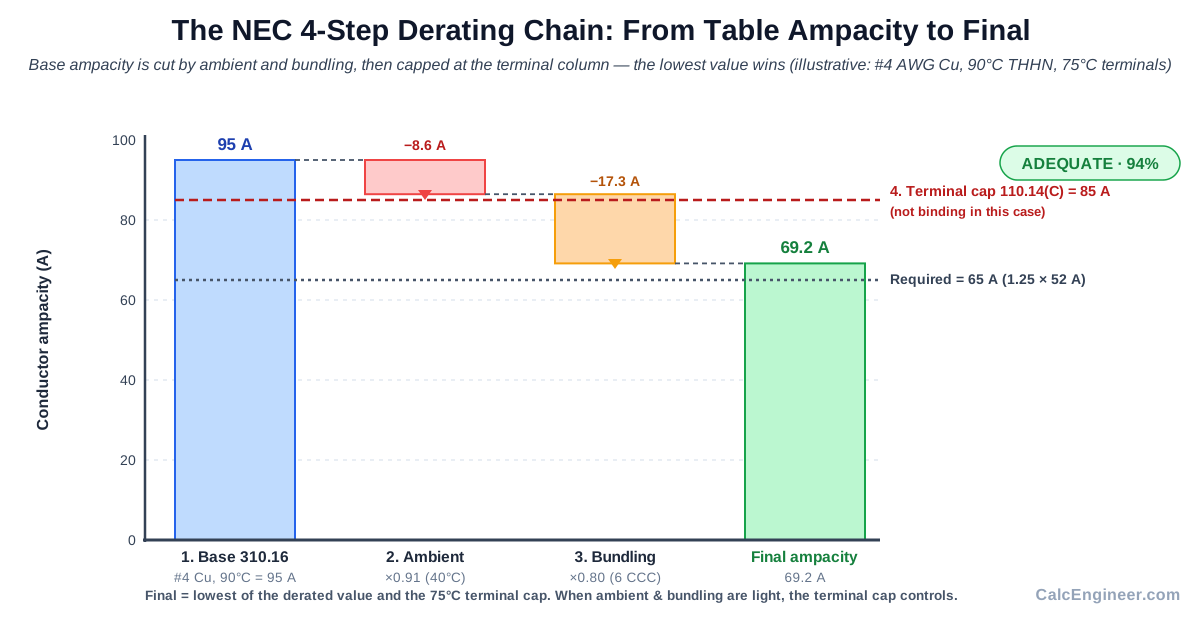
The Four-Step Derating Chain
Field ampacity calculations require four steps applied in a specific order. Skipping or combining steps is one of the most common errors in field electrical design. Step one is base ampacity from NEC Table 310.16. The lookup requires conductor size (AWG or kcmil), material (Copper or Aluminum), and insulation temperature rating (60°C, 75°C, or 90°C column). The insulation rating column must match the actual conductor marking, not the termination rating.
Step two is ambient temperature correction per NEC Table 310.15(B)(1). The correction factor multiplies the base ampacity and varies by actual ambient minus the 30°C base condition. Factors below 1.0 reduce ampacity; factors above 1.0 (for cool environments) increase it. The lookup uses the actual conductor insulation column — not the terminal rating — because insulation temperature governs how much heat the conductor can tolerate before the insulation begins to degrade.
Step three is bundling adjustment per NEC Table 310.15(C)(1). When more than three current-carrying conductors share a raceway, heat accumulation reduces the effective ampacity of each conductor. The factor applies to conductors that actually carry current — equipment grounding conductors and neutrals that carry only unbalanced current are excluded from the count.
Step four — the step most frequently missed — is the NEC 110.14(C) termination temperature limit. The final ampacity cannot exceed the ampacity at the terminal temperature column from Table 310.16, regardless of how high the conductor insulation rating is. If a circuit uses 90°C THHN but terminates in equipment rated for 75°C, the final ampacity is capped at the 75°C table value. Upgrading the insulation does not help if the controlling step is the termination.
Why Termination Temperature Controls More Than Engineers Expect
The 110.14(C) terminal limit is the single most commonly overlooked step in field ampacity calculations. Most engineers focus on ambient and bundling derating and apply the 90°C insulation column to get maximum base ampacity — but when commercial equipment has 75°C-rated terminals (the norm for most breakers, panelboards, switchgear, and motor control centers under 100A), the 90°C base ampacity is immediately capped back to the 75°C value.
This creates a paradox: specifying 90°C THHN for a circuit feeding standard 75°C-rated equipment provides no ampacity benefit over 75°C THWN. The benefit of 90°C insulation comes in two scenarios: (1) when the ambient temperature is high enough that the higher insulation column retains more ampacity than 75°C (because Table 310.15(B)(1) has a less aggressive correction factor for 90°C), and (2) when both terminations are genuinely listed and marked for 90°C operation.
This calculator explicitly identifies whether termination temperature is the binding constraint. When it is, the result explanation notes that insulation upgrades alone cannot resolve an UNDERSIZED condition — only a terminal upgrade or wire upsize can help.
Continuous Loads and the 125% Multiplier
NEC 210.20 and 215.3 require that conductors serving continuous loads (defined as loads expected to operate at maximum current for three or more hours) be sized at 125% of the continuous current component. This is applied before the ampacity comparison, not after.
The error pattern is consistent: an engineer calculates load current as 40A, selects #8 AWG copper THWN (75°C ampacity 50A), and concludes the circuit complies because 40A < 50A. If the load is continuous, the required ampacity is 1.25 × 40 = 50A, which exactly meets the conductor ampacity with zero margin. If any ambient correction or bundling applies, the circuit fails immediately.
The 125% multiplier is not optional for continuous loads — it is a mandatory code requirement per NEC 210.20(A). This calculator applies the 125% multiplier to the continuous load component before comparing to final conductor ampacity. The result explanation always notes the calculation explicitly when a continuous load is present, because this is the most common field calculation error.
Key Facts
- NEC 110.14(C) termination temperature limit frequently controls final ampacity — 90°C THHN paired with 75°C-rated terminals (standard for most commercial equipment) is capped at the 75°C ampacity column.
- The 125% continuous load multiplier (NEC 210.20 / 215.3) is the most common field calculation error — omitting it from required ampacity before comparing to conductor ampacity is a code violation.
- INFEASIBLE is scoped to the selected conductor material — switching from Aluminum to Copper typically increases ampacity by 24–30% per AWG, often resolving the condition without parallel conductors.
- Track B (OPTIMAL / OVERSIZED) runs only when manual wire size is selected and Track A is ADEQUATE or AT-LIMIT. AT-LIMIT / OVERSIZED is valid — AWG steps are non-linear and the binding constraint can shift between adjacent sizes.
- Aluminum conductors smaller than #12 AWG are not in NEC Table 310.16 for general branch/feeder wiring — the calculator rejects these combinations with a typed error.
- Bundling adjustment counts only current-carrying conductors — equipment grounding conductors and neutrals carrying only unbalanced current are excluded from the count per NEC 310.15(C)(1).
- Rooftop conduit in direct sunlight adds +18°C (33°F) to ambient before the Table 310.15(B)(1) correction lookup per NEC 310.15(B)(2). The actual adder varies with raceway height above the roof.
Applications
- Branch circuit conductor sizing for residential, commercial, and industrial installations
- Feeder conductor sizing per NEC 215.3 with continuous load 125% requirement
- Derating analysis for high-ambient installations (mechanical rooms, rooftops, attics)
- Bundled conductor ampacity verification in conduit with multiple circuits
- Termination temperature compatibility check (90°C insulation vs 75°C terminals)
- Aluminum conductor sizing for cost-optimized feeder and service entrance applications
- Parallel conductor feasibility screening per NEC 310.10(G)
- Auto-sizing for minimum compliant conductor selection on new circuit designs
- Small conductor OCPD compliance check per NEC 240.4(D) for #10 AWG and smaller
- Rooftop conduit ambient temperature adder verification per NEC 310.15(B)(2)
Example Calculation
Example Calculations
Example 1: Standard Branch Circuit — ADEQUATE / OPTIMAL
Inputs: 14 A continuous + 4 A non-continuous. Copper, 75°C THWN, 75°C terminals, 30°C ambient, 3 current-carrying conductors. Manual size: #12 AWG.
I_required = 1.25 × 14 + 4 = 21.5 A
I_base (#12 AWG Cu, 75°C) = 25 A
Ambient correction (30°C, 75°C) = 1.00
Bundling (3 CCC) = 1.00
I_adjusted = 25 × 1.00 × 1.00 = 25 A
I_terminal_limit (75°C, #12 AWG Cu) = 25 A
I_final = MIN(25, 25) = 25 A
utilization = 21.5 / 25 = 86.0%
I_margin = 25 − 21.5 = 3.5 A
Result: ADEQUATE / OPTIMAL. Utilization 86.0% — within limit with practical margin. #12 AWG is the smallest compliant size (#14 AWG Cu at 75°C = 20 A < 21.5 A required). NEC 240.4(D): #12 AWG Cu max OCPD 20 A — select OCPD ≤ 20 A.
Example 2: Termination Limit Controls — UNDERSIZED
Inputs: 70 A continuous. Copper, 90°C THHN, 75°C terminals (standard breaker), 30°C ambient, 3 CCC. Manual size: #6 AWG.
I_required = 1.25 × 70 = 87.5 A
I_base (#6 AWG Cu, 90°C) = 75 A
Ambient correction = 1.00, Bundling = 1.00
I_adjusted = 75 A
I_terminal_limit (75°C, #6 AWG Cu) = 65 A
I_final = MIN(75, 65) = 65 A
I_deficit = 87.5 − 65 = 22.5 A
Result: UNDERSIZED. The 90°C insulation supports 75 A but the 75°C terminal limit caps final ampacity at 65 A. Recommended: #3 AWG Cu (90°C base = 110 A; terminal limit 75°C = 100 A; I_final = 100 A; utilization 87.5%). This is the classic 110.14(C) trap — upgrading insulation alone cannot resolve UNDERSIZED when termination controls.
Example 3: Bundling Dominant — AT-LIMIT / OPTIMAL
Inputs: 35 A continuous. Copper, 75°C THWN, 75°C terminals, 30°C ambient, 8 current-carrying conductors. Manual size: #6 AWG.
I_required = 1.25 × 35 = 43.75 A
I_base (#6 AWG Cu, 75°C) = 65 A
Ambient correction (30°C) = 1.00
Bundling (7–9 CCC) = 0.70
I_adjusted = 65 × 0.70 = 45.5 A
I_terminal_limit (75°C, #6 AWG) = 65 A
I_final = MIN(45.5, 65) = 45.5 A
utilization = 43.75 / 45.5 = 96.2%
Result: AT-LIMIT / OPTIMAL. Utilization 96.2% — bundling adjustment of 0.70 is the binding constraint (terminal limit at 65 A does not control). #8 AWG Cu at 75°C with same bundling: 50 × 0.70 = 35 A < 43.75 A required — does not fit. #6 AWG is the smallest compliant size.
Standards & References
- NFPA 70 (NEC) Article 310 — Conductors for General Wiring. The primary code reference for conductor ratings, ampacity tables, and derating procedures. Free read-only access via NFPA.
- NFPA 70 — Standard for Electrical Installations — NFPA official page with current edition, supplements, and errata.
- NEC Table 310.16 — Allowable Ampacities of Insulated Conductors with Not More Than Three Current-Carrying Conductors in Raceway, Cable, or Earth, Based on Ambient Temperature of 30°C (86°F).
- NEC Table 310.15(B)(1) — Ambient Temperature Correction Factors Based on 30°C (86°F).
- NEC 310.15(B)(2) — Adjustment for Ambient Temperature, Special Cases. Rooftop conduit temperature adders.
- NEC Table 310.15(C)(1) — Adjustment Factors for More Than Three Current-Carrying Conductors in a Raceway or Cable.
- NEC 110.14(C) — Temperature Limitations of Conductors and Equipment. Terminal temperature limits final ampacity regardless of conductor insulation rating.
- NEC 210.20(A) — Continuous and Noncontinuous Loads. Branch circuit conductor minimum size at 125% of continuous current.
- NEC 215.3 — Feeder Ampacity. Continuous load 125% requirement for feeders.
- NEC 240.4(D) — Small Conductors. OCPD limits on #14 AWG through #10 AWG copper and #12–#10 AWG aluminum.
- NEC 310.10(G) — Conductors in Parallel. Requirements for parallel conductor installations.
- NEC 250.122 — Size of Equipment Grounding Conductors (out of scope — referenced for related sizing).
- OSHA 1910.305 — Wiring methods, components, and equipment for general use. Federal regulation that adopts NEC installation rules.
- NFPA 70 free-access portal (read-only) — Browse NEC 2023 online at no cost.
- OSHA 1910.305 (free federal regulation) — Full regulatory text available online.
- National Electrical Code overview (Wikipedia) — Background, history, and state adoption map.
Units
- All ampacity values in amperes (A).
- Temperature inputs and correction factors in degrees Celsius (°C).
- Wire sizes in AWG (American Wire Gauge) or kcmil (thousands of circular mils).
- Calculations are performed in SI units.
- Both Metric and Imperial unit systems display identical results for this calculator since NEC Table 310.16 values are dimensionless within the defined installation conditions.
Limitations
- Implements NEC Table 310.16 (raceway, cable, or directly buried, ≤3 CCC, 30°C ambient base). Free-air ampacity from Table 310.17 is not covered.
- Motor branch circuit conductor sizing per NEC 430.22 (125% of FLA from Tables 430.247–430.250) is not covered — motors require specialized handling.
- Voltage drop per NEC 210.19 informational note (3% branch / 5% combined target) is not computed — verify separately.
- Conduit fill per NEC Chapter 9 is not computed — verify separately using the Conduit Fill Calculator.
- Service load calculation per NEC Article 220 is not covered — feeder and service sizing requires demand factors.
- Short-circuit and ground-fault current calculations are out of scope.
- Arc-flash incident energy per IEEE 1584 is out of scope.
- Aluminum conductors smaller than #12 AWG are not in NEC Table 310.16 for general branch/feeder wiring.
- Parallel conductors per NEC 310.10(G) require each conductor to be #1/0 AWG or larger, equal length, same insulation, and common terminations — the calculator performs single-conductor analysis when the parallel flag is enabled; the user must verify all 310.10(G) requirements separately.
- NEC 2023 (NFPA 70-2023) Article 310 is used. Earlier editions renumbered 310.15(B)(16) to 310.16 but ampacity values are nearly identical for major conductor types. Verify code edition adopted by AHJ.
Common Mistakes to Avoid
- Comparing raw load amperes to conductor ampacity without the NEC 210.20 125% continuous load multiplier — I_required = 1.25 × I_continuous + I_non_continuous, not just the load current.
- Using the 90°C insulation column for base ampacity when equipment terminals are rated 75°C — the NEC 110.14(C) terminal limit caps final ampacity at the 75°C column regardless.
- Counting EGC and unbalanced-only neutrals in the current-carrying conductor count for bundling adjustment — these conductors are excluded from the count per NEC 310.15(C)(1).
- Treating INFEASIBLE as 'the load is impossible to serve' — it means no single conductor of the selected material can carry this load; switching material or using parallel conductors per NEC 310.10(G) typically resolves it.
- Applying the Table 310.16 base ampacity directly without ambient correction — at 40°C ambient, a 75°C conductor has 0.88 times its base ampacity; at 50°C, 0.75 times.
- Selecting conductor insulation based on availability without confirming terminal temperature compatibility — the conductor insulation must be rated ≥ the termination temperature to use the higher column.
Frequently Asked Questions
What is the difference between the 75°C and 90°C ampacity columns in NEC Table 310.16?
Why does the calculator apply the 125% multiplier to continuous loads?
How do I determine how many current-carrying conductors to enter?
What does INFEASIBLE mean, and does it mean the load cannot be served?
Can I use this calculator for motor branch circuits?
Why is the final ampacity lower than the value in NEC Table 310.16?
Do I always need to apply the 125% multiplier for continuous loads?
Can I use 90°C THHN on a 75°C breaker?
How do I size wire for a continuous load?
Does the neutral count in ampacity derating?
Does the ground wire count as a current-carrying conductor?
Why is my wire ampacity okay but my breaker size still limited?
Why doesn't 90°C insulation always give 90°C ampacity?
How do I count current-carrying conductors for the bundling adjustment?
Can I switch from aluminum to copper without changing wire size?
Does NEC Table 310.16 ampacity include voltage drop?
What's the difference between 60°C, 75°C, and 90°C insulation ratings?
Frequently Used Together
Engineers often use these calculators in combination for complete project workflows:
Related Calculators
Explore similar calculators that might be useful for your project:
Electrical Quick Reference — Keep It Open During Design
8 NEC formulas for voltage drop, ampacity, motor current, and CT burden. One sheet, every project.
- Voltage drop by NEC method — single-phase and 3-phase
- Ampacity with temperature & grouping derating (NEC 310.15)
- %VD limits by circuit type: branch, feeder, sensitive loads
No spam. Unsubscribe any time.
Calculate
NEC Table 310.16 lists Copper and Aluminum separately. Aluminum starts at #12 AWG.
Select a specific AWG/kcmil size for manual analysis, or Auto-size to find the smallest compliant size.
Load operating ≥ 3 hours at maximum current. NEC 210.20 applies a 125% multiplier.
Load operating < 3 hours. No 125% multiplier applies.
Conductor insulation column used for base ampacity lookup. 75°C (THWN/RHW) is default for most commercial installations.
Per NEC 110.14(C), final ampacity is capped at the terminal temperature column regardless of insulation rating. Verify actual equipment listing/marking. 90°C is uncommon — verify equipment marking.
Installation ambient temperature in °C. Default 30°C is the Table 310.16 base condition. Correction applies per Table 310.15(B)(1).
Count of current-carrying conductors sharing this raceway. EGC and unbalanced-only neutrals are not counted. Default 3 — no adjustment applies.
NEC 310.15(B)(2): raceway in direct sunlight on a rooftop adds +18°C to ambient before correction lookup. Verify installation height for exact adder.
If > 100 ft, a voltage drop advisory fires. This calculator does not compute voltage drop — verify separately per NEC 210.19.
NEC 310.10(G): each parallel conductor must be #1/0 AWG or larger, equal length, same insulation, common terminations. Calculator analyzes one conductor of the parallel set.
Required when parallel set is enabled. Minimum 2. Each conductor carries total required ampacity divided by this count.
When provided, triggers explicit NEC 240.4(D) small conductor rule check for #10 AWG and smaller.