Paver Calculator — The 4.5 Pavers per Square Foot Figure Has No Joint
On this page
Calculate
This selector governs every field, label, result and export here and takes priority over the site header switch. Switching converts what you entered rather than reinterpreting it, so a 400 sq ft patio becomes 37.16 sq m and returns to exactly 400.
The Area
The three answers open different fields. If the area came off a plan, a site measure or the Square Footage Calculator, the third answer takes it directly rather than making you work back to two sides.
The Paver and the Joint
In inches, the long side as the product is sold. Nominal paver sizes are trade designations rather than measurements, so a four by eight is a name: take the figure off the manufacturer sheet.
In inches, the short side as the product is sold. Together with the length it gives the bare paver area, which is the figure that circulates and the one this page reports without using.
In inches. Required here with no default, because the published per square foot figures split on whether the joint is in them. Published widths are one eighth, three sixteenths, a quarter and three eighths.
In inches, optional. The joint sand volume and the excavation depth both need it and neither is reported without it. The paver count, the bedding sand and the base are unaffected.
The Pattern and the Waste
The published waste band follows from this and nothing else does. Herringbone creates unusable triangular cut-offs at borders, and the forty five degree orientation is the one published as required under driveways.
Optional. One published source adds three to five percent on top of the pattern figure for curved borders or irregular shapes. Left unstated, nothing is added and nothing is claimed about the borders.
The band is offered rather than a point, because the published figures for one pattern span a factor of five. None is an answer and is offered as one. A stated percentage replaces the band outright.
The Base, the Soil and the Climate
This sets the published base minimum and nothing else. Four inches under a pedestrian patio, six for a residential driveway and eight to twelve for light vehicular, all of them over well-drained subgrade.
In the additive published form one source gives clay as plus two inches, loam as plus one and sand as plus none. Not known is an answer: the page reports the unadjusted minimum and says the adjustment was not applied.
No published source gives a fixed inch addition for the climate. What freeze-thaw does is put the job under the proportional published form and under separate published guidance of up to sixteen inches, and the page reports each on its own row rather than merging them into one depth range.
In inches, optional. Where you have a figure from a specification or a soil report it overrides the published one outright, and the volume and the excavation are computed on it with the published figure named beside it.
The Sand and the Edge
In inches, optional, defaulting to the association's published one inch. It is a setting bed rather than a variable: published guidance states it is not to be used to correct an uneven base.
In cubic feet per bag, optional, from the label. A bag count is issued only against a yield you enter, because the published bag figures for the same volume differ by a factor of five.
In feet, optional. The edge restraint is a linear quantity equal to the perimeter. The association gives a minimum one inch vertical restraining surface in contact with the side of the paver.
The Supply and the Prices
In square feet per pallet, optional, from the supplier. The pallet count comes from the waste adjusted area and never from the paver count, because a pallet is sold by the area it covers.
Optional, in your own currency. Applied to the order quantity rather than the coverage one, so a waste band returns a cost band.
Optional, in your own currency. Priced beside the pavers rather than added to them: if you price both, the same pavers are in the subtotal twice.
Optional, in your own currency. Applied only where a bag yield was entered, because no bag count is taken from the published figures.
Optional, in your own currency, per linear foot. Applied only where a perimeter was entered.
Overview
A four by eight paver is thirty two square inches, and a square foot is one hundred and forty four, so a square foot holds 4.5 of them. Four published calculators give that figure.
Pavers are not laid touching.
At a three eighths inch joint the paver occupies a module of 4.375 by 8.375 inches, because every joint is shared between the two pavers that meet at it. That is 36.64 square inches, so a square foot holds 3.93.
One published source names both and says which is which: a four by eight with a three eighths joint takes about 3.9 per square foot, against the often quoted 4.5. The gap is 14.5 percent, and on a four hundred square foot patio it is 1,800 pavers against 1,573.
The waste factor moves it further, and the published figures do not agree. Running bond appears at two, three, five, eight and ten percent across six sources, which is a factor of five on the simplest pattern there is.
And one layer on the job works the opposite way from the rest. Published association guidance gives bedding sand as a nominal one inch, and states that where the base is uneven from poor compaction or bad grading, the sand is not to be used to correct it.
What to Look at First
Read the joint width before you read the paver count. It is the one input that decides whether the count is 4.5 pavers per square foot or 3.93, and it is the input most calculators on this subject settle for you by leaving it out.
Then read the paver count as coverage rather than as a layout: it is what the area holds if the field tiles perfectly, and the rows, the border course, the edge cuts and the reusable offcuts are what the pattern waste allowance covers.
The waste is reported as a published band with the count at both ends, because running bond alone is published across a factor of five and a point inside that is a number no source gives.
How to Use This Calculator
Enter the joint width. It is required and has no default, because the per square foot figures that circulate split on whether the joint is in them. The published widths are one eighth, three sixteenths, five millimetres, a quarter inch and three eighths, and on a four by eight they move the count from 4.30 to 3.93.
Take the paver dimensions off the manufacturer sheet rather than from the nominal name. A four by eight is a trade designation rather than a measurement, and the module runs on the actual unit.
Read the paver count as coverage, not as a layout. The module figure is what the area holds if the field tiles perfectly, and the rows, the border course and the edge cuts are what the waste allowance covers.
Pick the pattern before the waste. The band follows from it, and the page reports both ends rather than a figure inside them. Herringbone at forty five degrees is the orientation published as required under driveways, because it locks against turning tires.
Leave the bedding sand at one inch. That is the association's nominal figure, its mechanical installation note gives one inch as a maximum, and it is not a variable to solve a low base with.
Answer the soil and the climate. The published base minimums are for well-drained subgrade, and the adjustment for anything else runs to a doubling. If you do not know one of them, say so: the page reports the unadjusted minimum and states plainly what was not applied.
Enter the paver thickness if you want the joint sand volume and the excavation depth. Without it neither is reported and everything else still is.
Take the base tonnage to the Gravel Calculator. It carries a compaction multiplier that belongs there and would be wrong here.
Inputs & Outputs
Inputs
Outputs
Paver Formula
The area and the module.
Area from a rectangle
area_sf = len_ft * wid_ft
Several rectangles summed
area_sf = area_1_sf + area_2_sf + area_3_sf
Module length
mod_l_in = pav_l_in + joint_in
Module width
mod_w_in = pav_w_in + joint_in
The count.
Pavers per square foot, module
per_sf_mod = 144 / (mod_l_in * mod_w_in)
Pavers per square foot, bare
per_sf_bare = 144 / (pav_l_in * pav_w_in)
Pavers before waste
pavers_raw = area_sf * per_sf_mod
Pavers with the waste allowance
pavers = pavers_raw * (1 + waste_pct / 100)
Pallets
pallets = area_sf * (1 + waste_pct / 100) / pallet_sf
The sand, the base and the dig.
Bedding sand volume
bed_cf = area_sf * bed_in / 12
Bedding sand in cubic yards
bed_cy = bed_cf / 27
Base depth with the adjustments
base_in = base_min_in + soil_in + climate_in
Base volume
base_cf = area_sf * base_in / 12
Base in cubic yards
base_cy = base_cf / 27
Bare paver area
pav_sf = pav_l_in * pav_w_in / 144
Joint area in the field
joint_sf = area_sf - pavers_raw * pav_sf
Joint sand volume
joint_cf = joint_sf * pav_t_in / 12
Joint sand in cubic yards
joint_cy = joint_cf / 27
Excavation depth
dig_in = base_in + bed_in + pav_t_in
Edge restraint
edge_ft = perimeter_ft
Unit conversions. 1 square foot is 0.09290304 square metres, 1 inch is 25.4 mm and 1 cubic foot is 0.0283168 cubic metres.
The module equations add one joint width to each dimension rather than two, because every joint is shared between the two pavers that meet at it. A four by eight at a three eighths inch joint occupies 4.375 by 8.375 inches, not 4.75 by 8.75.
The bare figure is reported and never used. It exists so a reader arriving with 4.5 per square foot can see what it leaves out: on that paver and joint it is 4.50 against 3.93, which is 14.5 percent.
The module count is a coverage estimate rather than a layout. It is what the area holds if the field tiles perfectly, and the number actually laid depends on the rows, the border course, the edge cuts and which offcuts are reusable. The pattern waste allowance is what covers that, which is why the two are reported as a pair.
The pallets equation runs on the area rather than on the paver count, because a pallet is sold by the area it covers and the two do not divide evenly into each other.
The bedding sand depth defaults to the association's nominal one inch and is not a variable to solve with. Published guidance states that where the base is uneven from inconsistent compaction or improper grading, the bedding sand is not to be used to correct it.
The base depth equation adds a soil adjustment and a climate adjustment to the published minimum for the use. One published source gives clay as plus two inches, loam as plus one and sand as plus none, and another gives the adjustment as fifty to one hundred percent of the minimum. The page reports the additive form, the proportional form and the high-end guidance as separate readings and merges none of them into a single range. No published source gives a fixed inch addition for the climate, so the climate term is nought in the additive form: what freeze-thaw exposure does is put the job under the proportional form and under separate published guidance of up to sixteen inches in clay or freeze-thaw climates, and the page reports each reading on its own row rather than inventing an inch figure no source gives or merging the readings into one span.
The joint sand equations are approximate and follow the same module model as the count. The joint area is the field less the bare paver area the modules occupy, and the volume fills it to the paver thickness. It assumes every joint is filled to the full depth and that the module tiles the field, neither of which is exactly true at a border.
The joint sand and the excavation both need the paver thickness. Where it is not entered, neither is reported: the excavation depth would be short by the pavers and the joint volume would have no depth to fill. The paver count, the bedding sand and the base are unaffected and still report.
All paver and pallet counts round up once, at the end. Bag counts are issued only where a product yield or a label coverage is entered, because the published bag figures on this subject disagree by a factor of five on the same volume.
Where the waste allowance is a band, both ends round up. The low end and the high end are each a whole number of pavers, and rounding one and not the other would report a band with one soft edge.
What Is a Paver Calculation
A paver surface is four layers and the pavers are the thinnest of them.
Underneath sits a compacted aggregate base carrying the load, a screeded inch of bedding sand seating the pavers, and above them a joint sand locking the surface. The base is sized by the traffic, the soil and the climate. The bedding is one inch and stays one inch. The joint sand fills whatever the joint width and the paver thickness leave.
The paver count is where most of the arithmetic goes wrong, and it goes wrong in the same place twice. First by leaving the joint out, which overstates the count. Then by treating the result as a layout, when it is a coverage figure that assumes the field tiles perfectly.
The pattern waste allowance is what turns coverage into an order, and it is the number the published sources agree on least.
So the useful output is not a paver count. It is a module figure with the bare figure beside it, a waste band with both ends carried through, a bedding volume at a fixed depth, a base depth built from three answers, and an excavation depth that follows from all of them.
The Waste Figure for One Pattern Is Published Across a Factor of Five
Every paver calculator offers a pattern waste factor, and most present it as settled.
Running bond is published at two percent, at three to five, at five, at eight and at ten, across six sources. That is a factor of five on the simplest pattern there is.
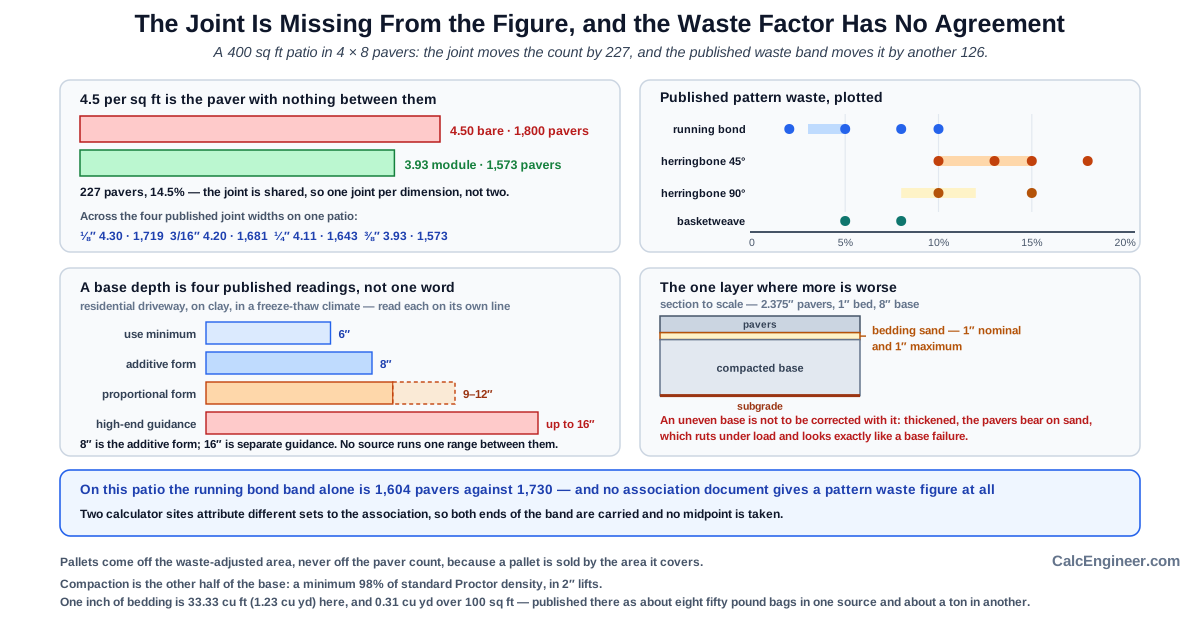
Herringbone at forty five degrees runs from ten to eighteen. At ninety degrees it runs from eight to fifteen. Basketweave is five in one source and eight in another. Two sources attribute their sets to the same industry association and the sets do not match, and no association document gives a pattern waste figure at all.
On four hundred square feet at 3.93 pavers per square foot, the running bond band alone is 1,604 pavers against 1,730. A hundred and twenty six pavers, from a figure the calculator presents as a constant.
So this page reports the band and the count at both ends, and takes no midpoint, because a point inside a published disagreement is a number no source gives.
What the sources do agree on is the reason, and it is worth carrying because it tells you which end of the band your job sits at. Herringbone creates unusable triangular cut-offs at borders, so a small patio with a lot of border relative to field sits high in the band and a long rectangular one sits low. And a forty five degree herringbone is published as the orientation required under driveways, because it locks against turning tires.
Bedding Sand Is the One Layer Where More Is Worse
Every other layer on a paver job answers a problem with more material. Base too thin, add base. Not enough pavers, order more. Joints not full, sweep more sand.
Bedding sand does not work that way, and the failure it causes looks like something else.
Published CMHA PAV-TEC-002, formerly ICPI Tech Spec 2, gives it as spread and screeded to a nominal 1 inch, 25 mm thickness. The association's specification guide repeats that figure and its mechanical installation note gives a maximum 1 inch, 25 mm thickness. The association states directly that where there is an uneven base, from inconsistent compaction or improper grading, the bedding sand is not to be used to correct it.
The reason is that sand is not a structural layer. It is a setting bed, thin enough that the pavers bear on the compacted base through it. Make it thick and the pavers bear on sand, sand moves under wheel and foot loads, and the surface develops ruts and dips that look exactly like a base failure.
So a reader who finds their base an inch low at one end and has sand on site has the wrong instinct available and the right one hidden. This page reports the published figure alongside the depth you entered, and states what the deeper layer does, because the number alone does not carry the warning.
A 1.5 inch maximum circulates on calculator sites. It appears in no association document, and this page does not repeat it.
The Base Depth Is a Soil Question Wearing a Use Label
Published minimums are given by use: four inches of compacted dense-graded aggregate under a pedestrian patio, six for a residential driveway, eight to twelve for light vehicular and streets.
Every one of those is qualified. The four inch figure is published for a patio over well-drained subgrade. The adjustment for anything else is large: one source gives fifty to one hundred percent added to the minimum for cold, wet or weak subgrade, and up to sixteen inches in clay or freeze-thaw climates. Another applies it directly as clay plus two inches, loam plus one, sand plus none.
So a six inch driveway base becomes nine to twelve on the proportional reading, and eight on the additive one, and the use label did not change.
This page asks the soil and the climate as their own inputs and reports the minimum, the additive form, the proportional form and the up-to-sixteen-inch clay or freeze-thaw guidance each on its own line, rather than choosing between them or running one range from the bottom of one reading to the top of another. The sixteen inch figure is published as guidance rather than as a required depth, and it is reported that way. Where the soil or the climate is not known, it says so and reports the unadjusted minimum, because a base sized for well-drained subgrade on clay is the failure published guidance calls the leading cause of settling and heaving.
Compaction is the other half. The association gives bases for pedestrian areas and residential driveways as compacted to a minimum 98 percent of standard Proctor density, in two inch lifts, and published guidance names skipping compaction as the leading cause of paver settling and heaving.
This Page Does Not Buy the Gravel
The Gravel Calculator on this site turns a depth into a tonnage and carries a compaction multiplier, because a base is bought by volume and a volume shrinks under a plate compactor.
None of that is repeated here.
This page produces the base depth, which is the part that depends on the paver job: the use, the soil, the climate and the layers above it. It reports the volume and hands the tonnage over.
The split matters because the corrections point different ways. A paver count carries a pattern waste factor and no compaction. A base carries a compaction multiplier and no pattern. A page doing both would be carrying two corrections that belong to different materials, and would disagree with the gravel page the first time either figure moved.
Key Facts
- A paver occupies its own dimensions plus one joint width in each direction, because every joint is shared between the two pavers that meet at it.
- A four by eight paver is 32 square inches, so a square foot holds 4.5 with no joint, and four published calculators give that figure.
- At a three eighths inch joint the module is 4.375 by 8.375 inches, which is 36.64 square inches, so a square foot holds 3.93.
- One published source names both readings and identifies 4.5 as the often quoted figure, against about 3.9 with a three eighths joint.
- The difference is 14.5 percent, which is 1,800 pavers against 1,573 on four hundred square feet.
- On a four by eight the count runs 4.30 at a one eighth joint, 4.20 at three sixteenths, 4.11 at a quarter and 3.93 at three eighths.
- Published pavers per square foot without a joint: a six by six gives 4.0, a six by nine gives 2.67, a twelve by twelve gives 1.0 and a twenty four by twenty four porcelain paver gives 0.25.
- Running bond waste is published at 2, 3 to 5, 5, 8 and 10 percent across six sources, which is a factor of five on one pattern.
- Herringbone at 45 degrees is published at 10, 13, 15, 18 and 10 to 15 percent, and at 90 degrees at 8 to 12, 10 and 15.
- No association document gives a pattern waste figure, and two calculator sites attribute different sets to the association, so the bands are industry practice rather than association figures.
- The published reason is consistent even where the figures are not: herringbone creates unusable triangular cut-offs at borders, and the 45 degree orientation is named as the one required under driveways because it locks against turning tires.
- Published CMHA PAV-TEC-002, formerly ICPI Tech Spec 2, gives bedding sand as spread and screeded to a nominal 1 inch, 25 mm thickness.
- The same association's mechanical installation note gives a maximum 1 inch, 25 mm thickness, and its specification guide repeats the nominal figure, so one inch is the published maximum rather than a starting point.
- The association states that where there is an uneven base, from inconsistent compaction or improper grading, the bedding sand is not to be used to correct it.
- Bedding sand should conform to ASTM C33 or CSA A23.1, and masonry sand for mortar, limestone screenings and stone dust are named as never to be used, because they do not compact uniformly and can inhibit lateral drainage of moisture in the bedding sand.
- Frozen or saturated sand should not be installed.
- Published base minimums are 4 inches of compacted aggregate under a pedestrian patio over well-drained subgrade, 6 inches for a residential driveway and 8 to 12 for light vehicular.
- Published adjustments for anything other than well-drained subgrade run from adding 50 to 100 percent of the minimum, to a fixed addition of 2 inches for clay and 1 for loam, with up to 16 inches in clay or freeze-thaw climates.
- Bases for pedestrian areas and residential driveways should be compacted to a minimum 98 percent of standard Proctor density, and skipping compaction is named as the leading cause of paver settling and heaving.
- A minimum 1 inch, 25 mm vertical restraining surface should be in contact with the side of the paver for the edge restraint to hold it.
- One inch of bedding sand over one hundred square feet is about 0.31 cubic yards, published as roughly eight fifty pound bags in one source and roughly one ton in another, which is a factor of five on the same volume.
Applications
- Someone who has read 4.5 pavers per square foot finds out what that figure leaves out and by how much.
- A reader choosing a joint width sees the count move across the four published widths.
- Someone comparing two calculators that disagree on running bond waste finds that both figures are published.
- A reader with a low spot in the base learns that the sand on site is the wrong fix and why.
- Someone on clay in a freeze-thaw climate sees a base depth built from three answers rather than from the word driveway.
- A reader ordering by the pallet gets a count from the area rather than from the paver number.
- Someone estimating the dig finds the depth from the layers rather than from a rule of thumb.
- A reader buying bedding sand sees why one published source says eight bags and another says a ton.
Example Calculations
Example 1. The figure with the joint left out
Given: a four hundred square foot patio in four by eight pavers at a three eighths inch joint.
Bare: 144 divided by 32 is 4.50 pavers per square foot, so 1,800 pavers.
Module: the paver occupies 4.375 by 8.375 inches, which is 36.64 square inches, so 144 divided by 36.64 is 3.93 per square foot, and 1,573 pavers.
Result: 1,800 against 1,573, a difference of 227 pavers and 14.5 percent. The bare figure is the one four calculators publish, and it is right only if the pavers touch.
Both figures are coverage rather than layout. Neither says how many pavers the border course will take.
Example 2. The joint width, on the same patio
Given: the same four hundred square feet and the same paver, at the four published joint widths.
At one eighth of an inch the module is 4.125 by 8.125, which is 33.52 square inches, and the count is 4.30 per square foot.
At three sixteenths it is 4.20, at a quarter it is 4.11, and at three eighths it is 3.93.
Result: 1,719, 1,681, 1,643 and 1,573 pavers on one patio, from the joint alone. One source names a quarter inch as standard and another names three sixteenths, so the joint is a required answer here and not a default.
Each count is rounded up once, at the end, from the unrounded per square foot figure. Multiplying the displayed 4.30 by four hundred instead gives 1,720, which is a paver of drift picked up from a rounded intermediate.
Example 3. The waste figure that is published five ways
Given: the same patio in running bond, at 3.93 pavers per square foot.
Published running bond waste: 2 percent in one source, 3 to 5 in another, 5, 8 and 10 in three more.
At 2 percent the order is 1,604 pavers. At 10 percent it is 1,730.
Result: a spread of 126 pavers from a figure most calculators present as settled. This page reports the band and the count at both ends and takes no midpoint, because a point inside a published disagreement is a number no source gives.
No association document gives a pattern waste figure at all, and two calculator sites attribute different sets to the association.
Example 4. The layer where more is worse
Given: the same patio, with the base an inch low at one end.
The bedding sand is one inch. Published CMHA PAV-TEC-002 gives it as spread and screeded to a nominal 1 inch, 25 mm thickness, and the association's mechanical installation note gives one inch as a maximum.
Result: the sand does not fix the base. The association states directly that where there is an uneven base, from inconsistent compaction or improper grading, the bedding sand is not to be used to correct it.
The reason is that sand is a setting bed rather than a structural layer. Thickened, the pavers bear on sand instead of on compacted base, and the surface ruts under load in a way that looks like a base failure.
At one inch over four hundred square feet the volume is 33.33 cubic feet, or 1.23 cubic yards.
Example 5. The base depth that the word driveway does not give
Given: a residential driveway, on clay, in a freeze-thaw climate.
The published minimum for a residential driveway is 6 inches, and that figure is for well-drained subgrade.
On the additive published form, clay adds 2 inches, which gives 8. No published source gives a fixed inch addition for the climate. On the proportional form, published guidance adds 50 to 100 percent of the minimum for cold, wet or weak subgrade, which is 9 to 12 inches, and up to 16 inches in clay or freeze-thaw.
Result: the published readings are reported separately, by role, rather than as one range.
Use minimum: 6 in, which is the published figure for a residential driveway over well-drained subgrade.
Additive soil form: 6 plus 2 for clay, which is 8 in.
Proportional form: 50 to 100 percent above the 6 in minimum, which is 9 to 12 in.
Published clay or freeze-thaw high-end guidance: up to 16 in.
8 to 16 is not one of those readings. The 8 comes from the additive form and the 16 from separate high-end guidance, so a range drawn from one to the other is a span no published form produced, and the page prints no base depth in that shape. The two forms disagree and the page reports the disagreement rather than resolving it with a midpoint or an average.
The base volume and the excavation depth are computed across the full published spread and both rows say so: the low end is the 8 in additive result and the high end is the up-to-16-inch guidance, which is an envelope across two readings rather than one form's range. The 16 in is guidance and not a required depth to build to.
Compaction is the other half. The association gives a minimum 98 percent of standard Proctor density for pedestrian areas and residential driveways, and published guidance names skipping compaction as the leading cause of settling and heaving.
Standards & References
- Concrete Masonry and Hardscapes Association The association formed by the unification of the Interlocking Concrete Pavement Institute and the National Concrete Masonry Association, publishing the technical notes cited on this page.
- Concrete Masonry and Hardscapes Association, PAV-TEC-002 Construction of Interlocking Concrete Pavements The technical note, formerly ICPI Tech Spec 2, giving the nominal 1 inch bedding sand thickness, the ASTM C33 sand requirement and the compaction figures.
- Concrete Masonry and Hardscapes Association, PAV-TEC-015 Guide for the Specification of Mechanically Installed Interlocking Concrete Pavements The specification guide covering bedding and joint sand and the testing intervals for material properties.
- ASTM International, ASTM C33 Standard Specification for Concrete Aggregates The grading requirement the bedding sand must conform to.
- ASTM International, ASTM C936 Standard Specification for Solid Concrete Interlocking Paving Units The manufacturing standard for the pavers themselves.
- ASTM International, ASTM D2940 Standard Specification for Graded Aggregate Material for Bases or Subbases The specification for the dense-graded aggregate base under the bedding sand.
- National Institute of Standards and Technology, Special Publication 811, Guide for the Use of the International System of Units The authority for the conversion factors used on this page.
The bedding sand thickness, the sand specification, the compaction density and the edge restraint contact figure are published by the Concrete Masonry and Hardscapes Association and are quoted rather than paraphrased. That association is the unification of the Interlocking Concrete Pavement Institute and the National Concrete Masonry Association, so PAV-TEC-002 and ICPI Tech Spec 2 are the same document under two names and both appear in live sources.
The one inch bedding figure is the association's own: it appears as a nominal thickness in the construction note and the specification guide and as a maximum in the mechanical installation note, and a 1.5 inch maximum that circulates on calculator sites appears in no association document, so this page does not repeat it.
The pattern waste bands are industry practice rather than association figures: no association document gives one, two calculator sites attribute different sets to the association, and the sets do not match, so the page reports the published spread and takes no midpoint. The base minimums by use and the soil and climate adjustments come from calculator sites and trade pages and are reported as minimums for well-drained subgrade with the adjustments named in both published forms. The pavers per square foot figures without a joint are arithmetic on the paver size and are reported only so a reader arriving with one can see what it leaves out.
This page reports quantities and issues no pass or fail: it computes no base tonnage, which is the Gravel Calculator's; makes no geotextile decision, which is a soil assessment; performs no structural design, for which the association publishes base thickness tables; and draws no laying pattern.
Units
Areas are entered and reported in square feet and square metres at 0.09290304. A four hundred square foot patio is 37.16 square metres.
Paver dimensions, joint widths, bedding depths and base depths are in inches with millimetres alongside at 25.4. A four by eight paver is 102 by 203 mm, a three eighths inch joint is 9.5 mm, and the association's one inch bedding is 25 mm, which it prints itself.
Volumes are in cubic feet and cubic yards with cubic metres alongside at 0.0283168. One inch over four hundred square feet is 33.33 cubic feet, 1.23 cubic yards and 0.944 cubic metres.
Paver nominal sizes are trade designations rather than measurements. A four by eight is a name, and the actual unit is what the module runs on, so confirm the dimensions from the manufacturer sheet. Metric markets sell a different product list rather than a conversion of these.
Pavers per square foot is a count against an Imperial area. In metric the same figure is pavers per square metre, which is 10.764 times it, so 3.93 per square foot is 42.3 per square metre.
The joint width, the waste percentage, the compaction percentage and all the counts are dimensionless or identical in both systems.
The internal unit selector governs the fields, labels, math, on-screen result and any exported result, and it takes priority over any site-wide unit switch. Switching converts the values you entered rather than reinterpreting them.
Limitations
- This page reports quantities and issues no pass or fail. The base figures are published minimums for well-drained subgrade that a soil report would override.
- The paver count is a coverage estimate rather than a layout. The rows, the border course, the edge cuts and which offcuts are reusable are not modelled, and the pattern waste allowance is what covers them.
- It computes no base tonnage. That is the Gravel Calculator's and it carries a compaction multiplier that would be wrong here.
- It makes no geotextile decision. Published guidance calls for one over fine, moist or freeze-susceptible soils, and that is a soil assessment.
- It performs no structural design. The association publishes base thickness design tables for vehicular loads and this page does not reproduce them.
- It draws no laying pattern and places no cuts.
- The pattern waste bands are industry practice and no association document gives one.
- No published source gives a fixed inch addition to the base depth for the climate, so the additive form adds nothing for it. Freeze-thaw exposure is reported through the proportional published form and the separate published guidance of up to sixteen inches, each on its own row.
- It issues no joint sand bag count. No published figure ties a bag to a joint width and a paver depth, so the page reports the joint volume and the bag coverage comes from the label.
- The joint sand volume is approximate. It follows the same module model as the paver count, assuming every joint is filled to the paver thickness and that the module tiles the field, neither of which is exactly true at a border.
- It takes no bedding sand bag or ton count from the published figures. The two published figures for the same volume are eight fifty pound bags and one ton, which is a factor of five, so a bag count is issued only against a bag yield you enter from the label.
- Without a paver thickness it reports no joint sand and no excavation depth. Both need it and neither is estimated without it.
- Any cost is arithmetic on a price you entered.
Common Mistakes to Avoid
- Using 4.5 pavers per square foot for a four by eight. That figure has no joint in it and overstates the count by 14.5 percent at a three eighths joint.
- Adding a joint to all four sides. Each joint is shared between two pavers, so the module adds one joint per dimension.
- Treating the module count as the number of pavers the layout will take. It is coverage, and the pattern waste is what turns it into an order.
- Taking a single pattern waste figure as settled. Running bond is published across a factor of five and no association document gives a figure at all.
- Attributing the waste bands to the association. Two calculator sites do, with different sets, and neither set appears in association material.
- Using bedding sand to level a low base. The association states directly that where the base is uneven from poor compaction or bad grading, the sand is not to be used to correct it.
- Screeding bedding sand thicker than an inch. One inch is the association's nominal figure and its mechanical note gives it as a maximum, and thicker sand ruts under load.
- Using masonry sand, limestone screenings or stone dust for bedding. All three are named as never to be used, because they do not compact uniformly and can inhibit lateral drainage.
- Sizing the base from the use alone. The published minimums are for well-drained subgrade and the adjustment for anything else runs to a doubling.
- Skipping compaction. The association gives a minimum 98 percent of standard Proctor density and published guidance names skipping it as the leading cause of settling and heaving.
- Deriving the pallet count from the paver count. A pallet is sold by the area it covers and the two do not divide evenly.
- Setting an edge restraint with less than an inch against the paver. The association gives a minimum 1 inch vertical restraining surface in contact with the side.
- Installing frozen or saturated sand. The association names both as not to be installed.
- Taking the joint sand volume as exact. It follows the module model and assumes every joint fills to the paver thickness, which a border course does not.
- Multiplying the displayed pavers per square foot by the area. Rounding once at the end from the full figure is a paver or two apart from rounding the rate first, and the drift is always upward.
Frequently Asked Questions
How many pavers per square foot?
Why do calculators give me different paver counts?
How much waste should I add for pavers?
How thick should the bedding sand be?
Can I use extra sand to level a low base?
How deep should the base be?
What sand goes under pavers?
How many pavers are on a pallet?
Frequently Used Together
Engineers often use these calculators in combination for complete project workflows:
Related Calculators
Explore similar calculators that might be useful for your project:
Calculate
This selector governs every field, label, result and export here and takes priority over the site header switch. Switching converts what you entered rather than reinterpreting it, so a 400 sq ft patio becomes 37.16 sq m and returns to exactly 400.
The Area
The three answers open different fields. If the area came off a plan, a site measure or the Square Footage Calculator, the third answer takes it directly rather than making you work back to two sides.
The Paver and the Joint
In inches, the long side as the product is sold. Nominal paver sizes are trade designations rather than measurements, so a four by eight is a name: take the figure off the manufacturer sheet.
In inches, the short side as the product is sold. Together with the length it gives the bare paver area, which is the figure that circulates and the one this page reports without using.
In inches. Required here with no default, because the published per square foot figures split on whether the joint is in them. Published widths are one eighth, three sixteenths, a quarter and three eighths.
In inches, optional. The joint sand volume and the excavation depth both need it and neither is reported without it. The paver count, the bedding sand and the base are unaffected.
The Pattern and the Waste
The published waste band follows from this and nothing else does. Herringbone creates unusable triangular cut-offs at borders, and the forty five degree orientation is the one published as required under driveways.
Optional. One published source adds three to five percent on top of the pattern figure for curved borders or irregular shapes. Left unstated, nothing is added and nothing is claimed about the borders.
The band is offered rather than a point, because the published figures for one pattern span a factor of five. None is an answer and is offered as one. A stated percentage replaces the band outright.
The Base, the Soil and the Climate
This sets the published base minimum and nothing else. Four inches under a pedestrian patio, six for a residential driveway and eight to twelve for light vehicular, all of them over well-drained subgrade.
In the additive published form one source gives clay as plus two inches, loam as plus one and sand as plus none. Not known is an answer: the page reports the unadjusted minimum and says the adjustment was not applied.
No published source gives a fixed inch addition for the climate. What freeze-thaw does is put the job under the proportional published form and under separate published guidance of up to sixteen inches, and the page reports each on its own row rather than merging them into one depth range.
In inches, optional. Where you have a figure from a specification or a soil report it overrides the published one outright, and the volume and the excavation are computed on it with the published figure named beside it.
The Sand and the Edge
In inches, optional, defaulting to the association's published one inch. It is a setting bed rather than a variable: published guidance states it is not to be used to correct an uneven base.
In cubic feet per bag, optional, from the label. A bag count is issued only against a yield you enter, because the published bag figures for the same volume differ by a factor of five.
In feet, optional. The edge restraint is a linear quantity equal to the perimeter. The association gives a minimum one inch vertical restraining surface in contact with the side of the paver.
The Supply and the Prices
In square feet per pallet, optional, from the supplier. The pallet count comes from the waste adjusted area and never from the paver count, because a pallet is sold by the area it covers.
Optional, in your own currency. Applied to the order quantity rather than the coverage one, so a waste band returns a cost band.
Optional, in your own currency. Priced beside the pavers rather than added to them: if you price both, the same pavers are in the subtotal twice.
Optional, in your own currency. Applied only where a bag yield was entered, because no bag count is taken from the published figures.
Optional, in your own currency, per linear foot. Applied only where a perimeter was entered.