Gravel Calculator — A Cubic Yard on the Truck Is Not a Cubic Yard on the Ground
On this page
Calculate
This selector governs every field, label, result and export here and takes priority over the site header switch. Switching converts what you entered rather than reinterpreting it, so a 20 ft length becomes 6.096 m and returns to exactly 20.
The Area
The dimensions asked for below follow from this answer. A ring is the shape of a gravel border around a patio, a tree or a pool, and it is the outer circle with the inner one taken out.
The Depth and the Material
In inches, and it is the depth you want on the ground after compaction. Not the depth of loose stone to be tipped: a loose depth entered here has the compaction allowance applied twice.
Choose this before anything that depends on it. The compaction allowance and the density both come from it, and there is no default that is right for the whole list.
It changes no arithmetic. It selects the published depth range your depth is reported against, and the published guidance on which stone suits which use.
Set separately from compaction, because they are two corrections and they multiply. Waste covers the site: uneven subgrade, spillage, edges that are not square. None is an answer and is offered as one.
Your Supplier's Figures (all optional)
A multiplier on the finished volume, dimensionless and the same in both systems. It overrides the published figures, is named on the result as yours, and turns a range into one order volume. The pit knows how its own stone behaves under a roller.
In tons per cubic yard. It overrides the published figure or range and produces a single tonnage. It is on their scale ticket, and it beats every published table including the ones on this page.
Where you have been given one. It changes no arithmetic and reports whether your specification shares a basis with the published loose to compacted range, which is tied to 95 percent Modified Proctor density.
In US tons, from your supplier. Where the order falls below it, the minimum governs what arrives and what you pay for, and the arithmetic decides nothing.
Per US ton, in your own currency. Arithmetic only: no delivery charge, no fuel surcharge and no tax.
Per cubic yard, in your own currency. It is priced against the loose order volume, because that is the quantity that arrives.
Overview
Every gravel calculator does the same two things. It multiplies length by width by depth for a volume, and it multiplies that volume by a density for a tonnage. Both are correct, and neither is where the money goes wrong.
Two corrections sit between the calculated volume and the delivery ticket, and the field routinely runs them together into one percentage.
The first is waste, which covers the site: uneven subgrade, spillage, edges that are not square, and material that ends up outside the area. Published guidance puts it at five to ten percent, and closer to fifteen where nothing holds the stone in place.
The second is compaction, and it is the one this page exists for, because it is not a property of the job. It is a property of the material. A dense graded base like crusher run is delivered loose and settles under a roller, so published estimating guidance says to order 1.15 to 1.25 loose cubic yards for every compacted cubic yard in place. Clean open graded stone such as number 57, and rounded pea gravel, do not compact in the same way, and one published source says they get no extra at all.
So a calculator that applies one compaction factor to everything on its material list is wrong for half that list, in whichever direction you chose.
And the tonnage is a second question again. A cubic yard runs from about 1.2 tons for river rock to 1.85 for riprap, so the same hole filled with two different materials differs by half as much again on a ticket priced by the ton.
What to Look at First
Read the order volume before the finished volume. The finished volume is what every gravel calculator returns and it is not what you buy: it is a compacted quantity, describing what is on the ground after the roller has been over it, while a supplier quote and a delivery ticket are loose quantities describing what is in the truck. Both are on the result and both are labelled.
Then read the two corrections apart rather than as one figure. Waste answers to the site and compaction answers to the stone, so changing material moves one of them and leaves the other alone. That is the whole reason they are shown at separate stages with the volume each one produced.
If the order is under about five tons, stop and read the delivery minimum block first. On a job that size the minimum decides what arrives and the arithmetic decides nothing.
How to Use This Calculator
Enter the finished depth, which is the depth you want on the ground after compaction. Not the depth of loose stone to be tipped. Entering a loose depth here has the compaction allowance applied twice.
Choose the material before anything else that depends on it. The compaction factor and the density both come from it, and there is no default that is right for the whole list.
Enter your supplier's compaction factor if you have one, and their density if you have that. Both override the published figures and both are better than any table, because the pit knows what its own material weighs and how it behaves under a roller.
Set the waste allowance separately from compaction. Five percent on firm ground with hard borders, ten as the usual figure, fifteen where nothing holds the stone in place.
Read the loose volume and the order volume as two numbers, not one. The first is what the compaction correction produced and the second is what the waste correction added, and seeing them apart is what lets you adjust one without the other.
Check the delivery minimum before the arithmetic. On a small job it decides the order and the calculation does not.
Inputs & Outputs
Inputs
Outputs
Gravel Formula
Every quantity on this page comes from one area, one depth and two multiplications. Areas are canonical in square feet internally, depths in inches, densities in tons per cubic yard.
Rectangular area
area_sf = len_ft * wid_ft
Circular area
area_sf = 3.14159 * (out_dia_ft / 2) ^ 2
Annular area
area_sf = area_out_sf - area_in_sf
Finished volume in cubic feet
vol_cf = area_sf * depth_in / 12
Finished volume in cubic yards
vol_cy = area_sf * depth_in / 324
Several areas summed
vol_total_cy = vol_1_cy + vol_2_cy + vol_3_cy
Identical areas repeated
vol_total_cy = vol_cy * area_count
Loose volume after compaction
loose_cy = vol_total_cy * comp_factor
Order volume after waste
order_cy = loose_cy * (1 + waste_pct / 100)
Combined multiplier
combined = comp_factor * (1 + waste_pct / 100)
Tonnage at the low density
tons_low = order_cy * density_low_tcy
Tonnage at the high density
tons_high = order_cy * density_high_tcy
The finished volume in cubic yards divides by 324 rather than by 27 because the depth is in inches and the area in square feet. It is the twelve inches to the foot and the twenty seven cubic feet to the yard combined, and published guidance gives the relationship both ways.
The circle equation prints pi to five decimals because a formula box holds an arithmetic expression and nothing else. The engine carries the constant at full precision, which on a twenty foot circle is a difference of three ten thousandths of a square foot.
The three terms in the several areas equation are representative. The build takes six rows and the equation takes any number, and a job with more areas than rows runs the page twice and adds the two orders, which is exact because every correction here is a multiplication.
The compaction factor converts a compacted volume to a loose one, and where it comes from is the compaction factor section above.
The reverse form appears in supplier wording and is the same fact: if the compacted volume is 80 percent of the loose volume, the factor is one divided by 0.80, which is 1.25. A settlement percentage used directly as a multiplier gives 1.20 where 1.25 is meant. No input takes a settlement percentage, and this conversion is here so a reader who meets that wording can reconcile it.
The tonnage runs at two densities where the published figure is a range, and at one where a supplier density is entered. A single figure chosen from inside a published range is a decision this page has no basis to make.
Loose Versus Compacted Cubic Yards
Aggregate volume has three states and one name, and almost every ordering mistake starts there.
Bank cubic yards are material undisturbed in the ground, before anything is dug.
Loose cubic yards are material excavated and in the truck. Breaking up the interlocked structure fills the spaces between particles with air, so the same mass takes up more room.
Compacted cubic yards are material placed, spread and rolled. Air is driven out and the particles are forced together, so the same mass takes up the least room of the three.
Published guidance states it plainly: always clarify whether a quantity is expressed in bank, loose or compacted cubic yards.
The reason it matters on a gravel order is that two documents use the same word for different states and neither says so.
A drawing, a specification or a finished depth is a compacted quantity. It describes what is on the ground after the roller has been over it.
A supplier quote and a delivery ticket are loose quantities. They describe what is in the truck.
Nobody is being careless. Within its own trade neither document needs to say which state it means, because everyone in that trade already knows. The reader standing between the two is the one who has to translate.
On this page the finished volume is compacted and the order volume is loose, and both are labelled on the result. Reading a loose figure as a compacted one, or the reverse, is not a rounding difference: on crushed stone base it is a sixth to a quarter of the whole order.
A third factor sits in the same family and is easy to confuse with compaction. Swell is the bank to loose conversion, not the loose to compacted one. Published figures give crushed stone a swell of 10 to 15 percent, sand and gravel 10 to 12 percent, and clay 30 to 40. This page starts from a finished depth rather than from an excavation, so swell does not arise here, and it is named because a reader who meets the word will otherwise apply it to the wrong pair of states.
One caution from the same source: the relationship between the three states is not always linear, so a volume cannot always be moved between them by multiplying once.
Gravel Compaction Factor
The compaction factor converts the volume you want on the ground into the volume that has to arrive on the truck, and it is not one number.
Published estimating guidance gives it for crushed stone base material compacted to 95 percent Modified Proctor density: the compacted volume is typically 80 to 85 percent of the loose volume, so 1.15 to 1.25 loose cubic yards are needed for every compacted cubic yard in place.
Two things about that sentence do most of the work.
It is a range, and the range is not vagueness. It reflects real variation in gradation, moisture and the effort applied.
And it is tied to a specification. Ninety five percent Modified Proctor is a stated compaction target, tested under ASTM D1557, with ASTM D698 covering the Standard Proctor test. The factor moves with what the material is compacted to, so a factor quoted without its specification is incomplete.
Two calculator sites give 1.25 and 1.20 for dense graded base and present them as settled figures. They are two points inside the published range, and neither states the specification the range depends on.
The factor is also a property of the material rather than of the job, which is the part most calculators get wrong.
Crusher run and other dense graded bases are graded from fines up to about three quarters of an inch. Under a roller the small particles migrate into the voids between the large ones and the whole mass loses volume. That is what a compaction factor describes.
Clean open graded stone such as number 57 has no fines to migrate. Rounded pea gravel has no fines and no angular faces to lock together. One published source states that neither compacts and that they get no allowance at all. Another gives clean stone 1.10.
That one is not settled. The estimating source with the specification behind it addresses base material rather than clean stone, so this page reports both figures for clean and rounded materials and issues no single order volume for them.
Where a supplier gives a factor for the specific material, that figure wins and the page uses it alone. The pit knows how its own stone behaves under a roller and no published table does.
What the page never does is average. The midpoint of 1.00 and 1.10 is 1.05, which appears in no source, and a reader who quoted it to a supplier would be using a number that exists nowhere.
Gravel Waste Allowance
Waste is the second correction and it covers the site rather than the stone.
Published guidance recommends adding five to ten percent to the calculated quantity for most jobs, and closer to fifteen percent on areas with no hard borders to hold the material in place.
What it pays for is an uneven subgrade that is deeper in places than the drawing says, spillage while spreading, edges that are not square, and material that ends up outside the area. One source puts the reason plainly: ordering slightly long is cheaper than paying for a second delivery.
Published guidance also states that waste and compaction are two separate things, each added once. The field routinely merges them into a single percentage.
They multiply rather than add. A compaction factor of 1.25 with a ten percent waste allowance is a combined multiplier of 1.375. Adding twenty five and ten gives 1.35, which is 1.8 percent below the correct 1.375.
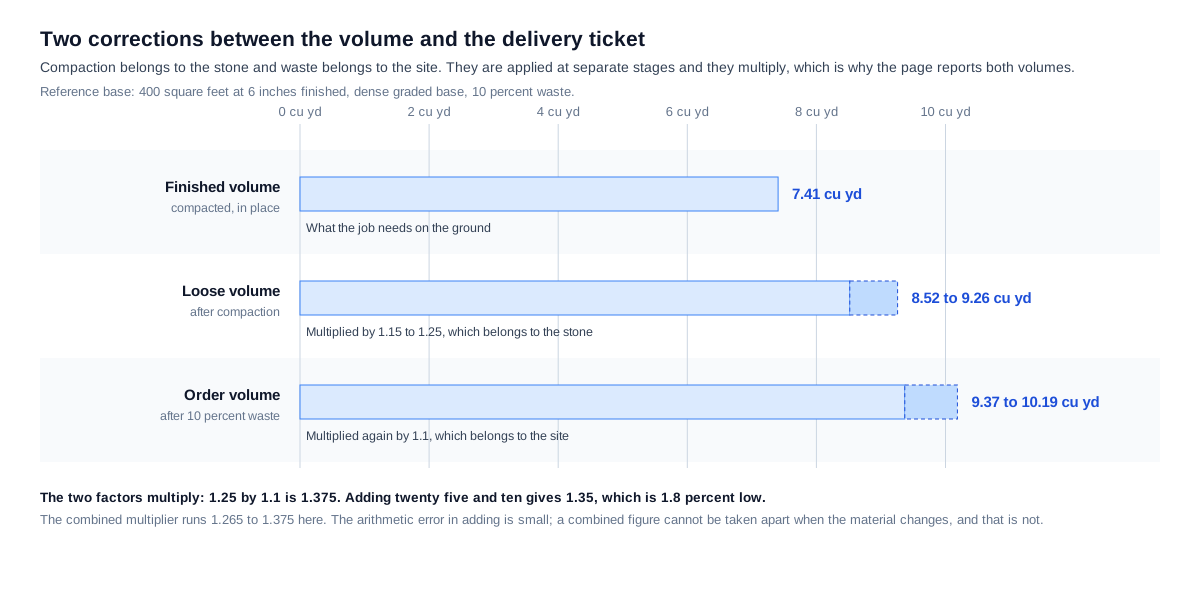
The arithmetic error is small. The consequence of merging is not, and it has nothing to do with the 1.8 percent.
A combined figure cannot be taken apart. The two corrections answer to different things: waste to the ground and the crew, compaction to the stone. Change the material and one of them moves while the other does not, and on clean open graded stone the compaction allowance may go to nothing while the waste allowance stays at ten percent.
A reader working from a single thirty five percent has no way to make that adjustment, and no way to see that one of the two even applies to their material.
So this page applies them at separate stages, reports the volume each one produced, and shows the combined multiplier alongside rather than instead.
Gravel Tons Per Cubic Yard
Suppliers price by the ton even when a reader specifies yards, so somewhere between the drawing and the invoice a volume is converted using a density. That conversion is where the money is.
Published figures in tons per cubic yard run from about 1.2 for river rock, through 1.3 to 1.35 for pea gravel, 1.4 for crushed stone and number 57, 1.5 for dense graded base and crusher run, to about 1.85 for riprap.
River rock to riprap is a factor of about 1.54 on the same cubic yard. Two materials filling the same hole differ by half as much again on a ticket priced by weight.
Published criticism names the failure directly: a generic 2,410 pounds per cubic yard, used by many calculators, understates dense crusher run, which is 2,700 or more. That is not a small approximation. It is out by a fifth on the densest common material.
Two things make a published density weaker than it looks.
Most figures do not say which volume state they describe. An estimating source gives aggregate base course at 115 to 130 pounds per cubic foot, which is 1.55 to 1.75 tons per cubic yard, and names it as the compacted density. The calculator figures give no state at all, which is the same fault in the weight that the three states problem is in the volume.
And moisture moves it. One source puts damp or compacted material fifteen to twenty five percent above dry loose stone. A load delivered after rain weighs more than the same volume delivered in August.
Where a source gives a range this page reports a range, because choosing a point inside a published range is a decision it has no basis to make. Where a supplier gives a density for the material coming out of their pit, that figure wins and produces a single tonnage.
The practical advice is short. Ask the supplier what their material weighs per yard. They know, it is on their scale ticket, and it beats every published table including the ones on this page.
Gravel Delivery Minimum
Bulk aggregate is delivered by the truck load, and published guidance puts the minimum at five to ten tons.
That figure decides more small jobs than the arithmetic does.
A path of a hundred square feet at three inches is about 0.93 cubic yards, or roughly 1.3 tons. Every minimum quoted is at least four times that.
So the order is the minimum. The calculated quantity has no bearing on what arrives or what is paid for, and a calculator that returns 1.3 tons and stops has answered a question the reader cannot act on.
What changes at that point is the question itself. It stops being how many yards and becomes whether to buy bagged material, whether to collect a load rather than have one delivered, and whether the delivery charge on a minimum load makes bags cheaper despite a much higher unit price.
This page reports the minimum where a reader enters one, names the published five to ten ton range where they do not, and says when an order falls below it. It does not compute a bag count, because bag weights and yields are not held here and a count without them would be invented.
The minimum varies by supplier and by region, and it is worth one phone call before any of the arithmetic on this page matters.
Driveway Gravel Depth
A gravel driveway is not one depth of one material, and treating it as one is the commonest way the quantity comes out short.
Published guidance gives four to six inches compacted under driveways, slabs and pavers, placed in two to four inch lifts because a thicker lift does not compact through.
For a full new gravel driveway the published figure is eight to twelve inches total, in two or three layers.
Those layers are not the same material. A driveway is described as a base of angular dense graded stone with a top layer of one to two inches of angular surface stone, and on soft soil or under heavy traffic the base goes to six inches or more.
So a full driveway is two or three calculations, each at its own depth and often in its own material, with its own compaction factor and its own density. This page calculates the layer you entered. It says so on every driveway result, because a reader who enters twelve inches of one material has priced something that is not what published guidance describes.
The material matters as much as the depth here. Published guidance is consistent that crusher run locks together and holds under wheels, and that rounded pea gravel shifts under tyres. One source puts it as rounded stone never stopping rolling.
That is guidance and not code. This page reports it and computes whatever material was chosen, because refusing would be inventing a prohibition and computing silently would be withholding something every source agrees on.
And the depths themselves are published ranges rather than design figures. A vehicle area carries loads that depend on the subgrade, the drainage and the traffic, and none of those is knowable from an area and a depth.
Drainage Gravel Versus Compacted Base
Drainage stone and base stone are chosen for opposite reasons, and the property that makes one work is the property that disqualifies the other.
A compacted base needs fines. Dense graded material runs from dust up to about three quarters of an inch, and under a roller the small particles migrate into the voids between the large ones. The mass locks together, loses volume and becomes a hard surface that carries load.
A drain needs the voids to stay open. Published guidance calls for washed clean stone with no fines, so water can move through the spaces between the particles. Number 57 is the common size for it.
Fines in a drain do the same thing they do in a base: fill the voids. In a base that is the point. In a drain it is the failure.
Two consequences follow for this calculation.
Clean stone does not compact in the way a base does, because there is nothing to migrate. That is why the compaction factor on this page depends on the material, and why one published source gives clean open graded stone no allowance at all.
And a drainage depth is not a surface depth. The published ranges on this page cover paths, driveways and paver bases, which are surfaces carrying something. A drain is sized by how much water has to move and where it goes, so this page reports no depth range for a drainage application and says why.
What this page does is name the requirement and compute the quantity. Trench width, pipe, geotextile, outfall and the drainage design itself are outside it.
What Is a Gravel Calculation
A gravel calculation turns an area and a depth into a quantity to buy, and the difficulty is that the quantity has three forms and two of them are hidden.
The volume itself is not in dispute. Area multiplied by depth, divided into cubic yards, is arithmetic every calculator gets right.
What follows is where the trade's own vocabulary works against a reader. The same stone is measured in the ground, in the truck and on the ground, and the three are different numbers with one name.
The second hidden form is weight. Suppliers price by the ton, so a density stands between the volume and the invoice, and it varies by a factor of one and a half across ordinary materials.
So the useful output of a gravel calculation is not a volume. It is an order: a loose volume, converted at a density that belongs to the specific stone, with the waste the site needs, checked against the minimum the supplier will deliver.
Key Facts
- Aggregate volume is measured three ways: bank cubic yards in the ground, loose cubic yards in the truck, and compacted cubic yards in place. Published guidance says to always clarify which one a quantity is expressed in.
- Suppliers quote and deliver in loose cubic yards. Specifications and finished depths are compacted cubic yards, and neither document says which state it means because within its own trade it does not need to.
- Published estimating guidance states that crushed stone base compacted to 95 percent Modified Proctor density occupies 80 to 85 percent of its loose volume, so 1.15 to 1.25 loose cubic yards are needed per compacted cubic yard in place.
- That range is tied to a compaction specification. Ninety five percent Modified Proctor is tested under ASTM D1557, and Standard Proctor under ASTM D698, so a factor quoted without its specification is incomplete.
- Two calculator sites give 1.25 and 1.20 for dense graded base and present them as settled. They are two points inside that published range rather than a disagreement between sources, and neither states the specification behind it.
- Compaction is a property of the material. Dense graded base compacts because its fines migrate into the voids under a roller. One published source states that clean open graded stone like number 57 and rounded pea gravel do not compact and get no allowance, and another gives them 1.10.
- Swell is a different factor from compaction and covers bank to loose rather than loose to compacted. Published figures give crushed stone 10 to 15 percent, sand and gravel 10 to 12 percent, and clay 30 to 40 percent.
- One source warns that the relationship between the three volume states is not always linear, so a volume cannot always be moved between them by a single multiplier.
- Waste is a separate correction covering uneven subgrade, spillage and unsquare edges, published at five to ten percent and closer to fifteen where nothing holds the stone in place.
- Waste and compaction multiply rather than add. A 1.25 factor with ten percent waste is a combined multiplier of 1.375, and adding twenty five and ten gives 1.35.
- Published densities in tons per cubic yard run from about 1.2 for river rock, through 1.3 to 1.35 for pea gravel, 1.4 for crushed stone and number 57, 1.5 for dense graded base, to about 1.85 for riprap, a spread of about 1.54 on the same volume.
- An estimating source gives aggregate base course at 115 to 130 pounds per cubic foot, which is 1.55 to 1.75 tons per cubic yard, and names it as the compacted density. Most published density figures do not say which state they describe.
- Published criticism states that a generic 2,410 pounds per cubic yard, used by many calculators, understates dense crusher run, which is 2,700 or more.
- Moisture moves density: one source puts damp or compacted material 15 to 25 percent above dry loose stone.
- Bulk aggregate has a delivery minimum, published at five to ten tons. A hundred square foot path at three inches is about 0.93 cubic yards or 1.3 tons, which is under every minimum quoted.
- Published depth guidance: paths and decorative cover about two inches, walkways two to three, a top up layer three to four, and four to six inches compacted under driveways, slabs and pavers, placed in two to four inch lifts.
- A full gravel driveway is published as eight to twelve inches total in two or three layers, each with its own depth and often its own material.
- Published guidance is consistent that crusher run locks together and suits driveways, and that rounded pea gravel shifts under tyres. For a drain the requirement reverses: washed clean stone with no fines, so water can move through the voids.
Applications
- A homeowner ordering a driveway base finds out that the yard on the quote and the yard on the drawing are different quantities with the same name.
- A contractor with a compaction specification enters the factor that specification implies rather than a generic allowance, and sees whether their specification shares a basis with the published range.
- Someone laying a paver base sees the loose volume and the order volume separately, so switching from crusher run to clean stone changes one of them and not both.
- A reader pricing two materials for the same area sees the tonnage differ by two tons on ten yards from the density alone.
- Someone with a small path finds that the delivery minimum decides the order and the arithmetic does not.
- A person told to allow twenty percent for settling learns that twenty percent settlement is a factor of 1.25 rather than 1.20.
- A reader building a drain finds that the clean stone a drain needs is the material that does not compact, which is the opposite requirement to a base.
- Someone with a supplier's own density and compaction factor gets one figure instead of two ranges, which is what having real numbers is worth.
Worked Examples
Example 1. A ring of gravel, and uncertainty that compounds.
Given: a gravel border around a circular patio, 20 feet across the outside and 12 feet across the inside, at 3 inches finished depth, in rounded pea gravel, with a ten percent waste allowance.
The outer circle is 314.16 square feet and the inner is 113.10, so the ring is 201.06 square feet. At 3 inches that is 1.86 compacted cubic yards.
Pea gravel has no settled compaction factor: one source gives it none and another gives 1.10. The order is 2.05 cubic yards at the first and 2.25 at the second.
Its published density is a range as well, 1.3 to 1.35 tons per cubic yard.
Result: four tonnage figures, from 2.66 to 3.04 tons, because a disputed factor and a density range multiply into each other. The spread is 0.38 tons on the low figure of 2.66, which is fourteen percent of the low tonnage and 12.5 percent of the high.
That is the case for asking the supplier two questions rather than one. Either answer alone halves the spread; both together give a single figure.
Example 2. A supplier factor collapses the range.
Given: a base of 400 square feet at 6 inches finished, in crusher run, with a supplier who states a compaction factor of 1.18 for their material, and a ten percent waste allowance.
The finished volume is 7.41 compacted cubic yards. The published range of 1.15 to 1.25 would give 8.52 to 9.26 loose cubic yards, a spread of nearly three quarters of a yard.
The supplier's 1.18 gives 8.74. With the waste allowance the order is 9.61 cubic yards.
Result: one figure instead of a range, and it is named on the result as the supplier's rather than as a published one. The page reports the published range alongside so the reader can see where their supplier's figure sits inside it.
Example 3. A published range against a supplier figure, on the same order.
Given: an order volume of 10.19 cubic yards of pea gravel.
At the published range of 1.30 to 1.35 tons per cubic yard that is 13.25 to 13.76 tons, a span of half a ton.
At a supplier density of 1.32 it is 13.45 tons.
Result: half a ton of uncertainty removed by one question. On a ticket priced by the ton that is real money, and the supplier already knows the answer because it is on their scale ticket.
The page never picks a point inside a published range on its own. Reporting 13.5 would look tidier and would be a number no source gives.
Example 4. Measured around instead of across.
Given: a circular area measured by running a tape around its edge, giving 62.83 feet, entered in the diameter field.
Taken as a diameter, the area is pi times 31.42 squared, which is 3,100 square feet.
The true diameter is 62.83 divided by pi, which is 20.00 feet, and the area is 314 square feet.
Result: out by a factor of 9.87, which is pi squared. At 3 inches deep that is 28.7 cubic yards ordered against 2.9 needed.
An error of this size is obvious once the truck arrives and not before, because every figure downstream of it is internally consistent. That is why the field asks what you measured, and why the page stops rather than guessing when a reader answers that they measured around.
Standards & References
- ASTM International, ASTM D1557 Standard Test Methods for Laboratory Compaction Characteristics of Soil Using Modified Effort The Modified Proctor test behind the 95 percent compaction specification that the published loose to compacted range of 1.15 to 1.25 is tied to.
- ASTM International, ASTM D698 Standard Test Methods for Laboratory Compaction Characteristics of Soil Using Standard Effort The Standard Proctor test, the other compaction specification a reader may be given, and a different basis from the one the published range assumes.
- ASTM International, ASTM C29 Standard Test Method for Bulk Density and Voids in Aggregate The test method behind a published aggregate density, and the reason a density figure needs its volume state named.
- ASTM International, ASTM C33 Standard Specification for Concrete Aggregates The grading requirements behind the size numbers used for clean crushed stone, including number 57.
- National Stone, Sand and Gravel Association The trade association for the aggregate industry, and the route to product data and regional supplier information.
- National Institute of Standards and Technology, Special Publication 811, Guide for the Use of the International System of Units The authority for the conversion factors used on this page: 0.764555 cubic metres to the cubic yard, 0.907185 tonnes to the US ton, 25.4 millimetres to the inch and 0.3048 metres to the foot.
Units
Volume is entered as an area and a depth and reported in cubic feet, cubic yards and cubic metres. A cubic yard is 27 cubic feet and 0.764555 cubic metres, so the reference base of 7.41 cubic yards is 200 cubic feet and 5.66 cubic metres.
Every volume on this page carries its state as well as its unit, because a cubic yard compacted and a cubic yard loose are different quantities of the same stone. The finished volume is compacted, the order volume is loose, and both are labelled on the result.
Weight is in US tons with tonnes alongside. A US ton is 2,000 pounds and 0.907185 tonnes, so 15.29 tons is 13.87 tonnes.
Density is in tons per cubic yard with tonnes per cubic metre alongside, converting by multiplying by 1.186553. Dense graded base at 1.5 tons per cubic yard is 1.78 tonnes per cubic metre.
Where an estimating source gives pounds per cubic foot, that converts by multiplying by 27 and dividing by 2,000: 115 pounds per cubic foot is 1.55 tons per cubic yard.
Lengths and diameters are in feet with metres alongside at 0.3048, and depths are in inches with millimetres alongside at 25.4. Six inches is 152 mm and three inches is 76 mm.
The compaction factor, the waste percentage, the combined multiplier and the area count are dimensionless and identical in both systems.
The internal unit selector governs the fields, labels, math, on-screen result and any exported result, and it takes priority over any site-wide unit switch. Switching converts the values you entered rather than reinterpreting them.
Limitations
- This page reports a quantity and issues no pass or fail. There is no published minimum for a quantity of gravel and the depth figures are typical ranges rather than requirements.
- It issues no single order volume without a supplier compaction factor, because the published figure is a range tied to a compaction specification and choosing a point inside it would be a decision the page cannot justify.
- It does not settle whether clean open graded stone and rounded pea gravel take a compaction allowance. Two sources give 1.00 and 1.10, and the estimating source with a specification behind it addresses base material.
- It holds no published compaction factor for riprap or for an aggregate outside the modelled list, and applies none unless a supplier factor is entered.
- It does not model swell, which is the bank to loose conversion, because this page starts from a finished depth rather than from an excavation.
- It treats the conversion between volume states as a single multiplier, and one published source warns that the relationship is not always linear.
- It calculates one layer. A full driveway is two or three layers with their own depths and materials, and every driveway result says so.
- The several areas mode takes six rectangles. A job with more areas runs the page twice and adds the two orders, which is exact because every correction here is a multiplication.
- It does not convert a radius or a circumference to a diameter. It asks what you measured and stops rather than guessing.
- It does not design a subgrade, specify geotextile, compaction equipment or lift thickness, or test anything.
- It computes no bag count, which needs bag weights and yields it does not hold.
- It does not size anything structural, and it does not design a drain: trench width, pipe, outfall and drainage capacity are outside it.
- It does not recommend a material. It reports what published guidance says about a material for a use and stops there.
- The densities are typical published figures rather than measurements of any specific product, most do not state which volume state they describe, and moisture moves them by 15 to 25 percent.
- Delivery minimums and depth ranges vary by supplier and region and are dated. Any cost is arithmetic on a price you entered, with no delivery charge, surcharge or tax in it.
Common Mistakes to Avoid
- Ordering the finished volume. The drawing is in compacted cubic yards and the truck arrives in loose ones, and published guidance puts the gap at 1.15 to 1.25 for crushed stone base.
- Entering a loose depth as the finished depth. That applies the compaction allowance twice, and the result looks entirely reasonable either way.
- Applying one compaction factor to every material. It is a property of the stone: dense graded base compacts because its fines fill the voids, and clean open graded stone has no fines to move.
- Quoting a compaction factor without its specification. The published range is tied to 95 percent Modified Proctor, and the figure moves with what the material is compacted to.
- Using a settlement percentage as a multiplier. Twenty percent settlement is a factor of 1.25, not 1.20, and 1.20 is four percent short of the 1.25 the job needs.
- Adding waste and compaction together. They multiply: 1.25 with ten percent is 1.375, and adding twenty five and ten gives 1.35.
- Merging waste and compaction into one allowance. A combined figure cannot be taken apart, and on clean stone one of the two may be nothing while the other is not.
- Confusing swell with compaction. Swell is bank to loose and compaction is loose to compacted, and they are different factors on different pairs of states.
- Using one density for every material. Published figures run from about 1.2 tons per cubic yard for river rock to 1.85 for riprap.
- Taking a density figure without its state. An estimating source gives 115 to 130 pounds per cubic foot as a compacted density, and most published figures do not say which state they describe.
- Ignoring the delivery minimum on a small job. A path calculating to 1.3 tons still gets a five ton minimum, and the arithmetic decides nothing.
- Measuring a circle around rather than across. The equation takes a diameter, and a circumference entered in that field is out by a factor of pi squared, which is 9.87.
- Treating a driveway as one depth. Published guidance describes eight to twelve inches in two or three layers, each with its own depth and often its own material.
- Using rounded stone on a driveway. Published guidance is consistent that it shifts under tyres, while crusher run locks together.
- Using stone with fines in a drain. A drain needs washed clean stone so water can move through the voids, which is the opposite of what a compacted base needs.
Frequently Asked Questions
How many tons of gravel are in a cubic yard?
How much extra gravel should I order for compaction?
What is the difference between loose and compacted cubic yards?
Do I add waste and compaction together?
Do I order 20 percent more if my supplier says the material settles 20 percent?
How deep should gravel be for a driveway?
Why is there a minimum order for gravel?
What gravel is best for a driveway?
What is the difference between swell and compaction?
What gravel should I use for drainage?
Related Calculators
Explore similar calculators that might be useful for your project:
Calculate
This selector governs every field, label, result and export here and takes priority over the site header switch. Switching converts what you entered rather than reinterpreting it, so a 20 ft length becomes 6.096 m and returns to exactly 20.
The Area
The dimensions asked for below follow from this answer. A ring is the shape of a gravel border around a patio, a tree or a pool, and it is the outer circle with the inner one taken out.
The Depth and the Material
In inches, and it is the depth you want on the ground after compaction. Not the depth of loose stone to be tipped: a loose depth entered here has the compaction allowance applied twice.
Choose this before anything that depends on it. The compaction allowance and the density both come from it, and there is no default that is right for the whole list.
It changes no arithmetic. It selects the published depth range your depth is reported against, and the published guidance on which stone suits which use.
Set separately from compaction, because they are two corrections and they multiply. Waste covers the site: uneven subgrade, spillage, edges that are not square. None is an answer and is offered as one.
Your Supplier's Figures (all optional)
A multiplier on the finished volume, dimensionless and the same in both systems. It overrides the published figures, is named on the result as yours, and turns a range into one order volume. The pit knows how its own stone behaves under a roller.
In tons per cubic yard. It overrides the published figure or range and produces a single tonnage. It is on their scale ticket, and it beats every published table including the ones on this page.
Where you have been given one. It changes no arithmetic and reports whether your specification shares a basis with the published loose to compacted range, which is tied to 95 percent Modified Proctor density.
In US tons, from your supplier. Where the order falls below it, the minimum governs what arrives and what you pay for, and the arithmetic decides nothing.
Per US ton, in your own currency. Arithmetic only: no delivery charge, no fuel surcharge and no tax.
Per cubic yard, in your own currency. It is priced against the loose order volume, because that is the quantity that arrives.