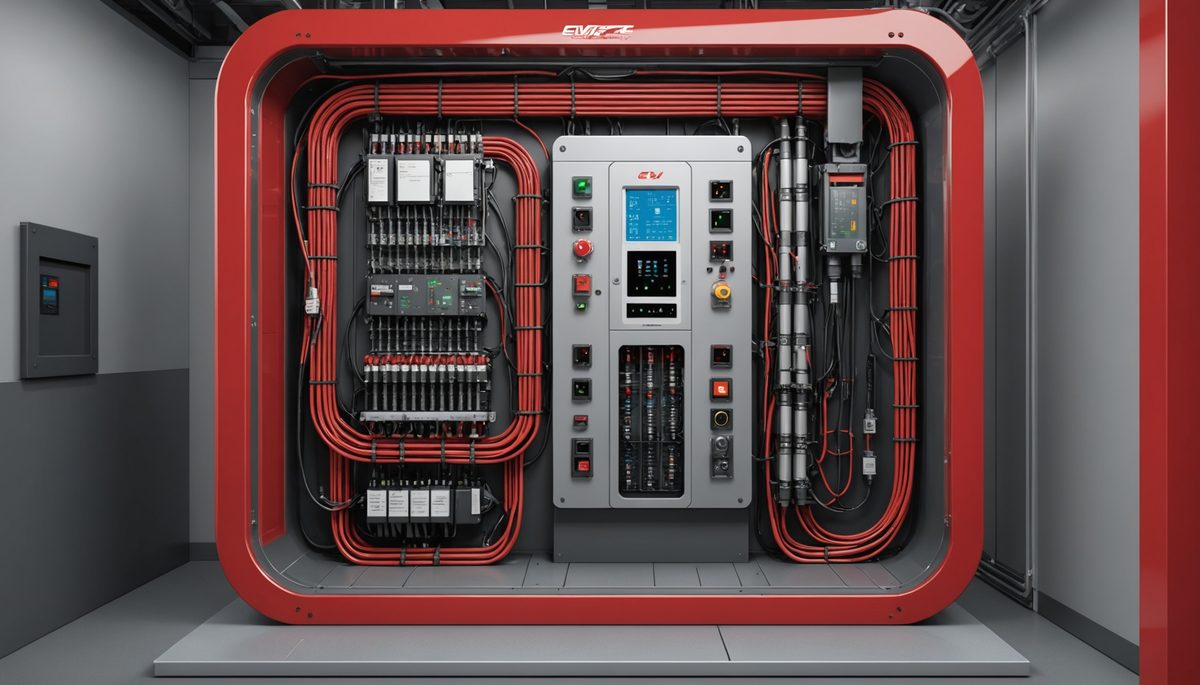
EV charging draws maximum current continuously for hours, making it a "continuous load" per NFPA 70 NEC Article 100 definition: a load expected to last three hours or more. NEC Article 625 (Electric Vehicle Power Transfer System Equipment) applies the standard continuous-load engineering treatment: branch circuit sized at 125% of EVSE maximum output current, served by a dedicated circuit per NEC 625.40, and protected by Class A GFCI per NEC 625.54.
Three NEC requirements distinguish EV charger circuits from standard residential receptacle circuits. First, NEC 625.40 requires a dedicated branch circuit for each EVSE, with no shared loads (no general-purpose receptacles, lights, or other equipment on the same circuit). This prevents nuisance breaker trips from combined loads and ensures full circuit capacity is available for charging. Second, NEC 625.41 combined with NEC 210.20(A) requires overcurrent protection sized at minimum 125% of EVSE maximum continuous current: a 32A continuous EVSE requires a 40A breaker (32 × 1.25 = 40); a 48A EVSE requires a 60A breaker (48 × 1.25 = 60). Third, NEC 625.54 mandates Class A GFCI protection (4–6 mA trip threshold per ANSI/UL 2231) for all Level 1 and Level 2 EVSE, either integral to the EVSE or as a separate GFCI breaker.
Permits are required in most US jurisdictions per local AHJ adoption of NEC 625. Licensed electrician installation is typically required due to 240V hazard and code compliance complexity. Per NFPA Annual Reports, incorrectly-installed EV chargers contribute to approximately 200 residential electrical fires annually in the US, so code compliance is not optional. Cross-reference to the Home EV Charging Cost article in this cluster: operating cost analysis establishes the monthly economics; installation per NEC 625 is what makes that cost projection real.
Calculator Inputs: EVSE Continuous Output, Connection Type, Voltage, NEC Edition
The EV Charger Load Calculator runs two directions of analysis. "Circuit from charger" mode sizes the breaker and conductor ampacity for a known EVSE (the most common case when a homeowner purchases a new charger). "Max charger from breaker" mode finds the largest EVSE supported by an existing circuit, useful when the electrical situation is fixed and the question is what can be installed.
The NEC Edition input accepts NEC 2020, NEC 2023 (default), and NEC 2026 (pending verification). Most US jurisdictions currently adopt NEC 2023 per 2024–2026 code adoption cycles. Verify the AHJ-adopted edition before permit submittal, since Article 625 revisions between editions affect some section references.
Charger entry uses either amperes (from nameplate) or kilowatts. Ampere entry is preferred because breaker size derives directly from amps, not from voltage-dependent kilowatts; Section 8 below shows why voltage matters when entering kW. Common EVSE continuous output values: 16A (Level 1 and small Level 2), 24A (medium Level 2, 30A circuit installations), 32A (standard Level 2, most common residential), 40A (high-end Level 2), 48A (maximum standard Level 2 — ChargePoint Home Flex, Tesla Wall Connector, JuiceBox 48), and 80A (high-power residential — Ford Charge Station Pro for F-150 Lightning).
Connection type carries significant engineering implications. Hardwired installations use full circuit capacity and are required for 48A-plus units. Cord-and-plug installations are capped at 80% of receptacle rating per NEC 625.40: a NEMA 14-50 receptacle limits continuous current to 40A regardless of the circuit breaker rating. The managed setpoint input (optional) invokes NEC 625.42(A) and (B): a listed Energy Management System or restricted-access adjustable EVSE with the reduced rating on the label. This reduces the sizing basis below nameplate, so a 48A EVSE managed to 32A sizes as a 32A load.
Calculator outputs include Required Breaker per NEC 240.6, Circuit Basis (125% × continuous current), Conductor Ampacity Basis for wire selection per NEC 110.14(C), Max Charger Output in reverse mode, and a sizing status: ADEQUATE, BREAKER-LIMIT, RECEPTACLE-LIMIT, or BREAKER-RATING-INADEQUATE.
The 125% Continuous Load Rule per NEC 625.41: Why a 32A Charger Needs a 40A Breaker
EV charging is a continuous load per NEC Article 100 (operating at maximum current for three-plus hours), so NEC 210.20(A) and NEC 625.41 require overcurrent protection at 125% of maximum continuous current. This is not arbitrary code overhead; it accommodates breaker thermal characteristics under sustained high current.
The formula per NEC 625.41:
Required Breaker = Standard Rating ≥ 1.25 × EVSE Continuous Current

where:
  EVSE Continuous Current  = nameplate rated output [A], typical range 12–80 A
  Standard Rating          = next NEC 240.6 standard ampere rating (see table below)
  Branch circuit           = dedicated to EVSE per NEC 625.40
Standard EV charger breaker ladder per NEC 240.6 + NEC 625.41:
| EVSE Continuous Current | × 1.25 | Required Breaker |
|---|---|---|
| 12 A (Level 1, plug-in) | 15.0 A | 15 A |
| 16 A (Level 1 max) | 20.0 A | 20 A |
| 24 A (medium Level 2) | 30.0 A | 30 A |
| 32 A (standard Level 2) | 40.0 A | 40 A |
| 40 A (high Level 2) | 50.0 A | 50 A |
| 48 A (max Level 2) | 60.0 A | 60 A |
| 64 A (extreme Level 2) | 80.0 A | 80 A |
| 80 A (max residential) | 100.0 A | 100 A |
Engineering rationale per NEC 110.3(B) commentary and ANSI/UL 489 (branch circuit breakers): inverse-time circuit breakers are tested at 100% continuous loading in open-air conditions, but derate approximately 20% inside enclosed panels with adjacent breakers due to thermal interaction. The 125% factor (1/0.80 = 1.25) ensures breakers operate within their thermal envelope during sustained charging cycles of 6–12 hours.
Inverse interpretation: the 80% maximum charger output rule from NEC 625.42 applies the same physics in reverse: a charger may draw at most 80% of breaker rating continuously.
| Breaker Rating | × 0.80 | Max Charger Output | Power at 240V |
|---|---|---|---|
| 40 A | 32 A | 32 A | 7.7 kW |
| 50 A | 40 A | 40 A | 9.6 kW |
| 60 A | 48 A | 48 A | 11.5 kW |
| 100 A | 80 A | 80 A | 19.2 kW |
Per NEC 240.6: standard breaker ratings always round up to the next standard rating, never down. A 32A continuous load requires a 40A breaker (32 × 1.25 = 40 exactly matches a standard rating); a 33A continuous load would require a 50A breaker (33 × 1.25 = 41.25 — next standard rating up).
Hardwired vs Cord-and-Plug: NEMA 14-50 Receptacle 40A Continuous Ceiling per NEC 625.40
Cord-and-plug EVSE installations carry an additional ceiling beyond the breaker rating: the receptacle's 80% continuous current limit per NEC 625.40 and NEC 210.21(B)(2). Hardwired installations use full circuit capacity; cord-and-plug installations are capped by whichever is lower: breaker capacity or receptacle capacity.
NEC 210.21(B)(2) governs continuous load on a single receptacle on an individual branch circuit: the receptacle must have an ampere rating not less than the load, with continuous loads limited to 80% of the receptacle rating.
NEMA configuration receptacle ceilings:
| NEMA Configuration | Receptacle Rating | Continuous Ceiling (80%) | Voltage | Common Use |
|---|---|---|---|---|
| NEMA 5-15 | 15 A | 12 A | 120V | Standard household, Level 1 |
| NEMA 5-20 | 20 A | 16 A | 120V | Higher-current Level 1 |
| NEMA 14-30 | 30 A | 24 A | 240V | Dryer outlet, repurposed Level 2 |
| NEMA 6-30 | 30 A | 24 A | 240V | Alternate 30A 240V |
| NEMA 14-50 | 50 A | 40 A | 240V | Most common cord-and-plug Level 2 |
| NEMA 6-50 | 50 A | 40 A | 240V | Alternate 50A 240V (no neutral) |
A NEMA 14-50 receptacle (50A, the most popular cord-and-plug Level 2 configuration) supports EVSE up to 40A continuous. A 48A EVSE on NEMA 14-50 hits a RECEPTACLE-LIMIT failure; the installation must either hardwire or select a 40A-or-smaller EVSE. Hardwired installations remove this ceiling entirely; a 48A EVSE on a 60A hardwired circuit delivers full 48A capacity, which is why Tesla Wall Connector and ChargePoint Home Flex at 48A both require hardwiring.
Re-purposed dryer outlets (NEMA 14-30) are a common DIY scenario. The 30A receptacle continuous ceiling is 24A per NEC 210.21(B)(2). A 32A EVSE on NEMA 14-30 hits a RECEPTACLE-LIMIT; either reduce the EVSE setting to 24A via managed setpoint per NEC 625.42 or upgrade to a NEMA 14-50 circuit.
Practical note from NFPA Annual Reports and electrical inspector guidance: repeated plug/unplug cycles weaken receptacle contacts over time. Industrial-grade NEMA 14-50 receptacles (Bryant 9450FR, Hubbell HBL9450A, approximately $40–80) are recommended over residential-grade units ($15–30) for sustained EVSE loading. ENERGY STAR EV Charger Certified products offer both connection configurations with installer selection at commissioning.
NEC 240.6 Standard Breaker Ladder: Round UP to Next Standard Rating
NEC 240.6 specifies standard ampere ratings for overcurrent protective devices. EVSE breaker selection always rounds up to the next standard rating from the calculated 125% value; never down. A common installation error is selecting the "closest" rating rather than the "next-higher" rating.
NEC 240.6 standard ratings for inverse-time circuit breakers (residential range): 15, 20, 25, 30, 35, 40, 45, 50, 60, 70, 80, 90, 100, 110, 125, 150, 175, 200, 225 A. Non-standard ratings (33A, 41A, 55A) are not permitted per NEC 240.6 for standard residential branch circuits.
Rounding examples per NEC 240.6:
| Calculated Requirement | Round-Up Result | Note |
|---|---|---|
| 40.0 A (32A × 1.25 exactly) | 40 A | Exact match to standard rating |
| 41.25 A (33A × 1.25) | 50 A | Next standard rating up; 45A not standard residential |
| 50.0 A (40A × 1.25) | 50 A | Exact match |
| 60.0 A (48A × 1.25) | 60 A | Exact match |
| 62.5 A (50A × 1.25) | 70 A | Next standard rating up |
| 80.0 A (64A × 1.25) | 80 A | Exact match |
| 100.0 A (80A × 1.25) | 100 A | Exact match |
EVSE manufacturers typically design to match standard breaker ratings (32A, 40A, and 48A continuous outputs correspond to 40A, 50A, and 60A breakers exactly per the 125% rule). Non-standard EVSE currents force the next-higher breaker, creating circuit capacity inefficiency.
Per ANSI/UL 489: residential branch circuit breakers must be UL 489 listed (not UL 1077 supplementary protectors, which are not acceptable for branch circuit protection). A 2-pole breaker is required for 240V circuits, not two tied single-pole breakers, which must be a common-trip breaker per NEC 240.15(B)(1). Verify the breaker is rated for the panel manufacturer: Square D QO, Eaton CH/BR, Siemens, and GE breakers are not interchangeable between panel types.
Managed Setpoint per NEC 625.42(A) and (B): Listed EMS Reduces Circuit Size 48A to 32A
NEC 625.42(A) and (B) provide two methods to reduce the sizing basis below nameplate continuous current. This often makes the difference between using an existing circuit and pulling new wire or upgrading the service panel.
NEC 625.42(A) — Listed Energy Management System: the EMS must be UL listed for EV charging load management, must limit EVSE output to a specified value below nameplate, and cannot be defeated by the user without restricted access. Documentation is required for AHJ inspection. Common implementations: ChargePoint Home Flex with external EMS integration, Wallbox with Power Boost option, Emporia EV Charger with smart home integration.
NEC 625.42(B) — Restricted-Access Adjustable Means: the EVSE itself carries an adjustable maximum current setting behind locked panel, specialized tool, or factory seal. The reduced rating must appear on the equipment label — not just as an internal setting. User-accessible settings (app slider, exposed DIP switch without a cover) do not qualify per NEC 625.42(B) code commentary.
Engineering examples from ChargePoint, Tesla, and Ford installation guides:
Example 1. ChargePoint Home Flex on existing 40A circuit: nameplate maximum 48A, configured to 32A at commissioning per NEC 625.42(B), label updated to 32A. Required circuit: 32 × 1.25 = 40A — fits the existing 40A breaker. Panel upgrade avoided; no new 60A circuit pull required.
Example 2. Tesla Wall Connector managed by Tesla EMS: nameplate 48A, EMS setpoint 32A during peak grid demand (utility demand response). Sizing basis per NEC 625.42(A): 32A, requiring 40A circuit versus the 60A circuit needed without EMS management.
Example 3. Ford Charge Station Pro at reduced setting: nameplate 80A, installation-time configuration to 48A per NEC 625.42(B). Required circuit: 60A instead of 100A. Useful when a 100A circuit is infeasible on the existing service panel.
Common failure modes per electrical inspector reports: user-adjustable settings without restricted access fail NEC 625.42(B); undocumented or unlisted EMS fails NEC 625.42(A); original 48A nameplate remaining on a unit set to 32A fails inspection because the label must reflect the restricted rating. Per NEC 625.42 Commentary: managed setpoint provisions enable practical EV charger installations in homes where service upgrades cost $3,000–15,000, but only with code-compliant implementation, including proper labeling and AHJ documentation.
Austin Texas Worked Example: ChargePoint Home Flex 32A, 40A Breaker, #8 AWG Copper, 200A Service Adequate
This example continues the Austin Texas Tesla Model 3 scenario from the EV Charging Cost article in this cluster. The same owner (single-family residence, Austin TX, 2015 construction, 2,500 sq ft / 232 m², Tesla Model 3 Long Range AWD purchased 2025) now plans ChargePoint Home Flex installation for daily home charging.
Existing electrical context: 200A Square D QO load center, approximately 32,000 VA computed demand per NEC 220.83 standard residential calculation (HVAC, water heater, dryer, range, lighting, and receptacles), garage at 35 ft (10.7 m) from the main panel. Climate Zone 2A per ASHRAE 169-2021.
ChargePoint Home Flex specification: maximum continuous output 48A, adjustable per NEC 625.42(B) to 16/24/32/40/48A, hardwired or NEMA 14-50 cord-and-plug, integral Class A GFCI per NEC 625.54 and ANSI/UL 2231, ENERGY STAR Certified at 92% typical efficiency. Capital cost: $700 (charger) + $1,100 (electrician installation) = $1,800 total. IRS Section 30C Alternative Fuel Vehicle Refueling Property Credit: 30% × $1,800 = $540. Net installation cost: $1,260.
Decision: configure ChargePoint Home Flex to 32A continuous (matches Tesla Model 3 onboard charger maximum), hardwired installation (superior reliability versus NEMA 14-50 receptacle for daily use).
Step 1. EVSE continuous current
EVSE Continuous Current = 32 A (per NEC 625.42(B) restricted-access adjustable setting)
Step 2. Required circuit ampacity per NEC 625.41
Required Circuit = 1.25 × 32 = 40 A
Step 3. Required breaker per NEC 240.6
Standard rating ≥ 40 A → 40 A 2-pole breaker (Square D QO240CP or equivalent, $25–40)
Step 4. Conductor ampacity per NEC 110.14(C)
Required ampacity ≥ 40 A at 75°C terminations per NEC Chapter 9 Table 8:
- #10 AWG copper THWN-2: 35 A insufficient
- #8 AWG copper THWN-2: 50 A sufficient
Selected: #8 AWG copper THWN-2 + #10 AWG copper equipment grounding conductor per NEC 250.122
Step 5. Voltage drop per NEC 210.19(A) Informational Note No. 4 (3% recommendation)
Per NEC Chapter 9 Table 9: #8 AWG copper THWN-2 AC resistance = 0.78 Ω/1000 ft
Round-trip distance: 35 ft × 2 = 70 ft
Total resistance: 70 × 0.78/1000 = 0.0546 Ω
V_drop = 32 A × 0.0546 Ω = 1.75 V
Percentage: 1.75 / 240 × 100% = 0.73%, well under 3% NEC recommendation
Step 6. GFCI verification per NEC 625.54
ChargePoint Home Flex includes integral Class A GFCI per ANSI/UL 2231. Separate GFCI breaker not required.
Step 7. Service capacity per NEC 220.83
Service capacity: 200 A × 240 V = 48,000 VA
NEC 220.83(B) Optional Method (existing service ≥ 100A, add 50% of new EV load):
New EV charger load: 32 A × 240 V × 1.25 = 9,600 VA
50% addition: 4,800 VA
Total: 32,000 + 4,800 = 36,800 VA → 36,800 / 48,000 = 77% service utilization — ADEQUATE
Step 8. Permit and installation
Austin AHJ permit: ~$150 residential electrical permit. Electrician labor: 4–6 hours at $150–200/hr = $800–1,100. Rough-in inspection (after wiring, before any drywall closure): within 24–48 hours of request. Final inspection (after EVSE installed): within 24–48 hours. Total project timeline: 1–2 weeks from permit application to final inspection.
Selected configuration: ChargePoint Home Flex hardwired at 32A continuous, 40A 2-pole breaker, #8 AWG copper THWN-2 with #10 AWG copper equipment ground, 35 ft (10.7 m) run. Voltage drop 0.73%. Service utilization 77%. Net installed cost $1,260 after IRS Section 30C credit. Dual compliance: NEC Article 625 + NEC 220.83. This installation supports the 1,200 mi/month (1,931 km/month) TOU-optimized charging scenario yielding $22.78/month operating cost per the Home EV Charging Cost article in this cluster.
Service Panel Capacity per NEC 220.83: When the Existing 200A Service Cannot Handle Added EV Load
NEC Article 220 service load calculation determines whether the existing electrical service can absorb a new EV charger. Per NEC 220.83 Optional Method for Additions to Existing Dwellings, two calculation paths are available; either may indicate the service is inadequate, requiring panel upgrade or managed setpoint reduction.
NEC 220.83(A) Standard Method adds 100% of existing general lighting/receptacle/appliance load (with tiered calculation) plus 100% of motor loads, plus 100% of new EV charger continuous load × 1.25 per NEC 220.18.
NEC 220.83(B) Optional Method uses existing measured demand from utility bills (12-month maximum), then adds 50% of the new EV charger continuous load × 1.25. It applies only to services rated 100A or greater, and requires AHJ acceptance of the historical demand data. This method typically produces a lower calculated load than Method A because actual usage patterns rarely reach theoretical simultaneous maximum.
For the Austin Texas scenario (2,500 sq ft / 232 m², 2015 construction, 200A service):
NEC 220.83(A) Standard Method total: general lighting/appliance subtotal + range + dryer + water heater + HVAC + 9,600 VA EV load = 44,700 VA (93% of 48,000 VA service, MARGINAL).
NEC 220.83(B) Optional Method: existing measured demand 32,000 VA + 50% of 9,600 VA = 4,800 VA → 36,800 VA (77%, ADEQUATE). The same scenario produces different results from the two methods; AHJ acceptance of Method B determines which governs.
Failure modes where service is inadequate: homes with 100A or 150A service (24,000 VA capacity) frequently cannot absorb a 9,600 VA EV load without upgrades costing $3,500–8,000 for a 200A panel replacement. Fully electrified homes (heat pump, electric water heater, induction range, two EV chargers) may require 320A or 400A service ($8,000–20,000). Detached garage installations with a 60A subpanel face a different constraint: the subpanel feeder governs available capacity, not the main service.
Per NEC 220.83 commentary and electrical contractor guidance: most homes with 200A service built post-2000 can accommodate one EV charger at 32–40A configuration. 48A and higher often require panel upgrade or managed setpoint reduction. Homes with 100–150A service almost always require panel upgrade or significantly reduced EVSE settings.
Voltage Effect: 208V Commercial vs 240V Residential — Same Amps, Different Kilowatts
Voltage choice affects EVSE power output but not breaker size when entering charger by amperage. Per P = V × I: fixed amps at lower voltage yields lower power, but the same circuit breaker calculation applies.
Residential 240V split-phase single-phase service (standard US residential per NEC 240.85): 240V between two hot legs, 2-pole breaker, each pole 120V to neutral. Commercial 208V three-phase wye service: 208V between any two phases of 3-phase 120/208Y service, common in apartment buildings, offices, and commercial spaces.
Same charger at 32A continuous output:
- 240V residential: 32 × 240 = 7,680 W (7.7 kW)
- 208V commercial: 32 × 208 = 6,656 W (6.7 kW)
- Same 40A 2-pole breaker in both cases
- Charging at 208V takes approximately 15% longer for the same state-of-charge target
Same charger at 48A continuous output:
- 240V: 48 × 240 = 11,520 W (11.5 kW)
- 208V: 48 × 208 = 9,984 W (10.0 kW)
- Same 60A 2-pole breaker; 13% slower at 208V
Engineering implication when entering charger as kW (not amps): an 11.5 kW EVSE at 240V derives 47.9A (I = 11,500/240), requiring a 60A breaker; the same 11.5 kW EVSE at 208V derives 55.3A (I = 11,500/208), requiring a 70A breaker (next NEC 240.6 standard rating above 55.3 × 1.25 = 69.1A). This is why ampere entry from the nameplate is preferred; breaker size is independent of voltage when working in amps.
Per SAE J1772 and SAE J3068: EV onboard chargers accept 208–240V input universally; charging time is longer at 208V but the equipment operates safely within the NEC 625 framework at both voltages.
Permits and AHJ Inspection Process: Rough-In, Final, and Licensed Electrician Requirements
EV charger installations require permits and inspections in most US jurisdictions per local AHJ adoption of NEC 625. Licensed electrician installation is typically mandatory due to 240V hazard and code compliance complexity. The permit and inspection process provides independent verification, ensures insurance coverage, and avoids issues at resale.
Standard process per Austin TX and comparable AHJ jurisdictions:
Permit application: submitted to local building department (Austin: Development Services Department). Required documents include scope of work, EVSE manufacturer datasheet with ANSI/UL 2202 listing, circuit specification (breaker rating, conductor size), and panel single-line diagram. Permit fee: $100–300 typical. Processing time: 3–10 business days; some jurisdictions offer same-day online permits.
Installation: performed per submitted permit scope by licensed electrician. Materials must match submitted specifications, since substitutions require permit revision. Rough-in inspection (after conductor is pulled from panel to EVSE location, before drywall coverage if applicable): inspector verifies conductor size (#8 AWG copper), breaker installation (40A 2-pole, panel-compatible), routing per NEC 300.3/300.4, GFCI integration per NEC 625.54, and bonding/grounding per NEC 250.122.
Final inspection (after EVSE is mounted and terminated): inspector verifies working condition, GFCI test result, accessibility, labeling per NEC 625.45 (disconnecting means identification), and nameplate setting verification per NEC 625.42(B) if a managed setpoint is used. Passes on approval; re-inspection costs $50–100 if corrections are required.
Licensed electrician requirements vary by state. Texas requires Master Electrician License for permit-issued work per the Texas Electrical Safety Act. California requires C-10 Electrical Contractor license from the CSLB. Florida requires CE/EC license from the Electrical Contractors Licensing Board.
DIY scenarios: some jurisdictions allow homeowner-permits for own-residence work, but DIY installation must still pass AHJ inspections and commonly voids homeowner insurance coverage of electrical-system claims. Per NFPA Annual Reports and electrical inspector data: properly-permitted EV charger installations show a 90%-plus first-inspection pass rate; unpermitted installations show 35–45% issues at post-sale inspections. Per insurance industry data: claims involving DIY EV charger installations are denied 4–6× more frequently than licensed-contractor installations.
Cost economics: licensed electrician installation ($800–1,600) costs more than DIY parts ($200–500) but includes permit handling, inspection coordination, and professional liability coverage.
Application Boundaries: Multi-Charger Load Sharing, Three-Phase, DC Fast, V2H/V2G Bidirectional
The EV Charger Load Calculator applies to a single AC EVSE on a single-phase residential circuit (120V Level 1 or 240V Level 2 per SAE J1772, SAE J3068, and SAE J3400 NACS ratified November 2023), using NEC 2020 or 2023. Several applications fall outside this scope and require extended methodology.
Multi-charger load sharing: multiple EVSE sharing a single circuit per NEC 625.42(A) listed EMS. Common equipment includes ChargePoint Power Boost, Wallbox Power Boost, and Tesla Wall Connector daisy-chain (up to 6 units per Tesla EMS). The calculator handles single EVSE only; multi-charger installations require manufacturer load management documentation.
Three-phase 208V commercial installations: workplace charging, fleet depots, and multi-unit residential. NEC 625 applies identically (125% rule, dedicated circuit, GFCI per NEC 625.54), but the full analysis requires NEC 220 commercial load calculations beyond the scope of the single-phase calculator.
DC fast charging (Level 3): per SAE J3068, CHAdeMO, CCS Combo 1/2, and NACS standards, delivering 50–350 kW via direct battery connection. NEC 625 is less applicable (NEC 625.17 covers DC-coupled systems); service requirements typically involve 480V three-phase and significant utility coordination. Outside residential scope.
Vehicle-to-Home (V2H) and Vehicle-to-Grid (V2G): bidirectional charging per SAE J3400 NACS and IEEE Std 2030.5, with 2024–2026 capable vehicles including Ford F-150 Lightning, GM Energy, Tesla Cybertruck, and Hyundai Ioniq 5. Requires specialized bidirectional EVSE, interconnection agreement, and UL 9540 listing for grid interconnection. Different equipment category from standard EVSE.
Detached structure installations: a garage subpanel fed from the main service governs available capacity per NEC 215.2. A 60A subpanel feeder limits EV charger circuit options regardless of main service size. The feeder ampacity analysis is a separate calculation from the EVSE circuit sizing.
Solar PV integration: per NEC 705, solar generation reduces grid-purchased kWh but does not affect EV charger circuit sizing per NEC 625. The EV charger circuit is independent of the solar PV circuit — different code articles, different installation analyses.
EV Charger Load Calculator
EV charger circuit sizing per NEC Article 625 — 125% continuous load factor, breaker selection per NEC 240.6 standard ratings, hardwired vs cord-and-plug ceiling analysis, and managed setpoint provisions per NEC 625.42 — with support for Circuit-from-Charger and Max-Charger-from-Breaker calculation modes.
Open EV Charger Load CalculatorFAQ
What size breaker does a 48 amp EV charger need?
Per NFPA 70 NEC 625.41 and 240.6: a 60A 2-pole breaker. EV charging is a continuous load per NEC Article 100, requiring overcurrent protection at minimum 125% of EVSE continuous output. Math: 48 A × 1.25 = 60.0 A, exactly matching the NEC 240.6 standard rating. Conductor must be #6 AWG copper THWN-2 (65 A ampacity at 75°C per NEC Chapter 9 Table 8) on a dedicated branch circuit per NEC 625.40. Hardwired connection is required: 48 A exceeds the 40 A continuous ceiling of a NEMA 14-50 receptacle per NEC 625.40 and NEC 210.21(B)(2). Common 48A EVSE units — ChargePoint Home Flex hardwired, Tesla Wall Connector hardwired, JuiceBox 48, Wallbox Pulsar Plus 48 — all require hardwired installation.
Can I use my dryer outlet (NEMA 14-30) for EV charging?
Per NFPA 70 NEC 210.21(B)(2) and NEC 625.40: yes, with significant limitations. A NEMA 14-30 receptacle (30A 240V) has a continuous-load ceiling of 24A (0.80 × 30 = 24 A). This supports charging at up to 24A continuous — slower than a standard 32A Level 2 EVSE but functional. Common configurations: ChargePoint Home Flex or Tesla Wall Connector set to 24A per NEC 625.42(B). Three caveats apply: (1) NEC 625.40 requires dedicated use — cannot share the outlet with the dryer simultaneously; (2) GFCI protection per NEC 625.54 still required; (3) older homes may have aluminum dryer wiring (not code-compliant per NEC 310.106(B)), requiring copper rewiring before EVSE use. A dedicated NEMA 14-50 circuit (50A breaker, #6 AWG copper, 40A continuous ceiling) is the preferred upgrade for future-proofing at modest additional cost.
Can a managed setpoint reduce the circuit size I need for my EV charger?
Per NFPA 70 NEC 625.42(A) and (B): yes, in two specific scenarios. Per NEC 625.42(A), a listed Energy Management System (UL listed for EV charging load management) can limit EVSE output below nameplate; AHJ documentation required. Per NEC 625.42(B), an EVSE with restricted-access adjustable means (factory-set DIP switch, installation-time configuration behind a locked panel, or specialized tool requirement) with the reduced rating on the label qualifies. User-accessible settings do not qualify. Example: a 48A nameplate EVSE configured to 32A continuous per NEC 625.42(B) requires a 40A circuit (32 × 1.25 = 40A), instead of the 60A circuit otherwise required (48 × 1.25 = 60A). This commonly allows installation on an existing 40A circuit, avoiding panel upgrades costing $3,000–15,000. The equipment label must physically reflect the restricted rating.
Will my existing 200 amp service handle a new EV charger?
Per NFPA 70 NEC 220.83 Optional Method for Additions to Existing Dwellings: most homes built post-2000 with 200A service can accommodate one EV charger at 32–40A configuration, resulting in service capacity utilization of 70–85%. Per NEC 220.83(B) with a 50% addition factor, a 32A EVSE adds 9,600 VA × 50% = 4,800 VA to existing demand. For a typical 2,500 sq ft (232 m²) home with measured demand of 32,000 VA: total 36,800 VA / 48,000 VA capacity = 77% utilization — adequate. A 48A EVSE adds 14,400 VA × 50% = 7,200 VA → 39,200 VA total = 82% utilization, still adequate for 200A service. Homes near capacity due to full electrification may need the EVSE reduced to 32A per managed setpoint or a service upgrade to 320A or 400A ($8,000–20,000). Use the Electrical Load Calculator in the Related Calculators section for precise NEC 220.83 service capacity analysis before purchase.
Can I plug my EV charger into a regular outlet for trickle charging?
Per NFPA 70 NEC 625.40: only with significant limitations. Level 1 (120V) trickle charging through a standard NEMA 5-15 (15A) outlet is functional for occasional use — a Level 1 EVSE draws 12A continuous (12 × 1.25 = 15A circuit), fitting a standard 15A circuit. The outlet should be dedicated per NEC 625.40 to avoid nuisance trips; it must be GFCI-protected per NEC 625.54; and extension cords are prohibited per ANSI/UL 2231 and manufacturer instructions. Charging rate is only 3–5 mi/hr (5–8 km/hr) for a typical Tesla Model 3 or comparable EV. Per DOE Alternative Fuels Data Center: Level 1 is acceptable for occasional use or 250–500 mi/month (400–800 km/month) charging needs; daily commuters charging 1,000-plus miles per month should install a dedicated Level 2 circuit per NEC 625.40 for adequate charging speed.
Related Calculators
Home EV charging operating cost analysis with time-of-use tariff optimization, complementing the NEC 625 installation circuit sizing in this article: Home EV Charging Cost article | Home EV Charging Cost Calculator.
Wire ampacity sizing per NEC Chapter 9 Table 8 for EV charger conductor selection (the #8 AWG vs #6 AWG decision from Section 6 worked example): Wire Size Ampacity NEC Calculator.
Residential service load calculation per NEC 220.82 and 220.83 for service capacity verification per Section 7: Electrical Load Calculator.
Voltage drop analysis per NEC 210.19(A) Informational Note No. 4 for long branch circuit runs to detached garages: Voltage Drop Calculator.
Service entrance sizing per NEC 230 for homes upgrading to 200A or 320A service to accommodate EV charger addition: Service Entrance Size Calculator.
Breaker sizing per NEC 240 for standard ampere rating selection: Breaker Size Calculator.
Demand factor analysis per NEC 220 for multi-load service planning: Demand Factor Calculator.