CT Burden Calculator
On this page
Calculate
Select how to specify the CT secondary circuit resistance
Enter the CT secondary current in amperes (typically 1 A or 5 A)
Enter the total CT secondary loop resistance in ohms (includes both lead conductors)
Enter the total burden of connected meters, relays, or other devices in VA
Overview
The CT Burden Calculator estimates current transformer secondary burden using a fixed screening model based on CT secondary current, total secondary circuit resistance, and connected-device burden. The result is the total volt-ampere burden imposed on the CT secondary circuit by the combination of lead resistance and connected devices.
This calculator is designed for preliminary CT secondary-circuit burden screening. It uses a transparent fixed model where burden increases directly when secondary current is higher, lead resistance is higher, or connected-device burden is higher. The model does not calculate CT saturation knee-point behavior, excitation curves, transient fault burden, relay dynamic response, or detailed protection accuracy studies. For protection applications, final CT burden review should be checked against CT nameplate class, burden rating, relay data, and applicable standards.
The result should be treated as a calculated steady-state CT burden estimate. Actual CT performance can differ because real secondary wiring, terminal resistance, device burden, accuracy class, and CT saturation behavior vary. This calculator provides a practical starting point for CT secondary-circuit comparison, burden configuration review, and early evaluation before deeper CT application engineering.
How to Use This Calculator
Select resistance input type — choose Direct Total Resistance to enter Ω directly, or Lead Length Data to derive resistance from conductor length and per-unit resistance.
Enter CT secondary current — in amperes (A). Use the rated secondary current basis for the circuit (typically 1 A or 5 A).
Enter total secondary resistance or lead length data — enter total loop resistance in Ω directly, or enter one-way lead length and conductor resistance per unit length.
Enter connected device burden — in VA. Include the burden of all connected meters, relays, or other devices on the CT secondary.
Click “Calculate” — get CT burden, burden from resistance, and total secondary resistance.
Review the result — compare the total VA against the CT nameplate burden rating.
Use the result to support preliminary CT secondary-circuit screening and burden review. Final design should be verified against CT accuracy class, burden rating, relay or meter data, and project-specific protection or metering requirements.
Inputs & Outputs
Inputs
Outputs
Formula
Calculator Formula
This calculator estimates CT secondary burden using a fixed screening model based on CT secondary current, secondary circuit resistance, and connected-device burden.
Step 1: Determine Total Secondary Circuit Resistance
If direct resistance is entered (Resistance Input Type = Direct Total Resistance):
Total Loop Resistance = Entered Total Resistance
If lead length data is entered (Resistance Input Type = Lead Length Data):
Lead Resistance = Conductor Resistance per Unit Length × (2 × One-Way Lead Length)
The factor of 2 accounts for both the outgoing and return conductors in the CT secondary loop.
Step 2: Calculate Burden from Resistance
Burden from Resistance = I² × Total Loop Resistance
Where:
- I = CT secondary current in amperes
- Total Loop Resistance = total CT secondary circuit resistance in ohms
Step 3: Add Connected-Device Burden
Total CT Burden = Burden from Resistance + Device Burden
Where:
- Device Burden = connected meter or relay burden in VA
- Total CT Burden = total calculated CT burden in VA
Variables
| Variable | Meaning | Units |
|---|---|---|
| I | CT secondary current | A |
| R | Total CT secondary loop resistance | Ω |
| Device Burden | Connected meter or relay burden | VA |
| Burden from Resistance | I² × R | VA |
| CT Burden | Total calculated CT burden | VA |
Formula Meaning
This is a transparent, fixed-model calculator. CT burden increases directly as:
- Secondary current increases (burden from resistance rises with the square of I)
- Lead resistance increases (longer or smaller-gauge secondary wiring)
- Connected-device burden increases (more meters or relays on the CT secondary)
CT burden decreases directly as:
- Secondary current decreases
- Lead resistance decreases (shorter or larger-gauge secondary wiring)
- Connected-device burden decreases
The model is intentionally simple and transparent so the result responds directly to its three drivers. It does not calculate CT saturation knee point, excitation curves, transient fault burden, or relay dynamic response.
What is CT Burden
CT burden is the load connected to the secondary of a current transformer, usually expressed in volt-amperes at the rated secondary current. In practical engineering terms, the secondary burden is made up of two main components: the resistance of the secondary wiring (lead burden) and the burden of connected devices such as meters and relays (device burden). The total CT burden is the sum of these two contributions.
The lead burden rises with the square of secondary current and increases with longer or smaller-gauge secondary wiring. The device burden is additive and depends on the specifications of each connected relay or meter. Burden review is important for both metering and protection CTs, because a CT can be correctly ratio-selected but still produce accuracy errors if the secondary burden exceeds its burden rating.
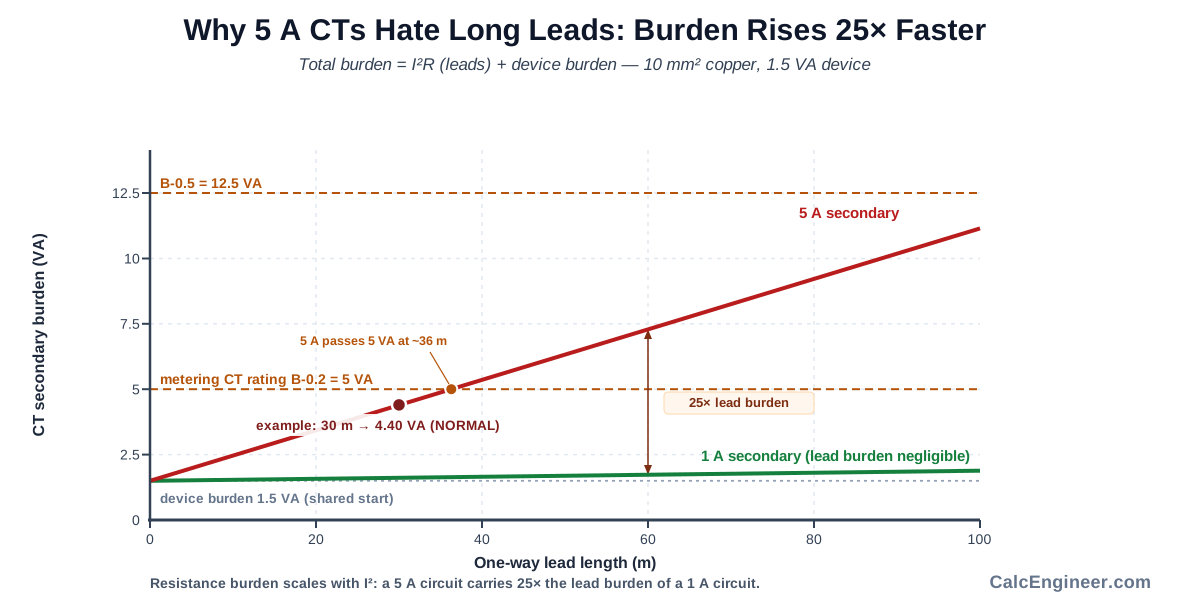
On this page, CT burden is treated as a steady-state secondary-loading problem: the calculator converts secondary current, circuit resistance, and device burden into a total burden in VA, and reports the total in VA. This gives engineers a practical starting point for CT secondary-circuit screening before deeper CT application engineering.
Key Considerations
This calculator uses a fixed steady-state burden model. It does not check CT saturation, excitation behavior, transient fault burden, or protection coordination performance. A CT secondary circuit that shows a workable burden result on this calculator may still need additional review depending on CT accuracy class, relay performance requirements, fault current magnitude, and CT saturation characteristics.
The choice between 1 A and 5 A secondary current significantly affects resistance-based burden. A 5 A secondary has 25 times the resistance-based burden of a 1 A secondary for the same secondary circuit resistance. This is why long secondary runs are more of a concern for 5 A secondary CTs than for 1 A secondary CTs.
When using Lead Length Data mode, enter the one-way distance to the farthest connected device. The calculator multiplies this by two to account for both the outgoing and return conductors. Entering the full loop length instead of one-way length will overstate the burden by a factor of two.
Units
CT secondary current is entered in amperes (A) in both metric and imperial modes. Secondary resistance is entered in ohms (Ω) in both modes. Lead length is entered in meters (m) in metric mode and feet (ft) in imperial mode. Conductor resistance is entered in Ω/m in metric mode and Ω/ft in imperial mode. The final CT burden result is always displayed in volt-amperes (VA) in both unit systems.
Practical Tips
For 5 A secondary CTs, even modest lead resistance values can produce significant burden. Check the total loop length carefully and consider using a larger conductor gauge if the burden result is high. For 1 A secondary CTs, resistance-based burden is much lower (25 times less than a 5 A secondary for the same circuit), which makes 1 A secondary arrangements more tolerant of longer secondary leads.
Always include the burden of all connected devices, not just the primary relay or meter. Test switches, shorting blocks, and other items in the CT secondary loop may also contribute burden.
Important: This calculator is a preliminary CT burden screening tool. Final CT application design must account for CT accuracy class, burden rating, saturation characteristics, relay performance, fault current conditions, and manufacturer application data.
Key Facts
- CT burden increases with the square of secondary current when resistance-based burden is dominant — doubling secondary current quadruples resistance-based burden.
- Longer secondary wiring increases total burden — using total loop length (twice the one-way distance) ensures both outgoing and return conductors are accounted for.
- Connected meters and relays contribute directly to total burden and must be included for an accurate secondary-circuit assessment.
- Burden review is different from CT ratio selection — a CT can be correctly ratio-selected but poorly applied if secondary burden exceeds the CT burden rating.
- The result reflects only the final CT burden in VA — the resistance entry mode (direct or lead-length) does not change the physics.
- Smaller secondary conductor gauge increases resistance and raises burden — using a larger conductor can reduce lead burden.
- A CT can be correctly rated for ratio but still fail accuracy requirements if secondary burden is too high relative to the CT burden rating.
Applications
- CT secondary circuit screening for metering and protection applications.
- Metering CT burden review before final CT specification.
- Protection CT burden review to support relay application decisions.
- Lead-length and wiring-effect comparison to evaluate how conductor sizing affects burden.
- Comparing the computed burden against CT nameplate burden ratings.
- Comparing burden scenarios when reviewing different CT secondary arrangements.
- Pre-checking secondary circuit assumptions before detailed CT application engineering.
- Supporting early-stage electrical design decisions where a quick CT burden check is needed.
Example Calculation
Example 1 — Direct Resistance
Given:
- Resistance input type: Direct Total Resistance
- CT secondary current = 5 A
- Total secondary resistance = 0.08 Ω
- Connected device burden = 1.50 VA
Step 1: Burden from Resistance
Burden from Resistance = I² × R
Burden from Resistance = 5² × 0.08
Burden from Resistance = 25 × 0.08 = 2.00 VA
Step 2: Add Device Burden
Total CT Burden = 2.00 + 1.50 = 3.50 VA
Result: 3.50 VA
This result indicates a moderate CT secondary loading condition for many practical applications. The entered lead resistance and device burden combine to produce a workable overall burden level. Compare this burden with the intended CT nameplate burden rating and verify the secondary lead and device assumptions.
Example 2 — Lead Length Data
Given:
- Resistance input type: Lead Length Data
- CT secondary current = 5 A
- One-way lead length = 30 m
- Conductor resistance = 0.00193 Ω/m (10 mm² copper, ≈1.9 Ω/km)
- Connected device burden = 1.50 VA
Step 1: Calculate Total Loop Resistance
Total Loop Length = 2 × 30 = 60 m
Lead Resistance = 0.00193 × 60 = 0.1158 Ω
Step 2: Burden from Resistance
Burden from Resistance = 5² × 0.1158 = 2.895 VA
Step 3: Add Device Burden
Total CT Burden = 2.895 + 1.50 = 4.40 VA
Result: 4.40 VA
This result shows how the combination of 30 m one-way lead length and 10 mm² copper conductor produces a moderate secondary burden. For comparison, the same 60 m loop in 2.5 mm² copper (≈7.4 Ω/km) gives 0.444 Ω and 11.1 VA of lead burden alone — which is why long 5 A secondary runs are wired with heavy conductors or moved to 1 A secondaries.
Standards & References
- IEEE C57.13 — Standard Requirements for Instrument Transformers, covering performance, accuracy, and burden ratings for current transformers
- IEC 61869-1:2023 — Instrument transformers — Part 1: General requirements
- IEC 61869-2:2012 — Instrument transformers — Part 2: Additional requirements for current transformers
- IEC TR 61869-100:2017 — Instrument transformers — Part 100: Guidance for application of current transformers in power system protection
- CT nameplate data and relay/meter burden specifications — the authoritative basis for final CT application review.
Limitations
- This is a preliminary CT burden calculator, not a full CT performance study.
- It uses a fixed calculator-specific screening model for steady-state secondary loading.
- It does not calculate CT saturation knee point, excitation curves, transient fault-response burden, relay dynamic behavior, or protection accuracy.
- It does not calculate ratio correction factor, phase-angle error, polarity errors, or insulation performance.
- The model assumes connected-device burden and lead resistance are correctly represented by the entered values.
- The model assumes a purely resistive secondary burden and does not account for phase shift or power factor effects of connected devices.
- It does not replace detailed CT application engineering, relay studies, or manufacturer data review.
- Real CT performance may differ because CT accuracy class, saturation characteristics, short-circuit conditions, and connected equipment behavior are not modeled here.
Common Mistakes to Avoid
- Ignoring the contribution of lead resistance to total CT burden.
- Forgetting that resistance-based burden rises with the square of secondary current — a 5 A secondary has 25 times the resistance-based burden of a 1 A secondary for the same resistance.
- Using one-way lead length when total loop length is required — the loop includes both the outgoing and return conductors.
- Omitting connected meter or relay burden from the total.
- Assuming a low burden result guarantees acceptable fault-performance accuracy — saturation and transient behavior require separate analysis.
- Confusing CT burden with CT ratio selection.
- Ignoring the CT nameplate burden rating when interpreting the result.
- Assuming this calculator alone finalizes CT application design.
Frequently Asked Questions
What does this CT Burden Calculator estimate?
Why does lead resistance matter for CT burden?
Why does connected-device burden matter?
How do I use the Lead Length Data mode?
How do I compare the result against a CT rating?
Why do 1 A secondaries tolerate long leads better than 5 A?
Does this calculator evaluate CT saturation?
Is this calculator enough to finalize a real CT application?
Frequently Used Together
Engineers often use these calculators in combination for complete project workflows:
Related Calculators
Explore similar calculators that might be useful for your project:
Electrical Quick Reference — Keep It Open During Design
8 NEC formulas for voltage drop, ampacity, motor current, and CT burden. One sheet, every project.
- Voltage drop by NEC method — single-phase and 3-phase
- Ampacity with temperature & grouping derating (NEC 310.15)
- %VD limits by circuit type: branch, feeder, sensitive loads
No spam. Unsubscribe any time.
Calculate
Select how to specify the CT secondary circuit resistance
Enter the CT secondary current in amperes (typically 1 A or 5 A)
Enter the total CT secondary loop resistance in ohms (includes both lead conductors)
Enter the total burden of connected meters, relays, or other devices in VA