Battery Bank Calculator
On this page
Calculate
Enter the total continuous load power in watts
Enter the desired backup runtime in hours
Typical DoD: 50% for AGM/lead-acid, 80% for LiFePO4
Overall system efficiency including inverter losses — typically 85–95%
Ah rating of one battery at the system voltage
Overview
A Battery Bank Calculator estimates how much battery capacity is required to support a specified load for a target runtime. This calculator uses a fixed battery-sizing model: it starts with the required load energy, applies the requested autonomy period, converts that energy into amp-hours at the selected system voltage, then adjusts the result for usable depth of discharge and system efficiency.
The page can also convert the required capacity into a recommended number of batteries when a battery size is provided. This makes the calculator useful for backup systems, off-grid setups, mobile power systems, solar storage planning, and general DC battery-bank sizing.
Accurate battery bank sizing ensures reliable runtime, avoids undersized or oversized installations, and helps balance cost, weight, and performance.
How to Use This Calculator
Enter load power — in W.
Enter autonomy time — in h.
Select system voltage — choose from 12 V, 24 V, 48 V.
Enter depth of discharge (dod) — in %.
Enter system efficiency — in %.
Enter battery unit capacity — in Ah.
Click "Calculate" — get required battery capacity, required energy (wh), required energy (kwh).
Use the result to support your engineering design and analysis decisions.
Inputs & Outputs
Inputs
Outputs
Formula
Calculator Formula
This calculator uses a fixed battery-bank sizing model.
Step 1: Required load energy
E_load = P × t
Where:
- E_load = required load energy in watt-hours (Wh)
- P = load power in watts (W)
- t = autonomy time in hours (h)
Step 2: Adjust for system efficiency
E_adjusted = E_load / η
Where:
- E_adjusted = adjusted required energy in Wh
- η = overall usable efficiency as a decimal
Step 3: Adjust for depth of discharge
E_bank = E_adjusted / DoD
Where:
- E_bank = required nominal battery-bank energy in Wh
- DoD = usable depth of discharge as a decimal
Step 4: Convert to required amp-hours
Ah_required = E_bank / V_system
Where:
- Ah_required = required battery-bank capacity in amp-hours
- V_system = system voltage
Step 5: Convert to battery count
Battery Count = ⌈Ah_required / Ah_battery⌉
Rounded up to the next whole battery.
Step 6: Energy conversions
kWh_required = E_bank / 1000
Variable Reference
| Variable | Meaning | Units |
|---|---|---|
| P / loadPower | Load power | W |
| t / autonomyHours | Autonomy time | h |
| V_system / systemVoltage | System voltage | V |
| DoD / depthOfDischarge | Depth of discharge | % |
| η / efficiency | System efficiency | % |
| Ah_battery / batteryAh | Single battery capacity | Ah |
| E_load | Required load energy | Wh |
| E_adjusted | Efficiency-adjusted energy | Wh |
| E_bank | Required nominal bank energy | Wh |
| Ah_required | Required battery capacity | Ah |
| kWh_required | Required energy in kWh | kWh |
| Battery Count | Number of batteries needed | — |
What is a Battery Bank
A battery bank is a group of one or more batteries connected to provide the total voltage and storage capacity needed for a system. In practical design, the most important question is not just "how many batteries do I have," but "how much usable energy can the bank actually deliver." Usable energy depends on system voltage, discharge depth, efficiency losses, battery chemistry, and runtime expectations. That is why a proper battery-bank calculator should not stop at raw amp-hours. It should estimate usable required capacity under the assumptions that actually matter in the field.
Sizing Model
This calculator follows one exact path:
Load → Runtime → Required Energy → Efficiency Adjustment → DoD Adjustment → Ah / Wh / kWh Requirement → Battery Count
This is the fixed model used on the page. It starts with the required load energy, applies the requested autonomy period, converts that energy into amp-hours at the selected system voltage, then adjusts the result for usable depth of discharge and system efficiency.
Why Usable Capacity Matters
Nameplate capacity is not the same as usable capacity. A 200 Ah lead-acid battery at 50% DoD delivers only 100 Ah of usable energy. A 200 Ah LiFePO4 battery at 80% DoD delivers 160 Ah. This difference is significant when sizing a battery bank for a specific runtime target.
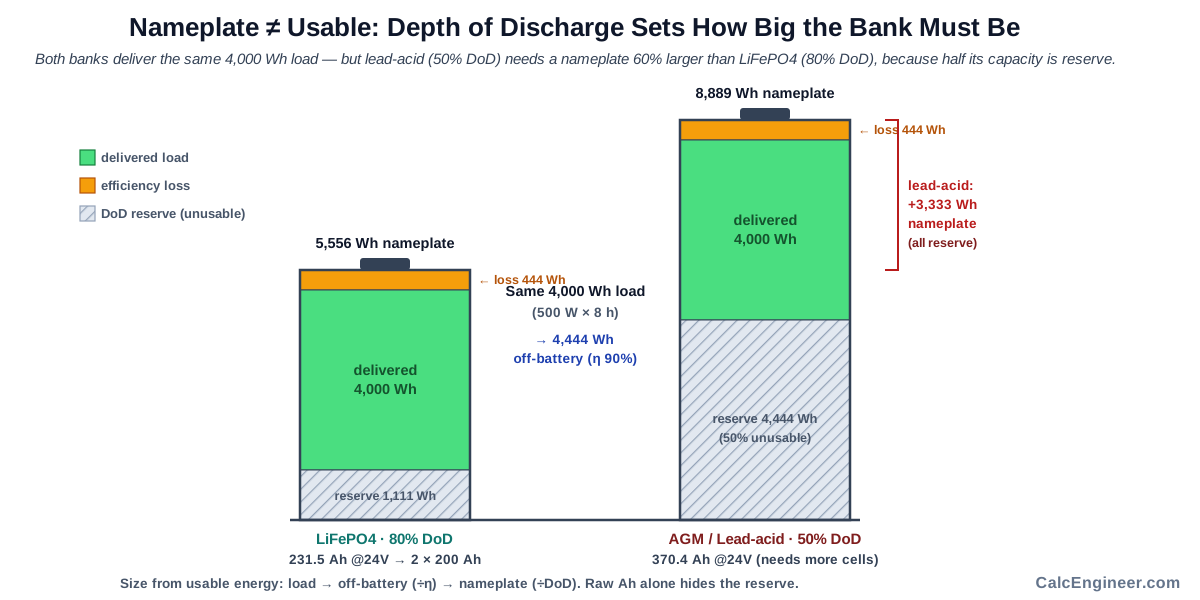
Victron Energy notes a practical reference of about 50% DoD for AGM and about 80% DoD for LiFePO4, while also emphasizing that system design must consider real operating conditions including temperature, discharge rate, and battery age.
Engineering Applications
Battery bank calculations are widely used across many applications:
- Off-grid solar systems — sizing battery storage to cover nighttime and cloudy-day loads
- Backup power systems — ensuring critical loads have sufficient runtime during outages
- RV and marine systems — balancing weight, space, and runtime for mobile installations
- Telecom sites — maintaining DC power for communication equipment during grid failures
- UPS systems — providing bridge power until generators start or grid returns
In all cases, accurate battery bank estimation directly impacts system reliability, cost efficiency, and safety.
Units
This calculator uses:
| Unit | Purpose |
|---|---|
| W (watts) | Load power |
| h (hours) | Autonomy time |
| Wh (watt-hours) | Energy storage |
| kWh (kilowatt-hours) | Large energy totals |
| V (volts) | System voltage |
| Ah (amp-hours) | Battery capacity |
| count | Number of batteries |
The core battery equations are unit-neutral: Ah stays Ah, Wh stays Wh, kWh stays kWh, V stays V. The underlying sizing logic remains the same regardless of display preferences.
Practical Tips
When sizing a battery bank, always start with the actual energy requirement (Wh), not just Ah. This ensures the system voltage is properly accounted for.
For lead-acid batteries, use a conservative 50% DoD to maximize cycle life. Deep discharges significantly reduce the number of charge cycles a lead-acid battery can deliver.
For lithium (LiFePO4) batteries, 80% DoD is a common practical assumption. Some manufacturers allow up to 90–100% DoD, but this may reduce long-term cycle life.
For efficiency, account for all losses in the system: inverter efficiency (typically 90–95%), wiring losses (1–3%), and charge controller losses (2–5%). A combined efficiency of 85–90% is realistic for most systems.
Important: This calculator provides a strong first-pass sizing estimate. Final battery bank design should always consider manufacturer specifications, temperature derating, battery aging, surge requirements, and charging source capacity.
Key Facts
- Nameplate capacity is not the same as usable capacity — practical usable fraction depends strongly on chemistry and discharge assumptions.
- Victron notes a practical reference of about 50% DoD for AGM and about 80% DoD for LiFePO4.
- System efficiency losses from inverters, wiring, and charge controllers typically range from 5% to 15%.
- Battery performance changes with temperature, discharge rate, age, and charge state.
- A 48 V system requires half the current of a 24 V system for the same power, reducing cable losses.
Applications
- Off-grid battery sizing
- Solar battery storage planning
- Backup battery-bank sizing
- RV / marine battery-bank sizing
- Telecom / DC system autonomy checks
- Small UPS / emergency storage review
- Estimating number of batteries required
- Comparing 12 V, 24 V, and 48 V battery-bank options
Example Calculation
Example Calculation
Given:
- Load power = 500 W
- Autonomy time = 8 h
- System voltage = 24 V
- Depth of discharge = 80%
- Efficiency = 90%
- Battery size = 200 Ah
Step 1: Required load energy
E_load = 500 × 8 = 4,000 Wh
Step 2: Adjust for efficiency
E_adjusted = 4,000 / 0.90 = 4,444.44 Wh
Step 3: Adjust for DoD
E_bank = 4,444.44 / 0.80 = 5,555.56 Wh
Step 4: Convert to Ah
Ah_required = 5,555.56 / 24 = 231.48 Ah
Step 5: Convert to battery count
Battery Count = ⌈231.48 / 200⌉ = 2 batteries
Result:
- Required Battery Capacity: 231.48 Ah
- Required Energy Storage: 5,555.56 Wh (5.56 kWh)
- Recommended Battery Count: 2 batteries
A battery bank rated below about 231.5 Ah at 24 V would be undersized for these assumptions. A 2 × 200 Ah configuration provides practical headroom above the minimum requirement.
Standards & References
- Victron Energy Battery Sizing Guide — practical depth-of-discharge and usable capacity references for AGM and LiFePO4 chemistries
- NFPA 855 — Standard for the Installation of Stationary Energy Storage Systems
- NFPA 70E Article 320 — battery and battery-room-related safety considerations
- IEEE 1188 — Recommended Practice for Maintenance, Testing, and Replacement of VRLA Batteries for Stationary Applications
- IEEE 485 — Recommended Practice for Sizing Lead-Acid Batteries for Stationary Applications
Limitations
- This calculator is a practical battery-sizing tool, not a full battery-system engineering package.
- It does not replace manufacturer discharge curves, temperature derating, or battery aging analysis.
- Real battery performance changes with temperature, discharge rate, age, charge state, and chemistry.
- Inverter surge review, charge-source sizing, and cable-loss review are not included.
- Final performance depends on actual operating conditions — treat this as a strong first-pass sizing tool.
Common Mistakes to Avoid
- Sizing a battery bank from raw Ah alone without first calculating the actual required Wh.
- Ignoring depth of discharge, which can make a battery bank look much larger on paper than it is in usable practice.
- Forgetting efficiency losses, especially inverter losses in AC-backed systems.
- Treating all chemistries the same even though lead-acid and lithium systems use different practical discharge assumptions.
- Sizing only for average load and ignoring real autonomy expectations or surge behavior.
Frequently Asked Questions
What does this Battery Bank Calculator calculate?
What formula does this calculator use?
Why does depth of discharge matter?
Why does efficiency matter in battery-bank sizing?
Is Ah enough by itself to size a battery bank?
Is bigger always better for a battery bank?
Can this calculator replace manufacturer recommendations?
Does this calculator work for both lithium and lead-acid batteries?
Frequently Used Together
Engineers often use these calculators in combination for complete project workflows:
Related Calculators
Explore similar calculators that might be useful for your project:
Electrical Quick Reference — Keep It Open During Design
8 NEC formulas for voltage drop, ampacity, motor current, and CT burden. One sheet, every project.
- Voltage drop by NEC method — single-phase and 3-phase
- Ampacity with temperature & grouping derating (NEC 310.15)
- %VD limits by circuit type: branch, feeder, sensitive loads
No spam. Unsubscribe any time.
Calculate
Enter the total continuous load power in watts
Enter the desired backup runtime in hours
Typical DoD: 50% for AGM/lead-acid, 80% for LiFePO4
Overall system efficiency including inverter losses — typically 85–95%
Ah rating of one battery at the system voltage