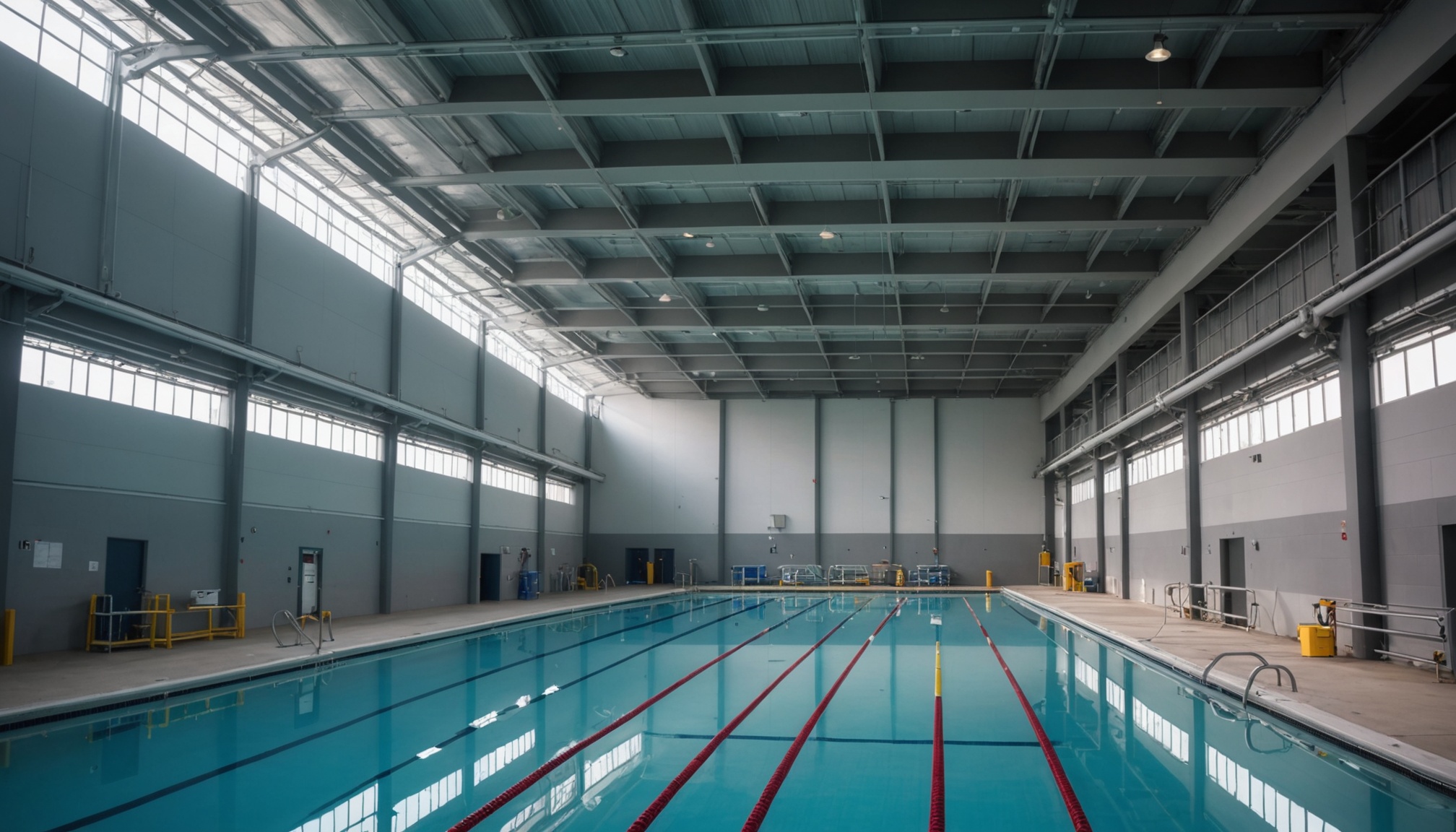
Carrier 1918 Equation and ASHRAE Activity Factor Refinement: Methodology Evolution Through Five Handbook Editions
Indoor pool evaporation rate calculation traces to Willis Carrier's 1918 ASHVE Transactions paper (Vol 24, pp 25-50), with the modern ASHRAE Handbook HVAC Applications methodology adding empirical Activity Factor corrections to bring Carrier's original quiet-water-surface equation closer to field-measured occupied pool evaporation rates. Carrier's original equation — ER (lb/h) = (95 + 0.425 × v) × A × (P_water − P_air) / Y, where v = air velocity over water (fpm), A = pool surface area (ft²), Y = latent heat of vaporization — assumed quiet, unoccupied water surface conditions and predicted evaporation from physics-derived mass-transfer principles without any occupant-activity correction.
The ASHRAE Handbook HVAC Applications evolved this methodology across five editions: the 1991 edition introduced the Activity Factor multiplier to correct Carrier's underprediction for occupied pools; the 2007 edition refined AF table values per Smith et al. (1993) field measurements; the 2011 edition expanded AF categories per VDI 2089 European data; the 2019 edition adopted current Equation 2 form (ER = 0.1 × A × AF × ΔP) as a simplified Carrier with empirical AF correction; and the 2023 edition incorporated minor table updates with methodology unchanged from 2019. Per ASHRAE Transactions Vol 119 Part 2 (2013) Shah analysis: the Carrier formula underpredicts occupied pool evaporation by 50-100% per Smith, Jones, Lof (1993, 1999) field measurements, and the Activity Factor correction brings predictions within 20-30% of field data, which represents meaningful improvement but leaves substantial uncertainty. This calculator implements the ASHRAE 2019/2023 Equation 2, the industry-standard methodology adopted by Seresco, PoolPak, Dectron, and Desert Aire, while disclosing methodology accuracy and providing sensitivity analysis of design parameter changes. Engineers requiring higher accuracy for academic research or precision energy modeling should consult ASHRAE Transactions Vol 120 (2014) Shah alternative correlation, summarized in Section 6.
Calculator Inputs: Vapor Pressure Differential as Primary Driver, Activity Factor as Secondary Multiplier
The ASHRAE Chapter 6 Equation 2 (ER = 0.1 × A × AF × ΔP) operates through six user-entered inputs whose sensitivity to evaporation rate varies significantly. Understanding the relative importance of each input enables prioritized data collection and targeted accuracy improvement.
Input 1 (highest sensitivity): vapor pressure differential ΔP, measured in inches of mercury (in Hg) or kilopascals (kPa), derived from pool water temperature and room conditions. Typical natatorium operating range: 0.05-1.0 in Hg (0.17-3.39 kPa). Per Section 5 sensitivity analysis: ΔP variation scales ER linearly, and every 0.01 in Hg (0.034 kPa) ΔP change corresponds to a 2.5-3% ER change for typical natatorium conditions.
Input 2 (high sensitivity): pool water surface area A (ft² or m²), a linear multiplier in Equation 2. A 1% area change produces a 1% ER change directly. Measurement accuracy is typically ±1-2% for regular rectangular pools and ±5-10% for irregular shapes.
Input 3 (high sensitivity): Activity Factor AF, an empirical multiplier per ASHRAE Handbook HVAC Applications 2023 Chapter 6 Table 2. Range: 0.5 (residential) to 2.0 (water park). The 3-4× variation across the AF range represents the largest single ER uncertainty source. Selection accuracy depends on correctly identifying the pool use category from the ASHRAE table.
Input 4 (vapor pressure component, moderate-high sensitivity): pool water temperature (°F or °C), which drives P_water, the saturated vapor pressure at the water surface. Per Section 5: a ±1°F (±0.6°C) water temperature change produces a ±9% ER change.
Input 5 (vapor pressure component, moderate inverse sensitivity): room air dry-bulb temperature (°F or °C), which drives P_sat at room conditions. Per Section 5: a ±1°F (±0.6°C) air temperature change produces a ∓7% ER change, an inverse relationship where raising air temperature reduces evaporation driving force.
Input 6 (vapor pressure component, highest single-variable inverse sensitivity): room air relative humidity (%), which multiplies P_sat at room conditions to obtain P_air. Per Section 5: a ±5% RH change produces a ∓15% ER change, making RH the most powerful controllable evaporation reduction lever. This option is bounded above by ASHRAE Standard 55-2023 (60% RH comfort ceiling) and ASHRAE Standard 160-2021 (condensation risk above 60% RH in cool-climate building envelopes).
Calculator outputs include evaporation rate ER (lb/h and kg/h), latent load equivalent (BTU/hr and kW), vapor pressure differential ΔP (in Hg and kPa) for verification, and component pressures P_water and P_air displayed separately. Conversion factors per NIST: 1 lb/h = 0.4536 kg/h; 1 in Hg = 3.386 kPa = 25.40 mm Hg = 0.4912 psia; 1 BTU/hr = 0.000293 kW; 1 ft² = 0.0929 m²; differential ΔT 1°F = 0.556°C.
Per ASHRAE Transactions Vol 120 (2014) Shah analysis: ΔP and AF dominate ER variation; pool area scales linearly; water and air temperatures and RH affect ΔP through psychrometric relationships. The largest accuracy improvements come from correct ΔP determination and appropriate AF selection, not from higher precision in linear inputs such as pool area measurement.
Vapor Pressure Determination: Steam Tables, Antoine Equation, and ASHRAE Psychrometric Chart Methods
Vapor pressure determination accuracy directly affects ER accuracy. Three established methods produce equivalent results when applied correctly; method choice depends on automation level and precision requirement.
Method 1: ASHRAE Fundamentals 2021 Chapter 1 Steam Tables (manual lookup, ±0.5% accuracy). Saturated vapor pressure P_sat is tabulated by temperature in 1-2°F increments. The engineer reads P_water at water surface temperature directly; P_sat at room dry-bulb temperature is read and then multiplied by RH to obtain P_air.
Pool water saturated vapor pressure reference values per ASHRAE Fundamentals 2021 Chapter 1 (water surface at 100% RH inherently):
| Water Temperature | P_water (in Hg) | P_water (kPa) | P_water (mm Hg) |
|---|---|---|---|
| 76°F (24.4°C) | 0.88 | 2.98 | 22.4 |
| 78°F (25.6°C) | 0.95 | 3.22 | 24.2 |
| 80°F (26.7°C) | 1.03 | 3.49 | 26.2 |
| 82°F (27.8°C) | 1.10 | 3.73 | 28.0 |
| 84°F (28.9°C) | 1.18 | 3.99 | 30.0 |
| 86°F (30.0°C) | 1.25 | 4.24 | 31.8 |
| 88°F (31.1°C) | 1.34 | 4.54 | 34.1 |
| 90°F (32.2°C) | 1.42 | 4.81 | 36.1 |
| 94°F (34.4°C) | 1.61 | 5.45 | 40.9 |
| 100°F (37.8°C) | 1.93 | 6.53 | 49.0 |
| 104°F (40.0°C) | 2.18 | 7.38 | 55.4 |
Method 2: Antoine Equation (calculator and spreadsheet automation, ±0.5% accuracy across the natatorium temperature range):
log₁₀(P_sat in mm Hg) = A − B / (C + T)
where T = temperature in °C. For water at 1-100°C per NIST WebBook (Stull 1947 reference data): A = 8.07131, B = 1730.63, C = 233.426. Per ASHRAE Fundamentals 2021 Chapter 1: the Antoine equation produces ±0.5% accuracy against NIST standard reference values for 0-100°C. This calculator uses the Antoine equation implementation; Seresco SelectMaster, PoolPak Selection Tool, and Dectron sizing software use Antoine-equivalent routines internally.
Method 3: ASHRAE Psychrometric Chart graphical method (visual verification, ±2% accuracy). The engineer locates water temperature on the saturation curve, reads P_water from the vapor pressure axis, locates the room air state point at the intersection of dry-bulb temperature and RH isoline, and reads P_air. The ±1-2% reading uncertainty makes this method suitable for visualization and cross-checking but not for final design calculation.
Per ASHRAE Transactions Vol 119 (2013) Shah validation: Methods 1 (steam tables) and 2 (Antoine equation) agree within 0.5% across the pool design temperature range. This calculator reports Method 2 results; verify against Method 1 steam tables for critical designs or when reviewing manufacturer calculations.
A practical note per PoolPak Humidity Control Calculations: water surface temperature may differ from bulk pool water temperature by 1-2°F (0.6-1.1°C) due to evaporative cooling at the surface. The pool water heater maintains bulk temperature; actual evaporation depends on surface temperature. Conservative design practice uses bulk water temperature (typically warmer than the surface), accepting ±2-3% ER overprediction. Precision modeling adjusts for surface cooling per Smith et al. (1993) field methodology.
Verification examples (Antoine equation vs ASHRAE Fundamentals 2021 Chapter 1 steam tables): at 80°F (26.67°C), Antoine gives 26.18 mm Hg = 1.031 in Hg (3.49 kPa); table gives 1.03 in Hg (3.49 kPa); agreement 0.1%. At 100°F (37.78°C), Antoine gives 49.0 mm Hg = 1.930 in Hg (6.53 kPa); table gives 1.93 in Hg (6.53 kPa); agreement 0.0%.
Sensitivity Analysis: ±1°F Water Temperature → +9% ER; ±1°F Air Temperature → −7% ER; ±5% RH → −15% ER
Understanding ER sensitivity to design parameter changes enables targeted operational optimization. Per partial derivative analysis of ASHRAE Chapter 6 Equation 2 around a typical natatorium operating point: room RH change is the most powerful evaporation reduction lever per unit change; air temperature increase is second; water temperature reduction is third.
Baseline conditions for this analysis: pool area 3,770 ft² (350 m²), a 25-meter competition lane pool; water temperature 80°F (26.7°C); room air temperature 82°F (27.8°C); design RH 60%; Activity Factor 1.0 per ASHRAE Chapter 6 Table 2 (Public/YMCA/Recreation). Vapor pressure values per ASHRAE Fundamentals 2021 Chapter 1: P_water at 80°F = 1.03 in Hg (3.49 kPa); P_sat at 82°F = 1.10 in Hg (3.73 kPa); P_air = 1.10 × 0.60 = 0.66 in Hg (2.24 kPa); ΔP = 1.03 − 0.66 = 0.37 in Hg (1.25 kPa). Baseline ER = 0.1 × 3,770 × 1.0 × 0.37 = 139.5 lb/h ≈ 140 lb/h (63.5 kg/h).
| Input Change | New ΔP (in Hg) | New ER (lb/h) | Change (lb/h) | % Change |
|---|---|---|---|---|
| Water +1°F: 81°F, P_w = 1.065 | 0.405 | 152.7 | +12.7 | +9.1% |
| Water +2°F: 82°F, P_w = 1.10 | 0.440 | 165.9 | +25.9 | +18.6% |
| Water −1°F: 79°F, P_w = 0.990 | 0.330 | 124.4 | −15.1 | −10.8% |
| Air +1°F: 83°F, P_sat = 1.14 | 0.346 | 130.4 | −9.1 | −6.5% |
| Air +2°F: 84°F, P_sat = 1.18 | 0.322 | 121.4 | −18.1 | −13.0% |
| Air −1°F: 81°F, P_sat = 1.065 | 0.391 | 147.4 | +7.9 | +5.7% |
| RH +5%: 65% | 0.315 | 118.8 | −20.7 | −14.8% |
| RH +10%: 70% | 0.260 | 98.0 | −41.5 | −29.7% |
| RH −5%: 55% | 0.425 | 160.2 | +20.7 | +14.9% |
| AF 0.65 (swim meet) | 0.370 | 90.7 | −48.8 | −35.0% |
| AF 1.5 (wave pool) | 0.370 | 209.3 | +69.8 | +50.0% |
Four engineering implications follow from this sensitivity analysis.
(1) RH setpoint is the most powerful operational lever. Increasing RH from 60% to 65% reduces ER 15%, directly reducing dehumidifier capacity demand. Per ASHRAE Standard 55-2023: 60% RH is the upper comfort limit. Per ASHRAE Standard 160-2021: exceeding 60% RH in cool-climate envelopes increases condensation risk on glazing and structural surfaces.
(2) Air temperature 2°F (1.1°C) above water temperature is the standard manufacturer recommendation per Seresco, PoolPak, and Dectron design rules. The sensitivity analysis confirms each additional 1°F air-above-water reduces ER approximately 6-7%. The 2-4°F (1.1-2.2°C) design differential captures 13-25% ER reduction vs equal water-air temperatures.
(3) Water temperature reduction is the least patient-friendly lever. Swimmers expect 78-84°F (25.6-28.9°C) per FINA and commercial pool operator standards. Per Dehumidified Air Solutions guidance: optimize air-side conditions (RH setpoint, air dry-bulb temperature) before considering water temperature reduction.
(4) Activity Factor selection accuracy dominates total ER variation, spanning a 3.2× range from AF 0.65 to AF 1.5. Misidentifying pool use category (specifying AF 0.8 hotel when the pool operates at AF 1.0 public access) produces a 25% capacity error. Per ACHR News April 2018 commentary (Paul Stewart): AF must reflect actual pool use and cannot be reduced to achieve a smaller equipment selection.
Combined strategy per Seresco Natatorium Design Manual: raise room air temperature 2-4°F (1.1-2.2°C) above water; set RH to 60% (maximum per ASHRAE 55-2023); install a pool cover for unoccupied hours; and assign AF based on verified pool use. These combined strategies achieve 30-50% ER reduction vs a naïve design at 75°F (23.9°C) room / 50% RH without a cover.
Shah 2013 Correlation per ASHRAE Transactions Vol 119: Modern Alternative to Carrier-Activity Factor Method
Mirza Mohammed Shah, PhD, PE developed alternative evaporation correlations per ASHRAE Transactions Vol 119 Part 2 (2013) and Vol 120 (2014) addressing Carrier formula limitations. The Shah methodology is grounded in physical phenomena (natural convection, occupant-driven surface area increase) rather than empirical Activity Factor correction.
The Shah 2013 occupied pool correlation per ASHRAE Transactions Vol 119 (2013) pp 450-455:
E_actual = E_0 × [1 + N* × U × (A_swim − A_pool) / A_pool]
where E_0 = unoccupied pool evaporation rate per Shah 2012 method; N* = adjusted occupant density factor (function of pool area per swimmer); U = utilization factor (0 ≤ U ≤ 1, with U = 1 at full occupancy); and A_swim − A_pool = increase in effective water surface area from swimmers and wave action. Per ASHRAE Transactions Vol 120 (2014) Shah accuracy analysis: the formula shows mean absolute deviation 14.5% from Smith et al. (1993, 1999) field data, compared to 35%+ mean absolute deviation for the ASHRAE Activity Factor method on the same dataset.
Physical interpretation per Shah 2003 phenomenological model: occupant bodies in the pool increase effective wet surface area; wet bodies emerging at deck level continue to evaporate at pool surface temperature; wave action and splashing physically increase evaporation surface area; and wet deck areas around swimmers contribute to total evaporating surface. The ASHRAE Activity Factor approximates these mechanisms with a single empirical multiplier rather than modeling them explicitly.
The Shah 2012 unoccupied pool method (ASHRAE Transactions Vol 118) takes the larger of two values: E_0,1 = 35 × (ρ_a − ρ_w) × A / Y, the natural convection term where ρ represents humid air density; and E_0,2 = 0.00005 × A × (P_water − P_air) / Y, the mass-transfer term. The dominant transport mechanism determines which governs.
Methodology adoption status: ASHRAE Handbook HVAC Applications 2019/2023 retains the Carrier-Activity Factor methodology (Equation 2) as the industry-standard approach for practical design. The Shah methodology appears in Chapter 6 commentary but has not been adopted as the primary methodology. European VDI 2089 (2010) uses the Hens 2009 correlation, differing from both Carrier-Activity Factor and Shah approaches. Per Smedegård et al. 2021 (Energy Efficiency Vol 14) systematic review of 92 swimming facility studies: VDI 2089 and Shah methodologies converge for typical occupied indoor pools; the ASHRAE Activity Factor method is conservative-biased, overpredicting ER 10-25% vs Shah for most occupied scenarios. This calculator uses ASHRAE Equation 2 per industry-standard convention; engineers requiring research-grade accuracy should consult the Shah ASHRAE Transactions papers directly.
Methodology Accuracy Comparison: ASHRAE/Carrier vs Shah vs Smith et al Field Data
Honest disclosure of evaporation methodology accuracy reveals 15-35% uncertainty across published methods — with the ASHRAE Activity Factor method providing conservative-biased estimates suitable for equipment sizing but not for precision energy modeling.
Accuracy benchmark per ASHRAE Transactions Vol 120 (2014) Shah analysis comparing predicted vs measured evaporation from 113 data points across multiple field studies:
| Method | Mean Absolute Deviation | Source |
|---|---|---|
| Shah 2013 phenomenological | 14.5% | ASHRAE Transactions Vol 119/120 |
| Smith et al. 1999 empirical | 21.5% | ASHRAE Transactions 1999 |
| ASHRAE Activity Factor (Carrier + AF) | 35%+ | per Shah Vol 120 analysis |
| VDI 2089 (Hens 2009 correlation) | 25-30% | VDI Verein Deutscher Ingenieure |
| Carrier 1918 (unmodified, no AF) | 50-100% underprediction for occupied | per Smith 1999 field comparison |
Field measurement reference data per Smith, Jones, Lof (1993 ASHRAE Annual Meeting): actual quiet water surface ER range 0.020-0.055 lb/(h·ft²) [0.098-0.269 kg/(h·m²)]; occupied pool ER range 0.040-0.150 lb/(h·ft²) [0.195-0.732 kg/(h·m²)]; measurement methodology: pool water level change rate and calibrated steam consumption from pool water heater; cross-validation: two independent measurement methods agreed within 5%.
For typical occupied natatorium ER prediction: ASHRAE Equation 2 (this calculator) carries ±25-35% vs field measurements; manufacturer software (Seresco, PoolPak) carries ±15-20% via Shah-style refinements; custom CFD analysis per Ciuman and Lipska (2018) achieves ±10-15% but requires hours of setup and validation against a measured baseline.
Per Smedegård et al. 2021 (Energy Efficiency Vol 14) systematic review: simplified design methods (ASHRAE Activity Factor) are sufficient for equipment sizing with conservative margin; precision energy modeling requires manufacturer software or the peer-reviewed Shah correlation; academic research requires CFD validation against measured baseline data.
Per Dehumidified Air Solutions Natatorium Design Guide: the ASHRAE Activity Factor method is intentionally conservative-biased to ensure equipment adequacy. A 25-35% ER overprediction translates to a 5-15% capacity margin in equipment selection (smaller because typical selection rounds up to the next available capacity step). Field-measured ER is often lower than predicted, reducing actual operating cost, but never lower than equipment capability, preventing humidity excursions.
Per ASHRAE Transactions Vol 120 (2014) Shah conclusion: "The Shah method is the most reliable among available methods and therefore may be used for prediction of evaporation from occupied pools where high accuracy is required. The ASHRAE method gives larger deviations but is simpler to apply." Engineering practice: use the ASHRAE method for equipment sizing; consult the Shah method for precision applications or methodology validation.
YMCA 25-Meter Pool Worked Example: Baseline ER 140 lb/h, Sensitivity to Design Parameter Variations
Project: YMCA recreation pool, 25-meter (82 ft) competition-size lane pool, 14-meter (46 ft) width, 1.5-meter (5 ft) depth throughout. Pool surface area 25 × 14 = 350 m² (3,770 ft²). Use mix: 60% lap swimming, 30% recreational family swim, 10% structured aquafit class. Activity Factor assignment per conservative design: AF 1.0 per ASHRAE Chapter 6 Table 2 (Public/YMCA/Recreation) for peak occupied condition.
Step 1. Baseline ER per ASHRAE Chapter 6 Equation 2
Design conditions: pool water temperature 80°F (26.7°C) per recreational standard; room air temperature 82°F (27.8°C) per Seresco "2°F above water" rule; design RH 60%; Activity Factor 1.0.
Vapor pressure values per ASHRAE Fundamentals 2021 Chapter 1: P_water at 80°F (26.7°C) = 1.03 in Hg (3.49 kPa); P_sat at 82°F (27.8°C) = 1.10 in Hg (3.73 kPa); P_air at 60% RH = 1.10 × 0.60 = 0.66 in Hg (2.24 kPa); ΔP = 1.03 − 0.66 = 0.37 in Hg (1.25 kPa).
Baseline ER = 0.1 × 3,770 × 1.0 × 0.37 = 139.5 lb/h ≈ 140 lb/h (63.5 kg/h).
Latent load equivalent: 140 × 1,061 BTU/lb = 148,540 BTU/hr (43.5 kW).
Step 2. Sensitivity to design parameter variations
Adjustment 1: raise room temperature from 82°F (27.8°C) to 84°F (28.9°C). New P_sat = 1.18 in Hg; P_air = 1.18 × 0.60 = 0.708 in Hg; ΔP = 1.03 − 0.708 = 0.322 in Hg. New ER = 0.1 × 3,770 × 1.0 × 0.322 = 121.4 lb/h (55.1 kg/h). ER reduction: 18.6 lb/h, −13.3%. Additional space heating cost: $0.50-1.00/month. Dehumidifier capacity savings at equipment selection: $5,000-8,000.
Adjustment 2: increase RH setpoint from 60% to 65% where envelope permits per ASHRAE 160-2021. New P_air = 1.10 × 0.65 = 0.715 in Hg; ΔP = 1.03 − 0.715 = 0.315 in Hg. New ER = 0.1 × 3,770 × 1.0 × 0.315 = 118.8 lb/h (53.9 kg/h). ER reduction: 21.2 lb/h, −15.1%. Per ASHRAE 160-2021: viable in mild climates (Florida, Hawaii, Southern California); cold climates (Chicago, Minneapolis, Toronto) likely require triple-pane glazing.
Adjustment 3: combine Adjustments 1 and 2 (84°F room / 65% RH). New P_sat = 1.18; P_air = 1.18 × 0.65 = 0.767 in Hg; ΔP = 1.03 − 0.767 = 0.263 in Hg. New ER = 0.1 × 3,770 × 1.0 × 0.263 = 99.2 lb/h (45.0 kg/h). ER reduction: 40.8 lb/h, −29.1%. The combined effect exceeds the sum of individual adjustments because both reduce ΔP multiplicatively.
Adjustment 4: pool cover during unoccupied hours per Dehumidified Air Solutions methodology. Cover schedule: 16 hr/day covered at 80% effective evaporation reduction; 8 hr/day occupied at baseline ER 140 lb/h. Covered ER = 140 × 0.20 = 28 lb/h. Daily average ER = (140 × 8 + 28 × 16) / 24 = (1,120 + 448) / 24 = 65.3 lb/h (29.6 kg/h). Peak occupied ER remains 140 lb/h for equipment sizing; annual energy reduction: 53% of moisture removal energy during covered hours.
Step 3. Equipment sizing recommendation
For the YMCA recreation pool at baseline conditions (140 lb/h), the standard equipment selection is a Seresco NE-090 or Dectron NP-100 equivalent. Applying combined design adjustments (84°F room / 65% RH where envelope permits, plus cover schedule): peak occupied ER reduces to 99 lb/h. Equipment selection at combined conditions: 100 lb/h capacity unit (Seresco NE-100 or next standard step) with 1.01× margin. Capital cost reduction: $5,000-10,000 vs baseline 140 lb/h selection. Annual operating cost reduction: 30-50% vs naïve design at 75°F (23.9°C) room / 50% RH without cover.
Per Dehumidified Air Solutions Table 4: pool cover ROI under 2 years through dehumidifier downsizing and reduced operating cost. Triple-pane glazing upgrade ROI: 5-8 years where 65% RH setpoint is pursued; viable for new construction, marginal for retrofits. The sensitivity analysis confirms that room air temperature and RH setpoints are the highest-impact operational design decisions; AF must reflect actual pool use; water temperature is constrained by swimmer comfort.
Cover Schedule Impact: 60–90% Evaporation Reduction During Unoccupied Hours per Dehumidified Air Solutions
Pool covers represent the single most impactful operational lever for reducing daily evaporation energy beyond design-condition optimization. Per Dehumidified Air Solutions Natatorium Design Guide: a covered pool reduces evaporation 60-90% depending on cover type and seal quality.
Cover types per Dehumidified Air Solutions classification:
| Cover Type | Evaporation Reduction | Cost (USD/ft²) | Service Life |
|---|---|---|---|
| Bubble (solar) cover, manual | 60-70% | $2-5 | 3-5 years |
| Liquid pool cover (sprayed) | 30-50% | $0.20-0.50/month | Continuous |
| Automatic reel slatted cover | 80-90% | $20-50 | 10-15 years |
| Insulated track cover (commercial) | 85-95% | $50-150 | 15-25 years |
| Solid retractable cover | 90-95% | $100-300 | 20-30 years |
Per Dehumidified Air Solutions Table 4: a public pool with 50 lb/h (22.7 kg/h) baseline ER and 2,000 cooling-season hours per year, covered 16 hr/day at 80% effective reduction, saves approximately $2,350/year electricity cost if primary pool water heating is electric. ROI: 1-3 years depending on cover type.
Cover deployment schedule per Seresco Natatorium Design Manual: cover is deployed during unoccupied hours (overnight, between scheduled use blocks) and stowed at the pool end or wall mount during occupied hours. Manual covers require pool operator labor for each deployment and retrieval cycle. Automatic covers are motorized and key-switch operated, minimizing labor cost.
Equipment sizing impact per Dehumidified Air Solutions methodology: the pool dehumidifier is sized for peak occupied evaporation when the cover is off. Cover schedule does not reduce equipment capacity requirement; it reduces annual energy consumption proportionally to covered hours per total hours. A 16 hr/day cover at 80% effective reduction produces (16 × 0.80) / 24 = 53% annual energy reduction.
Engineering decision framework per Dehumidified Air Solutions: public pools with high occupancy variation represent the highest-value cover application; hotel pools with 24/7 guest access have limited cover utilization benefit; residential pools have the highest cover benefit per occupied-to-unoccupied ratio; competition pools benefit during off-training hours. Per Seresco engineering practice: pool cover specification at design phase costs $5,000-50,000 depending on pool size and cover type; annual energy savings $1,500-15,000. Combined with dehumidifier heat recovery for pool water heating, pool covers form the foundation of natatorium energy efficiency.
Application Boundaries: Outdoor Pools, Saltwater, Wave Pools, and Methodology Limits
This calculator applies ASHRAE Handbook HVAC Applications 2023 Chapter 6 methodology to indoor pools with natural air circulation (10-30 fpm / 0.05-0.15 m/s air velocity over the water surface per Seresco), pool water at 75-104°F (23.9-40°C), steady-state operation with established cover and use schedules, and Activity Factor identifiable per ASHRAE Chapter 6 Table 2 categories.
Application boundaries where extended methodology is required:
(1) Outdoor pools per Carrier 1918 original equation with wind factor: ER = (95 + 0.425 × v) × A × (P_water − P_air) / Y, where v = wind velocity (fpm). Wind dramatically increases evaporation driving force; the wind factor correction is not implemented in this calculator, which is scoped to indoor pools only.
(2) Saltwater pools per Raoult's Law: salinity reduces P_water by 1-3% vs freshwater. The methodology is unchanged; a correction factor is applied to P_water. Per Smith et al. (1999): the salinity effect is minor relative to other methodology uncertainties.
(3) Wave pools and water parks: AF 1.5-2.0 per ASHRAE Chapter 6 Table 2 underpredicts peak occupied evaporation per Dehumidified Air Solutions analysis. Custom CFD analysis is required for mechanical wave generation conditions; standard methodology is valid for unoccupied or low-occupancy hours only.
(4) Therapy pools (88-94°F / 31.1-34.4°C water): elevated water temperature shifts P_water to 1.34-1.61 in Hg (4.54-5.45 kPa). Methodology is valid, but the ASHRAE Activity Factor table may underrepresent gentle low-splash therapeutic use. Per Seresco engineering practice: use AF 0.65 baseline with manufacturer consultation for precision therapy pool applications.
(5) Spas and hot tubs (100-104°F / 37.8-40°C water): P_water at 1.93-2.18 in Hg (6.53-7.38 kPa); jet aeration increases evaporation 10-20% above the baseline AF 1.0 prediction per Seresco. Standard methodology is applicable, but accuracy is reduced for intense jet operation.
(6) Per ASHRAE Transactions Vol 120 (2014) Shah validation: the ASHRAE Activity Factor method shows 25-35% mean absolute deviation from Smith et al. (1993, 1999) field data; the Shah 2013 correlation reduces deviation to 14.5%. Engineers requiring research-grade accuracy should consult Shah methodology per Section 6 disclosure.
(7) Olympic-scale natatoriums larger than 10,000 ft² (929 m²): scale-dependent effects including multi-zone air circulation and locally varying RH require manufacturer technical assistance beyond standard Equation 2 prediction.
(8) Heated commercial spas (continuous high temperature, multi-jet): water chemistry and bather load create unique evaporation profiles per CDC Public Spa guidance; consult manufacturer specific to spa application.
Natatorium Evaporation Rate Calculator
Natatorium Evaporation Rate Calculator
Evaporation rate calculation per ASHRAE Handbook HVAC Applications 2023 Chapter 6 Equation 2 with vapor pressure differential computed via Antoine equation implementation, sensitivity analysis across water temperature, air temperature, relative humidity, and Activity Factor inputs, and methodology accuracy disclosure per ASHRAE Transactions Vol 119-120 Shah research.
Open Natatorium Evaporation Rate CalculatorFAQ
How accurate is the ASHRAE Chapter 6 evaporation equation compared to actual field measurements?
Per ASHRAE Transactions Vol 120 (2014) Shah analysis of 113 field data points across multiple measurement studies: the ASHRAE Activity Factor method shows mean absolute deviation 25-35% vs measured evaporation. Carrier's 1918 original equation underpredicts occupied pool evaporation by 50-100% per Smith, Jones, Lof (1993, 1999) field data; the Activity Factor correction introduced in the 1991 Handbook edition brings predictions within 25-35% of field measurements. The Shah 2013 phenomenological correlation reduces deviation to 14.5%. Per Smedegård et al. 2021 (Energy Efficiency Vol 14): the ASHRAE method overpredicts ER 10-25% vs Shah for typical occupied scenarios, providing a conservative-biased result appropriate for equipment sizing but not for precision energy modeling.
Which design parameter has the biggest impact on evaporation rate?
Per Section 5 sensitivity analysis around the representative natatorium baseline (80°F / 26.7°C water, 82°F / 27.8°C room, 60% RH): Activity Factor variation produces the largest ER range (3-4× across AF 0.5-2.0); RH change produces the largest controllable single-input variation (±5% RH → ∓15% ER); water temperature change is second (±1°F / ±0.6°C → ±9% ER); air temperature change is third (±1°F / ±0.6°C → ∓7% ER). For operational optimization where AF is fixed by pool use category and area is fixed by construction: RH setpoint and room air temperature are the highest-leverage controllable variables. Per Seresco Natatorium Design Manual: combined raising air temperature 2-4°F (1.1-2.2°C) above water and maximizing RH setpoint to 60% reduces ER 25-30% vs a naïve design at equal water-air temperatures and 50% RH.
Why does the ASHRAE equation use the Activity Factor? What is the historical background?
The ASHRAE evaporation equation traces to Willis Carrier's 1918 paper in ASHVE Transactions Vol 24 (pp 25-50), which derived a quiet-water-surface evaporation formula from physics-based mass-transfer principles. Per ASHRAE Transactions Vol 119 (2013) Shah analysis and Smith, Jones, Lof (1993, 1998, 1999) field studies: Carrier's equation underpredicted occupied pool evaporation by 50-100% because it did not account for water surface area increase from swimmers, waves, splashing, and wet deck areas. ASHRAE Handbook HVAC Applications 1991 introduced the Activity Factor multiplier to correct Carrier's predictions for occupied conditions; Table 2 values were calibrated against Smith et al. field measurements and refined in subsequent editions (2007, 2011, 2019, 2023). Per Shah 2013 phenomenological model: occupant-induced effective surface area increase is the physical phenomenon that the Activity Factor empirically approximates.
What is the actual measured evaporation rate range from real pools?
Per Smith, Jones, Lof (1993 ASHRAE Annual Meeting) field measurements on a public swimming pool using two independent methods (pool water level change rate plus calibrated steam consumption from the pool water heater): actual quiet water surface evaporation ranged 0.020-0.055 lb/(h·ft²) [0.098-0.269 kg/(h·m²)]; occupied pool evaporation ranged 0.040-0.150 lb/(h·ft²) [0.195-0.732 kg/(h·m²)]. Per Shah 2014 (ASHRAE Transactions Vol 120): the two measurement methods agreed within 5% during validation tests. Design ER from ASHRAE Equation 2 should produce values within the Smith et al. measured range; predictions outside 0.020-0.150 lb/(h·ft²) warrant input verification, particularly AF selection and vapor pressure determination.
Will a pool cover reduce dehumidifier sizing or just operating cost?
Per Dehumidified Air Solutions Natatorium Design Guide and Seresco Natatorium Design Manual: pool cover reduces operating cost dramatically (53% annual reduction typical for 16 hr/day cover schedule at 80% effective reduction) but does not reduce equipment capacity requirement. Equipment is sized for peak occupied evaporation when the cover is stowed; cover impact is felt during covered (unoccupied) hours through reduced compressor cycling and dehumidifier runtime. Per DAS Table 4: $2,350/year annual savings typical for a 50 lb/h (22.7 kg/h) pool with 2,000 cooling-season hours and 16 hr/day cover schedule. Equipment downsizing is achievable only when combined with design parameter optimization: raise room temperature 2-4°F (1.1-2.2°C) above water, set RH to 60% (envelope permitting per ASHRAE 160-2021), and apply a pool cover for unoccupied hours; combined approach reduces peak occupied ER 25-30%, enabling downsizing by one to two standard capacity steps with cover ROI typically 1-5 years.
Related Calculators
Total natatorium dehumidification load and equipment selection methodology including spectator and outdoor air latent components: Dehumidifier Sizing for Pools Calculator. Mold growth risk assessment per ASHRAE Standard 160-2021 for humid pool environments and glazing condensation prevention: Mold Risk Calculator.
Complete psychrometric properties for natatorium design state-point analysis: Psychrometric Calculator. Humidity ratio from temperature and RH for vapor pressure cross-check: Humidity Ratio Calculator. Dew point temperature for glazing condensation analysis at design conditions: Dew Point Calculator.
Residential dehumidification load calculation for homes with humid climate challenges: Latent Heat Load Calculator. Energy recovery ventilator efficiency for outdoor air pre-conditioning in natatorium ventilation design: ERV/Energy Recovery Wheel Efficiency Calculator.