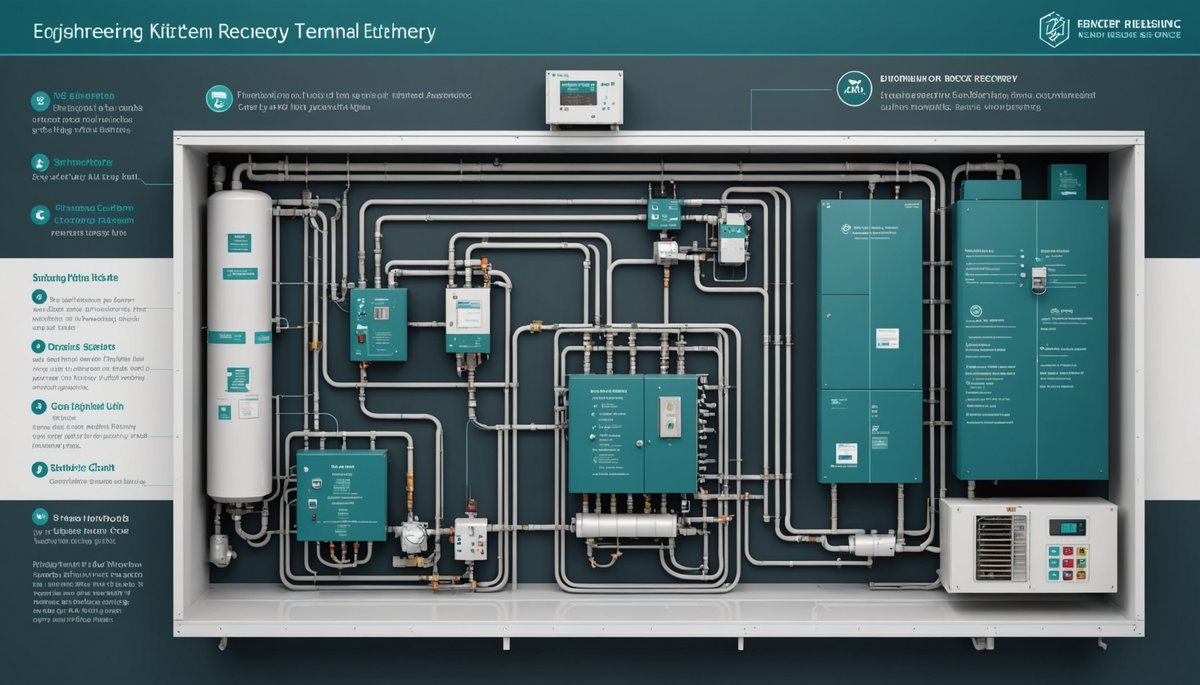
Commercial kitchen exhaust systems discharge large volumes of hot, contaminated air — typically at 90–120°F (32–49°C) — directly to atmosphere, discarding thermal energy that cost the facility real money to generate. In a full-service restaurant operating 12 hours per day, exhaust airflows of 2,000–6,000 CFM at elevated temperatures represent 30–100 kW of recoverable thermal energy during heating months. Energy recovery ventilators (ERV) or dedicated kitchen exhaust heat recovery coils can capture 40-65% of this energy under realistic kitchen operating conditions, accounting for grease-related effectiveness degradation between cleaning intervals. Annual energy savings scale with operating hours, climate severity, and recovery system type.
ASHRAE 90.1 Section 6.5.6 requires energy recovery on high-ventilation commercial kitchen systems in most climate zones, but code compliance only establishes the minimum recovery requirement — it does not guarantee optimal system design or accurate project economics. Engineers who calculate expected recovered heat precisely can specify recovery equipment correctly, size pre-conditioning coils accurately, and provide owners with defensible payback projections that support capital investment decisions.
Why Kitchen Exhaust Energy Recovery Pays Off in Heating-Dominated Climates
Commercial kitchen energy recovery extracts thermal energy from exhaust air before atmospheric discharge and transfers it to incoming makeup air (or, less commonly, to domestic hot water). The recovered heat reduces winter heating load on the makeup air unit. In summer, recovery is counterproductive — kitchen exhaust at 90-120°F is almost always warmer than outdoor air, so a running heat exchanger would warm the incoming makeup air and increase the cooling load. ASHRAE 90.1 Section 6.5.6.4 requires automatic bypass dampers to disable recovery whenever outdoor temperature exceeds the exhaust temperature, making this fundamentally a heating-season benefit with mandatory cooling-season bypass.
Engineers calculate recovered heat to determine whether an energy recovery system is economically justified, to select appropriately sized recovery equipment, to quantify annual energy savings for LEED or energy code compliance documentation, and to calculate simple payback periods for capital budgeting. The calculation requires exhaust airflow, exhaust temperature, outdoor temperature, and the recovery device's effectiveness — typically 0.40-0.55 for run-around coils and 0.55-0.65 for plate heat exchangers under real in-service grease conditions. Recovery sizing depends on exhaust airflow determination — see CFM calculation for HVAC ventilation for kitchen exhaust hood airflow rates per IMC Section 507 and ASHRAE 154 cooking duty classifications.
The Recovered Heat and Payback Formulas
Recovered Heat (W) = Effectiveness × Airflow (m³/s) × Air Density (kg/m³) × Cp × ΔT (°C)
Recovered Heat (BTU/hr) = Effectiveness × 1.1 × CFM × ΔT (°F)

Annual Energy Savings (kWh) = Recovered Heat (kW) × Operating Hours × Utilization Factor
Annual Cost Savings ($) = Annual Energy Savings × Energy Rate ($/kWh)
Payback (years) = System Cost ($) / Annual Cost Savings ($)
Effectiveness is the ratio of actual heat transferred to maximum possible heat transfer, dimensionless. Manufacturer-rated effectiveness for kitchen-rated heat exchangers (clean-air conditions, immediately after commissioning) is typically 0.65-0.80 for plate, 0.50-0.65 for run-around coils. In real grease-laden kitchen exhaust, effectiveness degrades 20-40% between cleaning intervals — design with realistic in-service values: 0.55-0.65 for plate, 0.40-0.55 for run-around. Rotary heat exchangers reach 0.75-0.85 in clean conditions but are unsuitable for grease applications (see common mistakes section). Airflow is the volumetric exhaust airflow in CFM or m³/s. ΔT is the temperature difference between exhaust air and outdoor air — the larger this difference, the more energy is recoverable. The factor 1.1 in the imperial formula combines air density (0.075 lb/ft³), specific heat (0.24 BTU/lb·°F), and the 60-second conversion.
Operating Hours is the annual hours when the kitchen exhaust is running and recovery is active. A restaurant running 12 hours per day, 365 days per year, operates 4,380 hours annually. Utilization Factor accounts for hours when outdoor conditions make recovery impractical (e.g., when outdoor temperature exceeds exhaust temperature in summer), typically 0.6–0.8 for heating-dominated climates.
Minneapolis Restaurant: 3,500 CFM at 95°F → 55 kW Recovery (1.7-Year Payback)
A full-service restaurant in Minneapolis operates exhaust hoods at 3,500 CFM. Average exhaust temperature: 95°F. Average outdoor temperature during heating season: 25°F. Plate heat exchanger effectiveness: 0.70. Operating hours: 4,200/year. Utilization factor: 0.75. Energy rate: $0.12/kWh.
ΔT = 95 − 25 = 70°F. Recovered heat = 0.70 × 1.1 × 3,500 × 70 = 188,650 BTU/hr = 55.3 kW.
Annual energy savings = 55.3 kW × 4,200 hours × 0.75 = 174,195 kWh. Annual cost savings = 174,195 × $0.12 = $20,903/year.
System cost for plate HX with ductwork and controls: $35,000. Simple payback = $35,000 / $20,903 = 1.7 years.
Practical takeaway: 1.7-year payback strongly justifies the investment for cold-climate full-service operations. Two implementation notes: (1) the 0.70 effectiveness used assumes aggressive cleaning per manufacturer schedule (typically every 3-6 months for plate HX in grease service) — without this maintenance, real effectiveness drops to 0.50-0.55 within the first year, doubling payback to 3+ years; (2) ASHRAE 90.1 §6.5.6.4 cooling-season bypass is mandatory — specify automatic dampers and outdoor-temperature interlock controls to disable recovery when outdoor temperature exceeds exhaust temperature, otherwise summer cooling load increases will offset winter savings.
Charlotte Cafeteria: 1,800 CFM at 85°F → 11 kW Recovery (15-Year Payback)
A school cafeteria in Charlotte, NC has 1,800 CFM kitchen exhaust at 85°F average temperature. Average outdoor temperature during occupied hours: 50°F. Run-around coil effectiveness: 0.55. Operating 1,500 hours/year (school year only). Energy rate: $0.11/kWh. Utilization factor: 0.65.
ΔT = 85 − 50 = 35°F. Recovered heat = 0.55 × 1.1 × 1,800 × 35 = 38,115 BTU/hr = 11.2 kW.
Annual energy savings = 11.2 × 1,500 × 0.65 = 10,920 kWh. Annual cost savings = 10,920 × $0.11 = $1,201/year.
System cost: $18,000. Payback = $18,000 / $1,201 = 15 years.
Practical takeaway: 15-year payback exceeds typical institutional facility decision criteria (5-10 year maximum for energy retrofits). For mild-climate cafeterias with limited operating hours, the engineer documents that the project does not pay back on its own merit. However, ASHRAE 90.1 §6.5.6 may still require energy recovery for Climate Zone 4 systems above the exempt threshold. Verify project airflow against the latest ASHRAE 90.1 exemption table; if recovery is mandatory by code, specify a minimum-effectiveness system (run-around coil at 0.40-0.45) at minimum first cost rather than higher-effectiveness equipment that the operating profile cannot justify.
Try the Commercial Kitchen Energy Recovery Calculator
Calculate recovered heat, annual energy savings, and payback period for any kitchen exhaust system with our free online tool.
Open Energy Recovery CalculatorWhat Drives Real-World Recovery Performance
Climate Severity and Heating Hours
The economic case for kitchen energy recovery scales with annual heating hours and average ΔT during those hours. ASHRAE Climate Zone 1-3 (warm) typically yields paybacks above 8 years and may not meet ASHRAE 90.1 §6.5.6 exemption thresholds for low-utilization systems. Climate Zones 5-8 (cold) routinely produce sub-3-year payback for full-service restaurants with 12+ hour daily operations. Use bin weather data with at least monthly resolution rather than annual averages — recovery hours are heavily weighted toward winter when ΔT is largest, and a single annual average understates the heating-season concentration of recoverable energy.
Heat Exchanger Type and Grease Compatibility
Kitchen grease imposes three constraints rotational equipment cannot meet: contamination accumulation, fire risk, and cleaning access. Run-around coil systems (separate water-glycol coils in supply and exhaust connected by a pump loop) tolerate grease best because the coil surfaces can be removed for soaking and pressure-washing without disturbing the makeup-air or exhaust-fan installations. Plate-type heat exchangers offer higher effectiveness but require more frequent cleaning and may need bypass dampers for cleaning access. Rotary heat exchangers should not be specified for grease-laden exhaust regardless of advertised wash-down features. ASHRAE 154 provides cleaning interval guidance based on grease load category (light, medium, heavy duty cooking).
System Cost and Energy Rate Sensitivity
Payback period is highly sensitive to local electricity (or gas) rates. At $0.08/kWh, a 1.7-year payback in cold climate stretches to 2.5 years; at $0.18/kWh (high-cost coastal markets), the same project hits sub-1-year payback. Run sensitivity analysis at ±25% of current rates to assess project robustness against future rate changes. System cost varies regionally with mechanical contractor labor rates, ductwork modifications required, and whether the recovery system is integrated at design or retrofitted into existing kitchens. Retrofit installations typically cost 1.5-2× new construction installations due to access restrictions and existing duct re-routing.
Where the Recovery Calculation Falls Short
The simple ε × ρ × CFM × ΔT method is a first-pass screening calculation. Five conditions push real kitchen energy recovery design beyond what the formula captures:
-
Steady-state assumption with constant ΔT. The formula uses one ΔT (heating-season average) for the full annual calculation. Real systems experience continuously varying outdoor temperature; recovery is highest in coldest hours and zero in summer. Bin weather data analysis per ASHRAE Handbook—Fundamentals Chapter 14, with HX effectiveness applied at each bin temperature, gives 15-30% more accurate annual savings than the single-ΔT method.
-
Effectiveness degrades over time. The calculator uses constant design-condition effectiveness. Real grease-laden kitchen heat exchangers lose 20-40% effectiveness between cleaning intervals; without aggressive maintenance, plate HX can drop from 0.70 design to 0.50 within 12 months. Project savings projections should derate effectiveness by ~25% on average over the 10-year economic life unless the operations contract guarantees periodic cleaning to manufacturer ratings.
-
No bypass operation captured. Cooling-season bypass per ASHRAE 90.1 §6.5.6.4 is mandatory but not modeled in the calculator. The utilization factor is a coarse proxy; for accurate projections, run hour-by-hour simulation with bypass logic (recovery active only when outdoor temperature is below exhaust temperature). This typically reduces recovered hours by 20-40% versus assuming 24/7 operation during occupied periods.
-
Maintenance and operating costs excluded from payback. Simple payback ignores annual cleaning costs ($1,000-5,000 per year for plate HX in grease service), pump operating cost for run-around systems (~5-10% of recovered energy goes to pump kW), and replacement cost at end of useful life (typically 10-15 years for grease-exposed equipment). Lifecycle cost analysis per ASHRAE 90.1 Appendix G is the rigorous metric, not simple payback.
-
Fire safety and code constraints. Heat exchanger placement in commercial kitchen exhaust ducts is regulated by NFPA 96 (Standard for Ventilation Control and Fire Protection of Commercial Cooking Operations). Some HX configurations require fire-rated ductwork, automatic shutoff dampers, and specific fire suppression integration that adds capital cost beyond the heat exchanger itself. Confirm AHJ acceptance of the proposed recovery configuration before specifying — retrofit corrections to meet NFPA 96 can exceed the original recovery system cost.
Where Kitchen Energy Recovery Goes Wrong
Engineers most frequently apply peak ΔT (coldest winter day) to the full annual calculation instead of using seasonal average temperatures from local heating degree day data. This overstates savings by 30-50% and produces payback projections that fail to materialize. Use bin weather data per ASHRAE Handbook—Fundamentals Chapter 14 for the project location, applying recovery only to the hours when outdoor temperature is materially below exhaust temperature. The utilization factor in this calculator is a coarse proxy for this; bin analysis is the rigorous approach.
Specifying rotary heat exchangers (0.80+ effectiveness) for kitchens with grease-laden exhaust is a serious safety and performance error. Grease carryover fouls rotary wheels within weeks, destroying effectiveness and creating a documented fire hazard per NFPA 96 §8.2.5 commercial cooking exhaust requirements. Plate-type heat exchangers (cleanable cassettes) and run-around coil systems are appropriate for grease environments despite their lower effectiveness, with cleaning intervals specified per ASHRAE 154 Ventilation for Commercial Cooking Operations.
Treating recovery effectiveness as constant over time ignores grease loading and air-side fouling that progressively degrade heat transfer. Calculate first-year savings at design effectiveness, then derate by 20-40% for years 2+ unless the maintenance contract guarantees periodic cleaning to manufacturer effectiveness ratings. This more realistic profile typically extends payback by 20-30% versus the constant-effectiveness assumption, but produces projections that owners can defend against actual utility bill data.
Climate-Driven Selection and Verification Workflow
Commercial kitchen energy recovery is calculated by multiplying exhaust airflow, temperature difference, and heat exchanger effectiveness to find recovered heat, then projecting annual savings using realistic operating hours and energy rates. The calculation demonstrates excellent paybacks (sub-3-year) in cold climates with high exhaust temperatures and long operating seasons; marginal paybacks (10+ year) in mild climates with short operating seasons.
Use the calculator during design to estimate baseline savings, then validate with bin weather data analysis for project location. Critical implementation steps before final equipment selection: (1) verify ASHRAE 90.1 §6.5.6 applicability to project airflow and climate zone; (2) confirm heat exchanger type compatibility with grease load per ASHRAE 154 cooking duty classification; (3) specify cleaning schedule and effectiveness verification protocol; (4) include automatic cooling-season bypass controls per §6.5.6.4; (5) coordinate with NFPA 96 fire safety requirements for grease-laden exhaust ductwork. Document calculated savings, selected equipment specifications, and assumed maintenance regime in project commissioning records — this provides the audit trail when actual energy bills are compared to projections.
FAQ
What is the typical effectiveness of a plate heat exchanger in a commercial kitchen?
Manufacturer-rated effectiveness under clean-air conditions is 0.65-0.80, but real in-service values in grease-laden kitchen exhaust typically fall to 0.55-0.65 due to progressive fouling between cleaning intervals. Design calculations should use these derated values unless an aggressive cleaning program (every 3-6 months) is contractually guaranteed.
When is commercial kitchen energy recovery required by code?
ASHRAE 90.1 Section 6.5.6 mandates energy recovery for commercial kitchen exhaust systems that exceed specified airflow thresholds in most climate zones. Exemptions apply for low-airflow systems and certain climate zone combinations. Engineers must check the current ASHRAE 90.1 exemption table against project-specific airflow and climate zone — the requirement is airflow- and location-dependent, not universal.
Why is cooling-season bypass required for kitchen energy recovery?
Kitchen exhaust at 90-120°F is almost always warmer than outdoor air in summer, so a running heat exchanger would transfer heat into the incoming makeup air, increasing the cooling load instead of reducing it. ASHRAE 90.1 §6.5.6.4 requires automatic bypass dampers that disable recovery whenever outdoor temperature exceeds exhaust temperature. Without bypass controls, summer operation offsets winter savings and can increase annual energy use.
Can rotary heat exchangers be used for commercial kitchen exhaust?
Rotary heat exchangers should not be specified for grease-laden kitchen exhaust. Grease carryover fouls the rotary wheel within weeks, destroying effectiveness and creating a fire hazard documented under NFPA 96 §8.2.5. Plate-type heat exchangers with cleanable cassettes and run-around coil systems are the appropriate choices for grease environments, despite their lower effectiveness compared to rotary units.
How do I account for seasonal variation in energy recovery calculations?
The single ΔT method (heating-season average) is a first-pass estimate that overstates savings by 30-50% versus bin analysis. For defensible projections, use bin weather data from ASHRAE Handbook—Fundamentals Chapter 14 for the project location, apply HX effectiveness at each outdoor temperature bin, and exclude hours when outdoor temperature exceeds exhaust temperature. The utilization factor in simplified calculators is a coarse proxy for this analysis.
Related Calculators
- Kitchen Hood Exhaust CFM Calculator — Determine kitchen exhaust hood airflow per IMC Section 507 and ASHRAE 154 cooking duty classifications
- HVAC Heat Load Calculator — Calculate makeup air heating load that energy recovery offsets
- Energy Recovery Wheel Efficiency Calculator — Evaluate heat exchanger effectiveness and annual energy savings alongside recovery system design