A Ratio Between Two Numbers You Already Have
The calculation divides one design quantity by another. Both are in the engineer's hands before the page is opened, which places the value of the exercise entirely in what the resulting number is read against.
The total installed hood exhaust is a sum. It is arrived at by adding the full exhaust of every hood on the system, and once the hood schedule exists there is nothing left to decide about it. The diversified design exhaust is a decision. It is arrived at by deciding how much of that total the central plant will be built to handle. Dividing the second by the first states that decision as a fraction, which is useful, and does not make the decision, which is where the difficulty lies.
The same factor has appeared twice before in this series, and it did different work each time. At vehicle exhaust extraction points it decided whether the airflow would suffice when several extraction arms ran at once. In multi-split systems it moved a selection between classification bands and changed which outdoor unit was chosen. Here what it decides is whether a hood keeps its contents inside it. If more sashes open than the design assumed, the plant cannot deliver more than it was built for, the available flow divides among the hoods drawing on it, and the face velocity at each one falls.
What follows covers what the ratio corresponds to in hoods rather than in cubic feet, why the range it can occupy is bounded from below by a property of the hoods that the calculation never asks about, what the sash positions between fully open and fully closed do to that picture, and what the system does when the assumption behind the ratio is exceeded. The page is explicit that its recommended band is its own rather than a figure drawn from a standard, and that framing carries through everything below.
Calculator Inputs: Two Airflows and a Band
The field list is two entries long, and both of them are airflows.
| Field | Imperial unit | Metric unit | What it is |
|---|---|---|---|
| Total Installed Hood Exhaust | CFM | m³/s | Sum of the full exhaust of every connected hood, before diversity |
| Diversified Design Exhaust | CFM | m³/s | The central exhaust the plant is designed to handle, after diversity |
Both are entered in the same unit, and the calculation is one division.
DF = Diversified Design Exhaust / Total Installed Hood Exhaust
The result is dimensionless. Units cancel, so switching between Imperial and Metric changes only the airflows displayed in the fields, never the ratio and never the class it falls in. That is unlike most of the calculators in this series, where a constant rounded differently in the two systems produced a small difference between them.
The result is placed in a band, and the bands are these.
| Diversity factor | Class |
|---|---|
| Below 0.40 | TOO LOW |
| 0.40 up to below 0.60 | LOW / MARGINAL |
| 0.60 to 0.80 | RECOMMENDED |
| Above 0.80 to 0.95 | HIGH |
| Above 0.95 to 1.00 | TOO HIGH |
| Above 1.00, or zero and below | INPUT ERROR |
The page calls these a fixed decision model used by the calculator, and it says that the recommended range is the range of this calculator. The standards it cites alongside them give context for laboratory exhaust design rather than these thresholds. The last row is a validation state rather than a class: a diversified design exhaust larger than the installed total is not a conservative design, it is an inconsistent pair of entries.
What the field list does not contain is the more informative half of the problem. The number of hoods, which decides whether a fractional value of the ratio corresponds to anything. The hood control strategy, which decides the range the ratio can occupy at all. The minimum flow a hood holds with its sash closed. The sash positions between fully open and fully closed.
What the Ratio Says About How Many Hoods Are Open
Translating the ratio back into hoods is the first thing worth doing with it, and the translation only works cleanly under assumptions a laboratory does not satisfy.
The simplest reading is that if every hood is identical, and each one either runs at its full exhaust or draws nothing at all, the ratio is the fraction of hoods running.
DF = N_running / N_total (identical hoods, two states only)
At a ratio of 0.72 across twenty five hoods that gives eighteen hoods running, which is a number that exists. At ten hoods it gives seven and two tenths, which is not.
The boundary between those two outcomes is set by the number of hoods, and it is worth stating as its own quantity. The step between adjacent reachable values of the ratio is one divided by the number of hoods.
| Hoods | Step in the ratio | Reachable values inside 0.60 to 0.80 |
|---|---|---|
| 25 | 0.04 | 0.60, 0.64, 0.68, 0.72, 0.76, 0.80: six |
| 20 | 0.05 | 0.60, 0.65, 0.70, 0.75, 0.80: five |
| 10 | 0.10 | 0.60, 0.70, 0.80: three |
| 6 | 0.167 | 0.667: one |
For a system of a few hoods, whether the design lands inside the recommended band is decided by which whole numbers are available, not by the quality of the simultaneity assumption behind it. The distinction is the same one that discrete outdoor unit sizes impose on multi-split selection.
The reading is still incomplete, and it is incomplete for a reason that matters more than the rounding. It assumes a closed hood draws no air. For hoods with variable exhaust that is not true, and the next section works out what follows.
Per ASHRAE Handbook, HVAC Applications, on laboratories: reading a diversity factor as a fraction of hoods in use assumes hoods of equal exhaust and two operating states, and the number of hoods sets the resolution with which any target ratio can actually be reached.
Minimum Flow Puts a Floor Under the Ratio
A hood with variable exhaust does not stop drawing air when its sash is closed. That residual flow sets a level below which the diversity factor cannot go, however many sashes are shut.
A variable volume hood reduces its exhaust to a minimum value rather than to zero. The minimum is held to sweep the volume of the hood, to remove vapour from whatever is standing inside it, and to keep the control stable near the bottom of its range. The size of that minimum is set by the hood model, by the requirements placed on it, and by the setup of the control system. Values in the order of twenty to thirty percent of full flow are met in practice, and the figure for a particular installation follows from its own hoods rather than from a general rule.
Under an idealisation the relation between that minimum and the ratio is linear.
DF = f_min + (1 − f_min) × x

f_min   minimum flow as a fraction of full flow, dimensionless, met in practice around 0.20 to 0.30
x       fraction of sashes standing fully open, dimensionless, 0 to 1
The expression applies to the case in which every hood has the same exhaust, every hood holds the same minimum fraction, and every sash is either fully open or fully closed. At a minimum fraction of 0.25 it gives the following.
| Fraction of sashes fully open | Diversity factor |
|---|---|
| 0.000, every sash closed | 0.25 |
| 0.467 | 0.60 |
| 0.627 | 0.72 |
| 0.733 | 0.80 |
| 1.000, every sash open | 1.00 |
The first row is the floor. The ratio does not fall below the minimum fraction at any number of closed sashes, because the closed hoods are still drawing. At a 0.25 minimum the TOO LOW band is only partly reachable, from 0.25 to 0.40, corresponding to under twenty percent of sashes open. At a minimum fraction of 0.45 the TOO LOW band is not reachable at all, and at 0.60 neither is LOW / MARGINAL.
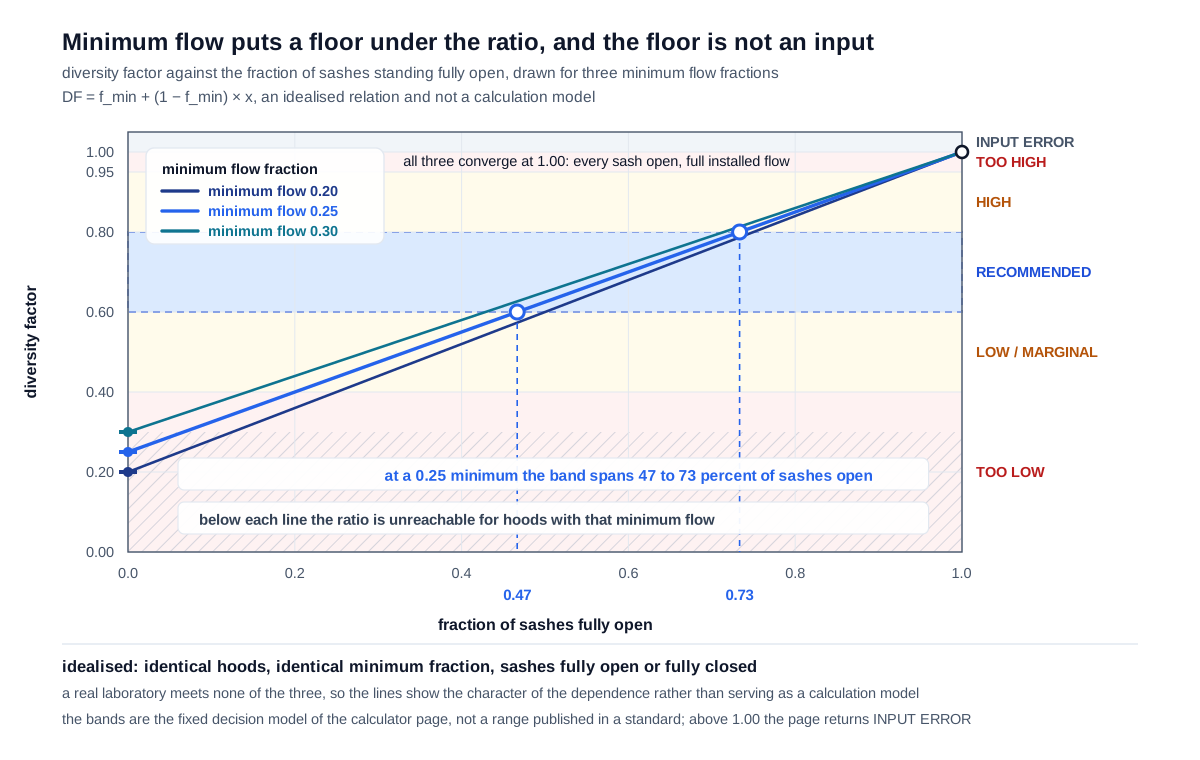
A real laboratory meets none of the three conditions the expression assumes. Sashes stand at intermediate positions rather than at either end of their travel. Hoods differ in width and in exhaust within the same installation. Minimum flows differ between hood models on the same manifold. The relation is therefore a way to understand the character of the dependence, and it is not a calculation model.
Per manufacturer data for variable volume fume hoods and ASHRAE Handbook, HVAC Applications: a variable exhaust hood holds a minimum flow with the sash closed, so the system flow cannot fall below the sum of those minima, which places a floor beneath the achievable diversity factor.
Sashes Are Not Switches
The two state picture used above is the convenient one. A sash occupies a continuum of positions, and that turns a stepped relation into a smooth one.
A hood controlled from sash position varies its exhaust roughly in proportion to the open area of the face, because the control holds the face velocity while the opening changes. Half an opening therefore corresponds, other things being equal, to roughly half the flow between the minimum and the full value.
What that does to the ratio is remove its steps. The diversity factor stops taking discrete values and becomes continuous. A value such as 0.72 across ten hoods, which had no meaning in the two state picture, becomes reachable, for instance with seven sashes fully open and one at half.
What sets the actual distribution is the work being done. A preparation step occupies a sash briefly. A reaction left running occupies one for its whole duration. Habits enter as well, since a sash left open with nothing behind it draws full flow exactly as a sash in use does.
Automatic sash closure is a design decision with a direct effect on the assumption. Devices that lower an unattended sash shift the actual distribution towards lower ratios and make it steadier over time. Their absence does the reverse.
The design diversity is therefore an assumption about collective behaviour, including both the sash positions and how long they are held. A survey of an existing laboratory gives that quantity directly, since the sashes can be observed over a working period. For a new building it is assumed from the intended use and the operating pattern.
Per ASHRAE Laboratory Design Guide and manufacturer control data: sash position control varies hood exhaust continuously between the minimum and the full value, so system diversity is a continuous quantity rather than a count of hoods in two states.
Constant Volume Hoods Change the Question
A hood with fixed exhaust draws the same airflow whether its sash is open or closed, which removes the mechanism diversity relies on.
The exhaust runs at an unchanging flow, and the face velocity varies inversely with the open area. A fully closed sash on such a hood gives the highest velocity through the remaining bypass openings and leakage paths, not the lowest flow. Nothing about the sash reaches the system.
The consequence for the ratio is direct. The system flow equals the sum of the exhausts of all operating hoods regardless of any sash position. If the hoods run continuously, which for laboratory exhaust is the ordinary case, the ratio is one. A ratio below one means that some hoods are assumed to be shut down.
Shutting a hood down is not always available. Materials stored inside a hood may require continuous removal of vapour. Shutting down and restarting creates a transient during which containment is not assured. Regulations and institutional requirements frequently call for continuous exhaust of hoods containing chemicals.
So for a constant volume installation a diversity factor materially below one requires its own justification, and that justification consists of naming which hoods are shut down and on what basis. The calculation does not see the difference. It takes two numbers and divides one by the other.
Refurbishment complicates this further, since laboratory upgrades frequently produce an installation in which some hoods have variable exhaust and others run at constant flow. The achievable range of the ratio is then set by the proportion of each type, and the constant volume group contributes its full exhaust to every operating case.
Per NFPA 45 and ASHRAE Handbook, HVAC Applications: constant volume hoods draw their rated exhaust whenever they operate, so a diversity factor materially below unity implies that hoods are shut down, which requires its own justification.
What Happens When More Sashes Open Than Assumed
The consequence of exceeding the design assumption is not a cost overrun, and that is what separates this application of diversity from the others.
The exhaust plant delivers a flow set by its characteristic and by the resistance of the system. When more sashes open than the design assumed, the total demand exceeds what is available, and the available flow divides among the hoods drawing on it. The flow at each one falls, and the face velocity falls with it.
The arithmetic is worth carrying through on a stated case: twenty five hoods at 1,000 CFM (0.47 m³/s) of full exhaust each, a minimum of 250 CFM (0.12 m³/s), and a design ratio of 0.72, which gives a design exhaust of 18,000 CFM (8.50 m³/s) against an installed total of 25,000 CFM (11.80 m³/s).
How many sashes that design flow holds fully open follows from one equation.
18,000 = N × 1,000 + (25 − N) × 250
11,750 = 750 N
N = 15.7 sashes
At fifteen sashes open the demand is 15,000 + 2,500 = 17,500 CFM (8.26 m³/s), which is inside what the plant delivers. At sixteen it is 16,000 + 2,250 = 18,250 CFM (8.61 m³/s), which exceeds the design flow by 250 CFM (0.12 m³/s), or 1.4 percent of the demand. The design point sits between the two, which is what a fractional answer to that equation means.
Beyond that the shortfall grows quickly.
| Sashes fully open | Demand | Shortfall against 18,000 CFM |
|---|---|---|
| 16 | 18,250 CFM (8.61 m³/s) | 250 CFM (0.12 m³/s), 1.4 percent |
| 20 | 21,250 CFM (10.03 m³/s) | 3,250 CFM (1.53 m³/s), 15.3 percent |
| 25 | 25,000 CFM (11.80 m³/s) | 7,000 CFM (3.30 m³/s), 28.0 percent |
If the available flow divides in proportion, the face velocity falls in the same proportion. A face velocity of 100 FPM (0.51 m/s) at the design condition becomes about 85 FPM (0.43 m/s) with twenty sashes open and 72 FPM (0.37 m/s) with all twenty five. The 100 FPM figure is taken here as a starting point for the illustration rather than as a criterion, since the setting and verification of face velocity is the subject of a separate calculation and a separate article.
Proportional division is itself an assumption, and it assumes every hood controller reaches the limit of its travel at the same moment. The actual distribution depends on where each hood sits relative to the plant and on the resistance of its branch, so hoods furthest from the plant lose more than the average and the worst affected one is worse than these figures.
Per ASHRAE Handbook, HVAC Applications, and manufacturer control data: when demand exceeds the capacity the system was built for, the available exhaust divides among the open hoods and face velocity falls in proportion, so the consequence of an optimistic diversity assumption is a loss of containment rather than a loss of efficiency.
Manifolded Systems and Individual Fans
Diversity exists only where several hoods share one system, so the arrangement of the exhaust decides whether the ratio has any meaning at all.
In a manifolded system several hoods connect to a common collection duct served by one plant, frequently built from several fans in parallel. Diversity applies, because the plant is sized on the collective demand rather than on the sum of the connected hoods, and the ratio is the statement of that sizing.
In an arrangement of individual fans each hood is served by its own fan. Diversity does not apply. Each fan is sized for its own hood, and the total installed capacity equals the sum whatever the pattern of use. Entering the two numbers still returns a ratio, and the ratio still lands in a band, and neither means anything for that installation.
What the manifolded arrangement buys is a smaller total plant capacity through diversity, the opportunity to dilute the exhaust stream before discharge, fewer discharge points on the roof, and redundancy, since the loss of one fan among several does not stop the system.
What it costs is the mixing of streams from different hoods in a common duct, which requires the compatibility of the materials handled to be assessed rather than assumed. It also makes every hood dependent on one plant, and it requires a control system capable of holding the flow at each hood while the number in use changes.
The ratio therefore describes a manifolded system. For an installation of individual fans the quantity has no application, and the calculation does not ask which arrangement is in front of it.
Per ASHRAE Laboratory Design Guide and NFPA 45: diversity applies to manifolded exhaust serving several hoods from common plant, and an arrangement of individual fans has no diversity to apply.
The Control System Sees Pressure, Not Sashes
The system does not know how many sashes are open. It knows what the pressure in the manifold is doing, and the difference matters as the capacity limit is approached.
Each hood has a controller that holds the exhaust flow corresponding to its sash position, working against a valve in its branch. The central plant holds a static pressure in the collection duct, increasing its output when that pressure falls. Neither element counts hoods.
As additional sashes open, the total draw increases, the manifold pressure falls, and the plant increases output to restore it. That works until the plant reaches its limit. Past that point there is nothing left to increase, the pressure continues to fall, and the hood controllers reach the end of their travel with their valves fully open and their setpoints unmet.
Nothing about that sequence announces itself. A hood controller regulates to a flow setpoint, and where there is insufficient pressure it simply fails to reach it. An alarm on the failure to meet a setpoint exists if it has been provided, and providing it is a design decision. Without it, the fall in face velocity across the laboratory happens quietly.
What is provided in practice is a low flow alarm at each hood, an insufficient pressure alarm on the manifold, and an indication of the total plant loading against its limit. The last of the three is what makes the condition visible before it arrives rather than after.
The design ratio and the alarm provision answer two different questions. The ratio sets the number of open sashes at which the limit is reached. The alarms decide whether anyone finds out that it has been.
Per manufacturer control data for laboratory exhaust systems: hood controllers regulate to a flow setpoint while the central plant regulates manifold pressure, so a shortfall appears as a controller failing to reach its setpoint rather than as an explicit system alarm unless one is provided.
The Emergency Case Has No Diversity
The scenario that most needs the exhaust to work is the one in which the assumption behind the ratio is least likely to hold.
A spill or an uncontrolled release prompts sashes to be opened for access to the incident, or closed to isolate it, and it does both at once in different parts of the building. Staff from neighbouring rooms may put hoods into use that normally stand idle.
Simultaneity is higher at that moment for a structural reason. An ordinary diversity assumption represents use distributed over time by people working independently. An event that affects several workers at once removes the independence, and the distribution that the assumption represents no longer exists.
What is provided against this is a mode in which the plant runs to full capacity regardless of sash positions, a standby fan started on demand, or separate systems serving rooms with elevated risk. Each of those is a decision taken alongside the ratio rather than derived from it.
The emergency case does not enter the ratio, and the page says as much in stating that operating modes outside the adopted design basis are not represented in the result.
It does change what ratio is defensible. A plant able to reach full capacity on demand tolerates a lower design ratio in normal operation, because the reserve exists and can be called. A plant without that capability needs a more conservative value, because the design flow is all there will ever be. The calculation does not see this difference.
Per NFPA 45 and ANSI/ASSP Z9.5-2022: an incident that prompts simultaneous use of hoods across a laboratory suspends the distribution of use that a diversity assumption represents, and provision for a full capacity mode is a design decision taken alongside the assumed ratio.
Unoccupied Setback Is a Different Ratio
The exhaust a laboratory draws at night is governed by a different quantity from the one the system was sized on, and confusing the two misstates both the plant and the energy.
In the unoccupied condition sashes are down, the hoods hold their minimum flow, and the total draw approaches the sum of those minima. The ratio at that moment equals the minimum flow fraction, and it does not depend on the design simultaneity at all. Twenty five hoods at a 250 CFM (0.12 m³/s) minimum draw 6,250 CFM (2.95 m³/s), which is 0.25 of an installed 25,000 CFM (11.80 m³/s), and that 0.25 is the minimum fraction and nothing else.
The two ratios answer different questions. A design ratio of 0.72 describes the peak condition and sets the size of the plant. A night ratio of 0.25 describes a sustained condition and sets the annual energy.
Annual consumption follows from the fraction of hours spent in each condition rather than from the peak. A laboratory on an eight hour working day spends two thirds of its hours unoccupied before weekends are counted, so that condition dominates the yearly figure though it never appears in the plant sizing.
What lowers that figure is automatic sash closure, a reduced minimum flow setpoint in the unoccupied condition where the requirements on the hood contents permit it, and a reduced room air change rate while the hood flows are maintained. The first of those also improves the credibility of the peak assumption.
Per ASHRAE Laboratory Design Guide: the exhaust drawn during unoccupied periods approaches the sum of the hood minimum flows and is a separate quantity from the peak diversity that sizes the plant, with the first governing annual energy and the second governing capacity.
Worked Example: 0.72 Across Twenty Hoods
The scenario matches the Imperial example on the calculator page.
Given. Total installed hood exhaust 20,000 CFM (9.44 m³/s). Diversified design exhaust 14,400 CFM (6.80 m³/s). The installation is twenty hoods of 1,000 CFM (0.47 m³/s) each, all with variable exhaust and a minimum of 250 CFM (0.12 m³/s).
Step 1. The ratio.
DF = 14,400 / 20,000 = 0.72
Step 2. The classification. 0.72 falls inside 0.60 to 0.80, so the result is RECOMMENDED. The band is the fixed decision model of the calculator rather than a range taken from a standard, and the page states this alongside the result.
Step 3. What that corresponds to in hoods. In the two state picture, 0.72 across twenty hoods is 14.4 hoods. The reachable values at twenty hoods step by 0.05, so the nearest are 0.70 and 0.75. The design ratio lies between two reachable states, which says that the two state picture is the wrong one here rather than that the ratio is wrong.
Step 4. What the minimum flow changes. At a minimum fraction of 0.25 the fraction of sashes fully open that gives 0.72 is
x = (0.72 − 0.25) / (1 − 0.25) = 0.627
which across twenty hoods is 12.5 fully open sashes, or any equivalent combination of intermediate positions.
Step 5. The system limit. The same 14,400 CFM (6.80 m³/s) holds
14,400 = N × 1,000 + (20 − N) × 250
9,400 = 750 N
N = 12.5 sashes
fully open. At twelve the demand is 12,000 + 2,000 = 14,000 CFM (6.61 m³/s), inside what the plant delivers. At thirteen it is 13,000 + 1,750 = 14,750 CFM (6.96 m³/s), which exceeds the design flow by 350 CFM (0.17 m³/s), or 2.4 percent. That 12.5 is the same number Step 4 produced from a different direction, which is the check that the two readings of the ratio agree.
Step 6. Further exceedance. At sixteen sashes open the demand is 16,000 + 1,000 = 17,000 CFM (8.02 m³/s), a shortfall of 2,600 CFM (1.23 m³/s) or 15.3 percent. At all twenty it is 20,000 CFM (9.44 m³/s), a shortfall of 5,600 CFM (2.64 m³/s) or 28.0 percent.
Step 7. What that does to face velocity. On proportional division, a face velocity of 100 FPM (0.51 m/s) at the design condition falls to about 85 FPM (0.43 m/s) at sixteen sashes open and 72 FPM (0.37 m/s) at twenty. The starting figure is an illustration rather than a criterion.
Step 8. What a different hood count would change. Ten hoods of 2,000 CFM (0.94 m³/s) each give the same installed total and the same design flow, and the same 0.72. The reachable values then step by 0.10, so the recommended band contains three of them instead of five.
Step 9. What the check does not cover. The hood control strategy. The size of the minimum flow. Whether an alarm exists on a controller failing to reach its setpoint. The emergency case. None of the four is an input.
Step 10. What to do with the result. Establish the number of open sashes at which the limit is reached, which for this installation is between twelve and thirteen out of twenty, and set that against the expected pattern of work. Confirm that an alarm exists to report the limit being reached. Establish whether the plant can be driven to full capacity on demand, since that is what makes 0.72 defensible rather than optimistic.
Metric Example and the Sash Fraction Behind the Band
The scenario matches the Metric example on the calculator page.
Given. Total installed hood exhaust 9.4 m³/s (19,917 CFM). Diversified design exhaust 6.8 m³/s (14,408 CFM).
DF = 6.8 / 9.4 = 0.7234
which falls inside 0.60 to 0.80, so the result is RECOMMENDED.
The Imperial example returns 0.72 and this one returns 0.7234, and the difference comes from the rounding of the entered quantities rather than from the calculation. 9.4 m³/s is 19,917 CFM against the Imperial 20,000, and 6.8 m³/s is 14,408 CFM against 14,400. The ratio is dimensionless and the unit system does not touch it, so the same pair of physical airflows returns the same number in either mode.
Behind the band lies a fraction of sashes open, and that fraction depends on the hoods. At a minimum flow fraction of 0.25 the edges of the recommended band correspond to
DF = 0.60 → x = (0.60 − 0.25) / 0.75 = 0.467
DF = 0.72 → x = 0.627
DF = 0.80 → x = (0.80 − 0.25) / 0.75 = 0.733
so the recommended band spans forty seven to seventy three percent of sashes standing open. Change the hoods and that span moves.
| Minimum flow fraction | Sash fraction at DF 0.60 | Sash fraction at DF 0.80 |
|---|---|---|
| 0.20 | 0.50 | 0.75 |
| 0.25 | 0.47 | 0.73 |
| 0.30 | 0.43 | 0.71 |
The higher the minimum flow, the smaller the fraction of open sashes that produces the same ratio. Taken far enough the effect removes bands entirely. At a minimum fraction of 0.45 the ratio never falls below 0.45 and TOO LOW becomes unreachable. At 0.60 the LOW / MARGINAL band goes as well, and the lower edge of RECOMMENDED coincides with every sash closed.
What follows is that the class a design ratio falls into depends not only on the assumed simultaneity but on the properties of the hoods installed. The calculation does not ask about the latter.
Per manufacturer data for variable volume fume hoods: the fraction of sashes open that corresponds to a given diversity factor depends on the minimum flow the hoods hold when closed, so the same ratio describes different operating states in installations with different hoods.
Application Boundaries: Control, Occupancy, Verification
The scope of the calculation is the expression of an adopted design assumption as a dimensionless ratio, and the comparison of that ratio against the band the page states as its own. The following each require separate treatment.
Adopting the assumption. The calculation expresses a decision the designer has already taken, and it provides no basis for taking it. That basis comes from a survey of comparable operation or from a stated description of the intended use.
Hood control strategy. It sets the range the ratio can occupy, and it is not among the fields.
Minimum flow. It places a lower limit on the ratio for hoods with variable exhaust, and it differs between hood models within one installation.
Sash positions. Intermediate positions make the ratio a continuous quantity, where the simplest reading of it assumes two states.
Number of hoods. It sets the resolution with which the ratio can be reached, and for small installations that resolution is coarse enough to govern the outcome.
Exhaust arrangement. Diversity applies to a manifolded system and does not apply to an arrangement of individual fans.
Alarm provision. Reaching the capacity limit appears as controllers failing to meet their setpoints, so detecting it requires an alarm to have been provided.
The emergency case. It does not enter the ratio unless it has been built into the adopted design basis.
The unoccupied condition. It governs annual energy and is a separate quantity from the peak ratio.
The classification bands. They are adopted within the calculation and are not taken from a normative document.
Per the calculator's stated scope, ANSI/ASSP Z9.5-2022 and ASHRAE Handbook, HVAC Applications: expressing a design assumption as a ratio and screening it against a stated band is the scope of this model, while the basis for that assumption, hood control strategy, minimum flow, exhaust arrangement, alarm provision and the emergency case each require separate treatment.
Laboratory Fume Hood Diversity Factor Calculator
Fume hood diversity by ratio: it divides the diversified design exhaust by the total installed hood exhaust and places the result in a band the page states as its own rather than as one drawn from a standard. Both inputs are quantities the designer already holds, so the value lies in what the ratio is read against. The range it can occupy is bounded from below by the minimum flow the hoods hold with their sashes closed, which is not among the inputs. A screening check on a design assumption, not the basis for making it.
Open Laboratory Fume Hood Diversity Factor CalculatorStandards and References
- ANSI/ASSP Z9.5-2022, Laboratory Ventilation (American National Standards Institute and American Society of Safety Professionals, 2022). The current edition, approved in March 2022. Requirements for laboratory ventilation systems, hoods and other exposure control devices, ventilation management, commissioning and performance testing.
- ASHRAE Handbook, HVAC Applications (American Society of Heating, Refrigerating and Air-Conditioning Engineers, 2023), chapter on laboratories. Design of laboratory exhaust systems, the factors bearing on simultaneity, and the behaviour of manifolded systems.
- ASHRAE Laboratory Design Guide: Planning and Operation of Laboratory HVAC Systems, 2nd edition (ASHRAE, 2015). Planning, design, operation and control strategy for laboratory systems, including sash management and unoccupied operation.
- NFPA 45, Standard on Fire Protection for Laboratories Using Chemicals (National Fire Protection Association, 2024 edition). Requirements for laboratory exhaust systems and chemical fume hoods, including continuity of operation.
- ANSI/ASHRAE Standard 110-2016 (RA 2025), Methods of Testing Performance of Laboratory Fume Hoods (reaffirmed 2025). The containment test that gives the basis for judging what a reduction in hood flow does.
- Manufacturer data for laboratory fume hoods (current published editions). Minimum flows, turndown ranges, behaviour with the sash closed and automatic sash closure devices, which is what the 0.20 to 0.30 minimum fractions in this article stand in for.
- Manufacturer data for laboratory exhaust control systems (current published editions). Hood flow control and manifold pressure control logic, response times, and alarms on the failure of a controller to reach its setpoint.
- Manufacturer data for manifolded laboratory exhaust plant (current published editions). Turndown range, behaviour at the capacity limit, standby fan arrangements and elevated capacity modes.
FAQ
What does the diversity factor actually represent?
Per the calculator's stated model: the fraction of the total installed hood exhaust that the central system is designed to handle. Both quantities are decisions or sums the designer already holds, so the calculation states an assumption rather than producing one.
Can the ratio be read as a fraction of hoods in use?
Per ASHRAE Handbook, HVAC Applications: only under assumptions a laboratory does not meet. It requires hoods of equal exhaust, sashes either fully open or fully closed, and no flow at a closed hood. The last of these fails for variable volume hoods, which hold a minimum flow when closed. The number of hoods also sets the resolution: at six hoods the step between reachable ratios is 0.167, and the recommended band contains exactly one of them.
Why can the diversity factor not fall below a certain value?
Per manufacturer data for variable volume hoods: because a closed hood still draws its minimum flow. The system total cannot fall below the sum of those minima, so the ratio has a floor at the minimum fraction. Where that fraction is high enough the lower classification bands become unreachable, at 0.45 for TOO LOW and at 0.60 for LOW / MARGINAL.
What happens if more sashes open than the design assumed?
Per ASHRAE Handbook, HVAC Applications: the plant cannot deliver more than it was built for, the available exhaust divides among the open hoods, and face velocity falls in proportion. For a system at 0.72 across twenty hoods of 1,000 CFM (0.47 m³/s) with a 250 CFM (0.12 m³/s) minimum, twenty sashes open exceeds the design flow by 28 percent, which takes a starting 100 FPM (0.51 m/s) face velocity down to about 72 FPM (0.37 m/s).
Does diversity apply to constant volume hoods?
Per NFPA 45 and laboratory practice: not in the same way. A constant volume hood draws its rated exhaust whenever it runs, so a ratio materially below unity implies hoods are shut down, and that requires justification given the requirements for continuous exhaust of hoods holding chemicals. It also has no application at all to an installation where each hood has its own fan, since there is no shared plant to size.
Where does the 0.60 to 0.80 band come from?
Per the calculator's own statement: it is the fixed decision model the page applies, not a range published in a standard. The standards cited alongside it, ANSI/ASSP Z9.5-2022, the ASHRAE Handbook and NFPA 45, give context for laboratory exhaust design rather than these thresholds.
Does a recommended result mean the design is adequate?
Per the calculator's stated scope: no. The ratio expresses an assumption without testing it. Whether the assumption holds depends on hood control strategy, minimum flows, the number of hoods, the exhaust arrangement, the provision of alarms, and the emergency case, none of which are inputs.
Related Calculators
- Fume Hood Face Velocity Calculator: the velocity at the face of a single hood, which is the quantity that falls when the available flow divides among more hoods than the design assumed.
- Cleanroom Air Change Rate Calculator: the adjacent problem of setting a room airflow from a requirement placed on the space rather than from a load.
- Hospital Operating Room Airflow Calculator: another case in which the airflow follows from a protection requirement rather than from a thermal balance.
- Ventilation Rate Calculator: the outdoor air rate for a space, which sits alongside the hood exhaust and has to make it up.
- Fan Power Calculator: the power drawn by the exhaust plant at the flow the diversity assumption produces, which is where a change in the ratio shows up as energy.
- Duct Size Calculator: sizing the collection duct of a manifolded system for the diversified flow rather than the installed sum.
- Duct Velocity Calculator: the velocity in that collection duct as the number of hoods in use changes.
- Air Changes Per Hour Calculator: the room air change rate of the laboratory, set separately from the hood exhaust and frequently the quantity that governs with the sashes down.