Capacitor Bank Calculator
On this page
Calculate
Enter the real power (active power) in kilowatts
Enter the initial power factor as a decimal (0.01 to 0.9999)
Enter the target power factor as a decimal (0.01 to 0.9999)
Overview
The Capacitor Bank Calculator estimates the capacitor bank size required for power factor correction using a fixed screening model based on real power, starting power factor, and target power factor. The result is the calculated reactive compensation in kilovolt-amperes reactive (kVAR) needed to move a load from its starting power factor to the target power factor. Alongside the kVAR result, the calculator reports the compensation level — reactive compensation as a percentage of real power.
This calculator is designed for preliminary reactive-power compensation review. It uses a transparent fixed model based on standard power-triangle geometry, where the required capacitor-bank size increases when real power is higher, the starting power factor is lower, or the correction target is more aggressive. The model does not calculate switching transients, harmonic resonance, detuned reactor sizing, filter tuning, or full power-quality analysis.
The result should be treated as a calculated capacitor-bank size estimate. For a real project, final application review should also consider harmonic content, system voltage, switching step size, and load variation. Installing capacitor banks can also shift system resonant frequencies, so the final design should be checked against power-quality and harmonic conditions. IEC 61921:2017 applies to low-voltage AC shunt capacitor banks intended for power factor correction purposes.
This calculator provides a practical starting point for reactive-power compensation review and early evaluation before detailed capacitor-bank application engineering. The fixed decision model is intentionally transparent: every result is directly traceable to the entered real power and the starting and target power factors.
How to Use This Calculator
Enter the real power — the active power basis in kilowatts used for the correction estimate.
Enter the starting power factor — the initial power factor of the load as a decimal (greater than 0 and less than 1.0).
Enter the target power factor — the desired power factor after correction as a decimal (greater than 0 and less than 1.0, and greater than the starting power factor).
Click “Calculate” — get the required capacitor bank size in kVAR.
Review the result — review the kVAR against standard bank and step sizes, and the compensation level against the correction strategy.
Use the result to support preliminary power-factor correction review. Final capacitor-bank application design should be verified against equipment ratings, harmonic conditions, switching requirements, and project-specific design requirements.
Inputs & Outputs
Inputs
Outputs
Formula
Calculator Formula
This calculator estimates capacitor bank size using a fixed screening model based on real power and the starting and target power factors.
Capacitor Bank Size (kVAR) = P × (tan φ1 − tan φ2)
Where:
- P = real power in kW
- φ1 = arccos(starting power factor)
- φ2 = arccos(target power factor)
Step-by-Step Calculation
Step 1: Determine the initial phase angle
φ1 = arccos(PF_initial)
Step 2: Determine the target phase angle
φ2 = arccos(PF_target)
Step 3: Convert each phase angle to tangent form
tan φ1 = tangent of the initial phase angle
tan φ2 = tangent of the target phase angle
Step 4: Calculate required compensation
Qc = P × (tan φ1 − tan φ2)
Variables
| Variable | Meaning | Units |
|---|---|---|
| P | Real power | kW |
| PF_initial | Starting power factor | — |
| PF_target | Target power factor | — |
| Qc | Required capacitor bank size | kVAR |
Formula Meaning
This is a transparent, fixed-model calculator based on standard power-triangle geometry. Capacitor bank size increases directly as:
- Real power increases (larger load)
- Starting power factor decreases (more reactive power draw from the source)
- Target power factor increases (more aggressive correction)
Capacitor bank size decreases directly as:
- Real power decreases (smaller load)
- Starting power factor is closer to the target (less correction needed)
- Target power factor is lower (less aggressive correction)
The model is intentionally simple and transparent so the result responds directly to the same inputs that determine capacitor-bank size. It does not calculate switching transients, harmonic resonance, detuned reactor sizing, filter tuning, or inrush current.
What is a Capacitor Bank
A capacitor bank is a group of capacitors connected together to supply reactive power to an electrical system and improve power factor. In a practical AC power system, many loads such as motors, transformers, and fluorescent lighting draw both real power (kilowatts) and reactive power (kilovolt-amperes reactive). Reactive power does not perform useful work at the load but must be supplied through the distribution system, which increases conductor loading, transformer losses, and utility demand charges.
Capacitor banks counteract lagging reactive power by supplying leading reactive power locally. When a capacitor bank is sized correctly, the reactive power drawn from the utility or distribution source decreases, and the power factor improves. A higher power factor means the same real power can be delivered using less apparent current, which reduces losses and can help avoid utility power-factor penalties.
In this calculator, the required capacitor bank size is estimated using standard power-triangle geometry. The formula calculates how much reactive compensation must be added to reduce the reactive component from its starting level to the target level, based entirely on real power and the two power-factor values. The model is intentionally transparent and directly traceable to the entered inputs.
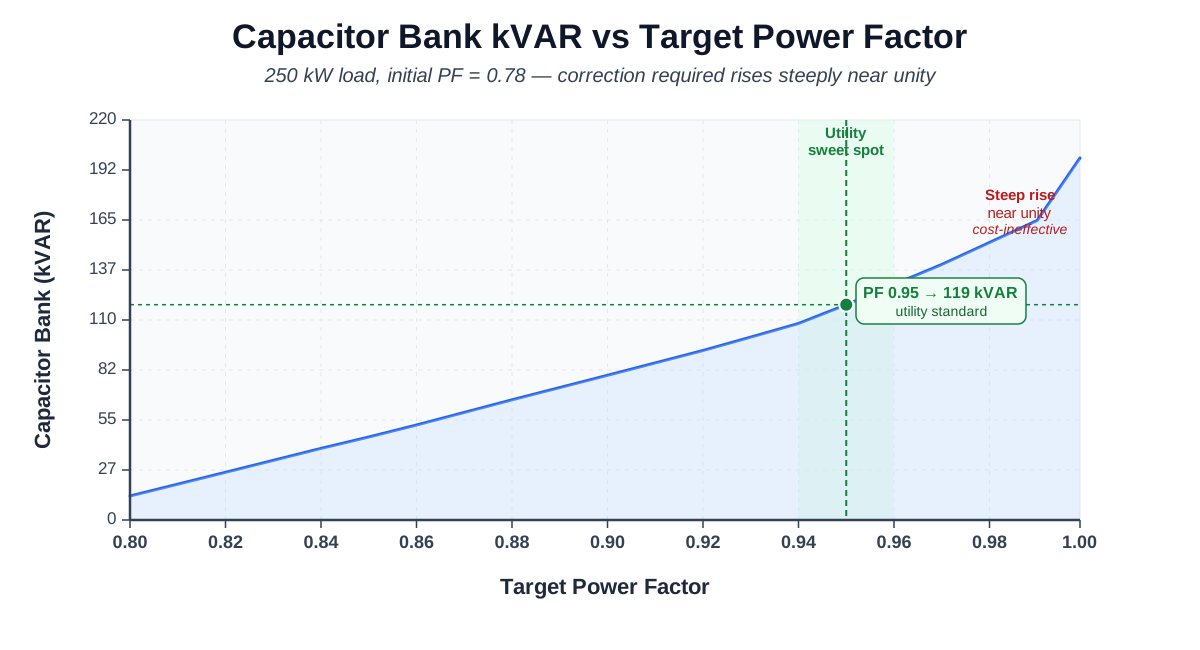
The compensation level — reactive compensation expressed as a percentage of real power — is reported alongside the kVAR result. This relative metric is meaningful regardless of system size and gives engineers a practical starting point for reactive-compensation screening before detailed capacitor-bank application engineering.
Key Facts
- Capacitor bank size increases as real power increases — a larger load requires more reactive compensation to achieve the same power-factor improvement.
- A lower starting power factor means the load draws more reactive power from the source, which increases the required capacitor-bank kVAR.
- Bringing the operating point closer to unity power factor requires more kVAR because the allowable reactive power from the source decreases as the target approaches 1.0.
- Capacitor banks reduce reactive current drawn from the source, which can reduce conductor loading, transformer losses, and utility demand charges.
- Installing capacitor banks can shift system resonant frequencies and may amplify harmonic voltages if harmonic sources are present — detuned reactors are sometimes used to address this risk.
- IEC 61921:2017 covers low-voltage AC shunt capacitor banks intended for power factor correction purposes.
Applications
- Preliminary power-factor correction review for industrial and commercial loads.
- Low-voltage capacitor-bank sizing screening before detailed application engineering.
- Industrial reactive-power compensation planning.
- Checking the compensation level relative to load size before detailed design.
- Comparing different target power-factor assumptions to evaluate correction strategy.
- Early review of whether a correction approach appears reasonable before detailed design.
- Supporting pre-design decisions where a quick reactive-compensation estimate is needed.
Example Calculation
Example Calculation
Given:
- Real Power = 250 kW
- Starting Power Factor = 0.78
- Target Power Factor = 0.95
Step 1: Determine the phase-angle tangents
tan(arccos 0.78) = 0.8023
tan(arccos 0.95) = 0.3287
Step 2: Calculate required capacitor-bank size
Qc = 250 × (0.8023 − 0.3287)
Qc = 250 × 0.4736
Qc = 118.40 kVAR
Result: 118.40 kVAR
This is a practical capacitor-bank size — compare it against standard bank ratings and step sizes for the intended switching scheme. The recommended next step is to compare this result with the intended correction target and verify the real power and power-factor assumptions.
Effect of More Aggressive Target
Given:
- Real Power = 250 kW
- Starting Power Factor = 0.78
- Target Power Factor = 0.99
Step 1: Determine the phase-angle tangents
tan(arccos 0.78) = 0.8023
tan(arccos 0.99) = 0.1425
Step 2: Calculate required capacitor-bank size
Qc = 250 × (0.8023 − 0.1425)
Qc = 250 × 0.6598
Qc = 164.95 kVAR
Result: 164.95 kVAR
This shows how a more aggressive target power factor significantly increases the required capacitor-bank size — from 118.40 kVAR at a 0.95 target to 164.95 kVAR at a 0.99 target, even with the same load.
Standards & References
- IEEE C37.99 — guide for protection of shunt power capacitor banks and filter capacitor banks
- IEEE 18 — shunt power capacitors context
- IEEE 1036 — application of shunt power capacitors
- IEC 60831-1 — low-voltage self-healing shunt power capacitors, including performance, testing, rating, safety, and installation/operation guidance
- IEC 60831-2 — ageing, self-healing, and destruction test requirements for capacitors covered by IEC 60831-1
- IEC 61921:2017 — low-voltage AC shunt capacitor banks intended for power factor correction purposes
- IEC 61439-1 and IEC 61439-2 — applicable where low-voltage power factor correction banks comply with switchgear and controlgear assembly standards
- Manufacturer capacitor-bank ratings and application guidance — the authoritative basis for final bank, step, and detuning selection.
Limitations
- This is a preliminary capacitor-bank calculator, not a full power-quality or switching study.
- It uses a fixed calculator-specific power-factor-correction model based on power-triangle geometry.
- It does not calculate: switching transients, harmonic resonance, detuned reactor sizing, filter tuning, inrush current, step-controller optimization, utility tariff structure, voltage-rise effects, relay coordination, or lifecycle or cost analysis.
- The model assumes steady-state load and steady-state power-factor conditions.
- The model assumes sinusoidal current and voltage — harmonic distortion may require detuned reactors and can change the correct capacitor-bank application.
- Real capacitor-bank design may differ if load variation, voltage fluctuation, harmonics, or staged switching requirements are significant.
- It does not replace detailed capacitor-bank design review, harmonic studies, or manufacturer application data.
Common Mistakes to Avoid
- Entering power factor as a percentage (e.g. 78) instead of a decimal (e.g. 0.78).
- Setting the target power factor unrealistically close to 1.00 without reviewing practical limits — utilities often target 0.95 rather than unity.
- Ignoring load variation when choosing a fixed capacitor bank — a widely varying load profile may need staged switching steps.
- Assuming the calculated kVAR automatically resolves harmonic issues — harmonics require separate analysis and may require detuned reactors.
- Ignoring switching-step requirements for stepped or automatic capacitor banks.
- Confusing reactive compensation with reduced real-energy consumption — power factor correction reduces reactive current but does not reduce kilowatt-hour consumption.
- Applying a single steady-state result to a widely varying load profile without reviewing whether a fixed bank is appropriate.
- Assuming this calculator alone finalizes capacitor-bank design — final design requires equipment ratings, switching method, harmonic review, and application-specific engineering.
Frequently Asked Questions
What does this calculator estimate?
Why does starting power factor matter?
Why does a higher target power factor need more kVAR?
Why do utilities target 0.95 instead of 1.0?
Where do I get the kW and power factor inputs?
Does this calculator include harmonic filtering?
What is a detuned capacitor bank?
Is this enough to finalize a real capacitor-bank application?
Frequently Used Together
Engineers often use these calculators in combination for complete project workflows:
Related Calculators
Explore similar calculators that might be useful for your project:
Electrical Quick Reference — Keep It Open During Design
8 NEC formulas for voltage drop, ampacity, motor current, and CT burden. One sheet, every project.
- Voltage drop by NEC method — single-phase and 3-phase
- Ampacity with temperature & grouping derating (NEC 310.15)
- %VD limits by circuit type: branch, feeder, sensitive loads
No spam. Unsubscribe any time.
Calculate
Enter the real power (active power) in kilowatts
Enter the initial power factor as a decimal (0.01 to 0.9999)
Enter the target power factor as a decimal (0.01 to 0.9999)