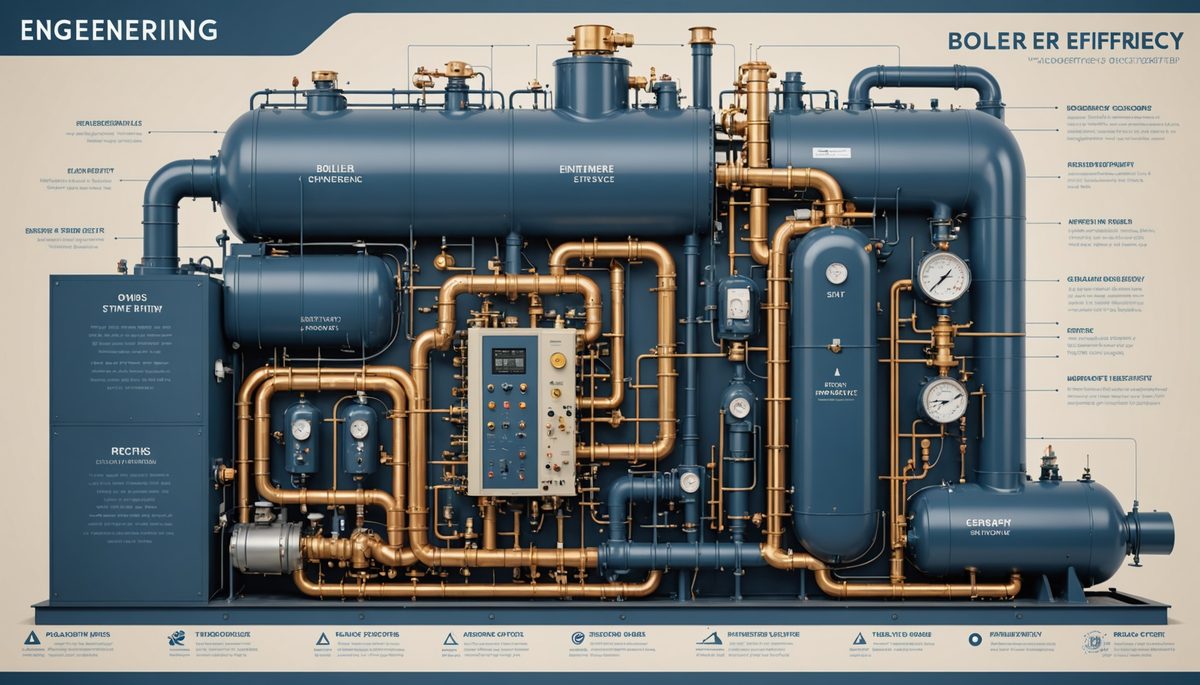
Boiler efficiency calculation errors directly impact operational costs and system reliability. When engineers skip proper efficiency analysis, they risk oversizing equipment by 15–20%, paying for boiler capacity, ancillary heating loops, and combustion air infrastructure that the building never uses. Incorrect efficiency assumptions cause underperformance in heating systems, resulting in temperature deficiencies during peak winter conditions and occupant complaints. ASME PTC 4-2013 (Performance Test Code for Fired Steam Generators) defines two methods for measuring boiler efficiency: the Input-Output method (η = Q_useful / Q_fuel) and the Heat-Loss method (η = 100% − Σlosses). This article focuses on the Input-Output method, the most common screening calculation for commercial heating boilers.
Efficiency degradation from 85% to 75% increases fuel input by 13.3% for the same heat output (85/75 = 1.133). The annual cost depends on operating hours and fuel price; a commercial boiler running 2,000 heating hours per year at typical commercial natural gas rates sees several thousand dollars in additional fuel cost from a 10-percentage-point efficiency drop. Without ongoing efficiency tracking, maintenance teams cannot detect heat-exchanger fouling, combustion air drift, or worn burners until performance has degraded significantly — corrective service is materially cheaper than the boiler replacement that follows extended neglect.
Why Direct Efficiency Differs from AFUE and Combustion Efficiency
Boiler Direct efficiency is the percentage of input fuel energy converted to useful heat output:
η = (Q_out / Q_in) × 100
Direct efficiency reflects steady-state performance at one operating point, distinct from seasonal metrics like AFUE. The ASHRAE Fundamentals Handbook, Chapter 32, establishes boiler efficiency as a critical performance parameter for heating system design, requiring engineers to verify that equipment meets specified efficiency targets during commissioning and operation.
Engineers need accurate boiler efficiency calculations to validate system performance against design specifications and identify operational issues before they escalate. A 5% efficiency drop typically indicates fouled heat exchangers, improper combustion air ratios, or excessive cycling losses that require immediate attention. The calculation provides quantitative data for maintenance scheduling, fuel consumption forecasting, and equipment replacement decisions.
Proper efficiency analysis also supports compliance with energy codes that reference ASHRAE Standard 90.1 requirements for commercial boiler efficiency. These standards establish minimum efficiency thresholds based on equipment type and size, with non-compliance potentially triggering permit issues and failed inspections. The direct efficiency calculation serves as the foundation for more complex analyses, including annual energy consumption projections and carbon footprint assessments for sustainability reporting.
The Input-Output Method per ASME PTC 4
Boiler Efficiency (%) = (Useful Heat Output / Fuel Energy Input) × 100
The formula variables represent specific physical quantities with defined units and typical ranges in real projects. Q_out (heatOutput) is the thermal energy delivered to the heating distribution system, measured in kW (metric) or BTU/hr (imperial), excluding losses through flue gases, radiation, and blowdown. In commercial applications, this typically ranges from 100–5,000 kW (341,000–17,000,000 BTU/hr), while residential systems operate in the 15–50 kW (51,000–170,000 BTU/hr) range.
Q_in (fuelInput) represents the total fuel energy supplied to the boiler, measured in the same units as heat output. This includes the chemical energy content of natural gas, oil, or other fuels converted to equivalent thermal input rates. Q_in is the energy baseline for the efficiency ratio, with typical values ranging from 120–6,000 kW (410,000–20,500,000 BTU/hr) for commercial boilers.
The multiplication by 100 converts the decimal efficiency ratio to a percentage. The resulting efficiency value falls between 0% and 100%, with modern condensing boilers achieving 90–95% efficiency under optimal conditions while older non-condensing units typically operate at 75–85%.
Energy loss represents the complement of efficiency, calculated as 100% minus the efficiency percentage. This value quantifies the portion of input energy not converted to useful heat, including stack losses (typically 10–20%), radiation losses (1–3%), and blowdown losses (1–5%). Understanding both efficiency and loss percentages helps engineers identify specific improvement opportunities, such as reducing flue gas temperatures or optimizing boiler cycling patterns to minimize standby losses.
Direct Efficiency vs Other Boiler Efficiency Metrics
The Input-Output (Direct) efficiency in this calculator is one of several boiler performance metrics. Engineers must not interchange them:
- Direct (Input-Output) Efficiency, ASME PTC 4 §5.4.1. η = Q_useful / Q_fuel. Snapshot at one operating point. Used by this calculator.
- Heat-Loss (Indirect) Efficiency, ASME PTC 4 §5.4.2. η = 100% − Σlosses (stack + radiation + blowdown + unburned fuel + miscellaneous). Lower uncertainty than Direct method when component-level instrumentation exists.
- Combustion Efficiency. Only stack losses subtracted from 100%. Excludes radiation and blowdown. Always 2–5 percentage points higher than Direct or Heat-Loss efficiency. Reported by combustion analyzers.
- Thermal Efficiency, ASHRAE 90.1 §6.4.1.1 commercial boiler minimums. Tested at full-fire, steady-state, no cycling. Used for code compliance and equipment specification. Close to Direct efficiency at design conditions.
- AFUE, DOE 10 CFR 430 Subpart B Appendix N. Annual seasonal average for residential boilers and furnaces below 300,000 BTU/hr only. Not applicable to commercial equipment. AFUE is typically 5–15 percentage points lower than steady-state Direct efficiency because it includes cycling, jacket, and infiltration penalties over the full heating season.
When a manufacturer publishes 95% efficiency, verify which metric — combustion vs thermal vs AFUE — to compare against the calculator result correctly.
1,200 kW Office Boiler: 82.8% Direct Efficiency
A 50,000 square foot office building in Chicago requires heating system evaluation during winter operation. The boiler supplies hot water to fin-tube radiation throughout the building, with measured conditions showing stable operation. Field measurements indicate the boiler delivers 1,200 kW of useful heat to the distribution system while consuming natural gas equivalent to 1,450 kW of input energy.
Metric Calculation:
Useful Heat Output (Q_out) = 1,200 kW
Fuel Energy Input (Q_in) = 1,450 kW
Boiler Efficiency = (1,200 / 1,450) × 100 = 82.76%
Energy Loss = 100 - 82.76 = 17.24%
Imperial Equivalent:
Useful Heat Output = 4,094,000 BTU/hr
Fuel Energy Input = 4,947,000 BTU/hr
Boiler Efficiency = (4,094,000 / 4,947,000) × 100 = 82.76%
Energy Loss = 17.24%
Practical takeaway: 82.76% Direct efficiency for non-condensing commercial equipment is on the low end of acceptable. The 250 kW (853,000 BTU/hr) heat loss runs through the stack, jacket, and blowdown — the breakdown is unknown without indirect-method analysis or combustion testing. Next steps: (1) run combustion analysis to measure stack temperature, O₂ percentage, and CO; expected stack loss ~15–18% for non-condensing at design fire — if measured stack loss approaches the full 17.24% calculated loss, the combustion side is the dominant problem and tuning may recover 1–2 percentage points; (2) inspect heat-exchanger fireside surfaces for soot or scale (each 1/8 inch of soot reduces efficiency by ~5%); (3) compare lifecycle replacement with a condensing boiler against retained capital — at 92% efficiency a condensing replacement saves ~10 percentage points on heating fuel and typically pays back through fuel savings over the life of the equipment in heating-dominated climates.
3,800 kW Hospital Steam Boiler: 86.4% Verified for Accreditation
A 300-bed hospital in Denver operates a steam boiler for sterilization equipment and space heating, with critical reliability requirements. During peak winter conditions, the boiler delivers 3,800 kW of useful steam energy while consuming fuel oil equivalent to 4,400 kW input. The hospital's engineering team needs to verify the boiler meets its 85% minimum efficiency specification for accreditation purposes.
Metric Calculation:
Useful Heat Output (Q_out) = 3,800 kW
Fuel Energy Input (Q_in) = 4,400 kW
Boiler Efficiency = (3,800 / 4,400) × 100 = 86.36%
Energy Loss = 100 - 86.36 = 13.64%
Imperial Equivalent:
Useful Heat Output = 12,968,000 BTU/hr
Fuel Energy Input = 15,016,000 BTU/hr
Boiler Efficiency = (12,968,000 / 15,016,000) × 100 = 86.36%
Energy Loss = 13.64%
Practical takeaway: 86.36% efficiency exceeds the 85% accreditation threshold. Document the compliance result in the accreditation file with measurement date, instrument calibration certificates, and operating conditions (load percentage, return temperature, ambient). For continuous improvement: 13.64% loss for a fuel-oil steam boiler is in the typical band — stack loss alone usually accounts for 12–15% in firetube steam boilers, plus 2–4% radiation/blowdown loss. If the boiler is 10+ years old, scheduled tube cleaning and combustion-chamber inspection per ASME CSD-1 maintenance practices typically recovers 1–2 percentage points without major capital. Schedule re-test after maintenance to verify recovery.
What Distorts Boiler Efficiency Measurement
Fuel Input Measurement Accuracy
Fuel input measurement errors of ±5% create efficiency calculation errors of ±4–5 percentage points, significantly impacting operational decisions. Natural gas meters with improper calibration or oil flow meters with viscosity sensitivity issues commonly cause these inaccuracies. When fuel input is overestimated by 5%, a boiler operating at 85% true efficiency appears to operate at only 81%, potentially triggering unnecessary maintenance or replacement considerations. Field verification using calibrated instrumentation and correction for temperature and pressure conditions ensures input measurements reflect actual energy content delivered to the boiler.
Proper fuel measurement requires accounting for heating value variations, with natural gas ranging from 950–1,050 BTU/ft³ depending on composition and season. Oil-fired systems must correct for temperature effects on volumetric flow measurements, as oil density decreases approximately 0.5% per 10°F temperature increase. These corrections prevent efficiency calculation errors that could mislead engineers about actual boiler performance and mask developing problems like burner deterioration or heat exchanger fouling.
HHV vs LHV Convention
US engineering practice (and ASME PTC 4) uses Higher Heating Value (HHV) — the gross heating value that includes the latent heat of water vapor formed during combustion. European practice and many international manufacturers use Lower Heating Value (LHV), which excludes that latent heat.
For natural gas, LHV is approximately 9% lower than HHV. A boiler reported at 95% LHV efficiency is approximately 86% HHV efficiency — the same physical equipment, different reporting basis. This 9-percentage-point gap matters: the calculator and ASME PTC 4 use HHV for fuel-input calculations, but European specifications often quote LHV-based efficiency.
When comparing manufacturer published efficiency to a calculated Direct efficiency, verify the basis. The conversion is approximately:
η_HHV = η_LHV × (LHV / HHV)
For natural gas: η_HHV ≈ η_LHV × 0.901
For #2 fuel oil: η_HHV ≈ η_LHV × 0.937
Failing to convert leads to apparent underperformance of imported equipment that is actually meeting specification, or apparent over-performance that hides real efficiency shortfalls.
Useful Heat Output Determination
Useful heat output measurement relies on accurate temperature and flow measurements in the boiler's distribution system. A 2°F error in ΔT measurement creates approximately 3–4% error in calculated heat output for typical 20–40°F temperature differentials. Flow measurement errors from improperly sized orifice plates or uncalibrated flow meters compound these temperature inaccuracies, potentially distorting efficiency calculations by 5–10 percentage points. These errors lead engineers to incorrect conclusions about boiler performance and inappropriate maintenance or replacement decisions.
Steam systems present additional challenges, requiring accurate measurement of steam flow, pressure, and enthalpy. Condensate return variations and flash steam losses must be accounted for in steam system heat output calculations. Liquid systems demand proper placement of temperature sensors to avoid stratification effects and ensure representative measurements. Regular calibration of all measurement devices according to manufacturer specifications and industry standards maintains calculation accuracy over time.
Operating Conditions and Load Factor
Boiler efficiency varies with load factor, with most units operating at peak efficiency between 60–80% of maximum continuous rating. At 30% load, efficiency typically drops 5–10 percentage points due to increased standby losses and reduced heat transfer effectiveness. Cycling operation further reduces effective efficiency, with frequent on-off cycling adding 3–8% to energy losses compared to steady-state operation. These variations mean a single efficiency measurement provides only a snapshot that may not represent average performance over varying operating conditions.
Seasonal effects also influence efficiency, with winter operation typically showing 2–4% higher efficiency than summer operation due to reduced standby losses in colder mechanical rooms. Return water temperature significantly impacts condensing boiler efficiency, with each 10°F decrease in return temperature increasing efficiency by approximately 1% for condensing units. Understanding these relationships helps engineers interpret efficiency calculations in context and identify whether measured values represent normal operation or indicate underlying issues requiring attention.
Where the Direct Efficiency Calculation Falls Short
The Input-Output method gives a single efficiency number from one snapshot. Five conditions push real boiler analysis beyond what the calculator captures:
-
Single operating point. Calculator returns η at one load and one set of operating conditions. Real boilers run across a load range; full performance requires measurements at 25%, 50%, 75%, and 100% load with separate efficiency at each. Part-load efficiency is typically 5–10 percentage points below peak per ASHRAE Fundamentals Chapter 32.
-
No cycling losses captured. Direct efficiency at steady-state misses on-off cycling losses. Boilers that cycle frequently (oversized for typical load, or with poor lockout control) can lose an additional 3–8% to prepurge and postpurge cycles. ASME PTC 4 §5.4.2 indirect method captures cycling effects when measured over a full operating cycle, not just at steady-state.
-
Steady-state assumption breaks during transients. Measurements taken during startup, shutdown, or immediate load changes show 20–30% lower efficiency than steady-state because of thermal mass heating and combustion stabilization. Take readings only after at least 30 minutes of steady fire at constant load.
-
Indirect method preferred for precision. ASME PTC 4 prefers the Heat-Loss (Indirect) method for performance testing because Q_fuel measurement uncertainty is typically lower for individual loss components than for total fuel flow. For acceptance testing or warranty claims, use ASME PTC 4 §5.4.2 indirect method, not the Direct method in this calculator.
-
No loss decomposition. Direct method tells you total efficiency but not which loss dominates. To find whether stack temperature, blowdown rate, or jacket radiation is driving inefficiency, use indirect method or combustion-only analysis with stack-loss tables (per ASHRAE Fundamentals Chapter 32 Figure 13).
Where Boiler Efficiency Calculations Go Wrong
Engineers frequently mix metrics across boiler classes. AFUE applies only to residential boilers and furnaces below 300,000 BTU/hr per DOE 10 CFR 430. Commercial boilers above that threshold use Thermal Efficiency or Combustion Efficiency for code compliance per ASHRAE 90.1 §6.4.1.1. When a residential AFUE specification (typically 80–95%) is compared against a steady-state thermal efficiency measurement on a commercial boiler, the AFUE will appear 5–15 percentage points lower because it includes seasonal cycling, jacket loss, and infiltration losses that the steady-state measurement does not. The two numbers describe different boilers under different conditions and cannot be substituted; verify which efficiency type appears in each specification before drawing comparison conclusions.
Inconsistent unit usage represents another common error, with engineers mixing kW and BTU/hr measurements in the same calculation. A boiler delivering 500 kW (1,706,000 BTU/hr) with 600 kW (2,047,000 BTU/hr) input shows 83.3% efficiency when units match, but appears as 24.4% efficiency if calculated as 500 kW / 2,047,000 BTU/hr without proper unit conversion. This error typically occurs when field measurements use different instruments with different default units, or when engineers combine design documents with field data without verifying unit consistency. The resulting incorrect efficiency values lead to false conclusions about equipment condition and inappropriate operational decisions.
Neglecting measurement conditions causes significant calculation errors, particularly when taking readings during transient operation or improper warm-up periods. Efficiency measurements during boiler startup or shutdown phases can show values 20–30% below steady-state operation due to thermal mass heating and system stabilization effects. Similarly, measurements taken immediately after load changes fail to capture stabilized performance, yielding unrepresentative results. These timing errors cause engineers to identify phantom efficiency problems that don't exist during normal operation, triggering unnecessary maintenance interventions and operational adjustments that may actually reduce true efficiency.
Try the Boiler Efficiency Calculator
Use our free online calculator to perform this calculation instantly.
Open Boiler Efficiency CalculatorEfficiency Thresholds and Investigation Workflow
Boiler efficiency below 80% for non-condensing units or below 90% for condensing units typically indicates maintenance requirements or operational issues requiring investigation. These thresholds, based on ASHRAE performance guidelines and manufacturer specifications, provide clear decision points for engineers evaluating boiler performance. When efficiency falls below these levels, immediate combustion analysis and heat exchanger inspection should precede any operational adjustments or replacement considerations, as the specific loss mechanisms must be identified before corrective actions can be properly targeted.
Use the boiler efficiency calculator during routine maintenance intervals, after significant operational changes, or when evaluating equipment replacement options. The calculated efficiency percentage provides the quantitative foundation for fuel consumption projections, maintenance prioritization, and capital planning decisions. Combine this direct efficiency calculation with stack temperature measurements and combustion analysis to develop a complete picture of boiler performance and identify specific improvement opportunities that maximize operational efficiency and minimize lifecycle costs.
FAQ
How does Direct efficiency differ from AFUE for boilers?
Direct (Input-Output) efficiency per ASME PTC 4 measures steady-state thermal performance at one operating point — useful heat out divided by fuel energy in. AFUE is a seasonal average that applies only to residential boilers and furnaces below 300,000 BTU/hr per DOE 10 CFR 430; it accounts for cycling, jacket, and infiltration losses across a full heating season and is typically 5–15 percentage points lower than steady-state Direct efficiency.
What is a good boiler efficiency for a commercial building?
Non-condensing commercial boilers typically operate at 78–85% Direct efficiency under design conditions; below 80% warrants investigation. Condensing boilers operating with low return-water temperatures (below 130°F / 54°C) should achieve 88–95% Direct efficiency. Values significantly below these ranges indicate fouled heat exchanger surfaces, combustion air drift, or worn burners.
Why does boiler efficiency drop at part load?
At reduced firing rates, radiation losses become a larger fraction of total heat input, heat transfer surface utilization decreases, and cycling frequency increases — each adding to total losses. Per ASHRAE Fundamentals Chapter 32, part-load efficiency is typically 5–10 percentage points below peak efficiency, which occurs between 60–80% of maximum continuous rating.
How do HHV and LHV affect the boiler efficiency calculation?
The calculation uses the fuel's Higher Heating Value (HHV) per ASME PTC 4 and standard US practice. European and some international manufacturers publish efficiency on a Lower Heating Value (LHV) basis, which for natural gas is about 9% lower than HHV. A boiler rated at 95% LHV is approximately 86% HHV — verify the basis before comparing manufacturer specs to the calculator result.
When should I use the Indirect method instead of Direct efficiency?
Use the ASME PTC 4 §5.4.2 Heat-Loss (Indirect) method for acceptance testing, warranty claims, or when you need to identify which loss component (stack, radiation, blowdown) dominates. The Indirect method also captures cycling losses when measurements span a full operating cycle. The Direct method in this calculator is appropriate for routine screening and maintenance tracking.