Fume Hood Face Velocity Calculator
On this page
Calculate
Total exhaust airflow through the fume hood
Width of the hood sash opening
Height of the hood sash opening
Overview
The Fume Hood Face Velocity Calculator estimates the average inward air speed across the hood opening. It is a screening tool for laboratory ventilation that helps determine whether the stated exhaust airflow and sash opening produce a low, marginal, practical, high, or very high face velocity condition. ASHRAE identifies Standard 110 as the standard used to test the performance of laboratory fume hoods, which is why face velocity is best treated as a screening indicator rather than a full containment certification result.
Face velocity matters because too little inward air speed may reduce capture at the hood face, while too much inward air speed can increase turbulence and disturb containment. NIOSH and CDC materials show that hood performance is not determined by face velocity alone: room air conditions, sash geometry, cross drafts, and local leakage patterns all matter. One NIOSH/CDC study found that 60 fpm was not adequate in its test setup, 80 fpm still showed some leakage, and 100 fpm was the only tested condition that remained effective regardless of room air-conditioner operation.
This calculator uses one fixed engineering model: calculate hood opening area, divide exhaust airflow by that opening area, and classify the resulting face velocity as the primary screening result.
How to Use This Calculator
Enter the exhaust airflow — in CFM (Imperial) or m³/h (Metric).
Enter the hood opening width — in ft (Imperial) or m (Metric).
Enter the hood opening height — in ft (Imperial) or m (Metric).
Click "Calculate" — get fume hood face velocity, hood opening area, and classification.
Review the result — use the face velocity classification to judge whether the hood condition is low, reduced, practical, high, or very high.
Use the result as a screening check, then verify actual hood performance with the required lab procedure, commissioning method, or formal hood test.
ASHRAE states that Standard 110 is used for performance testing of laboratory fume hoods, not just simple airflow arithmetic.
Inputs & Outputs
Inputs
Outputs
Formula
Fixed Decision Model Used by This Calculator
This calculator uses one fixed face-velocity model.
1) Hood Opening Area
If width and height are given:
Imperial:
Hood Opening Area (ft²) = Width (ft) × Height (ft)
Metric:
Hood Opening Area (m²) = Width (m) × Height (m)
2) Face Velocity
Imperial:
Face Velocity (FPM) = Exhaust Airflow (CFM) / Hood Opening Area (ft²)
Metric:
Face Velocity (m/s) = Exhaust Airflow (m³/s) / Hood Opening Area (m²)
If airflow is entered in m³/h:
Exhaust Airflow (m³/s) = Exhaust Airflow (m³/h) / 3600
3) Fixed Screening Bands
This calculator interprets face velocity using one fixed screening model.
Imperial – FPM
| Range | Classification |
|---|---|
| > 0 and < 60 FPM | Low face velocity – weak hood capture |
| 60 to < 80 FPM | Reduced face velocity – below typical operating band |
| 80 to 120 FPM | Practical face velocity – typical fume hood operation |
| > 120 to 150 FPM | High face velocity – elevated hood air speed |
| > 150 FPM | Very high face velocity – potential turbulence risk |
Metric – m/s
| Range | Classification |
|---|---|
| > 0 and < 0.30 m/s | Low face velocity – weak hood capture |
| 0.30 to < 0.40 m/s | Reduced face velocity – below typical operating band |
| 0.40 to 0.60 m/s | Practical face velocity – typical fume hood operation |
| > 0.60 to 0.75 m/s | High face velocity – elevated hood air speed |
| > 0.75 m/s | Very high face velocity – potential turbulence risk |
These are practical screening bands for calculator interpretation. They are not a substitute for formal hood-performance testing.
Calculator Variables
| Variable | Meaning | Units |
|---|---|---|
| exhaustAirflow | Total exhaust airflow | CFM / m³/h |
| hoodOpeningWidth | Width of hood sash opening | ft / m |
| hoodOpeningHeight | Height of hood sash opening | ft / m |
| hoodOpeningArea | Hood opening area | ft² / m² |
| faceVelocity | Fume hood face velocity | FPM / m/s |
What is Fume Hood Face Velocity?
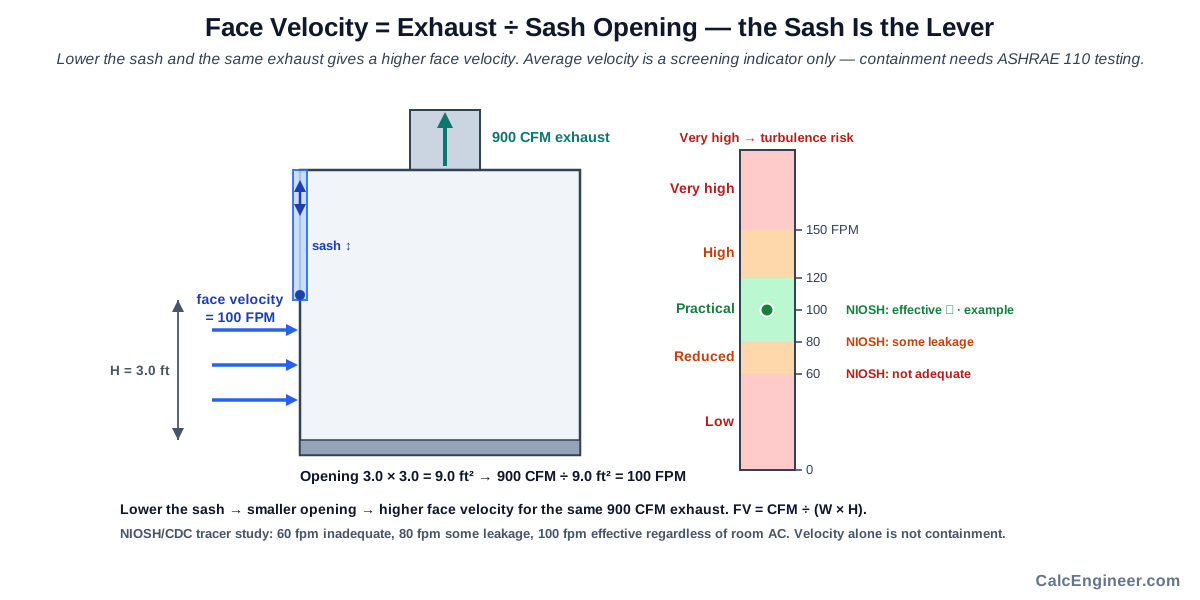
Fume hood face velocity is the average inward air speed through the open hood face. It is one of the most common screening indicators used to judge whether a laboratory hood is pulling enough air inward across the sash opening. But it is only one part of hood performance. ASHRAE Standard 110 exists because real hood containment must be tested, not assumed from average face velocity alone.
How This Calculator Works
This calculator uses one fixed model: hood opening area × face velocity = exhaust airflow. The user enters exhaust airflow and hood opening dimensions, and the calculator returns:
- Fume hood face velocity (FPM or m/s)
- Hood opening area (ft² or m²)
- A classification of face velocity (low, reduced, practical, high, or very high)
Units
| Parameter | Imperial | Metric |
|---|---|---|
| Face Velocity | FPM | m/s |
| Exhaust Airflow | CFM | m³/h |
| Hood Opening Area | ft² | m² |
| Width / Height | ft | m |
When to Use This Calculator
Use this calculator for preliminary screening of fume hood face velocity. It is not a substitute for ASHRAE 110 testing, tracer-gas testing, containment verification, or commissioning procedures. Always confirm final hood performance with project-specific testing.
Key Facts
- ASHRAE states that Standard 110-2016 (RA2025) is the method used to test performance of laboratory fume hoods.
- NIOSH/CDC material cites 80–100 fpm as the standard laboratory fume hood control-velocity range in one evaluation context, while another cited manual required quarterly evaluation in the 60–100 fpm range.
- A NIOSH/CDC tracer study reported that 60 fpm was not adequate under room-air-conditioner influence, 80 fpm still showed some leakage, and 100 fpm was effective in that study regardless of room AC operation.
- Hood performance depends not only on face velocity but also on airflow distribution, room drafts, sash geometry, and hood design.
- Large opening area requires more exhaust airflow to maintain the same average face velocity because velocity is airflow divided by opening area.
- A sash can materially affect hood protection; one CDC-cataloged study found the sash was the only intervention that improved protection efficiency to 100% across all tested combinations in that enclosure study.
Applications
- Laboratory hood airflow screening
- Exhaust airflow verification
- Sash-opening impact checks
- Preliminary lab ventilation review
- Hood commissioning pre-checks
- Capture-velocity estimation for design comparison
Example Calculation
Imperial Example
Given:
- Exhaust Airflow = 900 CFM
- Hood Opening Width = 3.0 ft
- Hood Opening Height = 3.0 ft
Step 1 — Opening Area
Opening Area = 3.0 × 3.0 = 9.0 ft²
Step 2 — Face Velocity
Face Velocity = 900 / 9.0 = 100 FPM
Interpretation: A result of 100 FPM falls in the practical face velocity screening band for many laboratory hood applications. It is consistent with the commonly cited 80–100 fpm laboratory screening range seen in NIOSH/CDC references, but final containment still depends on actual hood testing and operating conditions.
Metric Example
Given:
- Exhaust Airflow = 1800 m³/h
- Hood Opening Width = 0.90 m
- Hood Opening Height = 0.60 m
Step 1 — Opening Area
Opening Area = 0.90 × 0.60 = 0.54 m²
Step 2 — Convert Airflow
1800 m³/h ÷ 3600 = 0.50 m³/s
Step 3 — Face Velocity
Face Velocity = 0.50 / 0.54 = 0.93 m/s
Interpretation: A result of 0.93 m/s falls in the very high face velocity screening range for this calculator and should be reviewed for excessive inward air speed and possible turbulence concerns.
Standards & References
- ANSI/ASHRAE Standard 110 — Method of Testing Performance of Laboratory Fume Hoods — ASHRAE Standard 110-2016 (RA2025) is used for fume hood performance testing.
- ASHRAE Research Project 1573 Q&A — confirms the significance and widespread use of the ASHRAE 110 tracer-gas method for hood containment testing.
- NIOSH/CDC EPHB Report 356-13a — cites OSHA Appendix A around 60–100 fpm and ACGIH guidance around 80–100 fpm for laboratory fume hood face velocity.
- NIOSH/CDC tracer leakage study — shows that actual containment can differ across 60, 80, and 100 fpm test conditions depending on room-air effects.
- NIOSH nano fume hood study — emphasizes that airflow patterns, turbulence, and spatial leakage matter, not just average velocity.
Limitations
- This calculator is a screening tool, not a certification tool.
- It uses average face velocity only.
- It does not replace ASHRAE 110 testing, tracer-gas testing, containment verification, or commissioning procedures.
- It does not account for cross drafts, operator movement, hood design details, or spatial non-uniformity across the face.
- It does not determine chemical compatibility or hazard-specific hood suitability.
Common Mistakes to Avoid
- Using face velocity as if it alone proves safe containment.
- Ignoring sash opening size.
- Assuming higher face velocity is always better.
- Forgetting that large opening area needs more exhaust airflow.
- Ignoring room drafts and local turbulence.
- Mixing CFM, m³/h, ft², and m² incorrectly.
- Using nominal airflow without verifying actual installed flow.
- Treating screening arithmetic as equivalent to ASHRAE 110 performance testing.
Frequently Asked Questions
What does this calculator actually calculate?
What is the main result I should focus on?
Is 100 FPM always the correct target?
Why can very high face velocity be a problem?
Does face velocity alone certify a hood?
Why does sash opening matter so much?
Can low face velocity still work in some special setup?
Is this enough for final hood design or lab approval?
Frequently Used Together
Engineers often use these calculators in combination for complete project workflows:
Related Calculators
Explore similar calculators that might be useful for your project:
Free HVAC Quick Reference. Formulas & Checks.
Airflow, loads, refrigerant & duct checks — one printable page for the job site.
- Key formulas for airflow, load, refrigerant charge & duct sizing
- Quick sanity checks for the most common HVAC design errors
- Printable one-pager for field use and design review
No spam. Unsubscribe any time.
Calculate
Total exhaust airflow through the fume hood
Width of the hood sash opening
Height of the hood sash opening