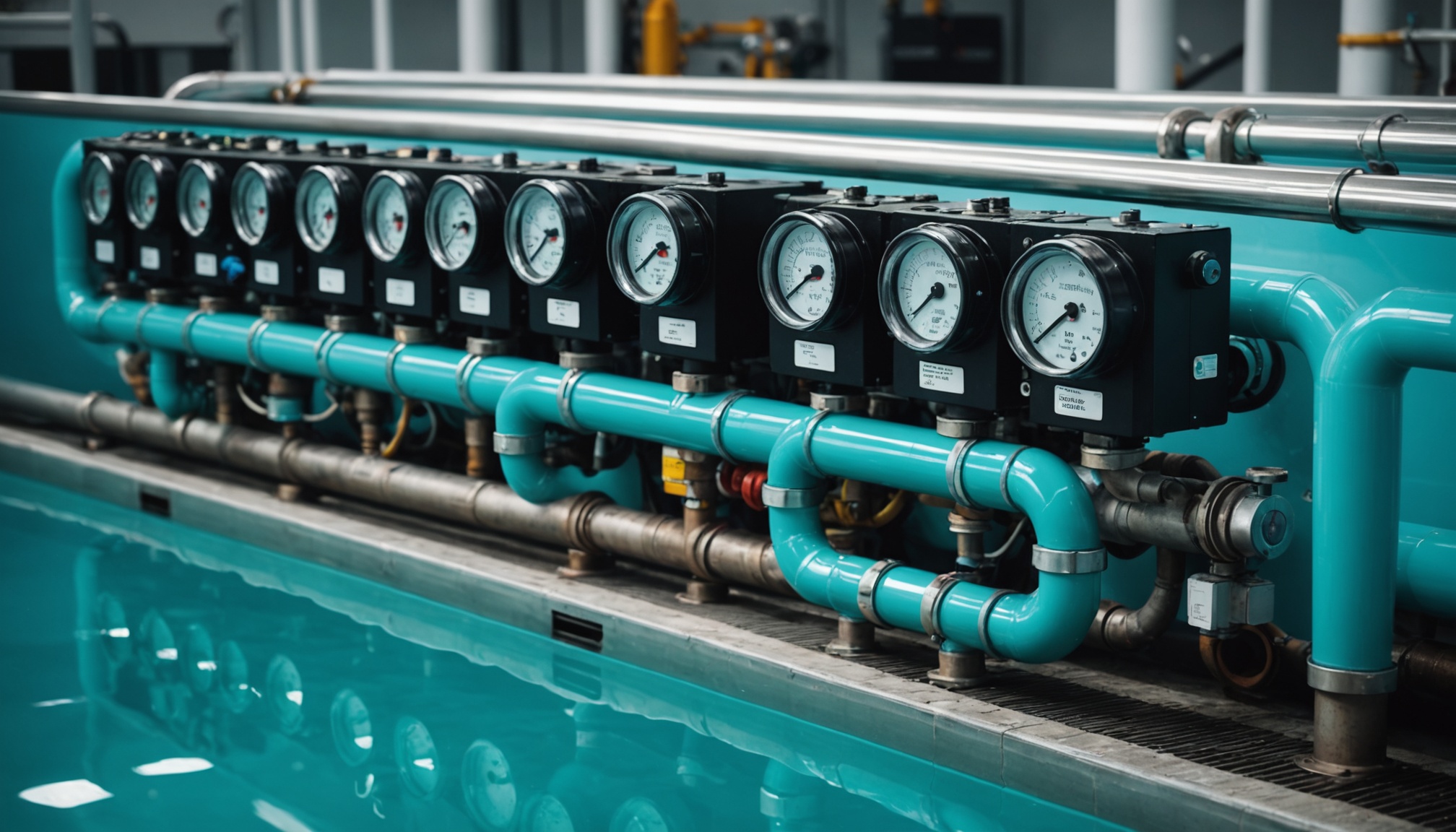
Pool Water Heat Balance per ASHRAE Chapter 6 and EnergyPlus: Four Loss Components Plus Make-Up Water
Indoor pool heating load is determined by a water-side energy balance per ASHRAE Handbook HVAC Applications 2023 Chapter 6 and the EnergyPlus Indoor Swimming Pool engineering reference. The pool heater must replace heat lost through four physical mechanisms, plus the energy needed to bring cold make-up water to pool temperature. This water-side analysis complements the room-air-side dehumidification load covered in the Pool Dehumidification pillar and closes the natatorium thermal balance across the three-article Pool/Spa cluster.
The EnergyPlus heat balance equation per the Engineering Reference Indoor Swimming Pool model:
Q_heater = Q_evap + Q_conv + Q_rad + Q_cond + Q_muw
where Q_heater = pool heater duty [BTU/hr]; Q_evap = evaporation heat loss [BTU/hr], the dominant term, calculated per ASHRAE Chapter 6 Equation 2 times latent heat of vaporization at pool water temperature (per the Natatorium Evaporation Rate sibling article methodology); Q_conv = convection heat loss or gain at the water surface [BTU/hr], small for indoor pools where room temperature is maintained above water temperature; Q_rad = radiative heat loss or gain to surroundings [BTU/hr], also small for indoor pools at similar room and water temperatures; Q_cond = conduction loss through pool walls and floor to surrounding ground or structure [BTU/hr]; Q_muw = make-up water heating energy [BTU/hr], heating cold supply water from make-up temperature to pool temperature.
Per ASHRAE Handbook HVAC Applications 2023 Chapter 6: for indoor pools maintained at recommended design conditions, with room air 2-4°F (1.1-2.2°C) above water temperature per Seresco, PoolPak, and Dectron design guidance, evaporation typically accounts for 75-95% of total heat loss. Convection and radiation contribute small offsetting gains when the room is warmer than the water surface, nearly cancelling one another. Conduction losses depend on pool construction, particularly slab insulation and soil contact conditions. Make-up water energy is small but non-negligible. The pool heater must be sized for peak heat-up demand (initial fill or recovery from major water exchange) rather than maintenance load alone, since heat-up demand typically exceeds maintenance by 5-10× per Section 7 worked example. This calculator computes both heat-up and maintenance loads, recommending heater capacity based on the dominant scenario.
Calculator Inputs: Pool Area, Water and Air Conditions, Setpoint, Initial Temperature, Make-Up Water Temperature
The full water-side heat balance requires ten engineering inputs covering pool geometry, operating conditions, heat-up target, and cover schedule.
Input 1: pool water surface area A [ft² or m²], the exposed uncovered water surface. This is the same input as the Pool Dehumidification and Natatorium Evaporation Rate calculators, enabling direct comparison across all three cluster calculations. Typical natatorium ranges per Pool Dehumidification pillar Section 3: residential 100-500 ft² (9.3-46.5 m²); hotel 500-2,000 ft² (46.5-186 m²); competition 2,000-12,000 ft² (186-1,115 m²).
Input 2: pool water temperature setpoint T_water [°F or °C]. Per FINA and commercial aquatics standards: competition 78-80°F (25.6-26.7°C); recreational 80-82°F (26.7-27.8°C); hotel 82-84°F (27.8-28.9°C); therapy 86-94°F (30-34.4°C); whirlpool/spa 100-104°F (37.8-40°C).
Input 3: room air temperature T_air [°F or °C]. Per Seresco "2°F above water" guidance; this parameter drives the evaporation rate calculation through the vapor pressure differential methodology detailed in the Natatorium Evaporation Rate sibling article.
Input 4: room air relative humidity RH [%]. Summer design 60% RH; winter design 50% RH per Seresco/PoolPak design rules. Drives partial vapor pressure for evaporation calculation.
Input 5: Activity Factor AF per ASHRAE Handbook HVAC Applications 2023 Chapter 6 Table 2, from 0.5 (residential) to 2.0 (wave pool). Full AF detail and sensitivity analysis are covered in the Natatorium Evaporation Rate sibling article Section 4.
Input 6: pool average depth D [ft or m]. Residential indoor: 4-6 ft (1.2-1.8 m); competition lanes: 5-7 ft (1.5-2.1 m); diving wells: 13-17 ft (4-5.2 m). Drives total water volume for heat-up calculation.
Input 7: initial fill temperature T_initial [°F or °C]. Cold fill from municipal supply: typically 60-65°F (15.6-18.3°C); warm fill during recommissioning: 70-78°F (21.1-25.6°C).
Input 8: make-up water temperature T_muw [°F or °C]. Municipal cold water supply, typically 50-65°F (10-18.3°C) depending on climate and season. Used for Q_muw calculation.
Input 9: heat-up time target [hours]. Typical range 24-72 hours for full initial fill. Per Pentair Sta-Rite engineering data: 24-hour heat-up requires roughly 5-10× maintenance load capacity.
Input 10: pool cover schedule [hours per day covered]. Typically 12-18 hours per day during unoccupied periods per Dehumidified Air Solutions Natatorium Design Guide.
Calculator outputs include: maintenance load Q_maint [BTU/hr and kW]; heat-up load Q_heatup [BTU/hr and kW]; recommended heater capacity [BTU/hr and kW]; total daily heat-up energy [MMBTU and kWh]; heat recovery potential from dehumidifier [BTU/hr and kW]; and component breakdown by percentage. Conversion factors per NIST: 1 kW = 3,412 BTU/hr; 1 lb water = 0.4536 kg; 1 gal = 3.785 L; specific heat of water 1.0 BTU/(lb·°F) = 4.186 kJ/(kg·K); latent heat of vaporization at 80°F: 1,048 BTU/lb = 2,438 kJ/kg; 1 ft³ water = 7.48 gal = 62.4 lb = 28.3 L.
The engineering distinction among the three cluster calculators is direct: the Pool Dehumidification pillar calculates the room-air latent load for dehumidifier sizing; the Natatorium Evaporation Rate sibling calculates the evaporation rate itself; this Pool Heating Load calculator calculates the water-side energy compensation for that same evaporation. The same 37 lb/h (16.8 kg/h) evaporation rate drives three separate engineering calculations serving three distinct equipment decisions.
Evaporation Heat Loss: ER × 1,048 BTU/lb Dominates Indoor Pool Maintenance Load
Evaporation heat loss is the dominant water-side energy demand for indoor pools, accounting for 75-95% of total maintenance heat loss per ASHRAE Handbook HVAC Applications 2023 Chapter 6. Each pound of water that evaporates carries latent heat from the pool, cooling the remaining water mass by exactly the latent heat of vaporization at the surface temperature.
Evaporation heat loss formula:
Q_evap = ER × h_fg
where Q_evap = evaporation heat loss [BTU/hr], ER = evaporation rate from ASHRAE Chapter 6 Equation 2 [lb/h] calculated per the pillar and Natatorium Evaporation Rate sibling methodology, and h_fg = latent heat of vaporization at the water surface temperature [BTU/lb].
Latent heat of vaporization at pool water temperatures per ASHRAE Fundamentals 2021 Chapter 6 and NIST steam tables:
| Water Temperature | h_fg (BTU/lb) | h_fg (kJ/kg) |
|---|---|---|
| 70°F (21.1°C) | 1,054 | 2,452 |
| 75°F (23.9°C) | 1,051 | 2,445 |
| 80°F (26.7°C) | 1,048 | 2,438 |
| 85°F (29.4°C) | 1,045 | 2,432 |
| 90°F (32.2°C) | 1,042 | 2,425 |
| 95°F (35.0°C) | 1,040 | 2,419 |
| 100°F (37.8°C) | 1,037 | 2,412 |
| 104°F (40.0°C) | 1,035 | 2,407 |
Latent heat decreases slightly with increasing water temperature; ASHRAE Fundamentals 2021 Chapter 6 recommends rounding to 1,050 BTU/lb (2,440 kJ/kg) for preliminary design purposes, introducing less than 0.2% error at typical recreational pool temperatures.
Worked evaporation heat loss calculation for the Miami hotel pool, consistent with Pool Dehumidification pillar Section 7 and Natatorium Evaporation Rate sibling Section 8: pool 1,250 ft² (116 m²), AF 0.8, 80°F (26.7°C) water, 82°F (27.8°C) room, 60% RH. ER per those two sibling calculations: 37 lb/h (16.8 kg/h). h_fg at 80°F = 1,048 BTU/lb (2,438 kJ/kg). Q_evap = 37 × 1,048 = 38,776 BTU/hr (11.37 kW).
Per Seresco Natatorium Design Manual and Dehumidified Air Solutions methodology: evaporation heat loss dominates indoor pool heating load because (a) the indoor environment maintains room air 2-4°F above water per Section 4 below, making convection and radiation small offsetting gains rather than losses, and (b) indoor pools are typically insulated below grade, limiting conduction per Section 5. The same 37 lb/h evaporation rate that drives the dehumidifier latent load in the pillar (39,257 BTU/hr at 1,061 BTU/lb, the reference value for that calculation at 75°F) also drives the pool heater duty (38,776 BTU/hr at 1,048 BTU/lb at actual 80°F water temperature). Both values are correct per ASHRAE Fundamentals 2021 Chapter 6 within ±1.5%, with the difference attributable to the temperature-specific h_fg selection.
Convection and Radiation: Why Both Components Are Small for Indoor Heated Pools
Convection and radiation heat transfer at the pool water surface are typically small or slightly positive (heat gains to the pool) for indoor pools where room air temperature is maintained 2-4°F (1.1-2.2°C) above water temperature per Seresco design rules. Both become significant losses only when room temperature drops below water temperature — during natatorium HVAC failure, extended weekend setback, or outdoor pool exposure.
Convection heat transfer at pool surface per ASHRAE Fundamentals 2021 Chapter 4:
Q_conv = h_c × A × (T_water - T_air)
where h_c = convective heat transfer coefficient [BTU/(hr·ft²·°F) or W/(m²·K)], A = pool surface area [ft² or m²], and (T_water - T_air) = temperature differential [°F or °C].
Typical h_c for indoor pools with low room air velocity (10-30 fpm / 0.05-0.15 m/s per Seresco): 0.4-0.6 BTU/(hr·ft²·°F) (2.3-3.4 W/(m²·K)) per ASHRAE Fundamentals 2021 Chapter 4 natural convection correlations.
Miami hotel pool convection calculation: A = 1,250 ft² (116 m²), T_water = 80°F (26.7°C), T_air = 82°F (27.8°C), ΔT = -2°F (-1.1°C); h_c = 0.5 BTU/(hr·ft²·°F) (2.84 W/(m²·K)). Q_conv = 0.5 × 1,250 × (-2) = -1,250 BTU/hr (-0.37 kW). The negative sign indicates heat gain to the pool.
Radiation heat transfer at pool surface per ASHRAE Fundamentals 2021 Chapter 4 Stefan-Boltzmann law:
Q_rad = ε × σ × A × (T_water⁴ - T_surround⁴)
where ε = water emissivity ≈ 0.95 per ASHRAE Fundamentals 2021 Chapter 4 long-wave radiation tables; σ = Stefan-Boltzmann constant = 5.67 × 10⁻⁸ W/(m²·K⁴) = 0.1714 × 10⁻⁸ BTU/(hr·ft²·°R⁴); T_water and T_surround = absolute temperatures [K or °R].
Miami hotel pool radiation: T_water = 80°F = 539.67°R (299.82 K); T_surround = 82°F = 541.67°R (300.93 K) assuming room walls and ceiling at room air temperature. 539.67⁴ = 8.485 × 10¹⁰; 541.67⁴ = 8.612 × 10¹⁰; difference = -1.27 × 10⁹. Q_rad = 0.95 × 0.1714 × 10⁻⁸ × 1,250 × (-1.27 × 10⁹) = -2,584 BTU/hr (-0.76 kW). Negative indicates heat gain to pool.
Per ASHRAE Handbook HVAC Applications 2023 Chapter 6: combined convection and radiation equal -3,834 BTU/hr (-1.12 kW) heat gain to pool for typical indoor conditions with room 2°F above water temperature. This partially offsets evaporation heat loss, contributing roughly -10% to the total heat balance. Per Dehumidified Air Solutions: precision energy modeling includes these components, but preliminary design uses evaporation-only methodology — within 10-15% accuracy for typical indoor pools per EnergyPlus validation.
Per Polysun pool heat loss simulation methodology: convection and radiation become significant losses only when (a) room temperature drops below water temperature during HVAC failure or weekend setback, (b) the pool is outdoors and exposed to wind, or (c) surrounding surfaces are cold due to poorly insulated glazing or exposed concrete decking at low ambient conditions.
Conduction and Make-Up Water: Below-Grade Losses and Cold-Water Heat-Up
Conduction heat loss through pool walls and floor to surrounding ground or structure is typically 5-15% of total maintenance load for indoor pools. Make-up water heating compensates for evaporated water replacement and is small but non-negligible per ASHRAE Chapter 6 methodology.
Conduction heat loss per ASHRAE Fundamentals 2021 Chapter 4:
Q_cond = U_pool × A_walls × (T_water - T_ground)
where U_pool = overall heat transfer coefficient from pool wall to ground [BTU/(hr·ft²·°F) or W/(m²·K)], typically 0.1-0.3 BTU/(hr·ft²·°F) (0.57-1.7 W/(m²·K)) per ASHRAE Chapter 6 for insulated concrete pool walls; A_walls = pool wall and floor surface area [ft² or m²]; and (T_water - T_ground) = water-to-ground temperature differential.
Miami hotel pool conduction (1,250 ft² surface × 5 ft average depth): pool walls and floor area = 1,250 ft² floor + perimeter 150 ft × depth 5 ft = 750 ft² walls = 2,000 ft² total (186 m²). U_pool = 0.15 BTU/(hr·ft²·°F) (0.85 W/(m²·K)), typical insulated concrete pool. T_water = 80°F (26.7°C), T_ground = 65°F (18.3°C) typical Miami subsurface. Q_cond = 0.15 × 2,000 × 15 = 4,500 BTU/hr (1.32 kW).
Per ASHRAE Handbook HVAC Applications 2023 Chapter 6: well-insulated indoor pool conduction is typically 3-8% of total heat loss. Poorly insulated below-grade pools reach 10-20%. Outdoor pools on cold soil may lose 25-40% per Polysun simulation methodology.
Make-up water heating per ASHRAE Chapter 6:
Q_muw = m_muw × c_p × (T_water - T_muw)
where m_muw = make-up water mass flow rate [lb/h or kg/h], equal to evaporation rate plus splash-out replacement (typically 10-20% above ER per Pentair Sta-Rite engineering data); c_p = specific heat of water = 1.0 BTU/(lb·°F) (4.186 kJ/(kg·K)); and (T_water - T_muw) = water-to-make-up temperature differential.
Miami hotel pool make-up water: m_muw = ER × 1.15 = 37 × 1.15 = 42.6 lb/h (19.3 kg/h); T_muw = 65°F (18.3°C) typical Miami municipal supply, ΔT = 15°F (8.3°C). Q_muw = 42.6 × 1.0 × 15 = 639 BTU/hr (0.19 kW).
Combined Sections 4 and 5 components: convection (-1,250) + radiation (-2,584) + conduction (4,500) + make-up water (639) = 1,305 BTU/hr net (0.38 kW). With evaporation at 38,776 BTU/hr, the remaining four components together represent roughly 3% of total maintenance load for this well-insulated indoor pool — confirming that evaporation dominates the water-side heat balance.
Heat-Up Versus Maintenance Load: Initial Fill 5.85 MMBTU Versus Continuous 37,000 BTU/hr
Pool heater capacity must accommodate both steady-state maintenance load (continuous heat replacement during normal operation) and peak heat-up load (initial fill or recovery from extended setback). Heat-up demand typically governs equipment sizing because pool water mass is large and the target heat-up window is short.
Heat-up energy calculation per ASHRAE Handbook HVAC Applications 2023 Chapter 6:
E_heatup = V × ρ × c_p × (T_target - T_initial)
where E_heatup = total heat-up energy [BTU or kWh]; V = pool water volume [ft³ or m³]; ρ = water density = 62.4 lb/ft³ (1,000 kg/m³); c_p = specific heat of water = 1.0 BTU/(lb·°F) (4.186 kJ/(kg·K)); T_target = operating setpoint; T_initial = initial fill temperature.
Pool water mass: m_pool = V × ρ = (A × D_avg) × ρ, where D_avg = average pool depth.
Heat-up rate required from the heater:
Q_heatup = (E_heatup / t_heatup) + Q_maint
where t_heatup = target heat-up time [hours] and Q_maint = continuous maintenance load during the heat-up period per Sections 3-5 methodology. The heater must supply both simultaneously: energy input to raise water temperature plus replacement of evaporation losses throughout the fill period.
Miami hotel pool heat-up calculations: pool 1,250 ft² (116 m²) × 5 ft (1.5 m) average depth = 6,250 ft³ (177 m³) = 46,750 gal (177,000 L). Water mass: 6,250 × 62.4 = 390,000 lb (177,000 kg). T_initial = 65°F (18.3°C), T_target = 80°F (26.7°C), ΔT = 15°F (8.3°C). E_heatup = 390,000 × 1.0 × 15 = 5,850,000 BTU (5.85 MMBTU; 1,716 kWh).
Heater capacity by heat-up time target:
24-hour heat-up: (5,850,000 / 24) + 37,000 = 243,750 + 37,000 = 280,750 BTU/hr (82.3 kW; approximately 23 ton equivalent).
48-hour heat-up: (5,850,000 / 48) + 37,000 = 121,875 + 37,000 = 158,875 BTU/hr (46.5 kW). A significantly smaller heater at the cost of longer downtime.
72-hour heat-up: (5,850,000 / 72) + 37,000 = 81,250 + 37,000 = 118,250 BTU/hr (34.7 kW).
Per Raypak P-Series engineering manual: faster heat-up requires a larger heater capital investment; slower heat-up reduces first cost but extends downtime. Hotel pools typically target 24-48 hours to balance capital against operational flexibility. Per Pentair Sta-Rite Application Guide: residential pools commonly size for 48-72 hour heat-up; commercial pools for 24-48 hours; competition pools for 12-24 hours per scheduling demands.
Per ASHRAE Standard 90.1-2022 Section 7.4.5: pool heater minimum efficiency and part-load performance are specified for energy code compliance. Right-sizing to the dominant operating condition (heat-up demand for commercial pools) avoids the part-load efficiency penalty that affects oversized heaters cycling at low maintenance loads.
Miami Hotel Pool Worked Example: 1,250 sq ft, 40,081 BTU/hr Maintenance, 283,831 BTU/hr Peak Heat-Up, 400-MBH Gas Heater Selection
Project: hotel indoor pool, new construction in Miami, FL. Pool 50 ft × 25 ft × 5 ft average depth (15.24 × 7.62 × 1.52 m), water surface 1,250 ft² (116 m²), water volume 46,750 gal (177,000 L), water mass 390,000 lb (177,000 kg). This worked example continues the Miami hotel pool scenario from the Pool Dehumidification pillar Section 7 (which selected the Seresco NE-090 dehumidifier for room-air-side dehumidification) and the Natatorium Evaporation Rate sibling Section 8 (which computed the ER baseline and sensitivity).
Design conditions per ASHRAE Handbook HVAC Applications 2023 Chapter 6 and Seresco Natatorium Design Manual: pool water 80°F (26.7°C) recreational standard; room air 82°F (27.8°C) per 2°F-above-water rule; design RH 60% summer; Activity Factor 0.8 hotel classification; initial fill 65°F (18.3°C) Miami municipal supply; make-up water 65°F (18.3°C); target heat-up 24 hours.
Step 1: evaporation heat loss per Section 3. ER from pillar Section 7 and sibling Section 8: 37 lb/h (16.8 kg/h). h_fg at 80°F = 1,048 BTU/lb. Q_evap = 37 × 1,048 = 38,776 BTU/hr (11.37 kW).
Step 2: convection and radiation per Section 4. Q_conv = 0.5 × 1,250 × (80 - 82) = -1,250 BTU/hr (-0.37 kW), heat gain to pool. Q_rad = -2,584 BTU/hr (-0.76 kW), heat gain to pool per Stefan-Boltzmann calculation.
Step 3: conduction and make-up water per Section 5. Pool walls and floor: 1,250 + (150 × 5) = 2,000 ft² (186 m²). Q_cond = 0.15 × 2,000 × 15 = 4,500 BTU/hr (1.32 kW). Q_muw = 42.6 × 1.0 × 15 = 639 BTU/hr (0.19 kW).
Step 4: total maintenance load. Q_maint = 38,776 - 1,250 - 2,584 + 4,500 + 639 = 40,081 BTU/hr (11.75 kW).
Component shares: evaporation 38,776/40,081 = 96.7%; conduction 4,500/40,081 = 11.2%; make-up water 639/40,081 = 1.6%; convection gain -1,250/40,081 = -3.1%; radiation gain -2,584/40,081 = -6.4%. Confirms ASHRAE Chapter 6 commentary: evaporation absolutely dominates indoor pool maintenance load.
Step 5: heat-up energy and rate per Section 6. E_heatup = 390,000 × 1.0 × 15 = 5,850,000 BTU (5.85 MMBTU; 1,716 kWh). 24-hour rate: 5,850,000 / 24 = 243,750 BTU/hr. Plus simultaneous maintenance 40,081 BTU/hr. Peak heat-up demand: 243,750 + 40,081 = 283,831 BTU/hr (83.2 kW).
Step 6: heater capacity selection. Peak demand 284 MBH with 10-15% safety factor per Raypak P-Series application practice requires rated capacity 313-326 MBH.
Manufacturer selections:
- Raypak P-401A (gas): 399,000 BTU/hr input × 87% thermal efficiency = 347,130 BTU/hr output. Safety margin 347/284 = 1.22×, within the recommended 1.10-1.30×. Capital cost approximately $4,500-6,000 installed.
- Pentair MasterTemp 400: 400,000 BTU/hr input × 84% efficiency = 336,000 BTU/hr output. Comparable capacity at $4,000-5,500 installed.
- AquaCal HP200R heat pump: 200,000 BTU/hr output at 80°F air/80°F water, COP approximately 5.5, 36 kW electrical input. 24-hour heat-up is not achievable at this capacity; 48-hour heat-up is viable. Capital cost $8,500-12,000 installed.
Step 7: dehumidifier heat recovery integration. The Seresco NE-090 selected in pillar Section 7 for room-air-side dehumidification is available with a pool water heating heat recovery option. Per Dehumidified Air Solutions Natatorium Design Guide: NE-090 cooling capacity approximately 84,880 BTU/hr; heat recovery divertible to pool water 25-40% of that capacity = 21,000-34,000 BTU/hr. During the cooling season (8 months Miami), recovery offsets 53-85% of maintenance load (Q_maint 40,081 BTU/hr) at no fuel cost, providing $1,500-2,500 per year in operating savings versus gas-only per pillar Section 8 economics.
Step 8: engineering decision. Selected Raypak P-401A gas heater (399 MBH input / 347 MBH output) for primary heating duty and peak heat-up capability, combined with Seresco NE-090 with heat recovery option for cooling-season maintenance offset. Total installed cost approximately $50,000-60,000 for the combined system. Per Seresco engineering practice and DAS Natatorium Design Guide Table 4: combined system payback typically 18-30 months versus gas-only baseline through heat recovery savings and reduced equipment redundancy. The dehumidifier replaces both standalone dehumidification and a substantial share of pool heating duty, justifying the premium over separate standalone equipment.
Equipment Categories: Gas Heater, Heat Pump, Solar Thermal, Dehumidifier Heat Recovery
Pool heating equipment selection follows total load (Sections 6-7 methodology), climate, energy cost, and integration potential with the dehumidification system. Four primary equipment categories cover the natatorium pool heating spectrum.
Category 1: gas heater (atmospheric or condensing). Capacity range 100,000-2,000,000 BTU/hr (29-586 kW). Manufacturers: Raypak P-Series, Pentair MasterTemp and ETi, Hayward Universal H-Series, Lochinvar Copper-Fin II. Installed cost $3,500-15,000 depending on capacity. Efficiency: 82-87% atmospheric, 92-97% condensing per AHRI 1500 testing. Application: primary heating duty when natural gas or propane is available; reliable peak heat-up for any commercial pool. Per Raypak engineering data: condensing models add 10-15% efficiency over atmospheric but require $1,500-3,000 capital premium and compatible flue venting.
Category 2: heat pump pool heater (air-source). Capacity range 80,000-250,000 BTU/hr (23.4-73.2 kW) per unit; multiple units for larger pools. Manufacturers: AquaCal SQ-Series and HeatWave, Pentair UltraTemp, Hayward HeatPro, Raypak Crosswind. Installed cost $5,000-15,000 per unit. COP: 4.0-6.0 at AHRI 1160 rating conditions (80°F air / 80°F water). Significant performance derating below 50°F (10°C) outdoor air per AquaCal engineering data. Application: cooling-season and moderate-climate operation; generally insufficient for 24-hour heat-up on large commercial pools. Operating energy cost $0.10-0.20 per kWh typical 2026 US.
Category 3: solar thermal pool heating. Capacity depends on collector area; typical 1-2 BTU/(hr·ft²) of pool surface per panel square foot at design solar conditions. Manufacturers: Heliocol, FAFCO, Aquatherm, SunGrabber. Installed cost: $3,000-15,000 residential; $20,000-100,000+ commercial. Efficiency: 60-80% absorption per ASHRAE Solar Energy Handbook. Application: supplemental heating, reducing gas or electric demand 30-70% annually per ASHRAE methodology. Pool-surface-area equivalent collector area provides 60-80% annual heating coverage per ASHRAE Solar Energy Handbook; smaller arrays contribute proportionally.
Category 4: dehumidifier heat recovery integration (preferred for indoor natatoriums). Recovery: 25-40% of dehumidifier compressor heat rejection diverted to pool water. Manufacturers with this option: Seresco NE/NW Series, PoolPak SWHP and MPK, Dectron NP-Series heat reclaim, Desert Aire LG and CA Series. Added cost: $5,000-15,000 premium over standalone dehumidifier; no separate pool heater unit required for cooling-season maintenance. Per ASHRAE Standard 90.1-2022: heat recovery integration is required for commercial pool installations exceeding specified threshold sizes, making it effectively mandatory for commercial natatoriums under current energy code.
Equipment architecture comparison per ASHRAE Handbook HVAC Applications 2023 Chapter 6 and Dehumidified Air Solutions:
| Equipment | Capital Cost | Operating Cost | ROI vs Gas Baseline | Best Application |
|---|---|---|---|---|
| Gas heater | $3,500-15,000 | $4,000-12,000/yr | Baseline | Universal, peak heat-up |
| Heat pump | $5,000-15,000 | $1,500-5,000/yr | 3-5 years | Moderate climate, year-round |
| Solar thermal | $3,000-100,000+ | ~$0/yr | 5-10 years | Supplemental, reduces gas/electric |
| Dehumidifier heat recovery | $5,000-15,000 premium | Effectively negative (offsets gas) | Under 1-2 years | Indoor natatoriums |
Per Seresco Natatorium Design Manual and PoolPak Pool Heating Application Guide: best practice for indoor natatoriums combines dehumidifier heat recovery for cooling-season maintenance with auxiliary gas heater for heat-up and off-season maintenance. This hybrid configuration achieves under 2-year ROI versus gas-only baseline and meets ASHRAE Standard 90.1-2022 efficiency requirements.
Pool Cover Impact: 60-90% Reduction in All Heat Loss Components per Dehumidified Air Solutions
Pool covers reduce all heat loss components simultaneously per Dehumidified Air Solutions Natatorium Design Guide and ASHRAE Handbook HVAC Applications 2023 Chapter 6. Cover impact on pool heating typically exceeds its impact on dehumidification load because heating compensates water-side energy, where the cover physically blocks evaporative cooling at the source.
Pool cover effect on heat loss components per Dehumidified Air Solutions and Polysun simulation methodology:
| Heat Loss Component | Uncovered | Bubble Cover | Automatic Slatted | Insulated Track |
|---|---|---|---|---|
| Evaporation | 100% baseline | 30-40% remaining | 10-20% | 5-10% |
| Convection (loss when room below water temp) | 100% | 50-70% | 30-50% | 20-40% |
| Radiation (long-wave) | 100% | 40-60% | 20-40% | 10-30% |
| Make-up water (proportional to evaporation) | 100% | 30-40% | 10-20% | 5-10% |
Combined effect: bubble cover reduces total pool heating load 60-70%; automatic slatted cover 80-90%; insulated track cover 85-95% per Dehumidified Air Solutions Natatorium Design Guide.
Miami hotel pool with 16 hr/day covered at automatic slatted cover (85% effective per DAS): uncovered maintenance load 40,081 BTU/hr; covered maintenance load 40,081 × 0.15 = 6,012 BTU/hr. Daily average: (40,081 × 8 hr + 6,012 × 16 hr) / 24 = (320,648 + 96,192) / 24 = 17,368 BTU/hr (5.09 kW). Daily energy: 17,368 × 24 = 416,832 BTU/day versus uncovered 962,000 BTU/day. Daily savings: 545,168 BTU (56.7% reduction). Annual savings at 244 operating days (8 months Miami): 545,168 × 244 = 133 MMBTU/year. At $1.20/therm natural gas: 1,330 therms × $1.20 = $1,596/year from cover schedule alone.
Per Dehumidified Air Solutions Table 4: pool cover ROI for hotel-scale natatoriums is typically 1-3 years through combined heating and dehumidification energy savings, since covers reduce both simultaneously. Automatic slatted cover capital cost at $20-50/ft² × 1,250 ft² = $25,000-62,500; payback 12-30 months in Miami climate per DAS methodology. Combined economics — dehumidifier heat recovery from pillar Section 8 plus cover schedule from this section — reduce hotel pool annual operating cost 60-80% versus a gas-heating-only, no-cover baseline.
Application Boundaries: Outdoor Pools, Saltwater, Geothermal Sources, Therapy and Spa Heating
This calculator applies to indoor pools at 75-104°F (23.9-40°C) water temperature, steady-state operation with an established cover schedule, pool depth 3-10 ft (0.91-3.05 m), and a single-zone main basin. The ASHRAE Handbook HVAC Applications 2023 Chapter 6 methodology governs within these parameters.
Specialty applications requiring extended methodology:
Outdoor pools per Carrier 1918 with wind factor: heat loss includes wind-driven evaporation enhancement per Natatorium Evaporation Rate sibling Section 9 outdoor caveat. Outdoor convection and radiation become significant losses: sky radiation to a clear sky increases radiative exchange substantially; wind-driven convection adds major heat transfer at the water surface. Per the ASHRAE Solar Energy Handbook: outdoor pool heat loss is 3-5× the same-area indoor pool. Solar heating is effective for outdoor pools through direct solar gain on the water surface (60-80% absorption per Duffie and Beckman).
Saltwater pools per Raoult's Law: pool salinity reduces P_water by 1-3%, slightly lowering evaporation rate and therefore evaporation heat loss. Heating methodology is otherwise unchanged. Material selection requires corrosion-resistant heater components (titanium heat exchangers per AquaCal SaltGuard and Pentair MasterTemp ETi engineering data), adding 20-40% to equipment cost.
Geothermal heat sources: ground-source heat pump systems can heat pool water using geothermal loops per ASHRAE Handbook HVAC Applications 2023 Chapter 35. Higher capital ($15,000-40,000) but lowest operating cost (COP 5-8 for pool heating at 80°F setpoint). Suited to large public or commercial natatoriums where annual operating savings justify the capital premium.
Therapy pools at 88-94°F (31.1-34.4°C): elevated water temperature increases evaporation 30-50% per ASHRAE Chapter 6, scaling heating load proportionally. Equipment sizing follows Section 6 methodology with adjusted h_fg: 1,040-1,045 BTU/lb (2,419-2,432 kJ/kg) at therapy temperatures versus 1,048 BTU/lb (2,438 kJ/kg) at 80°F.
Spa and whirlpool heating at 100-104°F (37.8-40°C): very high evaporation rate per AF 1.0 plus jet aeration adder per Seresco design guidance (10-20% above AF 1.0 baseline). Small surface area (under 100 ft² / 9.3 m²) keeps total load modest despite high specific evaporation rate. Smaller heaters (40-100 MBH / 11.7-29.3 kW) typical per Hayward Universal H-Series engineering data; 8-24 hour heat-up is acceptable for spa applications.
Indoor pools with 100% outdoor air ventilation: outdoor air heating load adds to the water heating demand. ERV pre-conditioning reduces 50-75% of the outdoor air heating component per AHRI Standard 1060-2018; the combined system must be sized for both demands simultaneously.
Per ASHRAE Handbook HVAC Applications 2023 Chapter 6: standard methodology applies to typical indoor pools; specialty applications require chapter-specific supplemental guides or manufacturer engineering manuals.
Pool Heating Load Calculator
Pool Heating Load Calculator
Pool heating load calculation per ASHRAE Handbook HVAC Applications 2023 Chapter 6 and EnergyPlus Indoor Swimming Pool methodology, with four-component water-side heat balance (evaporation, convection, radiation, conduction, and make-up water), heat-up versus maintenance load distinction, and integration with dehumidifier heat recovery economics per Dehumidified Air Solutions.
Open Pool Heating Load CalculatorFAQ
Why does evaporation account for 95% or more of indoor pool heating load when convection and radiation usually dominate building envelope heat transfer?
Per ASHRAE Handbook HVAC Applications 2023 Chapter 6 and EnergyPlus Indoor Swimming Pool engineering reference: indoor pool heating load differs fundamentally from building envelope heating because (a) the room is maintained 2-4°F (1.1-2.2°C) above water temperature per Seresco and PoolPak design rules, making convection and radiation either negligible or slightly positive (heat gain to pool, not loss); (b) pool walls and floor are typically well insulated and surrounded by warm building interior, limiting conduction to 5-15% of total; (c) evaporation is a phase-change process where each pound of evaporated water removes 1,048 BTU at 80°F (2,438 kJ/kg at 26.7°C) from remaining pool water, vastly exceeding sensible heat transfer mechanisms at typical natatorium temperature differentials. Per Seresco Natatorium Design Manual: a 1,250 ft² (116 m²) hotel pool evaporating 37 lb/h (16.8 kg/h) loses 38,776 BTU/hr (11.4 kW) to evaporation, while combined convection and radiation contribute approximately -10% (heat gain) and conduction adds roughly 11%. Engineering implication: reducing evaporation through cover deployment, room temperature optimization, or RH setpoint adjustment directly reduces heating load in proportion — making those operational strategies the most cost-effective pool energy management tools available.
Should I size a pool heater for maintenance load or heat-up demand?
Per Raypak P-Series Engineering Manual and Pentair MasterTemp Application Guide: pool heater capacity must handle peak demand, which is heat-up demand for almost all commercial installations. Heat-up demand exceeds maintenance by 5-10× for typical pools per Section 6 methodology. Sizing for maintenance only forces multi-day heat-up periods (3-7 days), which is unacceptable for commercial operation. Standard sizing rules per Raypak: residential pools 48-72 hour heat-up (sized 2-3× maintenance); commercial pools 24-48 hours (sized 5-7× maintenance); competition pools 12-24 hours (sized 8-12× maintenance). For the Miami hotel pool example (Sections 6-7): maintenance is 40,081 BTU/hr; 24-hour heat-up demand is 283,831 BTU/hr; the selected Raypak P-401A provides 347 MBH output after efficiency. Per ASHRAE Standard 90.1-2022 Section 7.4.5: minimum heater efficiency requirements apply at both full and part-load operation, so oversized heaters cycling at low maintenance load must meet AHRI 1500 part-load testing requirements.
How much can dehumidifier heat recovery contribute to pool heating load?
Per Dehumidified Air Solutions Natatorium Design Guide and Seresco NE/NP-Series Heat Recovery Option Engineering Data: dehumidifier heat recovery typically diverts 25-40% of compressor heat rejection to pool water heating instead of to outdoor ambient. For the Miami hotel pool example (Seresco NE-090, approximately 84,880 BTU/hr cooling capacity): recoverable heat is 21,000-34,000 BTU/hr. This recovery range meets or approaches the pool maintenance load (40,081 BTU/hr per Section 7) during full dehumidifier operation, providing 53-85% of maintenance heating demand at no fuel cost. Per DAS Table 4 economics: cooling-season operation (8 months Miami) provides $1,500-2,500 per year operating cost savings versus gas-only heating. Heat recovery does not cover heat-up demand (284 MBH peak); the auxiliary gas heater handles peak loads and off-season maintenance. Combined system payback is typically 18-30 months versus gas-only baseline per DAS methodology. Per ASHRAE Standard 90.1-2022 Section 6.5.6.3: heat recovery integration is required for commercial pool installations exceeding specified threshold sizes, making it effectively mandatory for commercial natatoriums under current energy code.
Is solar thermal pool heating practical for indoor natatoriums?
Per ASHRAE Solar Energy Handbook and Aquatherm/Heliocol engineering data: solar thermal pool heating is more economically attractive for outdoor pools (60-80% annual coverage achievable per ASHRAE methodology, capital cost $3-12 per square foot installed) than for indoor pools, but viable as supplemental heating in any climate. Indoor pool load is reduced by indoor temperature control compared to outdoor exposure, which limits the relative contribution of a given collector area. Typical indoor pool solar coverage: 20-40% annually per ASHRAE methodology; capital cost $25,000-100,000 for commercial scale. ROI 5-10 years versus gas heating, shorter in high-gas-cost regions. Per U.S. Department of Energy pool heating guidance: solar pool heating systems represent 30-50% of installed pool heaters in high-solar-resource regions (Arizona, Southern California, Florida). For the Miami hotel pool (Section 7): rooftop solar thermal could provide 30-50% annual heating coverage at $15,000-30,000 capital, complementing dehumidifier heat recovery and gas heater for substantial renewable and recovered-energy coverage.
What efficiency does ASHRAE require for new pool heaters under current energy code?
Per ASHRAE Standard 90.1-2022 Section 7.4.5 and corresponding 2024 IECC requirements: new pool water heaters must meet minimum thermal efficiency and part-load performance per AHRI 1500 testing protocol. Gas pool heaters: minimum 82% thermal efficiency (atmospheric) or 91% (condensing) per current code. Heat pump pool heaters: minimum COP 5.0 at AHRI 1160 rating conditions (80°F air / 80°F water). Electric resistance pool heaters are permitted only in residential applications below specified capacity thresholds; most state codes prohibit electric resistance pool heating commercially given the COP 1.0 efficiency disadvantage versus heat pump COP 5.0 or greater. Per ASHRAE Handbook HVAC Applications 2023 Chapter 6: best-practice commercial natatorium design combines (a) dehumidifier heat recovery, mandatory per ASHRAE 90.1-2022 Section 6.5.6.3 for commercial scale; (b) pool cover schedule as an operational practice; and (c) high-efficiency primary heater (gas condensing or heat pump). This combined approach reduces pool heating energy 60-80% versus an uncovered, no-heat-recovery baseline. Verify local jurisdiction adoption of ASHRAE 90.1-2022 or subsequent editions; California Title 24 and New York ECCC exceed ASHRAE baseline requirements in several respects.
Related Calculators
Indoor pool dehumidification load calculation with total natatorium latent, spectator, and outdoor air components per ASHRAE Chapter 6 Equation 2: Dehumidifier Sizing for Pools Calculator. Pool evaporation rate physics, sensitivity to design parameters, and ASHRAE versus Shah methodology comparison: Natatorium Evaporation Rate Calculator.
Spa and hot tub heat-up time calculation for small heated water systems: Spa Heat Up Time Calculator. Heat exchanger heat duty using LMTD methodology for pool water heat-exchange equipment: Heat Exchanger Calculator.
Boiler efficiency analysis for central plant pool heating systems: Boiler Efficiency Calculator. Glycol concentration for freeze protection in pool heating piping in cold climates: Glycol Concentration Calculator. Ground source heat pump COP estimation for geothermal pool heating applications: Ground Source Heat Pump COP Estimator.