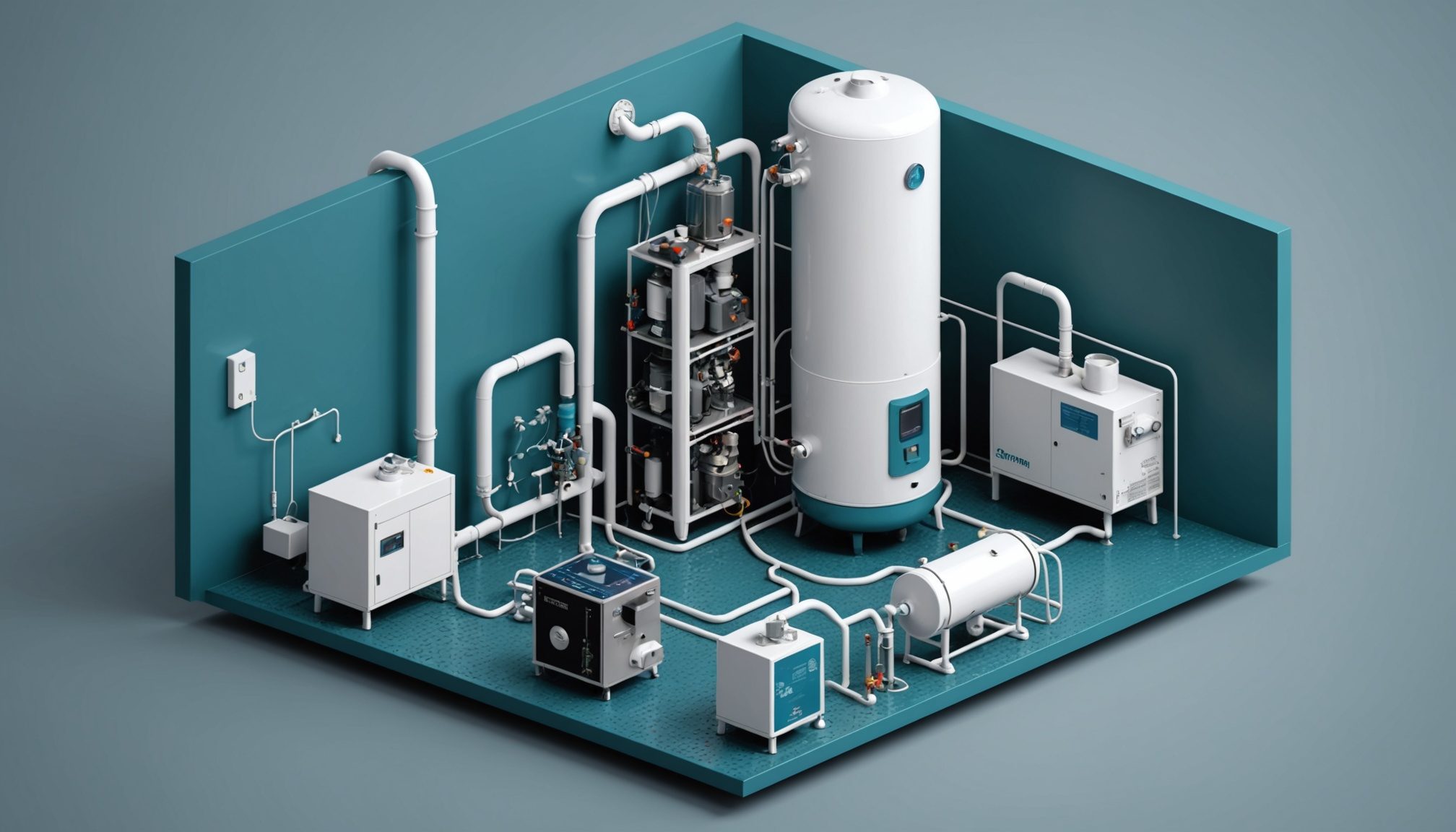
Humidification Load Physics: Moisture Mass Balance per ASHRAE Handbook HVAC Systems and Equipment 2020 Chapter 22
Humidification load equals the mass flow rate of dry outdoor air entering a space multiplied by the humidity ratio difference between indoor target and outdoor conditions, per ASHRAE Handbook HVAC Systems and Equipment 2020 Chapter 22 "Humidifiers." During winter, cold outdoor air carries very little moisture even at 70–80% relative humidity; bringing it to indoor comfort levels (typically 30–50% RH at 70°F / 21.1°C) requires adding significant water vapor mass through mechanical humidification.
ASHRAE Chapter 22 establishes two humidification load equations. Equation 1 for natural infiltration:
Q_humid = V × ACH × (ω_indoor − ω_outdoor) / v_air
where Q_humid is the humidification load [lb/hr or kg/hr], V is room volume [ft³ or m³], ACH is air changes per hour [hr⁻¹], ω_indoor is indoor target humidity ratio [lb_water/lb_dry_air or kg_w/kg_da], ω_outdoor is outdoor design humidity ratio [lb_w/lb_da], and v_air is specific volume of indoor air [ft³/lb_da or m³/kg_da] per ASHRAE Fundamentals 2021 Chapter 6 Equation 26. Equation 2 for mechanical ventilation:
Q_humid = ṁ_air × (ω_indoor − ω_outdoor)
where ṁ_air is the mass flow rate of supply air [lb_da/hr or kg_da/hr] per fan specifications or duct calculation. Per ASHRAE Chapter 22 commentary: outdoor RH can be assumed 70–80% at temperatures below 0°C (32°F) or 50% at temperatures above 0°C for winter design in most climate zones, per ASHRAE Fundamentals 2021 Chapter 14 climate data. The humidification load methodology accounts only for the ventilation/infiltration moisture deficit; internal moisture sources (occupants, cooking, bathing, plants) reduce the actual humidifier duty per ASHRAE Standard 62.1-2022 internal load tables. For preservation environments per ASHRAE Applications 2023 Chapter 23 and healthcare facilities per Chapter 16, internal sources are typically negligible relative to ventilation-driven load.
Calculator Inputs: Room Volume, Air Change Rate, Indoor Target and Outdoor Design Conditions
The humidification load calculation requires six engineering inputs covering the conditioned space geometry, ventilation parameters, and design psychrometric conditions.
Input 1 is room volume V [ft³ or m³], the total conditioned space volume calculated from floor area multiplied by ceiling height. Typical ranges: residential single-family 15,000–30,000 ft³ (425–850 m³); commercial office floor 50,000–300,000 ft³ (1,415–8,500 m³); archive and library 10,000–200,000 ft³ (283–5,665 m³); hospital surgical suite 5,000–15,000 ft³ (142–425 m³).
Input 2 is air change rate ACH [hr⁻¹], the total ventilation and infiltration rate. Sources include ASHRAE Standard 62.1-2022 minimum ventilation per occupancy type (Table 6-1), ASHRAE Standard 62.2-2022 residential minimum (default 0.35 ACH or per formula), blower door test result ACH50 divided by a climate-dependent factor of 17–25 to approximate natural ACH per ASHRAE 119-1988, and ASHRAE 170-2021 healthcare minimums (operating rooms 20–25 ACH, patient rooms 6 ACH). Typical ACH ranges: modern residential with tight envelope 0.2–0.5 ACH natural; older residential 0.5–1.5 ACH natural; commercial office 1–3 ACH mechanical; library and museum 1–2 ACH per Chapter 23; hospital operating room 20–25 ACH per ASHRAE 170-2021.
Input 3 is indoor target temperature T_indoor [°F or °C], the operating setpoint — typically 68–78°F (20–25.6°C) for residential and commercial per ASHRAE Standard 55-2023. Input 4 is indoor target relative humidity RH_indoor [%] per application: residential comfort 30–50% RH per ASHRAE 55-2023; commercial office 30–50% RH; healthcare patient rooms and surgical suites 30–60% RH per ASHRAE 170-2021 and FGI Guidelines 2022; museum and archive 30–55% RH per Chapter 23, Smithsonian Institution standards, and Image Permanence Institute guidance; rare books per Library of Congress 35–50% RH; semiconductor fabrication 40–50% RH ±2% per ISO 14644.
Input 5 is outdoor design temperature T_outdoor [°F or °C], the winter 99% design value per ASHRAE Fundamentals 2021 Chapter 14 and ASHRAE 169-2021 climate zone data. Examples: Climate Zone 5A Boston at -5°F (-20.6°C); Climate Zone 6A Minneapolis at -16°F (-26.7°C); Climate Zone 4A Atlanta at 17°F (-8.3°C); Climate Zone 1A Miami at 41°F (5°C) where humidification is rarely required.
Input 6 is outdoor design relative humidity RH_outdoor [%], using ASHRAE Chapter 22 defaults: 70–80% at temperatures below 32°F (0°C); 50% at temperatures above 32°F (0°C).
Calculator outputs include indoor and outdoor humidity ratios ω [lb_w/lb_da or kg_w/kg_da], humidity ratio difference Δω, air mass flow rate ṁ_air [lb_da/hr or kg_da/hr], humidification load Q_humid [lb/hr and kg/hr; gal/day for residential context], recommended humidifier nominal capacity with 20–30% safety margin per ASHRAE Chapter 22, and energy consumption [kW or BTU/hr] by equipment type. Conversion factors per NIST and ASHRAE Fundamentals 2021: 1 lb water = 0.4536 kg = 0.12 US gallon; 1 gal = 8.34 lb water at 60°F; 1 ft³ = 0.0283 m³; specific volume of dry air at 70°F (21.1°C) = 13.34 ft³/lb_da (0.833 m³/kg_da).
Humidity Ratio Difference: Why Cold Outdoor Air Carries Almost No Moisture
Cold outdoor air carries dramatically less absolute moisture than warm indoor air, even when outdoor relative humidity appears high. The humidity ratio (mass of water per mass of dry air) is the relevant absolute measure, not relative humidity. Cold air at 80% RH may hold less than one-tenth the moisture of comfortable indoor air at 30% RH.
Humidity ratio calculation per ASHRAE Fundamentals 2021 Chapter 6:
ω = 0.622 × P_w / (P_atm − P_w)
where ω is humidity ratio [lb_w/lb_da or kg_w/kg_da], P_w is partial pressure of water vapor = RH × P_sat(T) [psia or kPa], P_atm is atmospheric pressure = 14.696 psia (101.325 kPa) at sea level, and P_sat(T) is saturation pressure at air temperature T per the Hyland-Wexler equation from ASHRAE Fundamentals 2021 Chapter 6.
Humidity ratio comparison at typical winter conditions (P_atm = 14.696 psia, sea level):
| Air State | T [°F (°C)] | RH [%] | P_sat [psia] | P_w [psia] | ω [lb_w/lb_da] |
|---|---|---|---|---|---|
| Indoor target | 70 (21.1) | 50% | 0.363 | 0.182 | 0.00778 |
| Indoor comfort low | 70 (21.1) | 30% | 0.363 | 0.109 | 0.00465 |
| Outdoor Atlanta winter | 17 (-8.3) | 80% | 0.0594 | 0.0476 | 0.00202 |
| Outdoor Boston winter | -5 (-20.6) | 80% | 0.0250 | 0.0200 | 0.000847 |
| Outdoor Minneapolis winter | -16 (-26.7) | 80% | 0.0142 | 0.0114 | 0.000483 |
Per ASHRAE Chapter 22: outdoor air at Minneapolis winter design (-16°F, 80% RH) holds only 0.000483 lb_w/lb_da — approximately 6% of indoor target at 50% RH (0.00778 lb_w/lb_da). Bringing this air to comfort condition requires adding 0.00730 lb water per pound of dry air, a substantial mass at typical ventilation rates.
Quantitative example for residential context: a 2,500 sq ft (232 m²) home in Minneapolis with 0.35 ACH natural infiltration introduces approximately 7,000 ft³/hr (198 m³/hr) of outdoor air = 524 lb_da/hr (238 kg_da/hr) using 13.34 ft³/lb_da specific volume. Required moisture addition: 524 × 0.00730 = 3.83 lb water/hr (1.74 kg/hr) = 11 gal/day (41.6 L/day). This significantly exceeds residential bypass humidifier capacity. Steam humidification (Aprilaire 800 = 11.5 gal/day, 43.5 L/day) or larger commercial units are required for very cold climates.
Per ASHRAE Handbook HVAC Systems and Equipment 2020 Chapter 22: humidity ratio difference grows nonlinearly with outdoor temperature drop because saturation vapor pressure follows the Clausius-Clapeyron exponential relationship. Doubling the outdoor temperature differential from 0°F to -20°F (-17.8°C to -28.9°C) more than doubles humidification load due to exponential P_sat reduction.
Air Mass Flow from Ventilation: Natural Infiltration (Equation 1) Versus Mechanical Ventilation (Equation 2)
ASHRAE Chapter 22 distinguishes between natural infiltration (Equation 1, residential and envelope-leakage-dominated buildings) and mechanical ventilation (Equation 2, commercial buildings with known supply CFM). The same humidity ratio difference from Section 3 applies to both; the difference lies in air mass flow determination.
Equation 1 — Natural Infiltration per ASHRAE Chapter 22:
ṁ_air = V × ACH / v_air
where ṁ_air is air mass flow rate [lb_da/hr or kg_da/hr], V is room volume [ft³ or m³], ACH is air changes per hour [hr⁻¹], and v_air is specific volume of indoor air [ft³/lb_da or m³/kg_da].
ACH determination per ASHRAE Standard 62.2-2022 and ASHRAE 119-1988: blower door ACH50 divided by 17–25 (climate-dependent stack and wind factor) yields natural ACH. The rule of thumb — 1 ACH50 divided by 20 equals approximately 0.05 ACH natural — applies to moderate climates. Per ASHRAE Standard 62.2-2022, residential minimum ventilation equals 7.5 cfm/person plus 3 cfm per 100 sq ft of floor area.
Equation 2 — Mechanical Ventilation per ASHRAE Chapter 22:
ṁ_air = CFM_supply × 60 / v_air
where CFM_supply is supply air flow rate [ft³/min] per fan specifications, and 60 converts minutes per hour to the mass flow rate unit.
CFM determination per ASHRAE Standard 62.1-2022 Table 6-1: office 5 cfm/person plus 0.06 cfm/sq ft; education classroom 10 cfm/person plus 0.12 cfm/sq ft; library 5 cfm/person plus 0.12 cfm/sq ft; healthcare patient room minimum 25 cfm/person or 2 ACH outdoor air, whichever is greater; hospital operating room per ASHRAE 170-2021 minimum 20 cfm/sq ft outdoor air or 25–30 ACH total; museum and archive per Chapter 23 typically 1–2 ACH outdoor air.
Engineering decision per ASHRAE Chapter 22 Section 2.1: use Equation 1 for residential, light-commercial, and envelope-leakage-dominated buildings; use Equation 2 for commercial buildings with fixed mechanical ventilation; for mixed systems (residential with both natural infiltration and bath/kitchen exhaust), use the larger of the two values per ASHRAE Standard 62.2-2022 Appendix C.
Special considerations per ASHRAE Chapter 22: economizer cycles that maintain fixed mixed-air temperature by varying outdoor air fraction require maximum humidification load analysis at the most-outdoor-air operating point, not the nominal condition. Outdoor air reduction during deep winter — a common operational practice that violates ASHRAE 62.1-2022 but occurs in some commercial systems — reduces actual humidification load below the calculated value.
Indoor Humidity Targets per ASHRAE Applications Chapter 23 and Chapter 16: Residential, Healthcare, Archive, Industrial
Indoor humidity targets vary substantially by occupancy type. ASHRAE Handbook HVAC Applications 2023 establishes design RH ranges per application; humidification load scales directly with the chosen setpoint through the humidity ratio differential.
Residential per ASHRAE Standard 55-2023 and EPA consensus: comfort range 30–50% RH at 68–78°F (20–25.6°C). Below 30% RH produces dry skin, eye irritation, and elevated static electricity. Above 50% RH promotes dust mite proliferation and potential mold risk per ASHRAE 160-2021 (cross-referenced in the Mold Risk Calculator article). Practical winter setpoint: 35–40% RH, acknowledging envelope surface humidity limits per Section 9.
Healthcare per ASHRAE Standard 170-2021 and FGI Guidelines 2022: patient rooms 30–60% RH; surgical suites 30–60% RH per Table 7.1. The 30% lower limit is critical: it prevents surgical fires involving flammable surgical drapes, alcohol-based prep, and electrocautery sparks (approximately 600 surgical fires annually in the US per ECRI Institute analysis). The 60% upper limit prevents mold growth per ASHRAE 160-2021. Burn units require 40–60% RH per Centers for Burn Care guidelines. Pharmaceutical compounding pharmacies require 30–50% RH per USP 797/800.
Museum, archive, and library per ASHRAE Applications 2023 Chapter 23: mixed collections (general museum) 40–55% RH at 68–72°F (20–22.2°C) with seasonal drift of 5% acceptable per ASHRAE Class B criteria. Rare books and paper archives per Library of Congress standards: 30–50% RH at 65–70°F (18.3–21.1°C) with stability within ±5% per Image Permanence Institute guidance. Photographs and film prefer 30–40% RH for slower chemical degradation. Wooden artifacts require 45–55% RH to prevent drying shrinkage and cracking. Smithsonian Institution Class AA specifies ±5% RH year-round. Library of Congress climate-controlled storage targets 35% RH ±3%.
Industrial applications per ASHRAE Chapter 22 and manufacturer standards: semiconductor fabrication per ISO 14644 requires 40–50% RH ±2% for electrostatic discharge prevention; printing presses need 45–55% RH for paper dimensional stability; textile manufacturing requires 55–70% RH for fiber strength and static control; woodworking requires 35–50% RH; pharmaceutical manufacturing 30–50% RH per USP standards; electronics assembly 30–50% RH per ANSI/ESD S20.20.
Health considerations per WHO Indoor Air Quality guidelines and ASHRAE Standard 55-2023: below 20% RH increases respiratory virus transmission per peer-reviewed indoor environmental research. Above 60% RH promotes dust mite proliferation and mold germination per ASHRAE 160-2021. The 40–60% RH range minimizes both biological hazards. Per ASHRAE Standard 90.1-2022 Section 6.5: no humidification requirement below 65% RH applies except for specific high-humidity applications listed in Sections 16 and 23. Design humidity setpoint drives humidification load directly through Δω in Equations 1 and 2: doubling required indoor RH from 25% to 50% at 70°F more than doubles humidification load due to the nonlinear ω versus RH relationship at fixed temperature.
Boston Archive Library Worked Example: 10,000 sq ft, 1.0 ACH, 50% RH Target, 72 lb/hr Humidification Load, Nortec RS 90 Selection
A research library archive in Boston, MA (Climate Zone 5A per ASHRAE 169-2021) provides a concrete engineering calculation and equipment selection decision. The main archive room is 10,000 sq ft (929 m²) with a 14-foot (4.27 m) ceiling, yielding a volume of 140,000 ft³ (3,964 m³). New construction with modern envelope (R-25 wall, R-50 roof per Massachusetts Stretch Code). Collection includes rare books, manuscripts, and photographic materials requiring stable preservation per ASHRAE Applications Chapter 23 and Image Permanence Institute standards.
Design conditions per ASHRAE Fundamentals 2021 Chapter 14 and ASHRAE 169-2021: outdoor 99% winter design -5°F (-20.6°C); outdoor design RH 80% per ASHRAE Chapter 22 (below 32°F threshold); outdoor humidity ratio 0.000847 lb_w/lb_da per Section 4 table. Indoor design: 70°F (21.1°C) at 50% RH per Chapter 23 mixed-collection archive with photograph component; indoor humidity ratio 0.00778 lb_w/lb_da. Ventilation: 1.0 ACH outdoor air per Chapter 23 and ASHRAE 62.1-2022 library category. Specific volume of moist air at indoor design conditions: 13.55 ft³/lb_da (0.846 m³/kg_da) per ASHRAE Fundamentals 2021 Chapter 6.
Step 1 — Humidity ratio difference per Section 3:
Δω = ω_indoor − ω_outdoor = 0.00778 − 0.000847 = 0.00694 lb_w/lb_da (kg_w/kg_da)
Step 2 — Air mass flow rate per Section 4 Equation 1:
ṁ_air = V × ACH / v_air = 140,000 × 1.0 / 13.55 = 10,332 lb_da/hr (4,687 kg_da/hr)
Verification: 140,000 ft³ × 1.0 ACH = 140,000 ft³/hr = 2,333 CFM. Converting to mass: 2,333 CFM × 60 min/hr / 13.55 ft³/lb_da = 10,332 lb_da/hr.
Step 3 — Humidification load per ASHRAE Chapter 22 Equation 2:
Q_humid = ṁ_air × Δω = 10,332 × 0.00694 = 71.7 lb/hr ≈ 72 lb/hr (32.5 kg/hr)
Step 4 — Design margin per ASHRAE Chapter 22 and Condair/Nortec engineering manual: distribution loss factor 5–15% (steam absorption in ductwork and condensation); safety margin 10–20% (operating headroom and future growth). Total factor 1.20–1.30. Nominal capacity = 72 × 1.25 = 90 lb/hr (40.8 kg/hr).
Step 5 — Equipment selection per Condair Nortec RS-Series Engineering Manual: small housing 10–20 lb/hr (insufficient); medium housing 30–90 lb/hr (Nortec RS 90 selected); large housing 90–180 lb/hr (oversized). Selected: Nortec RS 90, nominal capacity 90 lb/hr (40.8 kg/hr), 480V/3-phase at 28 kW electrical input, steam output at 2 psig (13.8 kPa) saturated steam, wall-mount footprint 24 in. × 16 in. × 36 in. (610 × 406 × 914 mm), installed cost $8,500–12,000 per 2026 commercial pricing. Alternative selections: Nortec EL 100 electrode steam at 100 lb/hr (45.4 kg/hr), 60 kW electrical input, $7,500–10,500; DriSteem GTS-100 gas-fired at 100 lb/hr, 100,000 BTU/hr gas input, $10,000–15,000 (lower operating cost where gas is available).
Step 6 — Cross-reference to Mold Risk article surface humidity ceiling per ASHRAE 160-2021: indoor 50% RH at 70°F yields a dew point of 51°F (10.6°C). Modern Boston envelope with R-25 walls and thermal-break framing: wall surface temperature at -5°F outdoor design approximately 65°F (18.3°C). Surface RH at 50% indoor RH and 65°F surface = (0.00778 / 0.01342) × 100% = 58% — SAFE per ASHRAE 160-2021 Section 6.1. Dew point margin: 65 − 51 = 14°F (7.8°C) — adequate clearance per Mold Risk article framework. An older envelope (R-13 walls per 1990s construction, per Mold Risk article Minneapolis example) would risk surface mold at this setpoint per ASHRAE 160-2021.
Step 7 — Energy and operating cost: Nortec RS 90 at 28 kW full output; Boston heating season approximately 6,500 hours; assumed 60% load factor = 3,900 equivalent full-load hours. Annual electricity: 28 kW × 3,900 hr = 109,200 kWh. Cost at $0.18/kWh Massachusetts commercial rate (2026): $19,656/year. Water consumption: 72 lb/hr average × 4,000 hours = 288,000 lb = 34,500 gal/year (130,600 L/year). Cost at $5/1,000 gal Boston water and sewer rate: $172/year. Equipment lifetime: 12–15 years per Condair engineering manual.
Humidifier Equipment Categories: Steam (Electrode, Resistive, Gas-Fired), Evaporative, Atomizing, Heat Pump
Per ASHRAE Handbook HVAC Systems and Equipment 2020 Chapter 22: five primary equipment categories cover the humidification load spectrum. Selection depends on capacity, energy source availability, water quality, and application sensitivity.
Category 1 — Steam humidifiers (isothermal, no cooling effect on supply air): electrode steam such as Nortec EL-Series and DriSteem CRUV, capacity 5–200 lb/hr (2.2–91 kg/hr), installed cost $3,000–15,000; cylinders consumable at $500–1,200 replacement every 1–3 years depending on water quality; energy approximately 1,100 BTU/lb (0.32 kWh/lb); suitable for residential to medium commercial with tap water. Resistive steam such as Nortec RS-Series and DriSteem CRU, capacity 10–180 lb/hr (4.5–81.6 kg/hr), installed cost $5,000–15,000; no consumable cylinder; longer service life; energy same as electrode type; suitable for medium commercial to institutional. Gas-fired steam such as DriSteem GTS and Nortec GS, capacity 50–300 lb/hr (23–136 kg/hr), installed cost $8,000–25,000; energy approximately 1,200 BTU/lb gas; operating cost typically 50–70% of electric steam where natural gas is available at $1.20/therm versus $0.15/kWh electricity.
Category 2 — Evaporative humidifiers (adiabatic, cools supply air during evaporation): bypass and fan-powered residential units (Aprilaire 600M, Aprilaire 700) at 12–18 gal/day (45–68 L/day), installed cost $300–800; energy minimal (fan plus water flow only, no boiling); 1.0 lb water evaporation drops air temperature approximately 2–3°F per ASHRAE Fundamentals 2021 Chapter 6; pad replacement annually; suitable for residential heating system bypass. Wetted media commercial units (Munters CelDek plus fan) at 20–200+ gal/day (76–760+ L/day), installed cost $2,000–15,000; fan energy only; suitable for commercial spaces where the adiabatic cooling effect is acceptable.
Category 3 — Atomizing humidifiers: ultrasonic (Carel humiSonic, Hygromatik UltraSonic) at 5–100 lb/hr (2.3–45 kg/hr), installed cost $1,500–12,000; energy 100–200 W per kg/hr; demineralized water required to prevent dust deposition (approximately $2/1,000 gal RO water); suitable for cleanrooms and healthcare with RO water systems. Compressed air spray nozzle (Carel humiFog, Stulz CyberHum) at 50–1,000+ lb/hr (23–455 kg/hr), installed cost $5,000–50,000+; suitable for large commercial and industrial applications.
Category 4 — Heat-recovery humidifiers: enthalpy wheel in ERV and DOAS systems recovers moisture from exhaust air and transfers it to supply air. Not standalone — integrated in air handler. Reduces humidification load 50–75% with balanced supply and exhaust per AHRI Standard 1060-2018. The same heat-recovery principle applies to Pool/Spa cluster natatorium systems where dehumidifier heat recovery reduces energy consumption.
Equipment selection guidance per ASHRAE Chapter 22 plus Condair, DriSteem, and Aprilaire engineering data:
| Application | Recommended Category | Typical Capacity |
|---|---|---|
| Residential whole-house | Bypass evaporative or steam | 12–30 gal/day (45–114 L/day) |
| Small commercial office | Electrode steam | 10–50 lb/hr (4.5–22.7 kg/hr) |
| Medium commercial | Resistive or gas steam | 50–150 lb/hr (22.7–68 kg/hr) |
| Healthcare patient floor | Resistive steam | 50–100 lb/hr per AHU |
| Hospital operating suite | Steam (clean steam) | 20–50 lb/hr per OR |
| Museum and archive | Resistive steam or ultrasonic | 30–150 lb/hr (13.6–68 kg/hr) |
| Semiconductor cleanroom | Ultrasonic with RO water | 50–500 lb/hr (22.7–227 kg/hr) |
| Industrial woodworking | Atomizing (compressed air) | 100–1,000+ lb/hr |
Cross-Application to Mold Risk Article: Maintaining Comfort Humidity Without Exceeding Envelope Surface RH Threshold
Humidification setpoint determines comfort and preservation outcomes, but also determines envelope surface humidity exposure per Mold Risk article methodology. Coordination between humidification system sizing and envelope thermal performance is essential per ASHRAE 160-2021 surface RH criterion Section 6.1.
The constraint relationship per Mold Risk article Section 5:
RH_surface = P_vapor(room) / P_sat(T_surface)
= (RH_indoor × P_sat(T_indoor)) / P_sat(T_surface)
Per ASHRAE 160-2021 Section 6.1, the 30-day running average surface RH must remain below 80%. This sets an upper bound on indoor RH given envelope thermal performance:
RH_indoor_max = 0.80 × P_sat(T_surface) / P_sat(T_indoor)
Three envelope cases using P_sat values from ASHRAE Fundamentals 2021 Chapter 6:
Case 1 — Modern envelope (R-25 walls with thermal-break framing) in Climate Zone 5A Boston: outdoor design -5°F (-20.6°C); wall surface temperature behind furniture 65°F (18.3°C) per ASHRAE Fundamentals 2021 Chapter 25 wall heat balance. P_sat(65°F) = 0.622 in. Hg; P_sat(70°F) = 0.739 in. Hg. Maximum indoor RH: 0.80 × 0.622 / 0.739 = 67% — comfortably allows the 50% archive setpoint from Section 6.
Case 2 — 1990s envelope (R-13 batt insulation) per Mold Risk Section 6 Minneapolis example: outdoor design -16°F (-26.7°C); surface temperature behind furniture 55°F (12.8°C). P_sat(55°F) = 0.436 in. Hg. Maximum indoor RH: 0.80 × 0.436 / 0.739 = 47% — the 50% setpoint exceeds this envelope's capacity.
Case 3 — Single-pane glazing: outdoor design 0°F (-17.8°C); glass surface temperature 30°F (-1.1°C) per ASHRAE Fundamentals 2021 Chapter 25. P_sat(30°F) = 0.165 in. Hg. Maximum indoor RH: 0.80 × 0.165 / 0.739 = 18% — comfort-range humidity is impossible without glazing condensation.
Per ASHRAE 160-2021 and Joseph Lstiburek Building Science Corporation: humidification design must account for envelope thermal performance limits. Modern envelopes (R-20+ walls, triple-pane glazing with U-factor below 0.30 BTU/(hr·ft²·°F)) support 50% indoor RH without surface mold risk. Legacy envelopes (R-13 walls, double-pane glazing) require either envelope retrofit per Mold Risk article Section 11, reduced indoor RH setpoint (35–40% practical compromise), or Class I vapor retarder addition per IECC 2024 Section R702.7. Per Pool/Spa cluster cross-reference: natatoriums operating at 50–60% RH at 82–86°F (27.8–30°C) require continuous exterior insulation at R-20+ and triple-pane glazing per ASHRAE Applications 2023 Chapter 6 — the same envelope-humidification engineering coordination principle.
Distribution Losses, Absorption Distance, and Control System Design per ASHRAE Chapter 22
Nominal humidifier capacity must account for distribution losses, steam absorption distance, and control system response per ASHRAE Handbook HVAC Systems and Equipment 2020 Chapter 22 and Condair/Nortec engineering practice.
Distribution losses per ASHRAE Chapter 22 and Condair Nortec Engineering Manual: steam piping condensation 5–15% capacity loss depending on insulation, distance, and temperature; duct condensation an additional 2–5% with undersized or uninsulated supply ducts; direct space-mounted units 2–5% loss only; DOAS rooftop unit losses 10–20% with long duct runs typical in commercial construction.
Absorption distance per Condair SAM-e Engineering Manual: defined as the distance downstream of the steam distributor where moisture fully absorbs into the airstream. Typical 4–12 ft (1.2–3.7 m) at 2 psig (13.8 kPa) saturated steam. Calculation requires duct dimensions, airflow velocity, supply air dry-bulb, and steam injection rate. Compact steam distributors (SAM-e, Condair Mini) reduce absorption distance to 1–3 ft (0.3–0.9 m), which is critical where chilled water coils are located downstream — incomplete absorption causes coil wetting and biological growth risk.
Control system design per ASHRAE Chapter 22 and Condair Engineering Manual Section 4.4: high-limit duct humidistat prevents supply duct RH from exceeding 95% (typically set at 85%) to prevent duct condensation; space humidistat maintains room setpoint within ±2–5% RH per application; outdoor air reset reduces humidification setpoint during economizer operation per ASHRAE Standard 90.1-2022 Section 6.5; PID control (versus simple on/off) is appropriate for precise applications including archive, cleanroom, and healthcare; modulating capacity on Condair RS-Series via SCR control (0–100%) provides superior setpoint stability compared to staged units.
Water quality requirements per Condair Nortec Engineering Manual and AHRI Standard 851: electrode steam (Nortec EL) accepts tap water with conductivity 125–1,250 µS/cm; cylinder replaced periodically. Resistive steam (Nortec RS) benefits from softened water, extending cylinder lifetime 5–10 times versus electrode types. Ultrasonic and atomizing units require demineralized RO water with conductivity below 30 µS/cm to prevent dust deposition. Gas-fired steam accepts tap water with annual tank descaling.
Per ASHRAE Standard 90.1-2022 Section 6.5: humidification systems must be controlled to prevent operation when not needed, such as during the cooling season where humidity is already adequate or during unoccupied periods. Setback and lockout controls reduce annual energy consumption 20–40% per Department of Energy commercial building energy benchmarks.
Application Boundaries: Health Considerations, Outdoor Air Economizers, Direct Evaporative, Semiconductor Cleanrooms
The calculator applies to steady-state heating-season humidification load analysis in single-zone spaces with known ventilation rates, indoor temperature 60–85°F (15.6–29.4°C), indoor target RH 20–70%, outdoor design -20°F to 50°F (-28.9°C to 10°C), and mid-latitude Northern Hemisphere climates per ASHRAE 169-2021 Climate Zones 3–8.
Applications requiring extended methodology:
Health-mandated minimum humidification per Joint Commission and ASHRAE 170-2021: hospital operating rooms require 30% minimum RH to prevent surgical fires per Joint Commission infection prevention guidance. The calculator computes the load to maintain this minimum; equipment must be sized to meet that minimum even at cold-temperature peaks.
Outdoor air economizers per ASHRAE Standard 90.1-2022 Section 6.4: economizer cycles increase outdoor air fraction above minimum for free cooling. Humidification load varies during economizer operation; maximum load occurs at the highest outdoor air fraction during cold dry conditions. Per ASHRAE Chapter 22 Section 2.1, economizer load analysis requires evaluation at multiple operating points.
Direct evaporative cooling integration per ASHRAE Chapter 22: in dry climates (Climate Zones 2B and 3B, Western US), evaporative coolers add humidity while cooling simultaneously. The humidification load methodology must account for the combined cycle.
Semiconductor fabrication cleanrooms per ISO 14644: stringent RH control (40–50% ±2%) requires recirculation-based humidification beyond the standard ventilation-load methodology. The calculator computes ventilation moisture deficit; cleanroom design adds a recirculation loop humidification system per Section 7 atomizing equipment.
Below-freezing indoor temperatures in cold storage facilities fall outside the calculator's scope: cold storage typically does not require humidification because relative humidity approaches saturation from temperature alone. Cross-reference to the Refrigeration Load Calculator applies.
Pharmaceutical manufacturing per USP 797/800 requires stricter water purity (USP Purified Water or WFI) for humidifier feed; equipment selection per Section 8 must be upgraded to pharmaceutical-grade steam injection or ultrasonic with pharmaceutical RO/WFI supply. Per ASHRAE Standard 169-2021, detailed climate-specific moisture data should replace the default outdoor RH assumption when site outdoor humidity is below 50% RH at temperatures above 32°F (0°C).
Humidification Load Calculator
Humidification Load Calculator
Humidification load calculation per ASHRAE Handbook HVAC Systems and Equipment 2020 Chapter 22 methodology, with moisture mass balance from ventilation-driven outdoor air infiltration, humidity ratio calculation per ASHRAE Fundamentals 2021 Chapter 6 psychrometrics, and equipment selection across steam, evaporative, and atomizing categories. Compute load for your specific space volume, air change rate, indoor humidity target, and outdoor design conditions.
Open Humidification Load CalculatorFAQ
Why does my residential whole-house humidifier struggle to maintain 40% RH in cold weather?
Per ASHRAE Handbook HVAC Systems and Equipment 2020 Chapter 22 and Aprilaire residential engineering data, residential humidification load grows nonlinearly with outdoor temperature drop due to the Clausius-Clapeyron saturation vapor pressure relationship. A 2,500 sq ft (232 m²) Minneapolis home with 0.35 ACH natural infiltration sees humidification load nearly double from 0°F to -20°F (-17.8°C to -28.9°C) outdoor design temperature — from 1.6 lb/hr to 3.1 lb/hr (0.73 to 1.41 kg/hr) per Section 3 humidity ratio calculations. Typical bypass humidifier capacity (Aprilaire 600M = 17 gal/day, 64.4 L/day) provides insufficient output beyond moderate climates. Engineering options per ASHRAE Chapter 22: upgrade to steam humidification (Aprilaire 800 = 11.5 gal/day, 43.5 L/day — isothermal, no supply-air cooling penalty); reduce indoor RH setpoint to 30–35%, accepting lower comfort for operational headroom; reduce envelope air leakage through air sealing and blower door verification per ASHRAE 119-1988 ACH50 testing. Per Mold Risk article cross-reference: legacy envelope (R-13 walls, double-pane glazing) cannot support 50% RH without surface mold risk regardless of humidifier capacity per ASHRAE 160-2021 surface RH criterion — envelope upgrade addresses both humidity capacity and mold prevention simultaneously.
What humidity setpoint should I use for a mixed archive collection containing books, photographs, and wooden artifacts?
Per ASHRAE Handbook HVAC Applications 2023 Chapter 23 and Image Permanence Institute Preservation Calculator: mixed archive collections face conflicting humidity requirements — photographs prefer 30–40% RH (slower silver tarnish), books 30–50% RH (paper stability), and wooden artifacts 45–55% RH (prevents drying cracks). The standard engineering compromise is 40–50% RH year-round, accepting suboptimal preservation for individual material types in exchange for stability across the collection. Per Smithsonian Institution Class B preservation criteria, 45% RH ±5% is acceptable for most mixed collections. Specialized storage cells with separate climate control allow material-specific environments where collection sensitivity warrants the capital. Per Library of Congress climate-controlled storage protocol, 35% RH ±3% is recommended for irreplaceable manuscripts and rare books. Engineering implication: a 50% RH setpoint as in the Section 6 Boston worked example matches the mixed-collection mainstream archive standard; reducing to 30–40% for a photograph-priority collection proportionally reduces humidification load through the Δω term, allowing a smaller humidifier with lower annual operating cost.
What humidity level is required in a hospital operating room and why?
Per ASHRAE Standard 170-2021 Table 7.1, Joint Commission infection prevention requirements, and FGI Guidelines 2022: hospital operating rooms must maintain 30–60% RH at 68–75°F (20–23.9°C). The 30% lower limit prevents surgical fires — low-humidity environments support flammable surgical drapes, alcohol-based skin prep, and electrocautery ignition, causing approximately 600 surgical fires annually in the US per ECRI Institute analysis. The 60% upper limit prevents mold growth per ASHRAE 160-2021 surface RH criterion. Ventilation at 20–25 ACH per ASHRAE 170-2021 creates a large humidification load even at moderate RH targets: a typical 600 sq ft (56 m²) OR with a 10-foot (3.05 m) ceiling at 20 ACH ventilation yields a humidification load of 60–100 lb/hr (27–45 kg/hr) per cold-climate winter design. Equipment per ASHRAE Chapter 22 and DriSteem engineering data: clean steam injection humidifier with medical-grade water supply or steam-to-steam heat exchanger, per Joint Commission infection prevention requirements, installed cost $15,000–30,000 per operating room.
Should I size a humidifier for the design winter peak or for typical winter conditions?
Per ASHRAE Handbook HVAC Systems and Equipment 2020 Chapter 22 and Department of Energy commercial building energy benchmarks: humidifier capacity sizing follows the winter 99% outdoor design temperature per ASHRAE 169-2021 climate zone data, consistent with heating equipment sizing methodology. Sizing for milder typical winter conditions saves first cost but fails to maintain setpoint during cold-temperature peaks. Engineering best practice: nominal capacity equals peak design load multiplied by 1.20–1.35, incorporating the 10–15% distribution loss factor and 10–20% safety margin as used in the Section 6 Boston worked example. Cycling at part load during mild conditions does not impair humidifier longevity per Condair/Nortec engineering data; modulating control (SCR on electric steam) provides 0–100% capacity range without mechanical wear. Outdoor reset control per ASHRAE Standard 90.1-2022 Section 6.5 automatically reduces setpoint during economizer operation, preventing over-humidification and reducing annual energy consumption 20–40%.
Can I humidify to 50% RH in an older house without causing mold?
Per ASHRAE Standard 160-2021 and Joseph Lstiburek Building Science Corporation RR-0203 (cross-referenced in the Mold Risk article): the answer depends on envelope thermal performance, not humidification capacity alone. Modern envelope (R-20+ walls, triple-pane glazing with U-factor below 0.30 BTU/(hr·ft²·°F)) supports 50% indoor RH without surface mold risk per the ASHRAE 160-2021 80% surface RH threshold. Legacy envelope (R-13 walls per 1990s construction, double-pane glazing with U-factor 0.5–0.6) cannot sustain this — cold surfaces at 50–55°F (10–12.8°C) behind furniture or in corners exceed the ASHRAE 160-2021 criterion at 50% indoor RH, as shown in the Mold Risk article Minneapolis worked example. Engineering options for older homes: reduce indoor RH to 35–40%, accepting a comfort compromise but achieving proportional humidification load reduction per Section 3 Δω; envelope retrofit with continuous exterior insulation at R-5 to R-15 per Mold Risk Section 11, capital cost approximately $4,500–8,000 for a residential exterior wall section; add Class I vapor retarder on the warm interior side per IECC 2024 Section R702.7. The combined approach of humidity reduction to 40% plus envelope sealing plus targeted insulation upgrade typically delivers both comfort and mold prevention at modest capital investment, per ASHRAE 160-2021 and Lstiburek: humidification setpoint and envelope design are coupled engineering decisions.
Related Calculators
Mold risk assessment per ASHRAE Standard 160-2021 surface humidity methodology — the engineering ceiling on humidification setpoint per Section 8 cross-application analysis: Mold Risk Calculator. Humidity ratio calculation from dry-bulb temperature and relative humidity, the foundational psychrometric input for humidification load mass balance per Section 3 methodology: Humidity Ratio Calculator.
Dew point temperature calculation, complementary to surface mold risk analysis: Dew Point Temperature Calculator. Psychrometric properties of moist air for complete psychrometric state analysis: Psychrometric Calculator.
Air changes per hour calculation for ventilation rate determination per ASHRAE Standard 62.1-2022: Air Changes per Hour Calculator. Building envelope tightness from blower door testing, the foundational input for natural infiltration analysis per Section 4 methodology: Building Envelope Tightness Calculator. Indoor air quality CO2 mass balance analysis for DCV-based ventilation control affecting humidification load during reduced outdoor air periods: Indoor Air Quality CO2 Calculator.