HVAC systems that deliver incorrect heating or cooling capacity lead to occupant discomfort, increased energy consumption, and premature equipment failure. When engineers skip Delta T (ΔT) calculations during commissioning or troubleshooting, they risk accepting systems that operate substantially below design capacity. For a chilled water loop, ΔT of 6°F instead of the designed 10°F means 67% more flow is needed for the same load (10/6 = 1.67), and pumping energy scales with flow cubed for typical centrifugal pumps — a multiplier of 4.6× pumping power per the affinity laws. PNNL building commissioning audits regularly find a meaningful share of commercial HVAC systems operating outside acceptable ΔT ranges due to improper commissioning, with low-ΔT syndrome documented as a leading cause of chiller plant inefficiency in ASHRAE Journal field studies.
Delta T miscalculations directly impact refrigerant charge verification, airflow balancing, and heat exchanger performance. An AC system with ΔT of 10°F against the AHRI 210/240 expected range of 14–22°F indicates either low refrigerant charge or excessive airflow. Either condition reduces SEER measurably; the magnitude depends on charge deviation per ACCA Standard 5 QI Section 5 charge verification protocol. Without accurate ΔT calculations, engineers cannot distinguish between these failure modes, leading to incorrect repairs that fail to resolve the underlying performance issue. This fundamental measurement forms the basis for all sensible heat transfer calculations in HVAC systems.
Why ΔT Is the Single Most Diagnostic Measurement in HVAC
Delta T (ΔT) is the temperature difference between two measurement points in an HVAC system, most commonly between supply and return air or water streams. ΔT is a direct measure of sensible heat transfer across a heat exchanger, whether an evaporator coil, condenser, or heating element. Combined with mass flow rate, ΔT yields delivered sensible capacity using the fundamental heat transfer equation Q = ṁ × Cp × ΔT. Engineers reference ASHRAE Handbook—Fundamentals Chapter 1 for the thermodynamic principles governing these calculations.
HVAC professionals need accurate ΔT measurements to verify system performance against design specifications. During commissioning, ΔT values confirm proper refrigerant charge in vapor compression systems, with typical cooling ΔT ranges of 14-22°F (8-12°C) for air conditioning and 10-12°F (5.5-6.7°C) for chilled water systems. These measurements also validate airflow rates in duct systems, where improper balancing reduces ΔT measurably; NEBB Procedural Standards for Testing, Adjusting and Balancing of Environmental Systems Section 7 covers verification methods.
Field technicians use ΔT measurements for diagnostic purposes, comparing actual values against manufacturer specifications and design conditions. A gas furnace producing a ΔT below 40°F indicates insufficient heat transfer, potentially from a dirty heat exchanger or improper combustion air supply. Conversely, a ΔT above 70°F suggests restricted airflow through the system. These measurements become particularly important in data center cooling, where every kW of IT load converts to sensible heat that the air-side ΔT must remove (see server rack heat load calculation for the full thermal balance).
The ΔT Equation: From Temperature Reading to Delivered Capacity
ΔT = T_return − T_supply
Q_air = ρ × Cp × V̇ × ΔT = 1.2 × 1005 × V̇ × ΔT (metric, V̇ in m³/s)
Q_water = ṁ × Cp × ΔT = V̇ × 4186 × ΔT (metric, V̇ in L/s)
T_supply represents the temperature of conditioned air or water leaving the HVAC equipment. In air systems, this is typically measured 6 feet downstream of the evaporator or heating coil to ensure proper mixing. Units are °C (metric) or °F (imperial), with realistic ranges of 12-16°C (55-60°F) for cooling and 35-50°C (95-122°F) for heating applications. T_return represents the temperature of air or water entering the equipment from the conditioned space, typically ranging from 22-26°C (72-78°F) for cooling and 18-22°C (65-72°F) for heating. ΔT is always reported as a positive value in HVAC practice. For cooling, ΔT = T_return − T_supply (return air or water is warmer than supply). For heating, ΔT = T_supply − T_return (supply is warmer). The choice of subtraction direction depends on the operating mode, never the sign of the result.
V̇ (volumetric flow rate) represents the quantity of air or water moving through the system per unit time. For air systems, this is typically measured in m³/s (metric) or CFM (cubic feet per minute, imperial), with residential systems ranging from 0.1-0.5 m³/s (200-1000 CFM) and commercial systems from 1-10 m³/s (2000-20,000 CFM). For water systems, flow rates are measured in L/s (metric) or GPM (gallons per minute, imperial), with typical ranges of 0.5-5 L/s (8-80 GPM) for hydronic systems. Heat transfer depends on both temperature change and the mass of medium conditioned per unit time.
ρ (air density) represents the mass per unit volume of air, standardized at 1.2 kg/m³ at sea level conditions. This value decreases with altitude—at 5000 feet elevation, ρ drops to approximately 1.0 kg/m³, reducing the heat transfer constant from 1.08 to 0.92 in imperial calculations. Cp (specific heat capacity) represents the energy required to raise one kilogram of substance by one degree Kelvin, with air at 1005 J/kg·K and water at 4186 J/kg·K. ρ and Cp set the energy capacity per unit volume per degree of temperature change. The product ρ × Cp × V̇ converts volumetric flow to thermal capacity flow rate.
Q (heat transfer rate) represents the sensible heating or cooling capacity being delivered, calculated in watts (metric) or BTU/hr (imperial). For air systems, the imperial shortcut Q = 1.08 × CFM × ΔT derives from converting units: 0.075 lb/ft³ × 0.24 BTU/lb·°F × 60 min/hr = 1.08. For water systems, Q = 500 × GPM × ΔT comes from 8.33 lb/gal × 1 BTU/lb·°F × 60 min/hr = 500. These constants assume standard conditions and must be adjusted for altitude, water glycol mixtures, or non-standard air densities. The resulting Q value tells engineers whether the system delivers the designed capacity or requires adjustment.
Typical Delta T Ranges by System Type
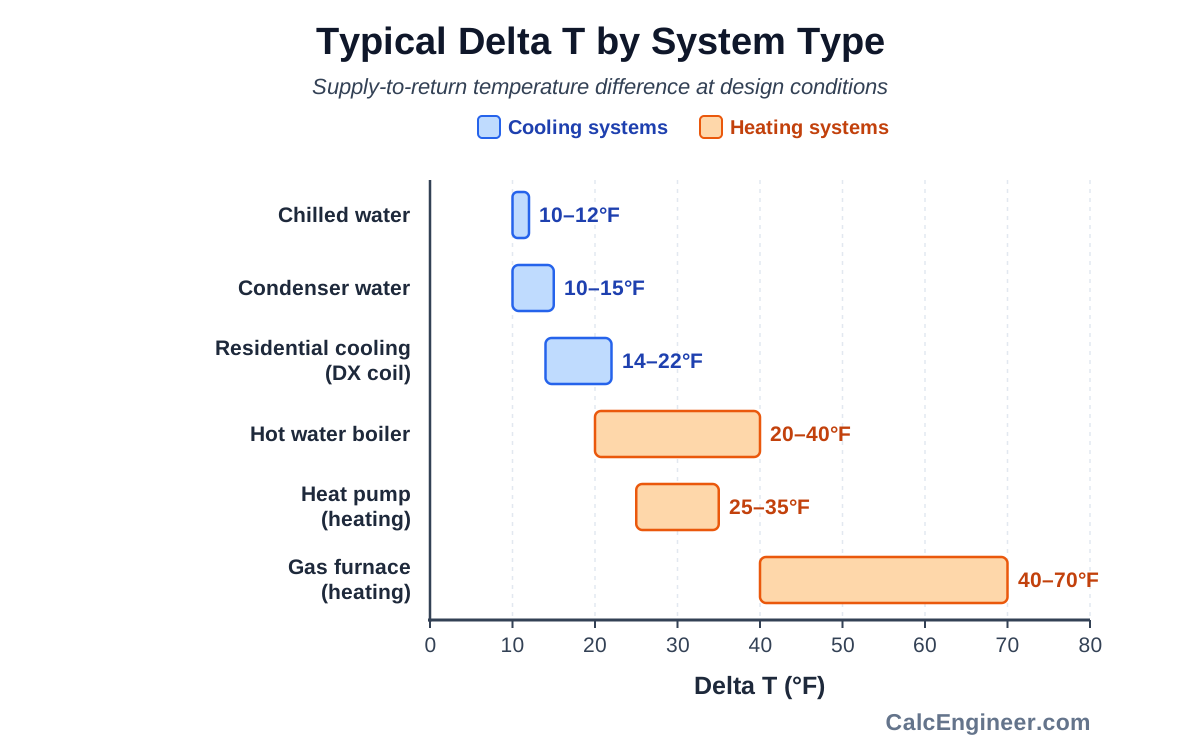
Different HVAC system types operate at fundamentally different ΔT values, determined by fluid properties, design flow rates, and equipment sizing. Using the wrong reference range when diagnosing a system leads to misdiagnosis — a heat pump showing 28°F ΔT in heating mode is healthy, while the same reading on a gas furnace would indicate airflow restriction. The chart below summarizes accepted design-condition ΔT ranges across the most common system types.
| System Type | Typical ΔT (°F) | Typical ΔT (°C) | Notes |
|---|---|---|---|
| Chilled water (cooling) | 10–12°F | 5.5–6.7°C | Design standard per ASHRAE 90.1; low-ΔT syndrome common in oversized plants |
| Condenser water (cooling tower) | 10–15°F | 5.5–8.3°C | Range/approach temps set by cooling tower design |
| Residential DX cooling | 14–22°F | 8–12°C | AHRI 210/240 standard rating conditions |
| Hot water boiler (heating) | 20–40°F | 11–22°C | Depends on system design temp (180/160°F vs 140/120°F) |
| Heat pump (heating mode) | 25–35°F | 14–19°C | Lower than gas furnace due to lower supply temp |
| Gas furnace (heating) | 40–70°F | 22–39°C | High ΔT due to high-temp heat exchanger; below 40°F = restricted airflow |
Residential 3-Ton AC: Verifying Sensible Capacity
A 3-ton split-system AC serves a 2,500 ft² home. The unit pulls 1,200 CFM (0.566 m³/s) at the air handler, verified with a calibrated flow hood. Return air measures 24°C (75°F); supply measures 12°C (54°F) after adequate mixing 6 ft downstream of the evaporator coil. ΔT = 24 − 12 = 12°C (75 − 54 = 21°F), within the 14–22°F (8–12°C) range that AHRI Standard 210/240 expects for properly charged residential cooling.
Metric: Q = 1.2 kg/m³ × 1005 J/kg·K × 0.566 m³/s × 12°C = 8,200 W = 8.2 kW = 2.33 tons (1 ton = 3.517 kW).
Imperial: Q = 1.08 × 1,200 CFM × 21°F = 27,216 BTU/hr = 2.27 tons (1 ton = 12,000 BTU/hr).
Both calculations give roughly 2.3 tons of sensible cooling. Expected sensible at SHR 0.78 for a 3-ton nominal unit ≈ 2.34 tons, so the system meets specification. Total capacity (sensible + latent) reaches the full 3-ton rating during peak humidity. If the calculated sensible capacity fell below 2.0 tons at this airflow and ΔT, the engineer would investigate refrigerant charge, coil cleanliness, or duct leakage before accepting the unit at commissioning.
Commercial Chiller: Diagnosing Low ΔT Syndrome
A medium office building with a central chilled water system serves air handling units throughout the building. Design conditions specify supply water at 7°C (45°F) and return water at 14°C (57°F) for a ΔT of 7°C (12°F). Field measurements after one year of operation show actual supply at 7°C (45°F) but return at only 10°C (50°F), creating a ΔT of 3°C (5°F). Water flow measures 3.15 L/s (50 GPM) at the chiller pump. Calculating heat transfer: Metric: Q = 3.15 L/s × 4186 J/kg·K × 3°C = 39,600 W. Imperial: Q = 500 × 50 GPM × 5°F = 125,000 BTU/hr.
The design capacity expected Q = 3.15 L/s × 4186 × 7°C = 92,400 W (500 × 50 × 12 = 300,000 BTU/hr). The actual capacity represents only 43% of design. This is the classic low ΔT syndrome signature. Practical takeaway: at ΔT 5°F vs 12°F design, the loop delivers 43% of design capacity at full pumping cost. Investigate three-way valve bypass, coil fouling, or stuck control valves before accepting the system. Without correction, the chiller short-cycles at part load and pumping energy stays at design level despite reduced cooling output.
What Distorts ΔT Readings in the Field
Air Density and Altitude Corrections
Standard ΔT calculations assume sea-level air density of 1.2 kg/m³ (0.075 lb/ft³). Density drops roughly 3% per 305 m (1,000 ft) of elevation per the ISA standard atmosphere model (ASHRAE Handbook—Fundamentals, Chapter 1). At Denver elevation (1,600 m / 5,250 ft), density is approximately 1.04 kg/m³, and the imperial constant 1.08 drops to about 0.93. Skipping this correction inflates calculated capacity proportionally to the density ratio — for projects above 600 m (2,000 ft) elevation, apply local density or pressure corrections rather than the standard constant.
System Operating Mode and Steady-State Conditions
ΔT measurements require the HVAC system to operate at steady-state conditions for at least 15 minutes before recording temperatures. During startup, supply temperatures change rapidly as equipment reaches design operating points—measuring before steady-state can show ΔT values significantly different from stabilized conditions; ACCA Standard 5 QI Section 5.3 requires a minimum 15-minute stabilization period before charge verification readings. Heating systems particularly exhibit this behavior, with gas furnaces requiring 5-10 minutes to achieve stable combustion and heat exchanger temperatures. Additionally, system operating mode affects expected ΔT ranges: heat pumps in heating mode typically produce 14-19°C (25-35°F) ΔT, while gas furnaces produce 22-39°C (40-70°F) ΔT. Mixing these expectations leads to incorrect diagnostics, such as assuming a heat pump has low charge when it's actually operating normally within its design parameters.
Measurement Location and Sensor Placement
Sensor placement strongly affects ΔT accuracy. For air systems, measuring supply temperature within 2 feet of the evaporator coil can show temperatures 2-4°C (4-7°F) colder than the mixed air temperature 6 feet downstream. Similarly, placing return sensors after filters but before coils measures mixed air rather than true return air from the space. Proper placement requires supply measurement 6-10 feet downstream of any mixing device or coil, and return measurement before any outside air intake or filter bank. For water systems, sensors must contact the pipe wall with thermal paste and be insulated from ambient air. Improper placement introduces multi-degree errors that propagate directly into the capacity calculation; ASHRAE Guideline 14 Section 5.2.2 specifies measurement uncertainty requirements for performance verification.
Where the Q = ρ × Cp × V̇ × ΔT Equation Falls Short
The sensible heat formula has three explicit limits engineers should not cross without correction:
-
Sensible only. The equation gives sensible capacity, not total. For total cooling capacity (cooling coils removing both sensible heat and moisture), use the enthalpy difference Q = ρ × V̇ × (h_return − h_supply) per ASHRAE Handbook—Fundamentals psychrometric chapter. In humid climates, sensible-only ΔT can underestimate actual coil capacity by 30–40% because latent removal is invisible to a dry-bulb temperature reading.
-
Steady-state and full-load. Part-load operation produces lower ΔT even on a healthy system. ΔT diagnostics apply only after 15-minute stabilization at near-design loading per ACCA Standard 5 QI Section 5.3. Comparing ΔT at 40% load against design ΔT at 100% load gives false low-ΔT alarms.
-
Glycol mixtures. Cp of pure water at 4,186 J/kg·K shifts to roughly 3,850 J/kg·K for 30% propylene glycol. Using the water constant on a glycol loop overstates capacity by approximately 8% per ASHRAE Handbook—Fundamentals secondary coolants chapter. Apply the actual Cp from manufacturer fluid property tables for any system with antifreeze or process glycol.
Where ΔT Diagnostics Go Wrong
Engineers often measure supply temperature too close to the evaporator or heating coil, before air has properly mixed across the duct section. This occurs because access panels typically locate near equipment, tempting technicians to take convenient rather than accurate measurements. The resulting ΔT appears 15-30% higher than actual, leading to incorrect conclusions about system capacity. This error commonly leads to overcharging a properly charged system, which raises head pressure, reduces SEER, and risks liquid floodback to the compressor on shutdown. ACCA Standard 4 QM Section 8 explicitly requires supply temperature measurement at the supply register or 6 ft downstream of the coil, not at the access panel.
Another frequent error involves using the standard 1.08 constant at high altitudes without density correction. Engineers familiar with sea-level applications sometimes forget altitude corrections: Denver (1,600 m / 5,250 ft) ≈ 0.93, Mexico City (2,240 m / 7,350 ft) ≈ 0.85. Apply ISA standard atmosphere corrections per ASHRAE Handbook—Fundamentals, Chapter 1 in all calculations above 600 m (2,000 ft); skipping correction overstates calculated capacity proportionally to the density deficit.
Mixing wet-bulb and dry-bulb readings between supply and return is a third common error, especially in humid climates. ΔT for sensible capacity must use dry-bulb on both sides. The risk is asymmetric: supply air is close to saturation across the evaporator coil, so wet-bulb and dry-bulb nearly coincide there; return air at typical 50% RH has wet-bulb several degrees below dry-bulb. If the technician records dry-bulb on supply and wet-bulb on return (a common psychrometer default), the apparent ΔT shrinks by 3–6°F, masking actual performance and potentially flagging a healthy system as undercharged. Always confirm both readings are dry-bulb before applying Q = 1.08 × CFM × ΔT.
Try the Delta T Calculator
Use our free online calculator to perform this calculation instantly.
Open Delta T CalculatorDiagnosing Problems with Delta T
Cooling Mode Diagnostics
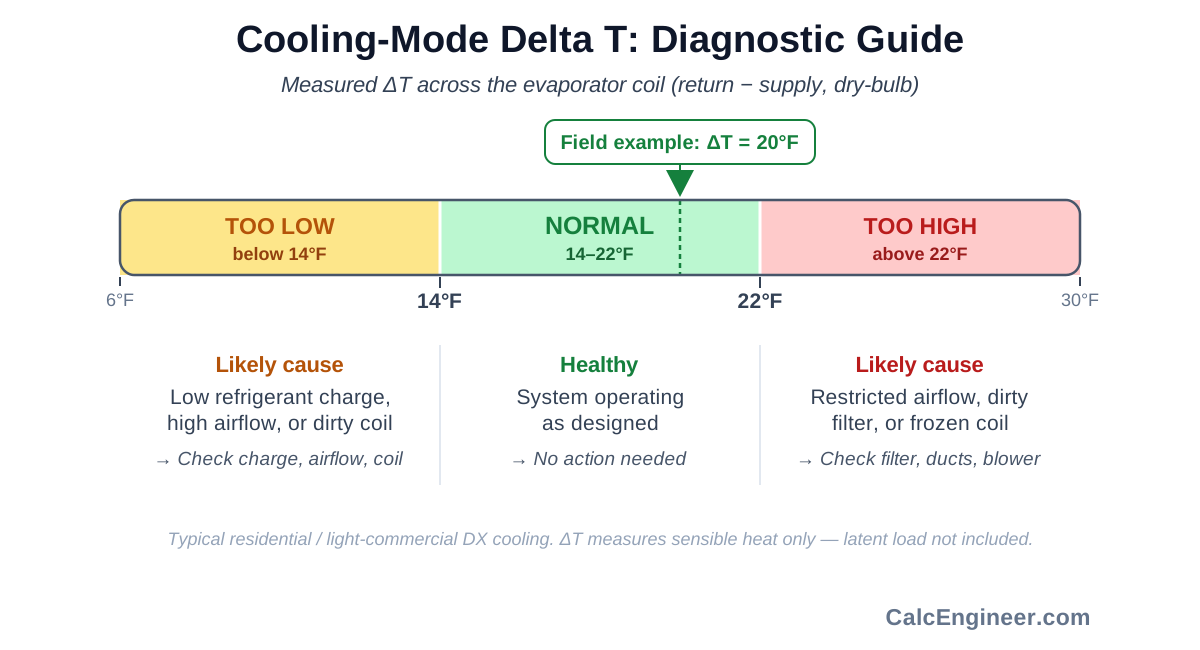
For residential and light-commercial DX cooling systems, the evaporator ΔT (return minus supply, dry-bulb) should fall in the 14–22°F (8–12°C) range under standard rating conditions per AHRI Standard 210/240. Readings outside this band point to specific failure modes that require different corrective actions.
| ΔT Range | Zone | Likely Cause | Recommended Action |
|---|---|---|---|
| Below 14°F (8°C) | Too Low | Low refrigerant charge, excessive airflow, or dirty evaporator coil | Verify refrigerant charge (ACCA Standard 5 QI), measure airflow, inspect coil |
| 14–22°F (8–12°C) | Normal | System operating as designed | No action required |
| Above 22°F (12°C) | Too High | Restricted airflow, dirty filter, or frozen coil | Inspect air filter, check duct restriction, verify blower operation |
Decision Rule and Documentation
For air conditioning systems, a ΔT below 14°F (8°C) with normal airflow indicates low refrigerant charge or excessive airflow, while a ΔT above 22°F (12°C) suggests restricted airflow or dirty coils. Engineers should intervene when measurements fall outside these thresholds, first verifying airflow with an anemometer or flow hood before adjusting refrigerant charge. This decision rule comes from AHRI Standard 210/240 rating conditions, which specify 80°F return air and 67°F wet-bulb for standard cooling performance testing.
Use the Delta T calculator during system commissioning to verify design performance, during seasonal maintenance to detect degradation, and when troubleshooting comfort complaints. Input supply and return temperatures measured at proper locations after 15 minutes of steady operation, along with verified airflow or water flow rates. Compare calculated capacity against equipment nameplate ratings and design documents, investigating discrepancies greater than 10% per ASHRAE Guideline 14 measurement and verification thresholds. Document all measurements in commissioning reports alongside corrective actions taken, creating a performance baseline for future comparison and identifying trends that indicate maintenance needs before failure occurs.